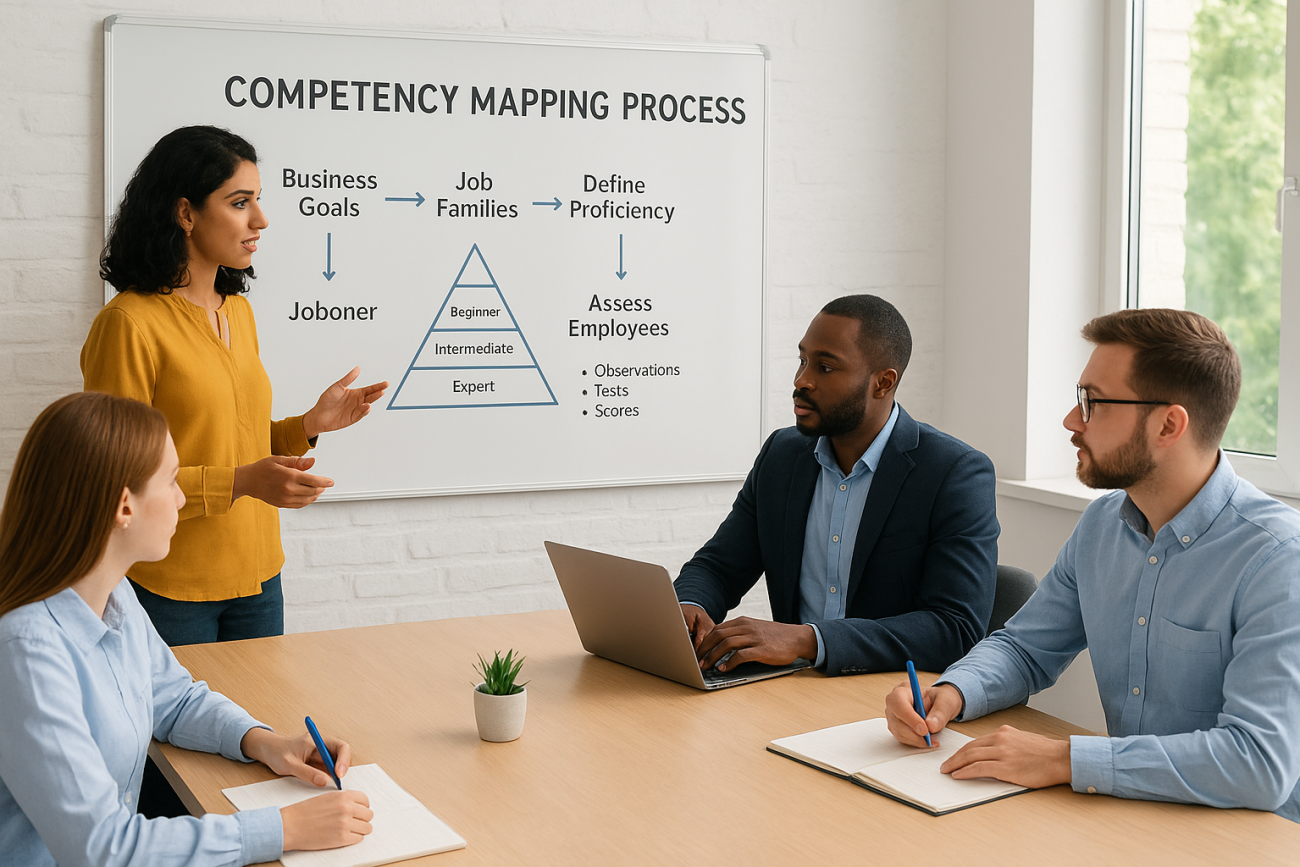
Most HR teams know which roles they need to fill, but far fewer can clearly define what "great" actually looks like in each of those roles. That gap between job titles and actual performance expectations is exactly what the competency mapping process addresses. It gives you a structured way to identify the specific skills, behaviors, and knowledge required for every position, then measure your people against those benchmarks.
Without this clarity, training budgets get spent on the wrong priorities, performance reviews feel subjective, and hiring decisions rely too heavily on gut instinct. A well-executed competency map changes that. It connects individual development directly to business outcomes and gives HR teams a shared language for talking about talent. The result: smarter hiring, targeted training, and measurable growth across the organization.
This guide walks you through the full competency mapping process, from defining your framework to assessing employees and closing skill gaps. You’ll get a practical, step-by-step approach built for HR and L&D professionals who need to move from theory to action. And because training delivery is where competency maps ultimately prove their value, we’ll also show how Axis LMS from Atrixware helps you operationalize your findings, turning mapped competencies into structured learning paths, automated compliance tracking, and real-time progress reporting.
What competency mapping is and why it matters
Competency mapping is the process of identifying, defining, and documenting the specific skills, knowledge, behaviors, and attitudes a person needs to perform a role effectively. It goes beyond a job description, which typically lists tasks and responsibilities. A competency framework captures the "how" behind the work: the observable behaviors that separate adequate performance from genuine excellence. When you run a full competency mapping process, you create a shared standard that every HR function, from hiring to promotion, can reference consistently.
Competency mapping is not a one-time audit. It is a living framework that evolves alongside your organization’s roles and strategic goals.
The core components of a competency
A competency is made up of more than a skill label. Each one you define should include a clear name, a behavioral description, and proficiency levels that distinguish beginner performance from expert performance. Without those levels, two managers assessing the same employee will score them differently because they are each working from a different mental model.
Here is what a single well-defined competency looks like in practice:
| Component | Example |
|---|---|
| Name | Data-Driven Decision Making |
| Definition | Uses quantitative and qualitative data to evaluate options and choose a course of action |
| Level 1 (Developing) | Collects data when prompted; relies on others to interpret findings |
| Level 2 (Proficient) | Independently analyzes relevant data and uses findings to inform decisions |
| Level 3 (Expert) | Builds frameworks others use; challenges assumptions with data across the organization |
Why organizations that skip this step pay for it later
When you skip competency mapping, training programs drift without direction. L&D teams field requests from managers, build content to match, and hope something sticks. There is no way to know if the training moved the needle because there was no defined benchmark to measure against in the first place. Performance reviews suffer the same problem: without a shared behavioral standard, feedback becomes a matter of opinion rather than observation.
The costs compound over time. Misaligned hiring, unfocused development budgets, and inconsistent performance standards chip away at organizational effectiveness. Organizations that invest in a structured competency framework consistently report clearer career paths, lower turnover, and higher confidence in their talent decisions. The framework is not just an HR tool; it is a foundational business asset that connects individual performance to organizational outcomes.
Step 1. Set the goal, scope, and roles
Before you map a single competency, you need to answer three questions: why you are doing this, which roles it covers, and who owns each part of the process. Skipping this step is the most common reason competency mapping projects stall. Without a defined goal, teams argue about scope; without defined owners, no one makes decisions, and the project loses momentum before it produces anything usable.
A competency mapping process with no clear goal produces a framework that solves no specific problem and gets abandoned within six months.
Define the business goal first
Your goal should connect directly to a business problem or strategic priority, not just an HR initiative. Are you trying to reduce time-to-competency for new hires? Identify high-potential employees for leadership development? Standardize performance reviews across multiple locations? Write the goal in one sentence and tie it to a measurable outcome so you can evaluate success once the framework is live.
Narrow the scope before you start
Trying to map every role in your organization at once is a reliable way to produce a bloated, unusable framework. Start with one department or job family instead. Customer service teams, sales roles, and compliance-heavy positions make strong starting points because performance expectations are already relatively well-defined in those areas.
Use this scope template before your first stakeholder meeting:
| Scope Element | Your Answer |
|---|---|
| Target role(s) | e.g., Customer Success Manager |
| Employees affected | e.g., 40 |
| Business goal | e.g., Reduce onboarding time by 20% |
| Project owner | e.g., L&D Manager |
| Timeline | e.g., 8 weeks |
Step 2. Build the competency framework and levels
With your scope defined, you can now build the actual framework. This is the heart of the competency mapping process: translating job expectations into observable, measurable behaviors organized by proficiency level. The output of this step is a structured document that every stakeholder, from hiring managers to direct reports, can read and apply consistently.
The most common mistake at this stage is defining competencies too broadly. Vague labels like "communication skills" mean different things to different people. Specific behavioral descriptions do not.
Gather input from the right sources
Your framework will only reflect reality if you collect input from people who know the role deeply. That means interviewing top performers, shadowing team leads, and reviewing existing performance data. Do not build the framework in a conference room with HR alone. Managers and high performers in the target role will flag behaviors and knowledge gaps that would otherwise stay invisible.
Use these input sources consistently:
- Structured interviews with 3 to 5 top performers in the role
- One-on-one conversations with direct managers
- Review of existing job descriptions and performance review data
- Observation of day-to-day workflows where practical
Define the proficiency levels for each competency
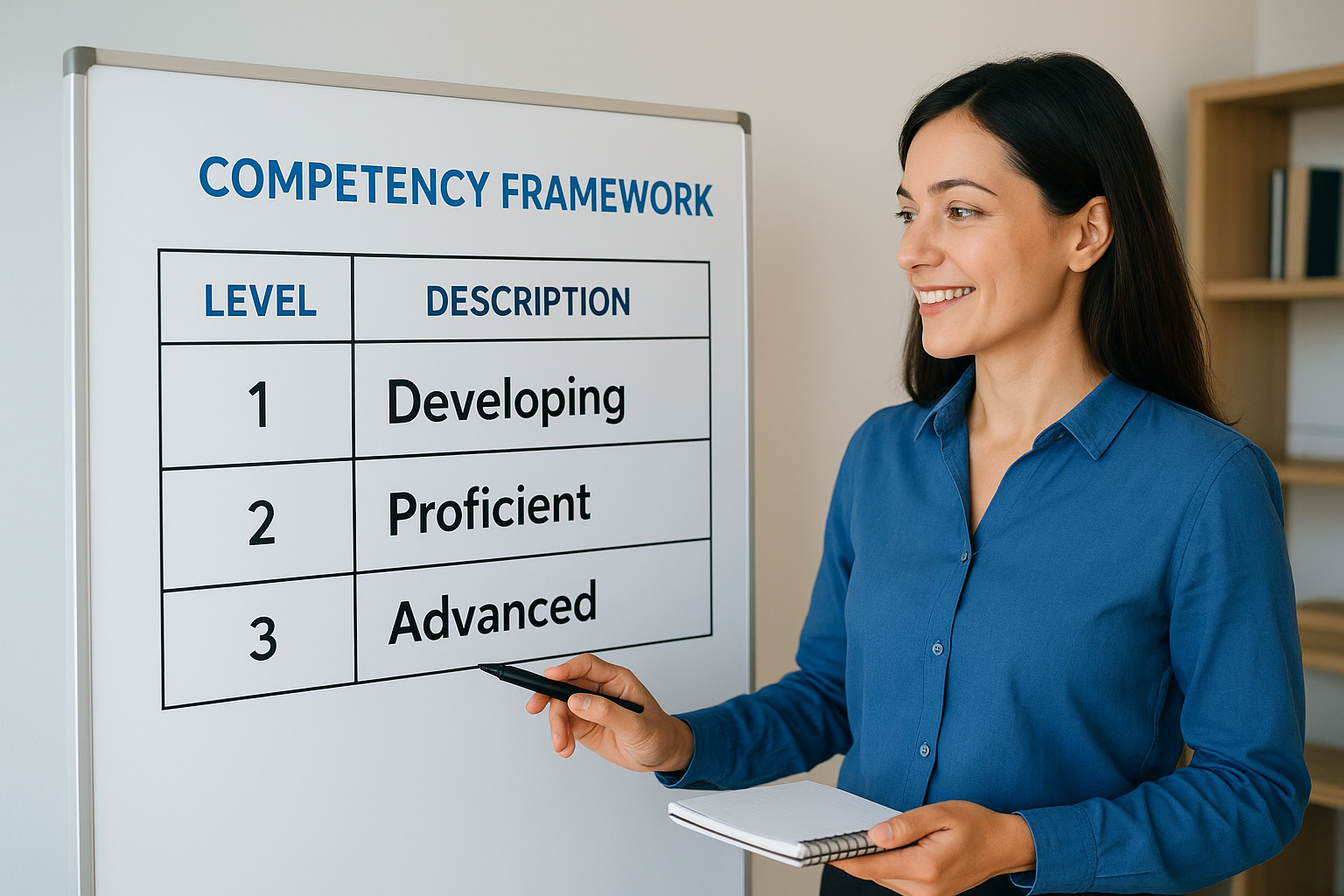
Once you have your list of core competencies, assign three to four proficiency levels to each one. Each level should describe specific behaviors, not just adjectives like "basic" or "advanced." This precision is what makes your framework usable for performance reviews, hiring, and individual development planning rather than just a document that sits in a shared folder.
| Level | Label | Description |
|---|---|---|
| 1 | Developing | Applies the skill with direct guidance and oversight |
| 2 | Proficient | Works independently and meets role expectations consistently |
| 3 | Advanced | Coaches others and improves team-wide performance |
Step 3. Assess current competencies consistently
Once your framework is built, you need to measure where each employee actually stands against those defined proficiency levels. This is where the competency mapping process either delivers value or breaks down. The key is consistency: every assessor needs to evaluate behaviors using the same criteria, or your data becomes unreliable before you ever act on it.

An assessment process that varies by manager produces scores that reflect the manager’s standards, not the employee’s actual competency level.
Choose your assessment methods
Multiple data sources produce more accurate results than a single method. Combine manager observations, self-assessments, and structured behavioral interviews to build a complete picture. For roles with measurable outputs, performance data adds another layer of objectivity.
Use these methods based on what each competency requires:
| Competency Type | Recommended Method |
|---|---|
| Behavioral (e.g., communication) | Manager observation + behavioral interview |
| Technical (e.g., data analysis) | Skills test or work sample review |
| Leadership | 360-degree feedback from peers and direct reports |
| Compliance-related | Knowledge assessment with a defined pass score |
Score employees against defined levels
Calibration sessions between managers are the most practical way to keep scores consistent across teams. Before finalizing any assessment results, bring two or three managers together to review sample cases and align on what each proficiency level looks like in practice.
Here is a scoring template you can use directly:
| Employee | Competency | Evidence Observed | Score (1-3) |
|---|---|---|---|
| [Name] | Data-Driven Decision Making | Built Q2 analysis independently used by leadership | 2 |
| [Name] | Coaching Others | Onboarded two new hires without manager support | 3 |
Step 4. Close gaps and embed it in HR workflows
Assessment data only has value if it drives action. Once you have scored each employee against the framework, your next job is to convert those scores into concrete development plans and then anchor the entire competency mapping process inside your existing HR workflows. Without this step, the framework becomes a one-time exercise that nobody references six months later.
A competency map that lives outside your HR systems will not change how people get hired, developed, or promoted.
Turn assessment results into learning paths
Start by grouping employees with similar gaps together. If eight of your twelve customer success managers score at Level 1 on data-driven decision making, that is a structured training opportunity, not just twelve individual coaching conversations. Build or assign a targeted course that addresses the specific behavioral gap, not a generic skills workshop.
Use this template to document each gap and the planned response:
| Employee | Competency Gap | Current Level | Target Level | Development Action | Timeline |
|---|---|---|---|---|---|
| [Name] | Data-Driven Decision Making | 1 | 2 | Assign LMS course + manager check-in | 60 days |
| [Name] | Coaching Others | 2 | 3 | Lead onboarding for next new hire | 90 days |
Connect the framework to existing HR processes
Your competency framework should not live in a separate document. Embed the competency levels directly into your job descriptions, interview scorecards, and performance review templates so every hiring decision and promotion conversation references the same standard. Update your onboarding program to use Level 1 competency descriptions as the benchmark for what a new hire needs to demonstrate before completing their first 90 days. This integration is what turns a static framework into a continuously useful operational tool that HR, managers, and employees rely on without being asked.
Next steps
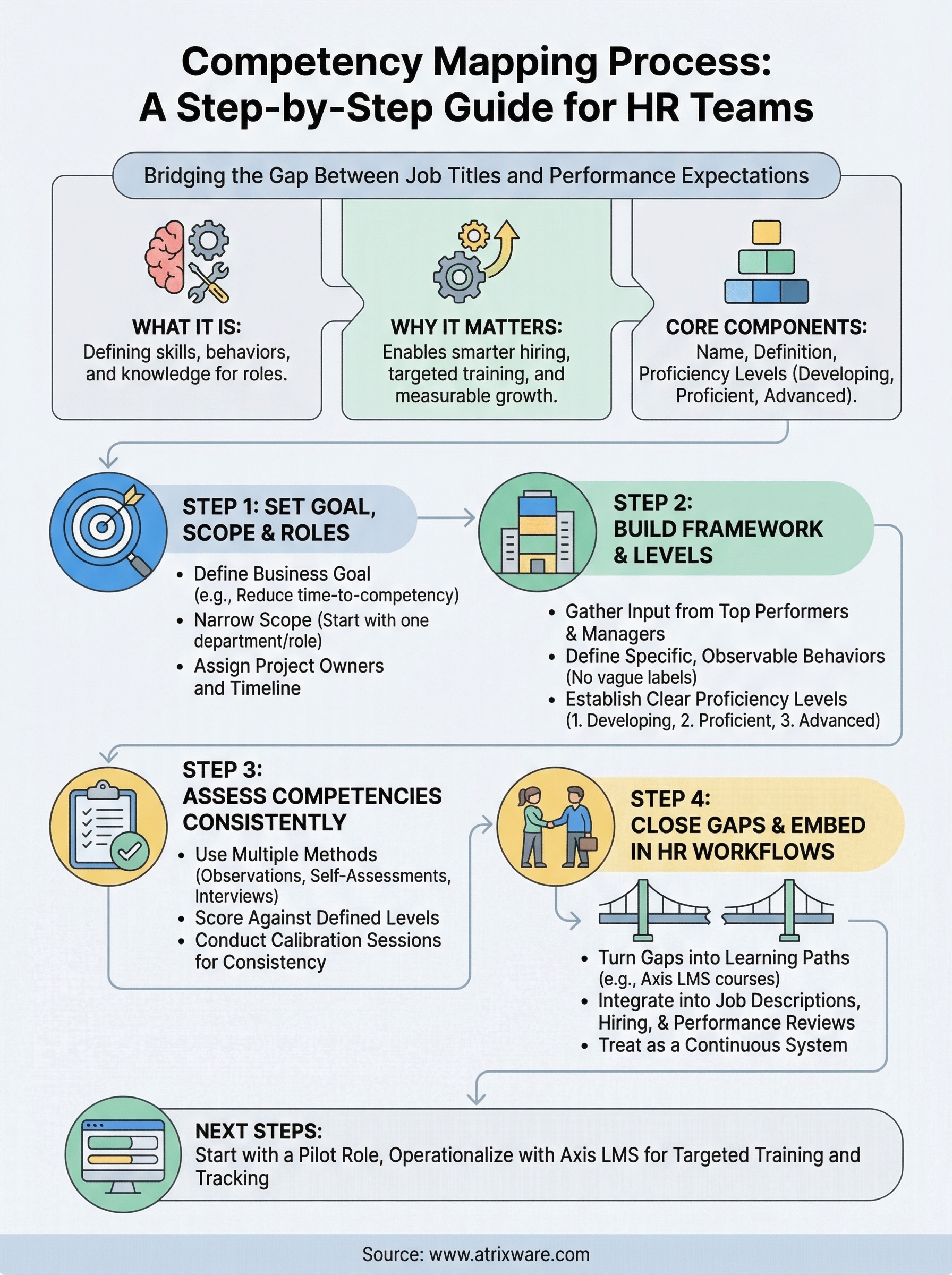
The competency mapping process works when you treat it as a system, not a project. You have now seen how to set a clear goal, build a behavior-based framework, assess employees consistently, and wire the results into the HR workflows that actually drive decisions. The next move is to pick one role and start. Do not wait until you have executive buy-in for every department. A single well-executed pilot gives you a proof of concept you can use to expand the program.
Once your assessments are complete, you need a way to deliver targeted training and track progress without managing everything manually. Axis LMS from Atrixware lets you turn competency gaps directly into assigned learning paths, automate re-certification reminders, and pull real-time reports on learner progress. That means your competency framework stays active rather than collecting dust. See how Axis LMS works with a free admin demo and find out how quickly you can move from mapped gaps to measurable results.
