Not every employee learns the same way or at the same pace. Some grasp concepts quickly; others need more time or different approaches. Traditional training programs often ignore these differences, delivering identical content to everyone regardless of their background, skills, or learning preferences. This disconnect leads to disengaged learners, wasted resources, and training that fails to stick. Adaptive learning in corporate training addresses this gap by using technology to customize the learning experience for each individual.
At Atrixware, we’ve seen firsthand how personalized training approaches transform outcomes. Our Axis LMS helps organizations move beyond static, one-size-fits-all programs toward training that responds to each learner’s needs. The result? Higher engagement, better retention, and measurable improvements in performance.
This article breaks down what adaptive learning means in a corporate context, explores its core benefits for employee development, and provides practical examples of how organizations are putting it to work. You’ll come away with a clear understanding of how adaptive learning technology functions and whether it makes sense for your training programs.
What adaptive learning looks like in corporate training
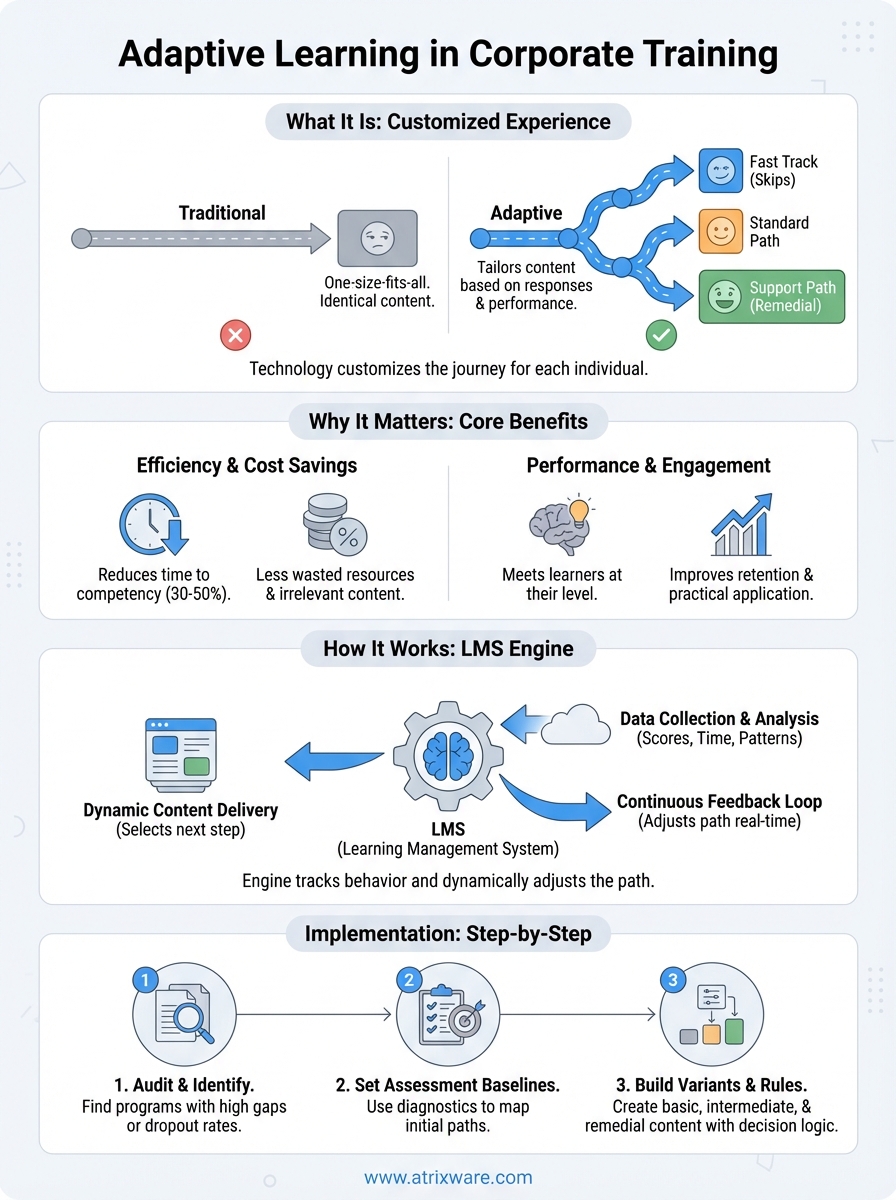
Adaptive learning in corporate training doesn’t feel like traditional training. Instead of clicking through predetermined modules in a fixed sequence, you encounter content that shifts based on your responses and performance. The system observes how you interact with the material, identifies gaps in your knowledge, and adjusts the path forward. If you demonstrate proficiency in a particular area, the platform skips redundant content and moves you ahead. If you struggle with a concept, it provides additional explanations, examples, or practice exercises before progressing.
The learner’s perspective
Your experience with adaptive learning starts the moment you log in. Some systems begin with diagnostic assessments that gauge your current skill level across various topics. Based on your results, the platform creates a customized learning path specific to your needs. You might skip entire modules that cover skills you’ve already mastered, while a colleague working through the same training program encounters completely different content tailored to their gaps.
Adaptive learning removes the frustration of sitting through material you already know while ensuring you get support exactly where you need it.
During the course itself, you’ll notice real-time adjustments. Answer a question incorrectly, and the system might present a video explanation or an interactive scenario that approaches the concept from a different angle. Demonstrate mastery through practice questions, and you’ll advance to more complex material without unnecessary delays. The platform continuously recalibrates based on your progress, maintaining an appropriate level of challenge throughout your training journey.
Behind the scenes
The technology powering this experience relies on algorithms that track hundreds of data points about your learning behavior. These systems analyze factors like response accuracy, time spent on content, completion rates, and interaction patterns to build a profile of your strengths and weaknesses. Machine learning models use this data to predict which content will be most effective for you next.
Why adaptive learning matters at work
Traditional training wastes time and money. Your employees sit through hours of content that doesn’t match their skill level, watching videos about topics they already understand or struggling with concepts that assume knowledge they don’t have. This mismatch creates frustration, disengagement, and poor outcomes. Adaptive learning in corporate training solves this problem by delivering exactly what each person needs when they need it.
Efficiency and cost savings
You spend less time training and get better results. Adaptive systems skip redundant content for experienced employees while providing additional support for those who need it. This approach reduces the average time to competency by 30 to 50 percent compared to traditional methods. Your training budget stretches further because you’re not paying employees to sit through irrelevant material or repeat courses that didn’t address their actual gaps.
When training adapts to the learner, every minute invested delivers value.
Performance and engagement improvements
Your employees perform better when training meets them at their level. Adaptive learning maintains an optimal challenge point throughout the experience, preventing both boredom and overwhelm. This balance keeps learners engaged and motivated to complete their programs. Performance metrics improve because employees actually retain and apply what they learn instead of forgetting information that didn’t connect with their existing knowledge or job responsibilities.
How adaptive learning works in an LMS
Your Learning Management System becomes the engine that powers adaptive learning in corporate training. The platform collects data from every interaction your employees have with training content, analyzes that information in real time, and uses the insights to adjust what learners see next. This process happens continuously throughout the learning experience, creating a feedback loop that refines the training path with each click, answer, and completion.
Data collection and analysis
Your LMS tracks dozens of performance indicators as learners progress through content. These include quiz scores, time spent on each module, video watch patterns, interaction with practice exercises, and confidence ratings. The system assigns weighted values to different activities, recognizing that a correct answer on the first attempt carries different meaning than a correct answer after multiple tries. This granular data feeds into algorithms that identify knowledge gaps and learning patterns specific to each individual.
The more data your LMS collects, the more accurately it can tailor the learning experience to each employee’s needs.
Content delivery and pathways
Based on performance data, your LMS dynamically selects which content to present next. Strong performers skip foundational material and jump to advanced topics. Struggling learners receive remedial content, alternative explanations, or additional practice before moving forward. The system maintains a library of content variants for different skill levels and learning styles, pulling from this library to construct personalized paths that optimize both efficiency and comprehension.
How to implement adaptive learning step by step
Implementing adaptive learning in corporate training starts with auditing your current content and identifying which programs would benefit most from personalization. Look for courses with high dropout rates, wide skill gaps among learners, or varied experience levels in your audience. These programs offer the greatest opportunity for improvement through adaptive approaches.

Start with assessment baselines
You need diagnostic assessments that measure current knowledge before training begins. Create pre-tests that cover the full range of topics in your program, ensuring questions span from foundational to advanced concepts. Your LMS uses these baseline scores to map initial learning paths for each employee. Set clear competency thresholds that determine when learners advance or need additional support.
Accurate baseline assessments determine whether your adaptive system helps or hinders learners from the start.
Build content variants and decision rules
Creating multiple versions of explanatory content for each concept comes next. Develop basic, intermediate, and advanced treatments of core topics, along with remedial materials for common misconceptions. Define the logic that determines which content variant the system presents based on performance triggers like quiz scores, completion time, or repeated attempts. Test these rules with pilot groups before full deployment.
Examples and use cases by team
Your teams face distinct training challenges that adaptive learning in corporate training addresses in measurably different ways. Sales representatives need product knowledge that varies by territory and customer type, while compliance teams must ensure everyone meets baseline regulatory standards regardless of role. Understanding how different departments apply adaptive approaches helps you identify which programs in your organization would benefit most from personalization.
Sales teams
Your sales team benefits from adaptive product training that adjusts based on territory, customer segment, or product line focus. New representatives receive foundational content about your offerings, pricing structures, and competitive positioning. Experienced sellers skip basics and access advanced negotiation tactics, objection handling scenarios, or deep technical specifications. The system tracks deal outcomes and adjusts training recommendations based on which skills correlate with closed revenue in each territory.
Sales performance improves when training focuses on the specific product knowledge and techniques each representative actually needs to close deals.
Compliance and safety teams
Compliance training uses adaptive learning to meet regulatory requirements efficiently while respecting employee time. Workers in high-risk roles receive comprehensive safety protocols with detailed scenario-based assessments. Office staff encounter streamlined versions covering essential policies without unnecessary depth. The LMS documents each employee’s path and mastery level for audit purposes, proving that everyone achieved required competency standards through appropriately rigorous training tailored to their risk exposure.
Next steps for your training team
Your organization already has training content and a learner base that could benefit from personalization. The question isn’t whether adaptive learning in corporate training works, but rather which programs you should adapt first and how your current LMS infrastructure supports these capabilities. Start by identifying one high-impact training program where skill gaps create measurable business problems or where employee time spent on training exceeds industry benchmarks.
Evaluating your readiness for adaptive learning requires understanding both your content library and your technology stack. You need diagnostic assessments, content variants for different skill levels, and an LMS that can process learner data in real time to adjust training paths. Take our LMS readiness quiz to assess whether your current platform can support adaptive features or whether you need to upgrade your infrastructure before implementing personalized training programs. Your results will clarify which capabilities you have today and what you need to add for successful adaptive learning deployment.
