One missed HIPAA update or an expired OSHA certification can cost your organization six figures in fines, and that’s before you count the reputational damage. If you’re an HR manager, compliance officer, or training lead at a healthcare organization, you already know that finding solid healthcare compliance training online isn’t optional anymore. Regulations change fast, staff turnover is high, and auditors expect documented proof that every employee completed the right courses on time.
This article gets straight to the point: which programs actually deliver on online healthcare compliance training, and which ones are worth your training budget. We looked at course content covering healthcare compliance and certification requirements, including HIPAA, OSHA, and CMS rules, how each platform tracks completions, and whether reporting holds up during an audit. That last piece matters more than most vendors admit, since compliance tracking is often what separates a program that protects you from one that just checks a box.
Below you’ll find six programs worth considering, along with what each one does well and where it falls short. Whether you’re vetting options for a small clinic or building out training for a multi-site health system, you’ll walk away knowing which platform fits your staff certification needs and budget.
1. Axis LMS by Atrixware
Axis LMS is Atrixware’s flagship learning management system, and it’s built for organizations that need more than a stack of generic courses. Unlike single-purpose training libraries, Axis LMS gives you a platform built for regulated training where you build, assign, and track compliance training on your own schedule, using your own content or courses you license from third parties. That flexibility matters when your compliance calendar includes annual HIPAA refreshers for every employee, OSHA bloodborne pathogen training on hire, and CMS updates that can drop with little warning.
What it covers
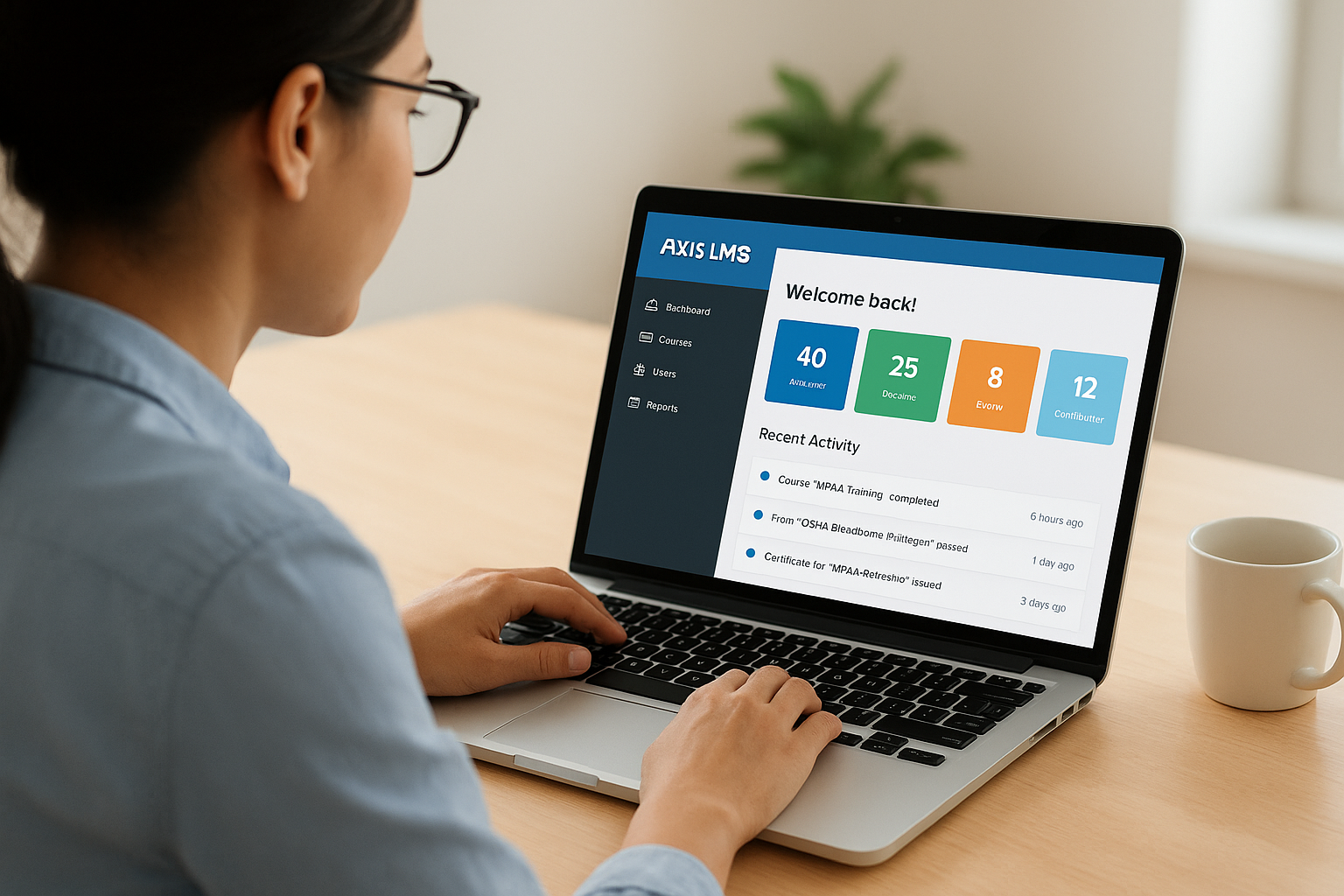
Because Axis LMS is a delivery and tracking platform rather than a fixed course catalog, you decide exactly what goes into your healthcare compliance training online program. Administrators build courses with a drag-and-drop interface, set automated re-certification schedules for CEUs, and configure rules that lock learners out of the next module until they pass a quiz. The system’s compliance management features track completions by department, location, or job role, which is exactly what keeps a healthcare organization audit-ready when someone requests documentation.
A compliance platform is only as good as the audit trail it produces when someone asks for proof.
Who it’s for
Health systems, multi-site clinics, and any organization running healthcare compliance officer training online for dozens or hundreds of employees will get the most value here. It also suits organizations that already have HIPAA and OSHA content from a vendor or internal SME and just need a reliable way to deliver and track it. Small practices with a handful of staff may find the platform more capable than they need day one, though it scales with you as you grow.
Format and pricing
Axis LMS runs as a cloud-hosted or self-hosted system, with pricing based on active user count rather than per-course fees. You can review current plans and try the admin side of Axis LMS directly from the Axis LMS pricing page, and most healthcare clients start with a pilot group before rolling out organization-wide.
2. EPICompliance Training
EPICompliance Training focuses squarely on prebuilt regulatory courses rather than a full learning platform. If you want a ready-made library instead of building your own online courses from scratch, this is the kind of vendor you’d shortlist alongside a system like Axis LMS.
What it covers
Courses run through HIPAA privacy and security rules, OSHA bloodborne pathogen standards, and general compliance training topics like workplace harassment and infection control. Content updates when regulations change, so you’re not stuck teaching an outdated HIPAA module for years. Most courses run 20 to 45 minutes, which suits busy clinical staff who can’t sit through a half-day session.
Who it’s for
Small to mid-size clinics, dental offices, and outpatient facilities that need online compliance training for healthcare staff without hiring an instructional designer tend to fit best here. Organizations already running a full LMS for other training may find the course library redundant unless they can import content directly.
Prebuilt courses save you build time, but they only work if the completion records survive an audit request.
Format and pricing
Pricing is typically per-seat or per-course-bundle, billed annually, with volume discounts for larger staff counts. Reporting is functional but limited compared to a dedicated compliance management system, so larger organizations often pair it with a separate LMS that keeps training records audit-ready and handles escalation workflows.
3. American Institute of Healthcare Compliance (AIHC)
AIHC is a professional association built around certifying individuals, not a platform for training your whole staff. If you’re a healthcare compliance officer training online and want a credential that signals real expertise, this is one of the more established options in the space.
What it covers
Courses walk through HIPAA privacy and security rules, healthcare fraud and abuse laws, coding compliance, and the day-to-day responsibilities of running a compliance program. AIHC also offers certification tracks, including credentials aimed at compliance officers and privacy officers, built around self-paced modules and exams. Because the focus is professional development rather than mass staff training, the content goes deeper into regulatory theory than most vendor course libraries do.
A certification proves individual expertise, but it won’t track whether your 200 employees finished their annual HIPAA refresher.
Who it’s for
Compliance officers, privacy officers, and auditors pursuing a personal credential fit this program best. It’s a poor match if you need online compliance training for healthcare staff at scale, since AIHC isn’t designed to assign courses to a workforce or generate department-level completion reports.
Format and pricing
Courses and certification exams are sold individually or as bundles, typically running from a few hundred to over a thousand dollars depending on the credential. Renewal usually requires continuing education credits, which AIHC also sells separately.
4. Health Care Compliance Association (HCCA)
HCCA is the largest professional membership organization for compliance officers in healthcare, and it runs one of the most respected certification programs in the field. Unlike a course vendor, HCCA operates more like a professional body, offering compliance officer training online alongside conferences, publications, and a certification exam that carries real weight on a resume.
What it covers
HCCA’s Certified in Healthcare Compliance (CHC) program covers fraud and abuse laws, HIPAA privacy and security, coding compliance, and how to structure an effective compliance program under OIG guidance. Study materials include self-paced online modules, live webinars, and boot camps, all built around the exam blueprint. The depth here suits someone building a career in healthcare compliance officer training online, not a frontline employee who just needs an annual HIPAA refresher.
A certification like the CHC tells an employer you understand compliance strategy, not just a single regulation.
Who it’s for
Compliance officers, privacy officers, and internal auditors pursuing career-level credentials get the most value. It’s the wrong fit for organizations trying to train an entire clinical staff, since HCCA doesn’t offer workforce assignment or completion tracking tools.
Format and pricing
Membership runs roughly $295 a year, with exam fees and study materials priced separately, often totaling $700 to $1,000 for full certification prep.
5. USC Health Care Compliance Certificate
The University of Southern California offers an academic credential through its Sol Price School of Public Policy, aimed at professionals who want a university-backed answer to healthcare compliance officer training online. This isn’t a vendor course library or a membership association exam. It’s a structured certificate program built like a graduate-level course sequence, with assignments, instructor feedback, and a transcript-worthy credential at the end.
What it covers
Modules move through fraud and abuse statutes, HIPAA privacy and security rules, corporate integrity agreements, and the practical work of building a compliance program from the ground up. Coursework leans academic, with case studies and written assignments rather than quick knowledge checks. Students finish with a working understanding of how regulatory bodies actually investigate and enforce healthcare compliance failures.
A university certificate proves you can think through compliance problems, not just recite the rules.
Who it’s for
Mid-career compliance professionals, healthcare attorneys, and administrators looking to formalize their expertise fit this program well. Frontline staff needing routine online compliance training for healthcare duties should look elsewhere, since this program targets career development, not annual refreshers.
Format and pricing
The certificate runs online over several months, part-time, with tuition typically in the $3,000 to $5,000 range depending on current university pricing and course load.
6. OIG Compliance Basics Training
The Office of Inspector General publishes free training resources built directly from federal enforcement priorities, making this the closest thing to a primary source for healthcare compliance training online. Rather than a polished commercial course, this is government guidance packaged into modules that spell out exactly what regulators expect from a compliance program.
What it covers
Modules cover the seven elements of an effective compliance program, physician self-referral law, anti-kickback statute basics, and how the OIG evaluates corporate integrity agreements. The OIG’s compliance resource library also includes guidance documents and advisory opinions that many vendor courses simply summarize secondhand. You get the source material rather than someone else’s interpretation of it.
When you’re building a program from scratch, reading the regulator’s own guidance beats guessing what they’ll ask for.
Who it’s for
Compliance officers writing or revising a program from the ground up benefit most, along with anyone doing healthcare compliance officer training online who wants primary-source material instead of a paraphrased summary. It’s not built for onboarding clinical staff, since there’s no learner tracking or quiz enforcement.
Format and pricing
Everything is free and available directly through the OIG website as downloadable guidance and self-paced reading, with no enrollment, certificate, or completion tracking involved.
Finding the right fit for your team
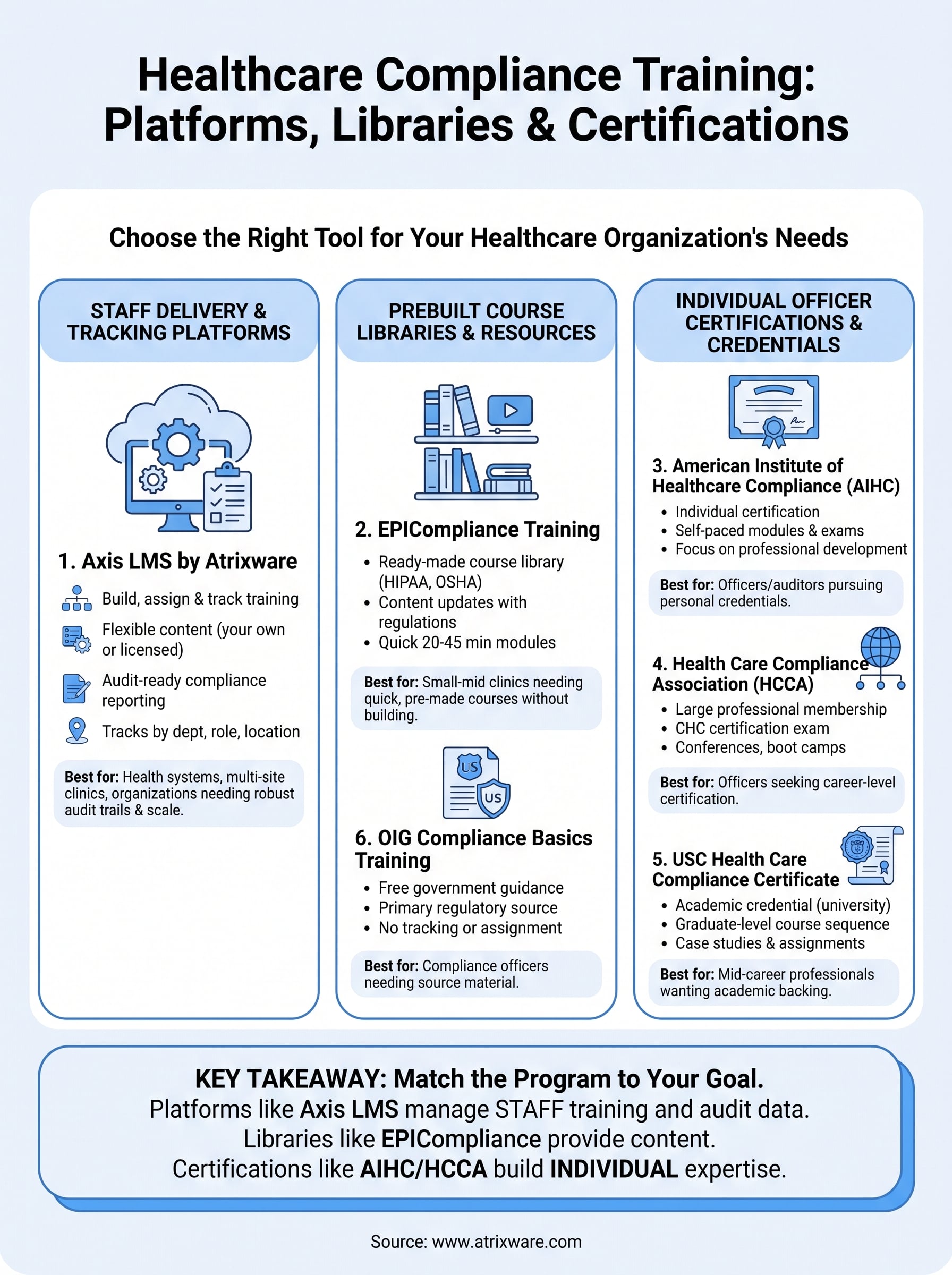
Match the program to the job you’re actually trying to do. Individual credentials like AIHC, HCCA, and the USC certificate build expertise in the person pursuing them, but none of them track whether your 300 employees finished their annual HIPAA refresher. Free resources like the OIG library give you the regulatory source material, but they won’t assign courses or flag who’s overdue. Course libraries like EPICompliance save you build time, though you’ll likely still need somewhere to house completions for an audit.
Organizations need a compliance management system that assigns training, enforces deadlines, and produces the reports auditors actually ask for. That’s the gap Axis LMS is built to close. If you’re not sure how ready your organization is for that step, find out how prepared you are to implement an LMS and see where you stand before you commit to a platform.
