If you’re trying to break into corporate training or level up your career, you already know that job postings and client contracts increasingly ask for proof you know what you’re doing. That’s where a certification in corporate training comes in. It signals to employers that you understand instructional design, adult learning theory, and how to measure whether training actually works, not just that you’ve sat through a workshop.
This article compares the seven programs worth your time and money in 2026. We break down each corporate training certification by cost, time commitment, and who actually recognizes the credential once you have it, whether that’s a Fortune 500 L&D department or a small consulting client. You’ll also see which options fit self-paced learners versus those who want live cohorts and mentorship.
As the team behind Axis LMS, we work daily with the training managers and instructional designers who hold these credentials, so we know which ones translate into real hiring decisions. Once you’ve picked a certificate in corporate training that fits your goals, you’ll still need a corporate training platform to put that knowledge to work, and we’ll point out where that connection matters.
1. ATD Certified Professional in Talent Development (CPTD)
What it covers
The CPTD comes from the Association for Talent Development (ATD), the largest professional body for the field, and it’s built around ATD’s Talent Development Capability Model. That model spans 23 capabilities across three domains: building personal capability, developing professional capability, and impacting organizational capability. You’re tested on instructional design, training delivery, coaching, and how you connect learning programs to business results, not just theory. Anyone researching a certification in corporate training with real name recognition among HR and L&D leaders will run into this one first.

Who it’s for
ATD designed the CPTD for people with real experience under their belt, not newcomers. You need at least two years of relevant professional experience plus a bachelor’s degree, or five years without one, before you can even sit for it. It suits training managers, senior instructional designers, and consultants who want a credential that opens doors to director-level L&D roles.
The CPTD rewards people who can already point to measurable training outcomes, not just course completions.
Cost and format
Pricing depends on ATD membership status, and the exam itself is a computer-based test you take at a Prometric testing center or online with remote proctoring.
| Item | ATD Member | Non-Member |
|---|---|---|
| Application fee | $150 | $150 |
| Exam fee | $695 | $895 |
| Recertification (every 3 years) | $475 | $675 |
Budget a few months of self-study on top of these fees if you’re working full-time while you prepare.
How to earn it
Earning the CPTD follows a structured path:
- Confirm you meet the education and experience requirements.
- Submit your application with supporting documentation.
- Study ATD’s Talent Development Body of Knowledge and take practice assessments.
- Schedule and pass the 100-item, three-hour computer-based exam.
- Recertify every three years by earning 60 recertification points through continuing education or professional contributions.
Given the experience requirement and exam depth, this corporate training certification works best as a mid-career milestone rather than an entry point into the profession.
2. ATD Associate Professional in Talent Development (APTD)
What it covers
Think of the APTD as the CPTD’s younger sibling. It draws on the same Talent Development Capability Model from ATD, but it narrows the focus to foundational skills: instructional design basics, training delivery, and evaluating learning results. You won’t face the same depth on organizational strategy or coaching that the CPTD demands, which makes this certification in corporate training a realistic target if you’re still building your resume rather than leading a department.
Who it’s for
Beginners and career-changers get the most value here. ATD built the APTD for people with less than two years of experience in talent development, including those moving into training roles from teaching, HR generalist work, or corporate communications. It also fits contractors who need a recognized credential fast, without waiting years to qualify for the CPTD.
The APTD proves you can design and deliver training, not that you can run a department yet.
Cost and format
Costs run lower than the CPTD across the board: application fee of $150, exam fee of $695 for members and $895 for non-members, with recertification every three years at reduced rates. The exam itself is shorter too, a computer-based test you can take at a testing center or remotely.
How to earn it
Apply, confirm you meet ATD’s experience threshold, study the Talent Development Body of Knowledge, then sit for the exam. Most candidates prepare in six to eight weeks using ATD’s official study guide alongside practice questions.
3. ATD Certified Professional in Training Management (CPTM)
What it covers
The CPTM zeroes in on a narrower slice of the field than the CPTD or APTD: managing the training function itself, not just designing courses. You’re evaluated on the Training Manager Competency Model, which covers budgeting for learning programs, building a training strategy that ties to business goals, and leading a team of instructional designers or facilitators. If your job title includes the word "manager," this certification in corporate training speaks directly to your day-to-day responsibilities in a way the more design-focused credentials don’t.
Who it’s for
Managers who already run a training department, or who are about to, get the most out of the CPTM. It also suits people stepping up into a first leadership position within L&D, since the coursework covers team management skills that instructional design certifications skip entirely.
The CPTM trains you to run the training function, not just deliver the training itself.
Cost and format
Expect to pay roughly $2,000 to $2,500 depending on whether you take the associated prep course bundle, and the program runs as a blended format combining self-paced modules with a final assessment.
How to earn it
Complete the required coursework covering the competency model, submit any work-based projects requested, then pass the certification exam. Most candidates finish within three to four months while working full-time.
4. Dale Carnegie Corporate Trainer Certification Boot Camp
What it covers
Dale Carnegie built its reputation on live facilitation skills, and this boot camp reflects that history. The program trains you in presentation delivery, group facilitation, and the classic Dale Carnegie methodology for engaging adult learners in a room or on video, the same skills that define instructor-led training. Unlike the ATD credentials, this corporate training certification skips instructional design theory almost entirely and puts you in front of practice audiences from day one, so you leave knowing how to hold a room’s attention rather than how to write a training strategy document.

Who it’s for
Facilitators and platform trainers who spend most of their week delivering content, not designing it, get the most from this program. It also suits sales trainers and onboarding specialists at companies that license Dale Carnegie’s own course catalog, since the certification doubles as a credential to teach those licensed programs internally.
This boot camp certifies your delivery skills, not your ability to build a curriculum from scratch.
Cost and format
Pricing runs higher than most options here, typically $3,000 to $6,000 depending on location and whether you attend in person or virtually. The format is intensive: a multi-day live boot camp rather than self-paced study.
How to earn it
Register for a scheduled boot camp session, complete the in-person or virtual training days, then pass practical facilitation evaluations conducted by Dale Carnegie trainers before you’re certified to teach their content.
5. MSI Corporate Trainer Certification (CTC)
What it covers
Management Skills International (MSI) built the Corporate Trainer Certification around a practical, skills-first curriculum: needs analysis, adult learning principles, session design, and platform delivery techniques you can apply the same week you learn them. The program leans heavily on experiential learning, meaning you practice designing and delivering short training modules and get direct feedback rather than just answering exam questions. Compared to the ATD credentials, this corporate training certification trades academic depth for a faster path to a working skill set.
Who it’s for
New trainers, subject matter experts asked to start teaching internally, and small business owners who train their own staff all fit the MSI profile well. It also suits people who want a recognized certificate without the multi-year experience requirements that gate the CPTD, since MSI accepts candidates regardless of prior L&D background.
MSI’s CTC gets you delivering competent training sessions fast, without demanding years of prior experience first.
Cost and format
Expect to pay between $1,500 and $2,500 depending on whether you choose the in-person or virtual track. The format combines instructor-led sessions with hands-on practice, typically completed over one to two weeks rather than months of self-study.
How to earn it
Enroll in a scheduled cohort, complete the required contact hours, and deliver a graded practice training session to a facilitator. Most candidates finish the entire program, start to certification, within three weeks.
6. SHRM Certified Professional (SHRM-CP)
What it covers
Unlike the ATD and MSI credentials, the SHRM-CP isn’t a training-only certification, it’s a broader HR generalist credential from the Society for Human Resource Management that happens to include talent development as one of its tested competencies. You’ll cover talent acquisition, employee engagement, workforce management, and HR strategy alongside training and development topics, all mapped to SHRM’s Body of Applied Skills and Knowledge (BASK). If your role blends HR duties with training responsibilities, this corporate training certification validates the whole job, not just the training slice of it.
Who it’s for
HR generalists who own training as part of a wider portfolio get the most value here, especially in smaller organizations where one person handles recruiting, onboarding, and closing skills gaps across the workforce. It also suits people who want a credential recognized well beyond L&D circles, since SHRM carries weight in nearly every HR department in the country.
The SHRM-CP proves you understand HR broadly, with training as one piece of a bigger picture.
Cost and format
Exam fees run around $300 to $400 for SHRM members and $400 to $500 for non-members, plus optional prep course costs. You’ll take a computer-based exam during scheduled testing windows at a Prometric center or via remote proctoring.
How to earn it
Confirm you meet SHRM’s education and experience eligibility, study the SHRM Learning System, register during an open testing window, then pass the exam and recertify every three years with 60 professional development credits.
7. Certified Instructional Designer and Developer (CIDD)
7. Certified Instructional Designer and Developer (CIDD)
What it covers
The Institute for Performance Improvement issues the CIDD, and it targets the craft side of training that the management-focused credentials skip: needs analysis, learning objectives, storyboarding, and sound course design that avoids common flaws. You’ll build actual course materials during the program rather than just answering exam questions about theory. Compared to the ATD credentials, this certification in corporate training puts less weight on organizational strategy and more on the mechanics of building a course from a blank page.
Who it’s for
Aspiring instructional designers and subject matter experts who want to move into course design work fit this program best. It also suits people already building courses informally who want a corporate training certification that proves their process holds up to outside scrutiny, since the credential requires you to submit real design work rather than just pass a multiple-choice test.
The CIDD certifies your ability to design a course, not just talk about instructional design theory.
Cost and format
Expect to pay around $1,200 to $1,800 for the full program, delivered through self-paced online modules with instructor feedback on submitted assignments. There’s no in-person requirement, which makes it accessible if you’re studying while working full-time.
How to earn it
Enroll in the program, complete the coursework covering each design phase, then submit a capstone project, typically a full course outline with materials, for instructor review. Most candidates finish within two to three months depending on how much time they can dedicate each week.
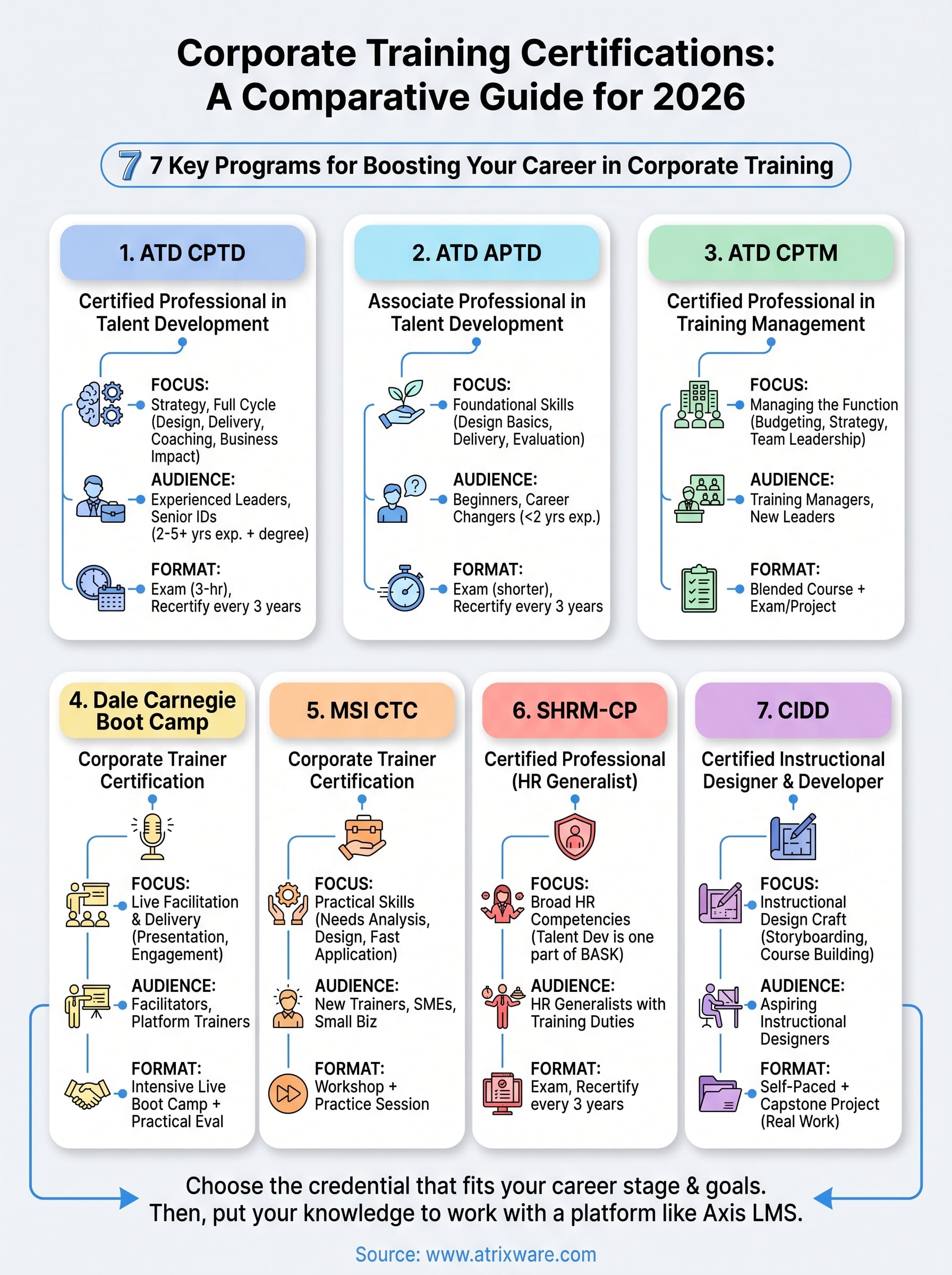
Choosing the right certification for your goals
Picking the right certification in corporate training comes down to where you sit today. If you’re new to the field, the APTD or MSI’s CTC gets you credentialed fast without years of prerequisite experience. If you already manage a training function, the CPTM or CPTD carries more weight in hiring conversations. And if your role blends HR and training, the SHRM-CP covers more ground than any training-only credential can.
Whichever corporate training certification you choose, the credential only proves you know the theory. You’ll still need a platform that lets you build courses, track certifications and completions, and prove training actually moved the needle for your organization. That’s exactly what Axis LMS is built for, and you can see it running with your own content before committing to anything. Try the Axis LMS admin demo and put your new certification to work.
