A good compliance training program sample shows you four things: the modules, the audience, the refresher schedule, and the proof of completion. Each of the eight samples below covers all four. Start with data privacy and cybersecurity if you hold customer records. Choose anti-harassment and code of conduct if you need a baseline for every employee. Workplace safety suits people who work on floors or job sites, and the healthcare sample suits anyone who touches patient data. Anti-bribery and financial compliance fit teams that move money, and the onboarding sample fits any company that hires steadily.
Most samples you find online are either blank policy PDFs or a list of topic names. Neither tells you how long a course should run, who should take it, or how often to repeat it. That gap is why programs get copied badly, or never get finished.
This article gives every sample in the same format, so you can compare them side by side. The last section shows how to combine them into one annual calendar and run it in a learning management system. Atrixware builds Axis LMS, so we write from the training administration side: assigning courses, tracking completion, and keeping proof for an audit.
1. Data privacy and cybersecurity training program
This sample compliance training program suits any organization that stores personal or customer data, which covers nearly every employer. It teaches employees to recognize sensitive data, handle it under the laws that apply, and build the daily habits that stop breaches.
Sample modules
Build this program as four modules of roughly 10 to 12 minutes each, about 45 minutes in total. Short modules are easier to update when a law or a threat changes, and people actually finish them. End each module with a short knowledge check.
- Data types: personal data, confidential company information, and customer records, with a sensitivity level for each.
- Applicable laws: GDPR for EU data subjects, state laws such as the CCPA in California, and sector rules such as HIPAA.
- Handling rules: password standards, multi-factor authentication, encryption, secure file transfer, and approved devices.
- Threat spotting: phishing, social engineering, and ransomware, plus how to report a suspicious message within minutes.
Audience, schedule, and proof
Assign the full course to every employee and contractor with system access. Repeat it yearly, and send short phishing refreshers between, because attackers change tactics faster than an annual course can.
- Audience: all staff and contractors, with an extra access-control module for IT and administrators.
- Frequency: at hire and every year, with a 10-minute phishing refresher each quarter.
- Proof: quiz scores, a signed data handling policy, and a log of reported incidents.
A privacy program works when employees know which data they hold and what to do the moment something looks wrong.
2. Anti-harassment and discrimination training program
Most employers need this sample first, because it applies to every employee and several states require it by law. It teaches what harassment and discrimination look like, how to report them, and what managers must do when they hear a complaint.
Sample modules
Split the content into an employee track and a supervisor track. Supervisors take extra time because they receive complaints, and a slow or dismissive response creates as much risk as the original behavior. The sample runs 60 minutes for employees and 120 for supervisors.
- Definitions: discrimination by protected characteristic, harassment, and sexual harassment, in verbal, nonverbal, and physical forms.
- Scenarios: a joke in a team meeting, a message sent after hours, an accommodation request that gets ignored.
- Reporting: internal channels, an anonymous hotline, anti-retaliation promises, and investigation timelines.
- Inclusion: unconscious bias, respectful communication, and accessibility basics.
- Supervisor add-on: how to take a complaint, escalate it the same day, and document what was said.
Audience, schedule, and proof
State rules set the minimums. California requires employers with five or more employees to give 2 hours to supervisors and 1 hour to other employees every two years, and New York requires annual training for all employees. Check your own state, then set the sample frequency to match.
- Audience: all employees on the standard track, all people managers on the supervisor track.
- Frequency: at hire, then yearly or on your state’s required cycle.
- Proof: signed acknowledgments, scenario quiz results, and completion dates by track.
Supervisors need a script for the first conversation after a complaint, not just a definition.
3. Workplace safety training program
This sample suits employers with plants, warehouses, labs, job sites, or field crews. It trains workers to spot hazards, use controls and protective equipment, and respond to emergencies. In the United States, OSHA sets the baseline.

Sample modules
Safety training is task-specific, so pair a general core with modules for particular jobs. The core runs about 60 minutes, and task modules add time only for the people who do those tasks.
- Hazard identification and controls: engineering controls, administrative controls, and personal protective equipment.
- Hazard communication: chemical labels and safety data sheets, which OSHA’s Hazard Communication standard requires employers to train workers on.
- Emergency preparedness: evacuation routes, fire extinguishers, first aid, and how to report an injury.
- Task modules: equipment operation, lockout/tagout, and fall protection where those risks exist.
Audience, schedule, and proof
Give the core course to everyone on site, and the task modules only to those who need them. In construction, OSHA’s Outreach Training Program offers 10-hour courses for entry-level workers and 30-hour courses for supervisors. An authorized trainer delivers them, so record the card number and date in your LMS.
- Audience: all site staff for the core, specific crews for task modules.
- Frequency: at hire, yearly for the core, and whenever equipment or procedures change.
- Proof: trainer name, date, topics covered, and a supervisor sign-off after a hands-on demonstration.
Safety training counts only when workers can show the task, not just pass a quiz about it.
4. Anti-bribery and corruption training program
This sample fits companies that sell to government, work abroad, or buy through agents and distributors. In the United States the main law is the Foreign Corrupt Practices Act, and firms operating in the UK also face the UK Bribery Act. The program teaches people to recognize bribes before they happen.
Sample modules
Keep it scenario-heavy and about 45 minutes long. Employees rarely face an obvious bribe. They face a gift that feels slightly too generous, or an agent who asks for a vague commission.
- What counts as bribery: offering, promising, giving, or accepting anything of value to influence a decision, including travel and jobs for relatives.
- Gifts and hospitality: monetary limits, pre-approval steps, and a register of what was given or received.
- Third parties: due diligence on agents, distributors, and consultants, since a company can be liable for what intermediaries do for it.
- Red flags and reporting: cash payments, unusual commissions, and pressure to use one specific vendor.
Audience, schedule, and proof
Do not assign this to everyone. Target sales, procurement, finance, and executives, plus anyone who deals with government officials or foreign partners. A narrow audience keeps the training relevant and the completion rate high.
- Audience: the roles above, plus their managers.
- Frequency: at hire into those roles and every year.
- Proof: quiz results, an annual certification, and an up-to-date gifts and hospitality register.
Anti-bribery training works best when it is aimed at the few roles that actually face the risk.
5. Code of conduct and ethics training program
This sample is the foundation the others hang from. It turns a code of conduct from a document nobody reads into decisions employees can make on a normal Tuesday.
Sample modules
Run it as one 30-minute course. If your code already exists as a PDF or slide deck, you can convert it into course screens instead of writing from scratch, then add scenarios from your own workplace.
- Values and purpose: the handful of principles behind the rules, in plain language.
- Conflicts of interest: a side business with a vendor, a relative on a bid, and how to disclose each.
- Speaking up: the hotline, the promise of no retaliation, and what happens after a report.
- A decision check: three questions such as "Is it legal? Does it match our code? Would I be comfortable seeing it reported?"
Audience, schedule, and proof
Give it to all employees at hire, then yearly. Add a short module for leaders on modeling the behavior, because employees copy what their managers do, not what the code says.
- Audience: everyone, with a leader add-on for managers and executives.
- Frequency: at hire and every year.
- Proof: a signed acknowledgment of the code and an annual conflict-of-interest disclosure form.
A code of conduct changes behavior only after employees practice applying it to a realistic dilemma.
6. Healthcare compliance training program
This sample suits providers, billing companies, health plans, and vendors that handle protected health information. HIPAA’s Privacy Rule requires covered entities to train all workforce members on its policies, and the Security Rule adds security awareness training.
Sample modules
Plan for about 45 minutes, with deeper add-ons for billing and IT roles. The goal is for a front desk employee and a billing analyst to both know what is protected and what to do when something goes wrong.
- PHI basics: what protected health information is, which identifiers count, and the minimum necessary standard.
- Patient rights: access to records, requests for amendments, and restrictions on disclosure.
- Security safeguards: access control, device and email security, and secure disposal of records.
- Breach response: spotting an incident and reporting it at once. The HIPAA breach notification rule requires notice to affected individuals without unreasonable delay and no later than 60 days after discovery.
Audience, schedule, and proof
Include the entire workforce, such as employees, volunteers, and trainees, with role-based depth on top. Train at hire and whenever policies change materially. Many organizations also repeat it yearly, and the sample calendar does.
Ask whether your training platform will hold sensitive records before you buy it. Atrixware offers a HIPAA compliant hosting option for Axis LMS.
- Audience: all workforce members, with add-ons for billing, IT, and clinical staff.
- Frequency: at hire, after material policy changes, and yearly.
- Proof: dated training logs per person, kept with your other HIPAA documentation.
HIPAA training has to be documented per person, because an audit asks who was trained and when.
7. Financial compliance and fraud prevention training program
This sample suits finance, accounting, and procurement teams, plus any firm subject to anti-money laundering rules. It teaches the controls that make fraud hard and the red flags that make it visible. Both matter, because most fraud exploits a gap in routine process.
Sample modules
Run it as 60 minutes, split into four parts. Use real payment scenarios, since vendor fraud usually arrives as a normal-looking invoice or an email from "the CEO."
- Internal controls: segregation of duties, approval limits, and reconciliations.
- Fraud types: asset misappropriation, financial statement fraud, and corruption, with the pressures that push people toward each.
- Money laundering: for regulated institutions, the Bank Secrecy Act requires AML programs that include ongoing employee training, covering structuring, unusual transactions, and suspicious activity reporting.
- Payment fraud: fake invoices, business email compromise, and verifying changed bank details by calling a known number.
Audience, schedule, and proof
Assign it to finance, accounting, accounts payable, and procurement, and give executives a shorter briefing. Include the AML module only if your organization is a regulated entity. Between annual courses, send a short alert whenever a new scam targets your industry.
- Audience: finance and procurement staff, with AML content for regulated roles.
- Frequency: at hire into the role and every year.
- Proof: quiz scores, results of an invoice fraud exercise, and a controller sign-off.
The most useful fraud training is the five-minute habit of verifying a payment change before approving it.
8. New hire compliance onboarding program
This sample suits any company that hires steadily. It delivers the baseline in the first 30 days, so nobody works unprotected until the next annual cycle. It also triggers extra training when someone changes roles.
Sample modules
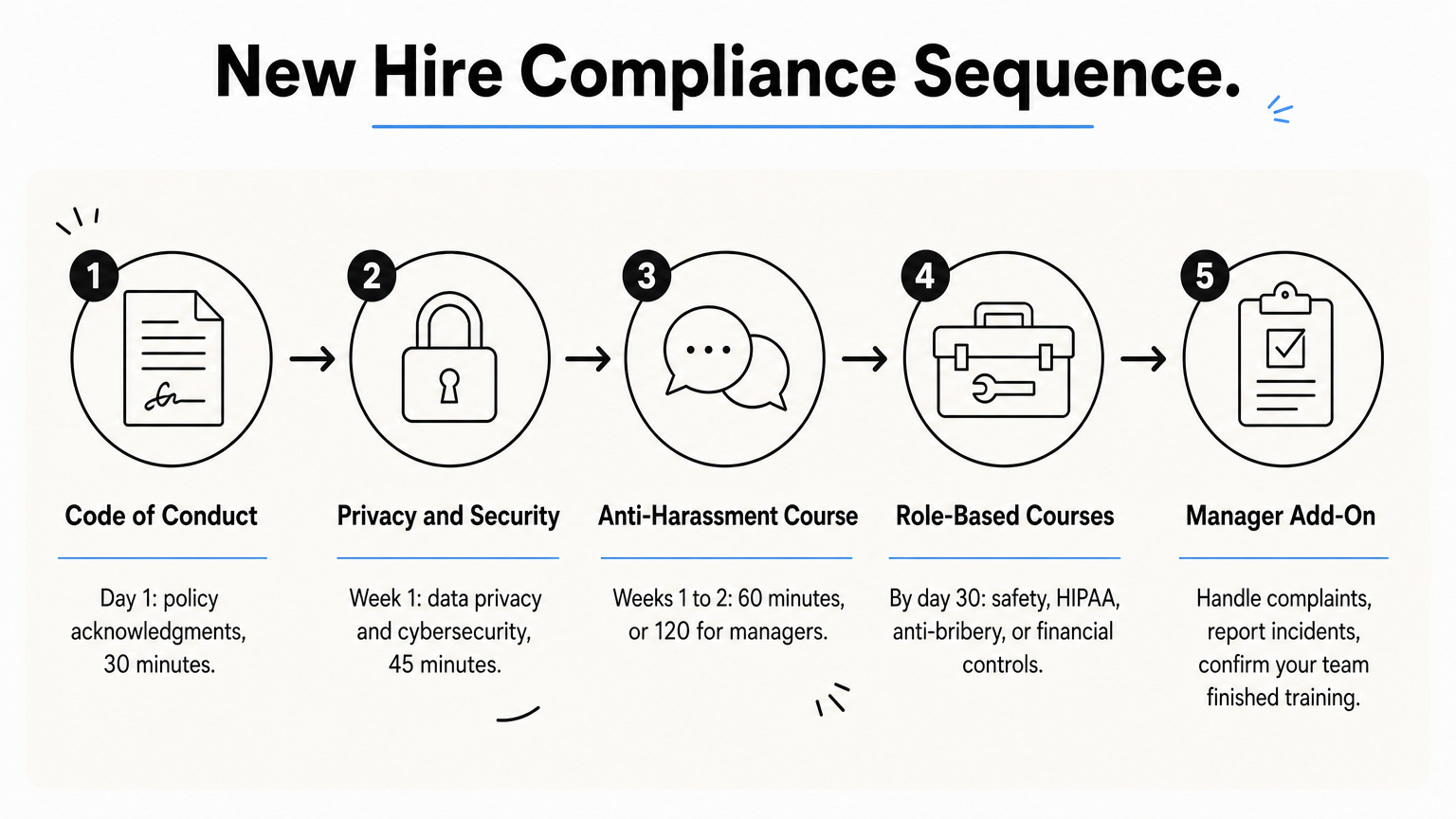
Sequence the courses instead of assigning them all on day one. A new hire who gets everything at once clicks through. One who gets a course at a time remembers more.
- Day 1: code of conduct and key policy acknowledgments, 30 minutes.
- Week 1: data privacy and cybersecurity, 45 minutes.
- Weeks 1 to 2: anti-harassment training, 60 minutes, or 120 for people managers.
- By day 30: role-based courses such as safety, HIPAA, anti-bribery, or financial controls.
- Manager add-on: how to handle a complaint, report an incident, and confirm that your team finished its training.
Audience, schedule, and proof
Every new hire and every employee who changes roles takes this program, whether through a promotion or a transfer. Automated assignment removes the usual failure, where someone forgets to enroll the new hire. An LMS that syncs with your HR system, as Axis LMS does with ADP, BambooHR, and others, can assign courses from the hire date.
- Audience: new hires, internal transfers, and newly promoted managers.
- Frequency: once at hire, plus again on any role change.
- Proof: completion tracked against the 30-day deadline, with reminders and escalation to the manager.
Compliance onboarding fails when assignment depends on someone remembering to do it.
How to turn these samples into your own program
Pick the three to five samples that match your biggest risks, fit them into one annual calendar, and surround them with the other parts of a compliance program. Training alone does not make a program, and regulators look at the whole.
Build around the seven elements
The Office of Inspector General at the U.S. Department of Health and Human Services describes seven elements of an effective compliance program. Training is one of them, so each sample above needs the other six behind it.
- Written policies and procedures
- A designated compliance officer and compliance committee
- Training and education
- Open lines of communication, such as a hotline
- Enforcement through disciplinary standards
- Auditing and monitoring
- Prompt response to problems and corrective action
If a sample lacks a policy to teach from or a channel for reports, fix that first. Otherwise you are training people on rules that do not yet exist.
A sample 12-month calendar
The table spreads the samples across the year, so no one faces a wall of courses. Lengths match the samples above.

| When | Program | Audience | Length |
|---|---|---|---|
| Within 30 days of hire | Onboarding (items 5, 1, 2) | New hires, role changers | 30 + 45 + 60 min |
| January | Code of conduct and ethics | All employees | 30 min |
| March | Data privacy and cybersecurity | All employees | 45 min |
| April | Workplace safety refresher | Site and warehouse staff | 60 min |
| May | Anti-harassment and discrimination | All employees, supervisors on track two | 60 min, 120 min for supervisors |
| June | HIPAA refresher | Staff handling PHI | 45 min |
| September | Anti-bribery and corruption | Sales, procurement, finance, executives | 45 min |
| October | Financial compliance and fraud | Finance, accounting, procurement | 60 min |
| Each quarter | Phishing refresher | All employees | 10 min |
Work an example for two people. A typical office employee takes 30 + 45 + 60 minutes, which is 2 hours 15 minutes, plus four 10-minute phishing refreshers, for about 2 hours 55 minutes a year. A regional sales manager takes 30 + 45 + 120 + 45 minutes, which is 4 hours, plus the same 40 minutes of refreshers, for 4 hours 40 minutes.
Run it in an LMS
A calendar like this is easy to draw and hard to administer by spreadsheet. A learning management system assigns courses by role, sends reminders, and produces the completion reports an auditor asks for. Axis LMS includes compliance management features, including support for GDPR and FDA 21 CFR Part 11 requirements and tracking of continuing education units and re-certifications.
If you would rather license content than write it, Atrixware offers a Pick-100 Bundle, which lets you choose 100 titles from a library of 25,000 and load them into Axis LMS. It also offers an Accessibility and Inclusion collection of 36 courses.
Design the calendar around risk first, then choose software that can assign and prove it without manual tracking.
Start with the program your risks demand
You do not need all eight samples. Start with the one that matches your largest legal or safety exposure, add code of conduct and onboarding as your baseline, and build the calendar around them. Keep each course short, aim it at the people who face the risk, and decide in advance what proof of completion you will keep.
Once the outline is settled, the work moves to administration: enrolling people, chasing deadlines, and producing records. That is where a platform earns its place. If you want to see how Axis LMS handles assignments, reminders, and reporting for a program like this, book an Axis LMS admin demo and walk through your own calendar with us.
