Effective call center new hire training combines four formats: self-paced learning for knowledge, role play for skills, live exposure to real calls, and a person who answers questions. The five methods below cover all four. Self-paced e-learning suits centers that hire in waves or across sites. Classroom role play suits centers with a trainer and a cohort. Observation and shadowing suits teams with no phone experience. Nesting suits complex or regulated queues. Mentoring suits centers that lose agents in the first 90 days.
Most new agents struggle for the same reason. They absorb a mountain of product and policy information in week one, then reach the phones before they have practiced a single hard conversation. Trainers repeat the same sessions, supervisors handle the escalations, and some agents quit before they ever feel competent.
Whether you call it onboarding, orientation, or contact center new hire training, the fix is a sequence rather than a single event. Each method below covers how it works, who it suits, and how to set it up. We build Axis LMS at Atrixware, so we start with the method our software supports. The five stack well whatever tools you use.
1. Self-paced e-learning on an LMS
Move product knowledge, policies, and compliance topics into self-paced online courses, so trainers spend classroom time on practice instead of lectures. A learning management system (LMS) delivers the courses, scores the quizzes, and records who finished what.

Move the reading online and the classroom becomes practice time.
How it works
Agents log in, work through short courses at their own pace, and take a quiz at the end of each one. They can reopen any module later, which helps when a rare call type shows up in week three.
In Axis LMS you build courses with a drag-and-drop interface, assign them with automated workflows, and run on-demand reports on learner progress. It also supports virtual classroom training, which helps when a cohort is remote.
Who it suits
E-learning fits most teams. It is the strongest choice when:
- You hire in waves, or onboard agents at several sites or from home.
- You must document compliance training, such as privacy or payment card handling.
- Your trainers deliver the same lecture every month.
Small teams can start with Axis LMS Lite, built for 25 to 100 employees and listed at $299 for 25 users. Larger operations should look at Axis LMS, which is built for 150 to 100,000 employees.
How to set it up
Atrixware usually sets up an Axis LMS system within 1 to 3 business days after purchase, so the course build is your real work. Follow these steps:
- Split content into modules of 10 to 15 minutes, one topic each.
- End every module with a short quiz and require a pass before the next one unlocks.
- Assign the first courses on the hire date by syncing with your HR system. Axis LMS connects with ADP and BambooHR.
- Check the progress report weekly and flag anyone who is behind.
2. Interactive classroom and role-play sessions
Replace lectures with short, hands-on sessions where agents practice real call scenarios with a trainer and peers. Practice, not information, is what changes how a new agent sounds on the phone.
Agents forget a lecture, but they remember the call they fumbled in role play.
How it works
The trainer demonstrates one call type, then agents pair up. One plays the customer from a written scenario, the other handles the call, and then they swap. The trainer scores each attempt with the same quality form supervisors use on live calls, then runs a short debrief.
Games, stories, and short videos break up the day and help material stick. Keep any lecture block under 20 minutes, then get agents talking again.
Who it suits
This method works best for:
- Centers that hire in cohorts and have a dedicated trainer.
- Roles built on soft skills, such as de-escalation, empathy, and retention calls.
- Remote cohorts, because virtual classroom tools support the same format.
How to set it up
Preparation matters more than the room. A scenario library built from your real calls beats generic scripts.
- Pull your top five to eight call reasons from your reporting and write one scenario for each.
- Give every scenario a customer goal, a hidden problem, and an attitude. Include at least one angry customer.
- Score every attempt with your live quality form, so trainees know the standard from day one.
- Close each session by naming one skill to practice the next day.
3. Call observation and shadowing
Let trainees hear real calls first, then sit beside an experienced agent, so they know what the job sounds like before they take a call. This is the cheapest way to build realistic expectations.

Hearing a hard call before you take one removes half the fear.
How it works
Observation comes first. Trainees listen to recorded calls from a library of good and poor examples, with customer details removed and each call tagged by skill, such as empathy or first-call resolution.
Shadowing comes second. The trainee sits with a veteran on live calls, watches the screens, and asks questions in the gaps. Some centers let trainees handle note-taking or lookups while the agent talks.
Who it suits
Use this method for:
- Trainees with no phone experience.
- Teams that already record calls for quality review.
- Any center that wants quick context before role play gets harder.
Remember that shadowing costs a veteran’s time, so plan it around their schedule.
How to set it up
Give trainees a listening guide so they do not just drift through calls. Follow these steps:
- Tag 15 to 20 recorded calls by skill and difficulty.
- Hand trainees three questions: how did the agent open, what did the customer need, and what ended the call?
- Schedule a few hours of shadowing across at least two different agents.
- Hold a five-minute debrief after each session, and follow your recording consent and privacy rules.
4. Nesting with supervised live calls
Nesting puts trained agents on real calls in a protected group, with limited call types and a supervisor close by, before they join the main floor. It is the bridge between training and production.
Nesting lets a new agent make mistakes where they are cheap.
How it works
Trainees sit together in a nest, often a separate queue. Only basic call types route to them, and supervisors or senior agents can step in at any moment. As confidence grows, the mix widens until the agent graduates to the regular queue.
Trainees on live calls are working, so they are normally paid. Under U.S. federal wage rules, required training during working hours generally counts as paid time for non-exempt employees. Confirm state rules and your offer letters with HR.
Who it suits
Nesting pays off most when:
- Your calls involve billing, healthcare, or financial details.
- Early attrition is high and first-week stress is a known cause.
- Your queue has a wide spread between easy and hard call types.
How to set it up
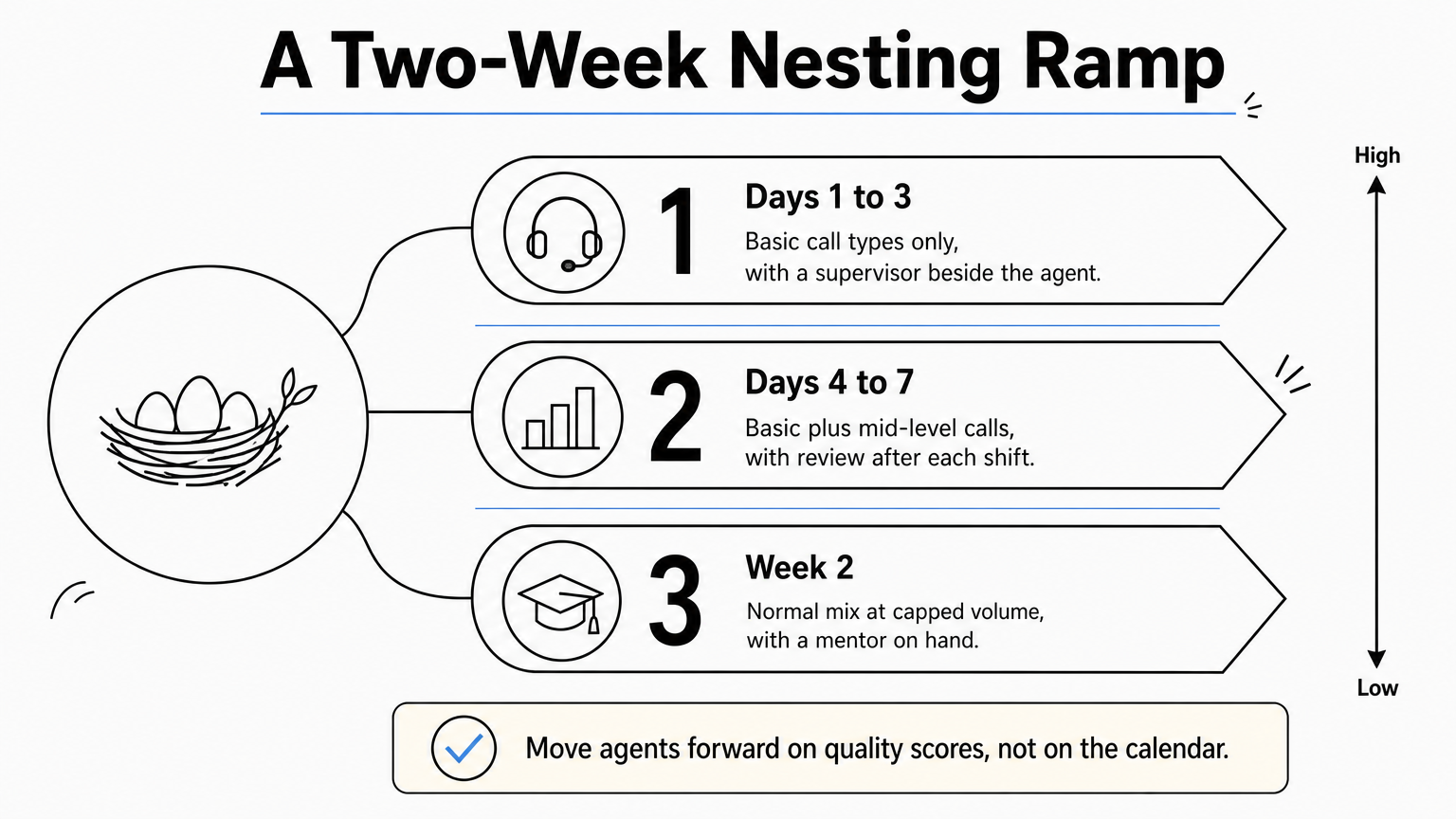
Decide the ramp before the first cohort starts. For a cohort that spends week one on e-learning, role play, and shadowing, a two-week nesting ramp might look like this:
| Stage | Calls handled | Support |
|---|---|---|
| Days 1 to 3 | Basic call types only | Supervisor beside the agent |
| Days 4 to 7 | Basic plus mid-level call types | Supervisor nearby, review after each shift |
| Week 2 | Normal mix, capped volume | Mentor on hand, calls spot-checked |
Treat these as a starting point. Move agents forward on quality scores, not on the calendar.
5. Peer mentoring and coaching
Pair each new agent with a skilled colleague for the first weeks on the floor, so questions get answered in minutes instead of waiting for the next training session. Mentoring is the method that keeps early turnover down.
The best training program still needs one person who answers the question right now.
How it works
The mentor sits nearby, takes questions, listens to a few calls each week, and gives short feedback. The new agent gains a safe place to ask what feels like a silly question. Mentors often grow into team leads.
Ownership should be clear. The training team owns the curriculum, supervisors own coaching and performance, and mentors own the day-to-day questions. New hires should know exactly who to ask for what.
Who it suits
Mentoring suits:
- Centers with a stable group of experienced agents.
- Teams where new hires fail on the floor, not in the classroom.
- Organizations that want a visible step between agent and team lead.
How to set it up
Your best performer is not always your best teacher. Choose mentors for patience and clarity, then protect their time.
- Pick mentors who are reliable, approachable, and good at explaining their own choices.
- Lighten their queue or workload, so mentoring is not unpaid overtime.
- Pair for four to six weeks, with a short weekly check-in with the supervisor.
- Recognize mentors with a bonus, a title, or a development path.
Putting the five methods together
Strong call center new hire training is a sequence. E-learning delivers knowledge, role play builds skill, observation and shadowing show the real job, nesting offers protected practice, and mentoring carries agents past the first weeks. Start with whichever gap hurts most, then add the next method.
If you want the e-learning layer in place before your next hiring wave, take the LMS readiness quiz to see where you are in the buying process and what to settle first.
