DOT supervisor compliance training online has to cover two things under FMCSA rules: at least 60 minutes on the signs of probable drug use and at least 60 minutes on the signs of alcohol misuse. That makes two hours in total. A good course also names the DOT agency that regulates your workforce and gives you a completion record to keep on file. A paid self-paced course suits most small fleets. The free FTA video suits transit employers. Live sessions suit supervisors who want to ask questions. A group package or your own LMS suits companies with many supervisors.
The problem is that every provider says its course is compliant, and the pages look nearly identical. Two hours is the same everywhere. What differs is cost, scheduling, record-keeping, and whether the course fits your DOT agency. If you pick on price alone, you can end up with a certificate that is hard to track or a course built for the wrong mode.
Below are five ways to get supervisors trained online or in a live session. Each one shows how it works, who it suits, and what to check before you pay. We start with the option for companies that need to track training at scale, because that is the work our own platform does.
1. Host the course in your own LMS with Axis LMS
Hosting the course in a learning management system means your supervisors take DOT training in the same place as the rest of your training, and you see every completion in one report. Axis LMS from Atrixware is built for this. The DOT content itself comes from a course you build or license.
How it works
Axis LMS delivers online and virtual training, and its drag-and-drop interface lets you assemble course material quickly. You assign the course, learners work through it, and automated reports show who has started and finished. It also tracks re-certifications, which helps if your company policy sets a refresher schedule on top of the federal minimum.
An LMS does not replace the DOT course. It proves, for every supervisor, that the course was taken.
Who it suits
This option fits employers that train supervisors continually, such as growing carriers, municipalities, and multi-site operators. It also fits companies that already run safety or HR training and want one system. Integrations with HR systems like ADP and BambooHR keep user lists current as supervisors are hired or promoted.
Cost and what to check
Atrixware sets up most Axis LMS systems within 1 to 3 business days of purchase, with contracts of 1 to 3 years. Tech support is included. Pricing depends on the product, so ask sales at 1.866.696.8709. Before you commit, confirm that your DOT course content totals the required 60 plus 60 minutes and that you can export completion records for an audit.
2. Self-paced course from a specialist provider
A self-paced course is the fastest way to certify one or a few supervisors. You buy it, log in, finish at your own speed, and print a certificate. For most small employers this is the default answer to what online DOT supervisor training should look like.
How it works
Specialist providers sell the two-hour course as a single product. Certified Training Solutions lists its DOT course at $49.99 and describes it as 1 hour of drug recognition plus 1 hour of alcohol recognition, with immediate access and a printable certificate. CNS Learning Hub lists a 120-minute course at $45.00. Motor Carrier HQ also describes a 120-minute online course meeting FMCSA requirements.
| Provider | Length | Listed price |
|---|---|---|
| Certified Training Solutions (DOT) | About 2 hours | $49.99 |
| Certified Training Solutions (non-DOT) | Not specified | $44.99 |
| CNS Learning Hub | 120 minutes | $45.00 |
Who it suits, and what to check
It suits small fleets and any employer with a new supervisor to certify this week. Check that you are buying the DOT version. A non-DOT supervisor course is built for general workplaces and does not replace DOT-required training. Also check the agency fit, since Certified Training Solutions names FMCSA, FAA, FRA, FTA, and PHMSA coverage, and whether you need a Spanish-language version, which that provider also lists.
For 12 supervisors at $49.99, the cost is $599.88. At $45.00 each, it is $540.00.
3. The free FTA reasonable suspicion video
If you run a transit operation, the Federal Transit Administration publishes its own two-hour reasonable suspicion training video. It costs nothing, which makes it the standard answer to searches for free reasonable suspicion training for supervisors.

How it works
The FTA page hosts the full two-hour video. When you finish, you enter your name to certify that you completed it. That entry is a self-certification, so it does not come with the tracking or reporting a paid provider gives you.
Free training still needs a paper trail, so save your own proof that each supervisor finished.
Who it suits, and what to check
It is built for FTA-regulated transit employers, such as agencies and contractors that oversee safety-sensitive transit employees. A trucking company under FMCSA should confirm with its own compliance advisor before treating the video as sufficient, because the content is written for the transit mode.
Keep a record for each supervisor: name, date completed, and the page or screenshot showing completion. If you manage many people, upload that record to your LMS so it sits beside the rest of your compliance files.
4. Live webinar or in-person supervisor training
Live training gives supervisors a trainer they can question, and that matters because reasonable suspicion calls are judgment calls. Some providers pair live delivery with online options, including Compliance Systems, which offers webinar and in-person supervisor training, and Certified Training Solutions, which lists live webinar options for organizations.
How it works
A trainer walks the group through the same required content: physical, behavioral, speech, and performance indicators of drug use and alcohol misuse. The advantage is discussion. Supervisors can ask what to do when an employee shows some signs but not others, or how to document what they saw.
Who it suits, and what to check
Live sessions suit employers who want supervisors to practice together, such as a new management team or a company that just had an incident. They cost more in time because everyone must be available at once. Pricing for live sessions is quoted by the provider, so ask for it in writing.
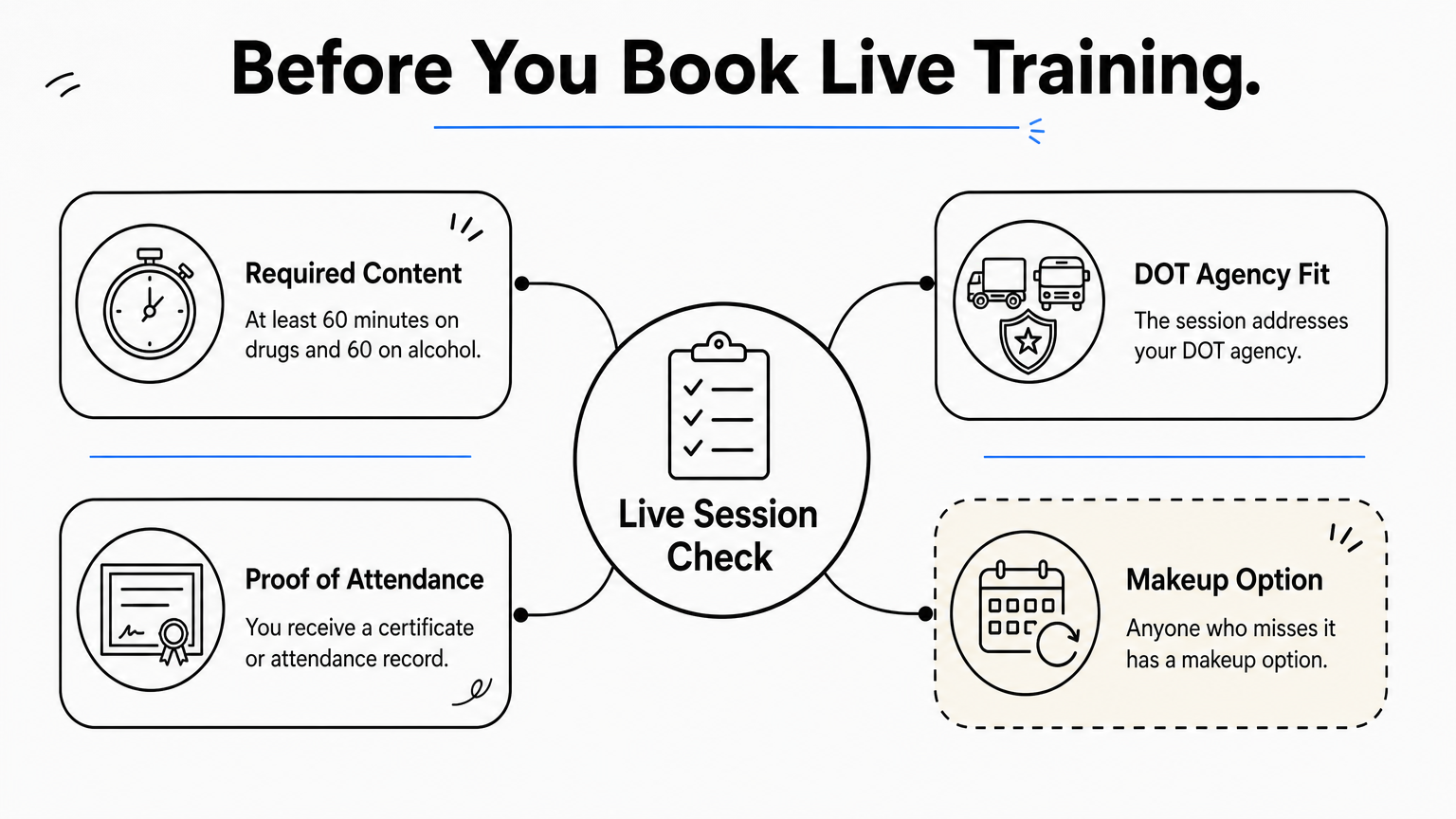
Before you book, confirm four things:
- The session covers at least 60 minutes on drugs and 60 on alcohol.
- It addresses your DOT agency.
- You receive a certificate or attendance record.
- Anyone who misses it has a makeup option.
5. Group enrollment with manager reporting
Group enrollment is for employers with ten or more supervisors who want one invoice and one view of progress. Certified Training Solutions, for example, offers group pricing quotes at 10 or more seats, and its group customers can arrange manager access to see invitation status, track progress, run reports, and print certificates.
How it works
You contact the provider with a headcount and ask for a group quote. Each supervisor receives an invitation and completes the same course. Manager access lets a designated person see who has not started, which saves the follow-up emails you would otherwise send by hand.
The cost of group training is not the course fee. It is the time you spend chasing completions.
Who it suits, and what to check
This works for mid-size carriers and organizations that do not want to run their own system. The tradeoff is that records stay in the provider’s system, so confirm how long you keep access and how to export certificates. The federal rules require the initial 60 plus 60 minutes and set no annual refresher interval, so decide whether your policy adds one, and make sure the provider can show who took the course and when.
Choosing the right route for your supervisors
Match the option to your headcount and DOT agency. One to nine supervisors usually points to a self-paced paid course. Transit employers can start with the free FTA video and keep their own records. Teams that want discussion should book live training. Companies with ten or more supervisors, or with ongoing training duties, should look at group enrollment or their own LMS.
Whatever you choose, verify the two-hour content, the DOT agency fit, and the completion record before you buy. If you want to see how an LMS would track your supervisors alongside your other required training, book an Axis LMS admin demo and walk through the reporting with Atrixware.
