
The best employee training incentive programs pay back a share of what you spend on training, and the rules differ sharply by state. A tax credit like New York’s suits employers that train many people and can wait for the payout. A grant like the Massachusetts Workforce Training Fund suits employers that already pay into the fund. Minnesota’s grants suit companies that are adding jobs, and on-the-job training reimbursement suits anyone hiring entry-level workers.
The problem is that no single national program exists, and nearly every program wants approval before the first training session. Miss that step and the money is gone. This article covers five programs, three state examples and two models you can find in most states. For each you get the award amount, who qualifies, and how to apply.
Treat the state programs as templates for what to look for in your own state. Funders also want proof of what was taught, to whom, and at what cost. Atrixware makes Axis LMS, a learning management system built to track those records, so we flag what to document along the way.
1. New York Employee Training Incentive Program (ETIP)
What it pays
New York’s ETIP is a refundable tax credit worth 50% of eligible training costs, up to $10,000 per employee. Its internship track pays 50% of the intern’s stipend, up to $3,000 per intern. Refundable means you receive the money even if the credit exceeds your tax bill. The state issues it only after the training is finished, for the tax year in which the training was completed.
Here is a worked example. You train 8 employees at $6,000 each, a $48,000 total. Each cost is under the cap, so the credit is $24,000. If each employee’s training cost $24,000, the credit would stop at $10,000 per person.
ETIP refunds 50% of training costs, but only after the approved training is complete.
Who qualifies and how to apply
Empire State Development runs the program, and the rules are strict. You must operate predominantly in a strategic industry and make a significant capital investment with a benefit-cost ratio of at least 10:1 against the training project. Accounting firms, law firms, restaurants, hospitality, medical practices, real estate and financial services businesses are excluded. So is training required by law or leading to a mandatory license. Internships need an employer with fewer than 100 employees, last up to 12 months, and must be in advanced technology, life sciences, software development or clean energy.
The steps, per the Empire State Development program page:
- Submit the ETIP Consolidated Funding Application before training begins.
- Receive a certificate of conditional eligibility.
- Complete the approved training.
- File the final application within 24 months of the certificate.
- Claim the credit on Form CT-646 (corporations) or IT-646 (everyone else).
2. Massachusetts Workforce Training Fund Program
What it pays
The Workforce Training Fund is a grant program that pays toward training current and newly hired employees. It is financed by employers through a workforce training contribution paid with unemployment insurance. You are getting back money you already put in. Grants usually require you to match part of the cost, and the program splits into a General Program for customized training and an Express Program for shorter, off-the-shelf courses. Caps and match rates change, so confirm current figures before you budget.
In Massachusetts you have already paid into the fund, and the grant is how you draw on it.
Who qualifies and how to apply
To qualify, your business must pay into the Fund. Check your unemployment insurance filings to confirm you contribute. Commonwealth Corporation administers the program and takes applications. Plan to apply before training starts, and keep rosters, course descriptions, hours and invoices so you can document the spend. This option suits established employers with steady payroll who want to upskill existing staff, not only new hires.
3. Minnesota Job Training Incentive Program (JTIP)
What it pays
Minnesota’s JTIP awards grants of up to $200,000 to eligible businesses to train workers for new jobs. The Department of Employment and Economic Development runs it. The key word is new. The money follows job creation, so it fits an expansion or relocation better than an effort to upskill the staff you already have.
JTIP funds training for jobs you are creating, not for people already on your payroll.
Who qualifies and how to apply
Eligibility usually turns on the number of new jobs, the wages they pay, and your industry. Read the department’s current guidelines before you build a hiring plan around the grant. Contact the department’s business development staff before you hire and train, because grant programs of this type rarely reimburse work that began before approval. Have your hiring timeline, wage schedule and training outline ready for that first conversation.
4. WIOA on-the-job training reimbursement
What it pays
On-the-job training under the federal Workforce Innovation and Opportunity Act reimburses part of a new hire’s wages while they learn the job. Federal rules allow up to 50% of the wage rate, and local boards can raise that to 75% in some cases. Here is an illustration. A new hire earns $20 an hour, your board reimburses 50%, and the training period is 160 hours. That is $10 an hour, or $1,600 back.
On-the-job training turns the slow first weeks of a new hire into a partly reimbursed investment.
Who qualifies and how to apply
This program exists in every state, run by local workforce development boards. You hire a jobseeker the board refers, usually through an American Job Center. The board signs a training agreement with you that sets the skills taught, the length of training and the reimbursement rate. Do not hire first. Contact your local board before the offer goes out, and find it through CareerOneStop. It suits employers hiring entry-level or career-changing workers.
5. State customized training grants
What it pays
Many states fund customized training for companies that create or keep jobs. Georgia’s Quick Start provides customized training at no cost to qualifying companies. The Texas Skills Development Fund pairs employers with community and technical colleges to build training around specific job needs. The value is often delivered as training built for you, not as a check. Award sizes depend on jobs created or retained, so no single figure applies.
Customized training grants usually reward job creation or retention, not training spend alone.
Who qualifies and how to apply
To find your state’s version, start with your state economic development agency and your local workforce board, then ask your nearest community college. Put these questions to each program:
- Must I get approval before training starts?
- Does it require new or retained jobs?
- Is there a per-employee or per-project cap?
- Does it pay me, or pay the training provider?
- What records must I keep as proof?
The last question is where an LMS helps, since funders want completion records, hours and rosters. Axis LMS produces these through on-demand and automated reports.
Choosing where to apply first
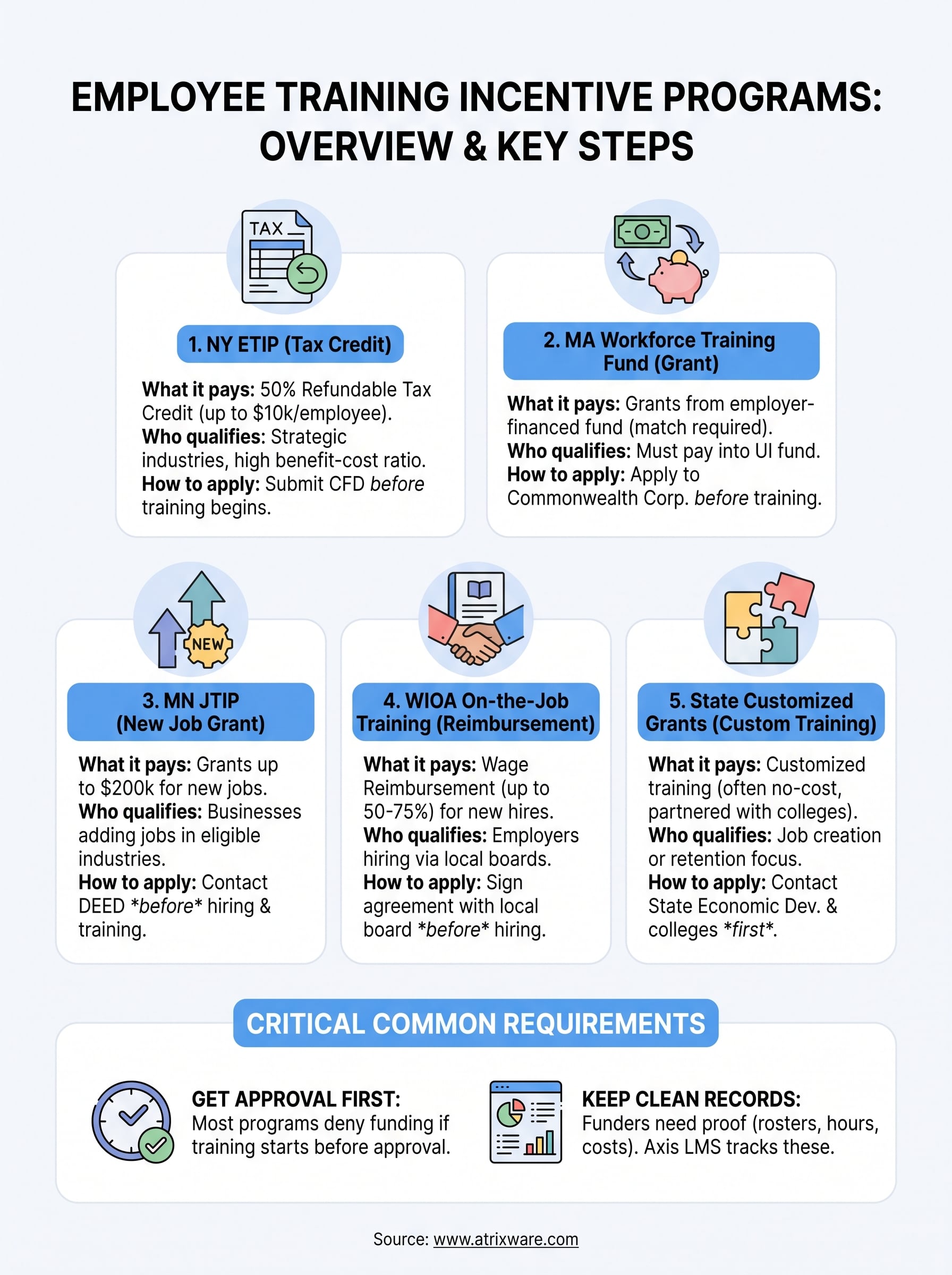
Pick by situation. A tax credit rewards heavy, sustained training. A fund like Massachusetts’ returns money you have already contributed. Grants like Minnesota’s follow new jobs, and on-the-job training reimbursement covers the early wages of a new hire. Customized state grants fill the gaps for expanding employers. In every case, get approval before you spend and keep clean records.
Once you know which program fits, you need a system that proves the training happened. If you are weighing options, take the LMS readiness quiz to see where you stand in the buying process.
