
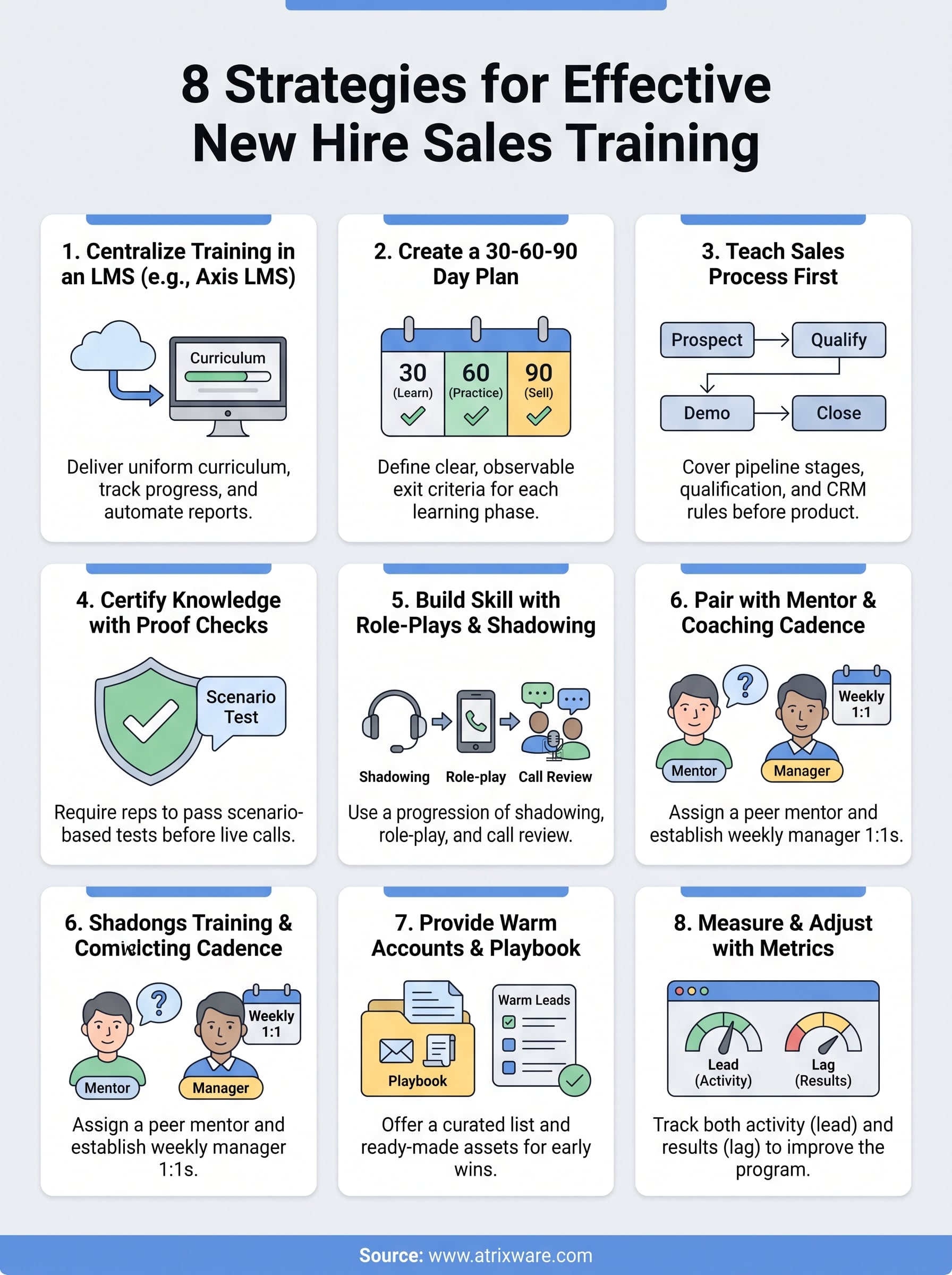
The best new hire sales training follows a fixed structure: a 30-60-90 day plan with clear exit criteria, early training on your sales process, practice before live calls, a mentor plus a manager coaching rhythm, and metrics you review every week. If you lead a team of three to five reps, start with strategies 2, 5, and 6. If you hire in cohorts or manage remote reps, start with strategies 1 and 8.
The problem is that most onboarding looks like a week of product demos followed by a territory and a login. Reps guess their way through the first quarter, managers lose track of who knows what, and a hire who could have worked out ends up leaving. This article gives you eight ways to build a program that prevents that. You get a sample 90-day plan, practice formats, a coaching agenda, and the metrics that show whether it works.
Atrixware makes Axis LMS, a learning management system that sales enablement and training teams use to deliver and track training. That is why the first strategy covers where an LMS fits. The other seven work with any tools, including a shared drive and a spreadsheet.
1. Run training from one LMS, such as Axis LMS
A sales training LMS gives every new rep the same curriculum, the same knowledge checks, and one place where you can see who is stuck. Axis LMS from Atrixware is built for that job, and it suits any team that onboards more than a couple of reps a year.
Why it works
Scattered training causes most onboarding gaps. One rep gets a recorded demo, another gets a slide deck, and a third gets whatever the nearest veteran remembers. A central system gives every hire the same curriculum and gives you a completion record you can check at any point.
Axis LMS lets you build courses with a drag-and-drop interface, run virtual classroom sessions, and schedule automated reports on learner progress. It syncs user data with HR and CRM systems such as Salesforce, BambooHR, and ADP. It also supports single sign-on through providers like Okta and Azure, so reps log in once and get to work.
A new rep should never have to ask where the training lives.
How to run it
Build one role-based learning path per role, then keep it modular so you can reuse it for every cohort. A workable setup looks like this:
- Create modules for sales process, product, buyer personas, and tools, each ending with a short quiz.
- Release modules weekly instead of all at once, so reps pace themselves.
- Sync user data from your HR or CRM system so new hires have accounts ready on day one.
- Use automated communication to nudge reps who fall behind.
- Bring the completion report to your weekly pipeline meeting.
Where it goes wrong
The usual failure is treating the LMS as a storage closet. Forty hours of video with no checks teaches little, and reps skip it. Keep modules to 10 to 15 minutes, end each with a quiz, and make new hire sales training a weekly rhythm rather than a one-time dump.
An LMS also cannot replace coaching. It tells you a rep finished the objection-handling module. It cannot tell you whether that rep handled a real objection well. Pair completion data with the practice and coaching described in the strategies below.
2. Map a 30-60-90 day plan with exit criteria
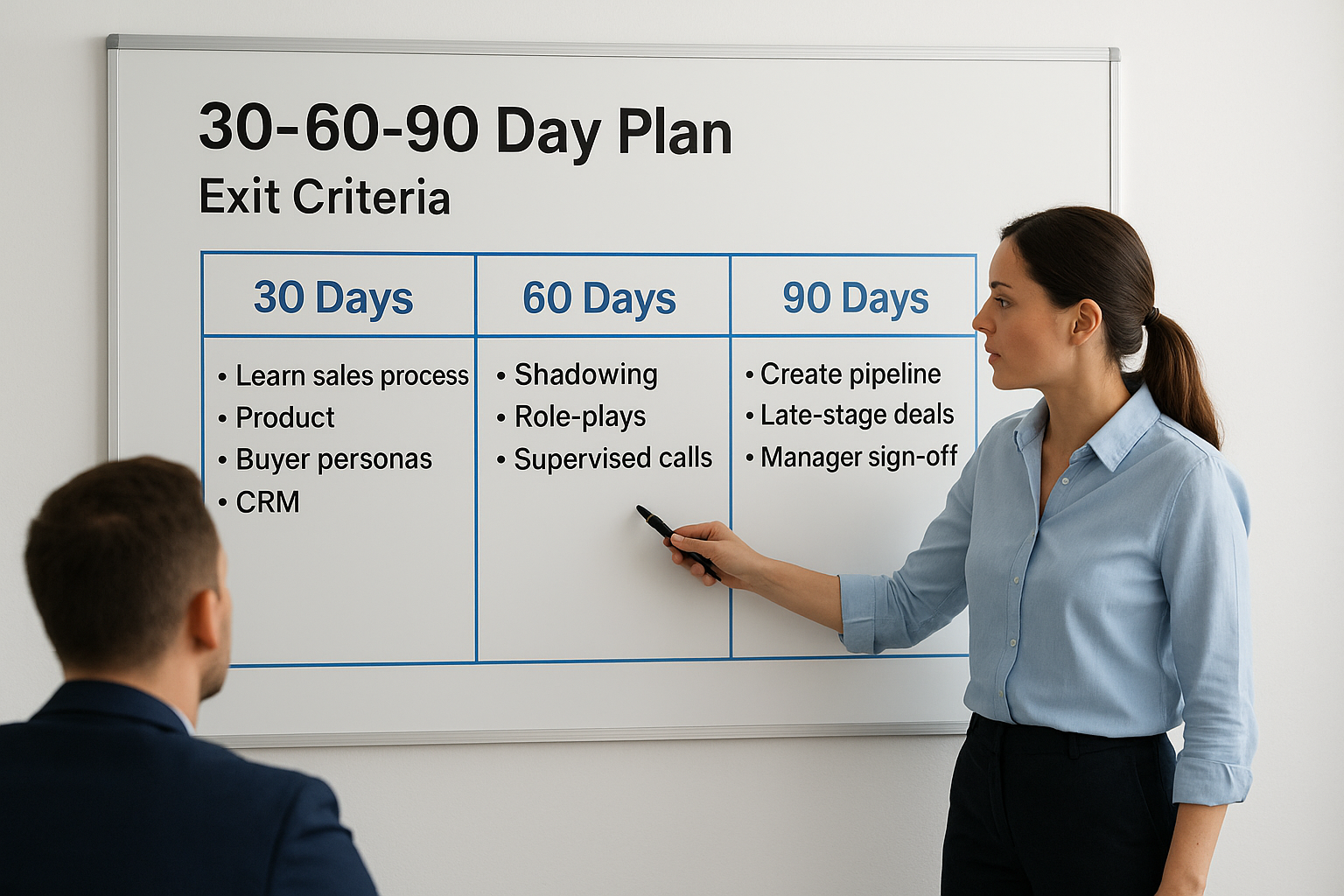
A 30-60-90 day plan splits ramp-up into three phases: learn, practice, and sell. Each phase ends with a check the rep must pass before moving on. Plan for about 90 days of structured training, and expect reps with long sales cycles to need longer before they hit full quota.
Why it works
The plan gives you and the rep a shared definition of progress. Without one, "ramping up" means whatever the manager feels on a given Friday. Exit criteria replace that feeling with observable results, which also answers the question of how long new hire sales training should last. Structured training runs 60 to 90 days, and coaching continues after it.
| Phase | Focus | Exit criteria |
|---|---|---|
| Days 1 to 30 | Learn the sales process, product, buyer personas, and CRM | Passes knowledge checks, delivers a pitch to the manager, keeps clean CRM records |
| Days 31 to 60 | Practice through shadowing, role-plays, and supervised calls | Runs coached discovery calls, passes an objection role-play, meets activity targets |
| Days 61 to 90 | Sell from an owned pipeline with coaching on real deals | Hits pipeline creation target, has deals in late stages, manager signs off |
How to run it
Put the plan on one page and hand it over on day one. Pick three to five exit criteria per phase, and make each one something you can see or count. Hold a 30-minute review at day 30 and day 60, and let the rep show evidence instead of describing progress.
Adjust the table to your sales cycle. A transactional team might compress it to 45 days. An enterprise team selling over nine months should still use 90 days, but judge the third phase on pipeline quality rather than closed revenue.
Where it goes wrong
Teams often set revenue goals in the first phase, which punishes reps for a cycle they cannot influence yet. Others write the plan and never review it. A plan that nobody checks at day 30 is a calendar, not a program.
A 30-60-90 plan only works when each phase ends with a test, not just a date.
3. Teach your sales process before your product
Start with how your company sells, then teach what it sells. A rep who knows your stages, your qualification questions, and what counts as progress can absorb product details faster, because each detail has a place to land.
Why it works
Product facts are easier to remember when they attach to a moment in the sale. A rep learns that a certain feature matters during discovery and a different one matters during the demo. Many teams have never written down their sales process, so this strategy forces a useful exercise. It also gives managers a common language for coaching.
How to run it
Treat the process as a short course of its own, taught in the first week. Cover these pieces:
- Each pipeline stage, with entry and exit criteria.
- Your qualification framework, whether that is MEDDIC, BANT, or a homegrown checklist.
- Recorded calls from each stage, with notes on what the rep did well.
- CRM rules: which fields to fill, when, and why.
- Two won deals and one lost deal, walked through from first touch to close.
Give the rep a one-page process map to keep beside the keyboard. During new hire sales training, refer back to it in every coaching session so the map becomes habit.
Where it goes wrong
The common error is teaching a methodology that nobody on the floor actually uses. If your top reps run a different approach, new hires will copy them and ignore the training. Either update the written process to match what works, or get managers to coach to it consistently. Mixed messages from trainers and managers cost a new rep weeks.
Teach the way your team really sells, not the way the slide deck says it should.
4. Build product and buyer knowledge with proof checks
Product knowledge is table stakes. Buyer knowledge separates reps who book meetings from reps who recite features. Teach the product in terms of the problems it solves for specific personas, then make every rep prove it before a live call.
Why it works
Prospects test a new rep within minutes. A wrong answer about pricing or integrations damages trust before the rep has earned any. Teaching by persona builds a more useful habit. Ask each rep to complete this sentence for every persona: "Our customers buy when…" If they cannot, they are not ready to prospect.
Proof checks also protect your brand. Certifying reps on core product claims means that nothing inaccurate reaches a buyer in the first month.
How to run it
Use a repeatable sequence for each product area:
- Teach the product by persona and use case, not by menu.
- Keep modules short, around 10 to 15 minutes each.
- End every module with a knowledge check that uses scenario questions, not trivia.
- Ask the rep to explain or demo the product to a manager as if the manager were a buyer.
- Add a one-page comparison against your two most common alternatives, with honest strengths and weaknesses.
Set a simple rule: no rep takes a live prospect call until they pass the checks for the products they will sell.
Where it goes wrong
Feature dumping is the main trap. When the product team runs the sessions without sales input, reps leave knowing how everything works and nothing about why anyone buys. Have a senior rep co-teach each session. Update the material every time a release changes the pitch, because stale training in new hire sales training is worse than none.
Certify product knowledge before the first live call, not after the first lost deal.
5. Practice with role-plays and call shadowing
Reps learn to sell by selling, so give them safe repetitions before live prospects are involved. Shadowing, role-plays, and call review each build a different skill, and a good program uses all three.

Why it works
Skills like discovery questions and objection handling fade without practice, and a failed role-play costs nothing. Shadowing shows a rep what good sounds like in real conditions. Role-play lets them try it themselves with a manager watching.
| Format | What it builds | How to run it |
|---|---|---|
| Shadowing | Pattern recognition, pacing, tone | Rep listens to 5 to 10 live or recorded calls with a note-taking template, then debriefs |
| Role-play | Discovery, objection handling, pitch | Manager or peer plays a named persona for 20 minutes, then gives specific feedback |
| Call review | Self-awareness, coachable habits | Rep submits a recorded call and the manager marks two strengths and one fix |
How to run it
Move through the formats in order across days 15 to 60. Start with shadowing, shift to role-play, and then graduate to supervised live calls where the manager or mentor listens in. Give every role-play a scenario card with a persona, a situation, and one objection the rep must handle.
Record the sessions when your team allows it. Reps learn more from hearing themselves than from hearing a summary.
Where it goes wrong
Role-plays fail when the scenarios are too friendly. A manager who nods along and says "good job" teaches nothing. Build scenarios from real objections and lost deals, and let the "buyer" push back the way buyers do. Also watch for skipped practice when the team is busy. That is exactly when a new rep needs it most.
Practice is cheap when the buyer is a colleague and expensive when the buyer is a prospect.
6. Pair each hire with a mentor and a coaching cadence
A mentor and a manager do different jobs. The mentor answers the daily "how do I…" questions, and the manager coaches skill and holds the rep accountable. New hire sales training works best when both roles are named in the first week.

Why it works
Managers cannot answer every small question without losing their day. A peer mentor gives the new rep a safe person to ask, which cuts the silent confusion that slows ramp-up. The manager’s weekly 1:1, meanwhile, keeps coaching consistent and ties it to the plan.
Choose mentors who perform reliably and enjoy teaching. Your top seller is not always the best choice, because top performers sometimes cannot explain what they do by instinct.
How to run it
Limit each mentor to one or two new reps at a time. Block 30 minutes every week for the manager 1:1 and keep it on the calendar. A simple agenda keeps those meetings useful:
Weekly new hire 1:1 (30 minutes)
1. Wins since last week (3 minutes)
2. Plan check: which exit criteria are met, which are at risk (5 minutes)
3. Call review: one recorded call, two strengths, one fix (12 minutes)
4. Blockers: tools, access, questions for the mentor (5 minutes)
5. Commitments for next week, written down (5 minutes)
Where it goes wrong
Many teams assign a mentor and walk away. The mentor, under quota pressure, drops the rep within two weeks. Recognize mentoring time by adjusting the mentor’s targets or acknowledging it in reviews. Also avoid letting the 1:1 become a pipeline interrogation. It is a coaching meeting first.
A mentor answers questions, a manager builds skill, and a new rep needs both.
7. Start reps with a warm account list and a playbook
A new rep ramps faster on accounts that might answer than on a cold territory. Combine a thoughtful starting list with a playbook of ready-made assets, and the rep spends the first weeks selling instead of searching for materials.
Why it works
Early wins build confidence, and confidence builds activity. Opening a brand-new territory is the hardest assignment in sales, which makes it a poor first one. A curated list gives the rep a realistic chance at a first meeting. A playbook removes the hunt for assets, since reps otherwise waste months writing emails that already exist.
How to run it
Assign accounts with a reason behind each group, such as:
- Inbound leads that have not been worked yet.
- Existing customers with room to expand.
- Older opportunities that went quiet but fit your ideal customer profile.
- One segment or persona so the rep can learn a single pitch deeply.
Then collect the playbook in one place, either in your LMS or a shared folder. Include prospecting email templates, call openers, objection responses, pricing and discount rules, and short competitor notes. Tell the rep where everything is on day one.
Where it goes wrong
The weak version hands the rep a geography and a CRM login. A related mistake lets new reps build their own lists, which burns the first month on research. Veterans also hoard good accounts. Set clear rules so assigning accounts to new hires is a team decision and not a negotiation.
Give new reps accounts that can answer, and materials that already exist.
8. Measure ramp with lead and lag metrics, then adjust
Track two kinds of numbers. Lead metrics show whether a rep is doing the right things, and lag metrics show whether those things produce results. Review both weekly, then use the results to fix your program, not just to judge the rep.
Why it works
Revenue arrives too late to guide training in a program that lasts 90 days. Lead metrics tell you in week three that a rep is behind. Lag metrics confirm in month six whether the program produced reps who stay and perform. Together they show where new hire sales training needs repair.
| Type | Metrics to track |
|---|---|
| Lead | Modules completed, quiz scores, role-plays passed, calls shadowed, calls made, meetings booked, coaching sessions held |
| Lag | Days to first meeting, days to first deal, quota attainment, sales cycle length, retention at 6 and 12 months |
How to run it
Set targets for each metric before the cohort starts, and show them to the reps. Pull the numbers into your weekly 1:1 and into a short cohort review each quarter. Ask new hires for written feedback at days 30, 60, and 90, and keep the surveys anonymous so people answer honestly.
When many reps miss the same milestone, the program is the problem, not the people. Fix the module, the practice format, or the timing, and then watch the next cohort.
Where it goes wrong
Teams track completion and stop there. A rep can finish every module and still be unprepared. Another mistake is changing the program after a single cohort. Wait for two cohorts before you rewrite anything, unless the data points to an obvious flaw.
If you do not define ramp-up in numbers, you cannot improve it.
Where to start
Good new hire sales training is a structure, not a single event. Write the 30-60-90 plan, teach the sales process first, make reps prove product knowledge, and give them real practice before live calls. Add a mentor, a weekly coaching rhythm, a warm account list, and metrics you review every week.
You do not need all eight strategies at once. Start with the plan and the practice, because they create the biggest gains for the least effort. Add the rest as the team grows.
If you are weighing whether a learning management system belongs in your onboarding, take the quick LMS readiness quiz to see where you stand in the buying process.
