Picking an online sales training platform is harder than it looks. Some options are free courses with a certificate. Others are full learning systems built for a whole team. They solve different problems, and mixing them up wastes budget and rep time.
Here is the short answer. If you are a beginner or solo seller, start with a free or low-cost course that offers certification. If you manage a team, you need a platform that tracks progress, reports results, and fits your CRM. Content alone will not change how your reps sell.
Below, you will find 12 options for 2026, covering free courses, paid programs, and platforms for teams. For each one, we note who it suits, what it costs, and where it falls short. We also cover what to check before you commit, from certification to reporting. At Atrixware, we build Axis LMS and help companies train and certify sales teams, so we know which features matter.
1. Axis LMS by Atrixware
What it offers for sales training
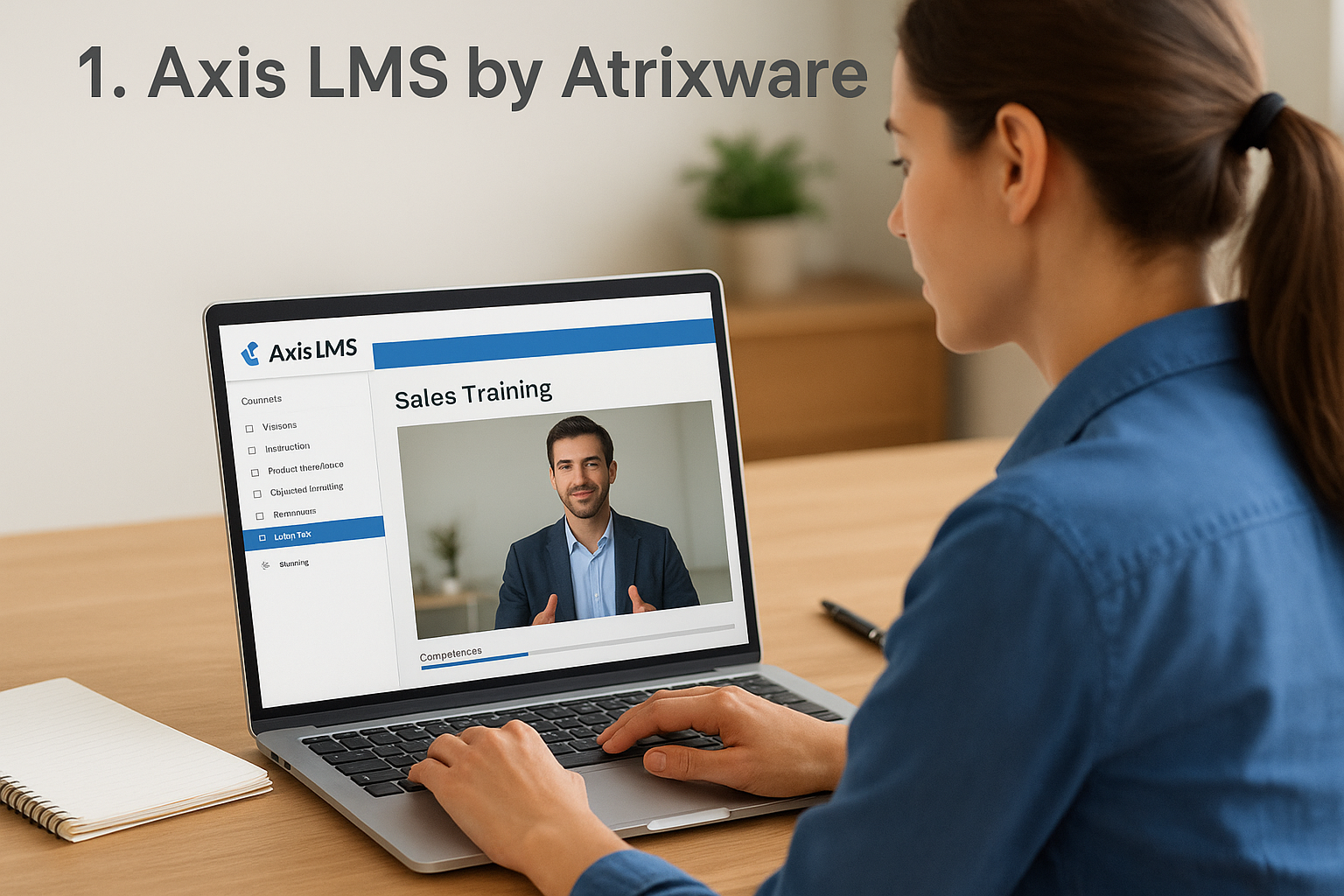
Axis LMS is a learning management system, not a content library. You build or upload your own onboarding, product knowledge, and objection-handling courses, then deliver them as self-paced lessons or virtual classroom sessions. The drag-and-drop course builder means an enablement manager can publish a new module in an afternoon, and the reporting tools show who finished what.
A sales training platform earns its cost by tracking what reps do with the training, not by holding more videos.
That is why Axis works as an online sales training platform for teams. The features around the content do the heavy lifting:
- Automated and on-demand reports on completion, scores, and progress
- Automated and real-time messages, such as reminders for reps who fall behind
- User sync with CRM and HR systems like Salesforce, ADP, BambooHR, and Zoho
- SAML SSO through Okta, Azure, and Ping Identity
- REST API and webhooks for custom workflows
Who it is best for
Sales managers, enablement leads, and training teams who answer for a group of reps get the most from it. It also suits companies that train channel partners or customers, because you can brand the portal to match your company and keep audiences separate.
It is overkill for a lone rep who wants a free certificate. If that is you, the courses later in this list fit better. If you run a team of 10 or 10,000, a system with reporting and CRM sync is the better starting point.
Pricing and certification options
Axis LMS is a paid platform, and pricing depends on your setup, so you need to request a quote from Atrixware. There is no free tier. Plan for the cost of building or licensing your own sales content as well.
On certification, you control the program. You can issue completion certificates, track Continuing Education Units (CEUs), and set re-certification reminders so reps refresh their skills on a schedule. Compliance features cover standards such as GDPR and FDA 21 CFR Part 11, which matters if you sell in regulated industries. The built-in e-commerce tools also let you sell your own training to individuals or as seat licenses to business buyers.
Pros and limitations
The strengths are clear. You get full control of branding and content, deep reporting, and integrations with a very wide range of systems, including more than 5,000 through the integration builder. Atrixware also offers custom integration services if your stack is unusual. Administrators and learners both get an interface that is easy to pick up.
The limitations are just as clear. Axis LMS does not ship with a ready-made sales curriculum, so someone has to create or source the content. It is also more than a solo seller needs. If you want a finished course with a famous name on the certificate, pair Axis with a content provider from this list, or start with one of the options below.
2. Highspot
What it offers for sales training
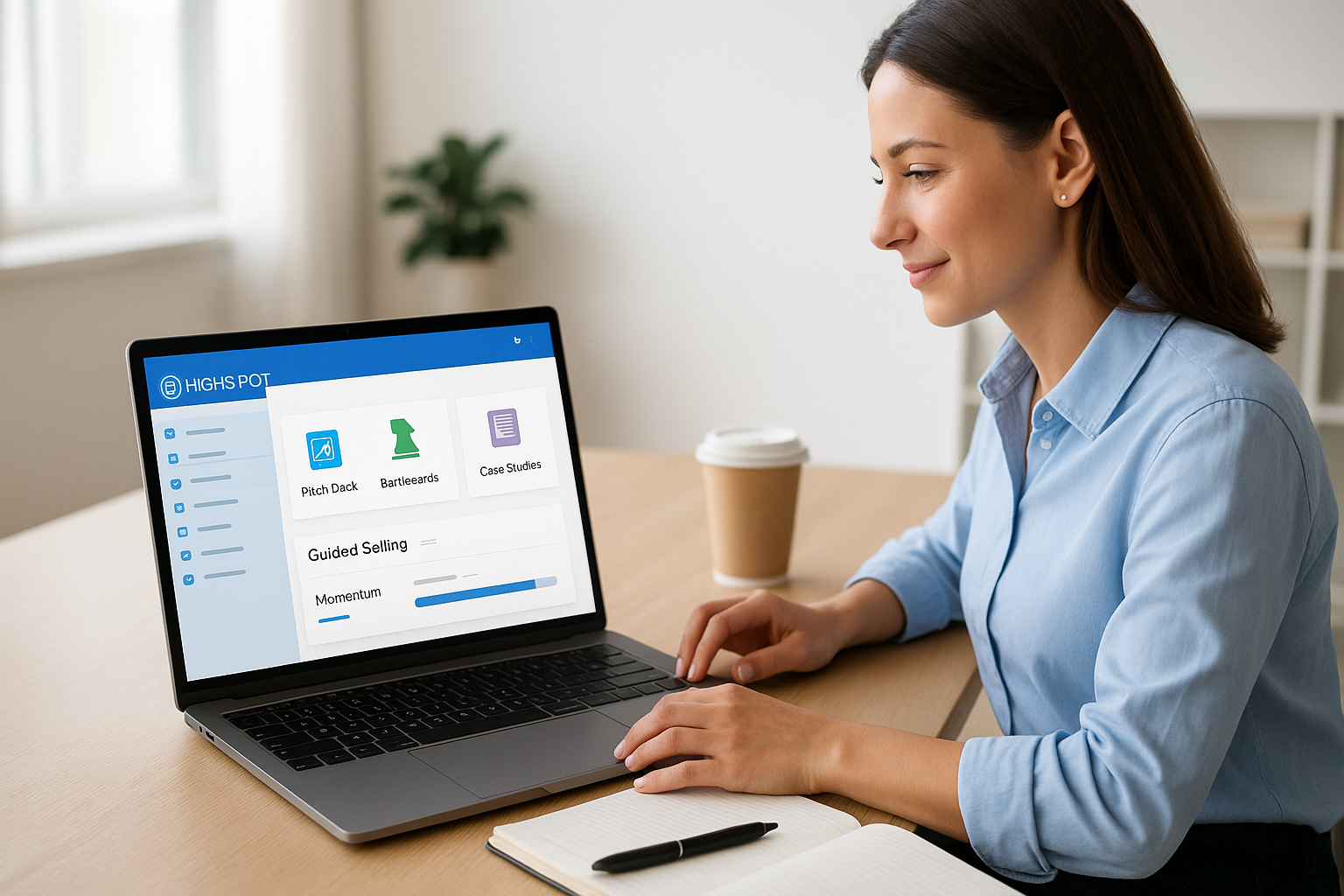
Highspot is a sales enablement platform, and training is one piece of a larger toolset. Reps find pitch decks, battlecards, and case studies in one workspace, and managers attach lessons, quizzes, and coaching tasks to the same place. Its guided selling "plays" bundle the right content and training for each deal stage, so a rep gets help while working an opportunity instead of logging into a separate portal.
Highspot trains reps inside the selling workflow, which is its biggest strength and the reason it is not a general course library.
Analytics show which content reps use and which assets show up in won deals. Practice tools let reps record a pitch for manager feedback, which makes coaching easier to scale across a distributed team.
Who it is best for
Mid-size and enterprise B2B sales organizations get the most value. You should already have a CRM such as Salesforce or Microsoft Dynamics, a large pile of sales content, and a dedicated enablement team to manage it. Without that team, the platform tends to go stale.
It is a poor match for beginners, solo sellers, or anyone who wants to learn sales fundamentals. Highspot organizes and delivers what you already have. It does not teach prospecting from scratch.
Pricing and certification options
Highspot does not publish prices. You request a quote, and costs depend on seat count and which modules you add. Expect annual contracts priced per user, and no free tier. Budget for implementation time as well.
For certification, there is no recognized sales credential for learners. You can build internal quizzes and completion tracking, but if you want a certificate with an outside name on it, the Coursera and LinkedIn Learning entries below are better fits.
Pros and limitations
Here is how it stacks up:
- Pro: Training lives next to the content reps use every day
- Pro: Strong analytics tying content to deal activity
- Pro: Deep CRM and collaboration tool integrations
- Limit: Premium, quote-only pricing that suits larger budgets
- Limit: Light on structured courses, grading, and compliance tracking
- Limit: Needs ongoing admin effort to stay useful
If you need formal courses, certificates, and detailed learner reports, an LMS covers that gap better than an enablement tool.
3. Coursera
What it offers for sales training
Coursera hosts university and company-built courses on selling, negotiation, and sales operations. You can take a single course, a multi-course specialization, or a Professional Certificate. Most run four to six weeks at a few hours per week, with video lessons, quizzes, and peer-graded assignments. The content leans toward frameworks and theory rather than live role play.
Coursera gives you a recognized name on your resume, but it will not coach you through a real sales call.
Who it is best for
Beginners, career changers, and individual reps who want structured learning with a credential get the most from it. It also works when a manager wants to hand a new hire a self-study path before they join live training. Teams that need to prove completion to leadership will want more control over content and reporting than Coursera for Business offers, because it is not built around your own sales playbook.
Pricing and certification options
Coursera is one of the easiest places to try free sales training with certification options, though the free tier has limits. Here is how the main routes compare:
| Option | Typical cost | Certificate |
|---|---|---|
| Audit a course | Free on many courses | No |
| Single course or specialization | Paid monthly subscription | Yes |
| Coursera Plus | Roughly $59 per month or $399 per year | Yes |
| Coursera for Business | Quote-based, per seat | Yes |
Prices change, so confirm them at checkout. Financial aid is available on many courses if you qualify. Auditing gives you the lessons, but you need a paid plan to get graded work and the shareable certificate.
Pros and limitations
The upside is strong brand credibility and a huge catalog. The downside is that nothing here is tailored to your product, your buyers, or your sales process.
- Pro: Certificates from recognized universities and companies
- Pro: Free audit option for low-risk learning
- Pro: Flexible, self-paced schedules
- Limit: Generic content, not your playbook
- Limit: Little hands-on coaching or role play
- Limit: Completion rates drop without manager follow-up
If you want a credential for yourself, Coursera is a smart pick. If you want to change how a team sells, you still need a system to assign, track, and reinforce the training.
4. LinkedIn Learning
What it offers for sales training
LinkedIn Learning is a video course library with a deep sales section. You will find courses on cold calling, discovery, negotiation, social selling, and CRM basics, usually 30 to 90 minutes each and taught by working practitioners. Learning paths string courses together, such as a sales foundations track for new reps.
LinkedIn Learning is a fast way to cover sales basics, but it teaches general concepts, not your company’s way of selling.
Social selling is where it stands out. Lessons connect directly to your LinkedIn profile, outreach, and prospect research.
Who it is best for
Beginners and individual reps get the most value. As a beginner-friendly online sales training platform, it lets you sample topics cheaply before you commit to a longer program. Self-motivated learners can build a broad skill base in a few weeks.
Teams can use it as a supplement. The business plan adds assignment and reporting features, but you cannot build your own product training or sales playbook inside it.
Pricing and certification options
Individuals pay a monthly or annual Premium subscription, and new users usually get a one-month free trial. Many public libraries and some employers also provide free access, so check before you pay. Prices change, so confirm them at checkout.
| Option | Typical cost | Certificate |
|---|---|---|
| Free trial | Free for one month | Yes, while active |
| Individual subscription | Roughly $30 to $40 per month | Yes |
| LinkedIn Learning for business | Quote-based, per seat | Yes |
The certificate is a completion certificate you can add to your profile. It shows you finished a course, not that you passed an accredited exam.
Pros and limitations
The appeal is low cost, broad coverage, and a simple, polished interface. The weak spots appear when you need rigor or customization.
- Pro: Large catalog with frequent updates
- Pro: Easy to share certificates on your profile
- Pro: Cheap way to test topics before buying deeper programs
- Limit: Passive video, with little practice or role play
- Limit: No custom content, branding, or compliance tracking
- Limit: Certificates carry less weight than a university credential
If you want reps to practice and be measured, pair it with a system that tracks results.
5. Udemy
What it offers for sales training
Udemy is an open marketplace where independent instructors publish thousands of sales courses. You will find cold calling, B2B prospecting, closing techniques, sales scripts, and CRM tutorials, from 2-hour primers to 15-hour deep dives. Lessons are pre-recorded video with downloadable templates and the occasional quiz.
Because anyone can publish, quality swings wildly. Check the rating, review count, and last-updated date before you buy. A course with 4.5 stars, thousands of reviews, and a recent update is a safe bet.
On Udemy, the instructor matters more than the platform, so vet the course before you pay.
Who it is best for
Beginners and budget-conscious reps get the most from it. If you want to learn one specific skill, such as email outreach or handling price objections, a focused course beats a broad curriculum. It is also a solid way to sample a sales method before paying for a premium program.
Managers can use Udemy Business for a curated team library. Still, you cannot build your own playbook inside it, and reporting is basic. As an online sales training platform for a full team, it works best as a supplement.
Pricing and certification options
Most courses are a one-time purchase with lifetime access, and Udemy runs frequent sales that bring prices down to roughly $15 to $20. A handful of free sales training courses exist too, though they tend to be short introductions. Prices change, so confirm them at checkout.
| Option | Typical cost | Certificate |
|---|---|---|
| Free courses | $0 | Limited, varies by course |
| Single paid course | Roughly $15 to $20 on sale, more at list price | Yes |
| Udemy Business | Quote-based, per seat | Yes |
The certificate is a completion certificate, not an accredited credential. It shows you finished the videos, and employers will read it that way. Udemy offers a 30-day refund window on most purchases.
Pros and limitations
Udemy wins on price and variety, and it loses on consistency and depth.
- Pro: Very low cost per course, with lifetime access
- Pro: Narrow, practical topics you can finish in a weekend
- Pro: Refund window lowers the risk of a bad pick
- Limit: Uneven instructor quality
- Limit: No live coaching, role play, or manager feedback
- Limit: Certificates carry little weight outside your own profile
6. RAIN Group
What it offers for sales training
RAIN Group is a sales training and consulting firm, not a course marketplace. Its programs rest on original buyer and seller research, and they cover prospecting, consultative selling, negotiation, and sales management. You get them as live virtual or in-person workshops, with online reinforcement between sessions so reps keep practicing.
RAIN Group sells a behavior change program, so you pay for coaching and practice, not for a library of videos.
Free content adds value too. Its research reports, webinars, and podcast give beginners a useful look at the method before anyone signs a contract.
Who it is best for
Mid-size and enterprise B2B teams get the most from it. Sales leaders who want to change how a whole team sells, and who can spare reps for workshop time, are the target buyer. It also suits managers who want coaching skills built in alongside rep training.
It is a poor fit for a beginner on a tight budget. If you want a low-cost online sales training platform to learn the basics on your own, start with the earlier entries.
Pricing and certification options
RAIN Group does not publish program prices. Costs depend on team size, program, and delivery format, so expect a custom quote and a sales conversation. Confirm current details with the company.
| Option | Typical cost | Certificate |
|---|---|---|
| Research, webinars, podcast | Free | No |
| Team workshops | Quote-based | Completion, varies by program |
| Facilitator certification | Quote-based | Yes, to teach the content in-house |
Its certification is aimed at internal trainers who license the content, not at individual learners wanting a resume credential.
Pros and limitations
- Pro: Methodology backed by research, not opinion
- Pro: Live practice and coaching, which videos cannot match
- Pro: Free resources let you test the approach first
- Limit: Premium, quote-only pricing
- Limit: Needs scheduled time away from selling
- Limit: Not a platform for tracking, reporting, or hosting your own courses
That last gap is common with training providers. You can pair the workshops with an LMS to assign follow-up lessons and measure results.
7. Sandler Training
What it offers for sales training
Sandler Training teaches a behavior-based selling method that David Sandler developed in 1967. Two ideas define it. Up-front contracts set expectations at the start of every call, and the pain funnel is a question sequence that uncovers the buyer’s real problem before you pitch. Delivery runs through local franchise centers, in person or virtual, with online modules and coaching between sessions.
Sandler teaches reps to qualify hard and pitch late, so they stop chasing deals that were never going to close.
Free material gives newcomers a way in. The company’s podcast, blog, and webinars let you test the approach before anyone asks for a contract. For a beginner shopping for an online sales training platform, that is a useful preview, but it is not the full program.
Who it is best for
Small and mid-size B2B teams with long, consultative sales cycles get the most from it. It suits owners and sales leaders who want a shared selling language across the team and are willing to schedule regular coaching time.
It is a weak match for solo beginners who want self-paced lessons on their own schedule. It also does not host your own content, so you cannot build product training inside it.
Pricing and certification options
Sandler publishes no standard price list. Each franchise sets its own fees, so you should request quotes from local centers and compare. Expect per-person or per-team programs that run for several months.
| Option | Typical cost | Certificate |
|---|---|---|
| Podcast, blog, webinars | Free | No |
| Team or individual programs | Quote-based, set by franchise | Completion, varies by center |
| Trainer certification | Quote-based | Yes, to deliver the method in-house |
Confirm current details with your local center before you commit.
Pros and limitations
The main strength is a proven method with live coaching. The main drawback is inconsistent pricing and delivery from one franchise to the next.
- Pro: Clear, repeatable framework for qualifying and questioning
- Pro: Live practice and accountability that videos cannot give you
- Pro: Free resources to test the style first
- Limit: Quote-only pricing and uneven experience by location
- Limit: Needs sustained time commitment from reps
- Limit: No built-in tracking, reporting, or custom course hosting
8. Dale Carnegie
What it offers for sales training
Dale Carnegie Training has taught communication skills since 1912, and its sales courses grow out of that base. The focus is building trust, listening, and persuasion rather than a rigid sales process. You can take programs in person, as live instructor-led online sessions, or in blended formats with online practice between classes.
Dale Carnegie teaches reps how to connect with buyers, which matters most when the sale rests on trust.
Sessions are practice-heavy. You present, get feedback, and try again, which helps people who freeze on calls. Think of it as coaching delivered online, not a self-service library.
Who it is best for
Reps and managers who struggle with confidence, presentation skills, and rapport get the most value. It also suits leaders who want sales training bundled with broader communication and leadership development.
Skip it if you need product training, CRM-linked tracking, or a cheap beginner course. The programs are not built around your own playbook, and you cannot host custom content inside them.
Pricing and certification options
Dale Carnegie does not publish a flat price list for most programs. Costs vary by format, location, and team size, so request a quote from your local franchise. Public classes typically run in the thousands of dollars per person. Confirm current details before you commit.
| Option | Typical cost | Certificate |
|---|---|---|
| Books and blog content | Free to low cost | No |
| Public instructor-led course | Quote-based, often thousands per person | Completion |
| Corporate team program | Quote-based | Completion, varies by program |
The certificate shows attendance and completion, not an accredited credential. Still, the well-known name carries weight on a resume, especially for client-facing roles.
Pros and limitations
The strength is live practice with real feedback. The weakness is cost and a general focus that does not map to your product or pipeline.
- Pro: Strong on rapport, listening, and presenting
- Pro: Instructor feedback that videos cannot replace
- Pro: Recognizable brand for certificates
- Limit: High price compared with self-paced courses
- Limit: Experience varies by franchise and instructor
- Limit: No built-in reporting or custom course hosting
If you want to track who attended and what changed afterward, pair the classes with a system that records results.
9. Alison
What it offers for sales training
Alison is a free learning platform with a sales category that covers sales fundamentals, sales management, negotiation, and customer service. Lessons are self-paced text and video, followed by a scored assessment. Certificate courses take roughly one to three hours, and diploma courses run longer.
Alison lets you learn sales for free, and you only pay if you want the certificate.
The platform is ad-supported, and course quality depends on the publisher. Read the syllabus and learner ratings before you start, so you do not spend an evening on a thin course.
Who it is best for
Students, job seekers, and new reps who want free sales training and a credential for their resume get the most from it. It is also a low-risk way to test whether a sales career suits you. Managers can point new hires to it for basic vocabulary and concepts before live training begins.
As an online sales training platform for a team, it falls short. You cannot upload your own content or build a playbook, and reporting is minimal.
Pricing and certification options
Learning is free. Payment applies only to certificates. Expect to pass each assessment with about 80 percent to qualify. Prices change, so confirm them at checkout.
| Option | Typical cost | Certificate |
|---|---|---|
| Course lessons | Free, ad-supported | No |
| Digital certificate | One-time fee per course, roughly $20 to $40 | Yes |
| Printed certificate or diploma | Higher fee plus shipping | Yes |
| Ad-free Premium plan | Monthly or annual subscription | Varies by plan |
Treat the certificate as proof of completion, not an accredited qualification.
Pros and limitations
Alison wins on price and access. It loses on depth and recognition.
- Pro: Free lessons with no credit card needed
- Pro: Short, beginner-friendly courses you can finish quickly
- Pro: Optional certificate at a modest cost
- Limit: Uneven course quality and ads throughout
- Limit: No coaching, role play, or custom content
- Limit: Certificates carry less weight than a university credential
10. Action Selling
What it offers for sales training
Action Selling is a sales methodology and training program built around a defined, repeatable process. Reps learn a consistent way to plan calls, ask questions, and guide buyers toward a decision instead of pitching features. Delivery usually blends instructor-led workshops, virtual sessions, and online reinforcement, so skills get practiced after the class ends.
Action Selling gives a team one shared process, and a shared process is what makes sales coaching repeatable.
The method is the product here. You get a framework and practice, not a library of unrelated videos.
Who it is best for
Sales leaders who want every rep following the same process get the most from it. It suits small and mid-size B2B teams and managers who plan to coach to a defined method. Teams that already run inconsistent pipelines, where each rep sells their own way, see the clearest gains.
Beginners shopping for a low-cost online sales training platform will find it a poor fit. It is sold to organizations, so it requires a team commitment and a manager willing to reinforce it.
Pricing and certification options
Pricing is not published, so plan on a custom quote based on team size, format, and reinforcement options. There is no free tier for individuals. Confirm current details with the company before you budget.
| Option | Typical cost | Certificate |
|---|---|---|
| Team workshops and online reinforcement | Quote-based | Completion, varies by program |
| Facilitator or trainer certification | Quote-based | Yes, to teach the method in-house |
The credentials are aimed at internal trainers and company programs, not at learners who want a resume line.
Pros and limitations
The strength is a clear process that managers can coach to. The weakness is that it is a method, not a system for running your training.
- Pro: One shared selling process across the whole team
- Pro: Live practice and reinforcement, not passive video
- Pro: Works well alongside your CRM and sales stages
- Limit: Quote-only pricing and no individual option
- Limit: Needs scheduled rep time and manager follow-through
- Limit: No hosting for your own courses, branding, or detailed learner reports
That last gap is where an LMS helps. Use one to assign follow-up lessons and track completion after each workshop.
11. The Brooks Group
What it offers for sales training
The Brooks Group is a sales training and consulting firm founded in 1977 in North Carolina. Its flagship is IMPACT Selling, a process-based method covering prospecting, discovery, presenting, and closing. Programs run as virtual or in-person workshops, with online learning, assessments, and coaching between sessions. It also trains sales managers, which many providers skip.
The Brooks Group trains the manager as well as the rep, and that is where most sales training programs quietly fail.
Free blog posts, webinars, and a podcast let you sample the approach before you talk to anyone.
Who it is best for
Small and mid-size B2B teams that want a repeatable sales process and a coaching habit get the most from it. It fits sales leaders who can schedule workshop time and will reinforce the method afterward.
Beginners should look elsewhere. For a low-cost online sales training platform to learn the basics on your own, the earlier entries such as Alison or Udemy are a better start. The Brooks Group is sold to organizations, and it does not host your own courses.
Pricing and certification options
Brooks Group does not publish a price list. Expect a custom quote based on team size, program, and delivery format. Confirm current details with the company before you budget.
| Option | Typical cost | Certificate |
|---|---|---|
| Blog, webinars, podcast | Free | No |
| Team sales programs | Quote-based | Completion, varies by program |
| Manager or trainer programs | Quote-based | Varies by program |
Certificates mark completion of company programs, not an accredited credential.
Pros and limitations
The strength is a structured method for reps and managers. The weakness is that it delivers training, not a system to run it.
- Pro: Clear process that managers can coach against
- Pro: Manager-focused training, not only rep courses
- Pro: Free resources to test the style first
- Limit: Quote-only pricing and no individual option
- Limit: Needs scheduled rep time and manager follow-through
- Limit: No custom course hosting, branding, or detailed learner reports
Pairing the workshops with an LMS lets you assign follow-up lessons and track completion.
12. Salesforce Trailhead
What it offers for sales training
Trailhead is Salesforce’s free learning platform, and its sales content centers on Sales Cloud and the sales process. You work through short modules grouped into trails, covering lead management, opportunity tracking, forecasting, and pipeline reviews. Hands-on challenges run in a free practice org, so you click through real screens instead of watching a demo.
Trailhead teaches you to sell with Salesforce, not how to sell, and that difference decides whether it fits you.
Every completed module earns a badge, which gives self-paced learners visible, checkable progress. For discovery, negotiation, and objection handling, pair it with one of the selling-skills programs above.
Who it is best for
Reps, managers, and new hires at companies that already run Salesforce get the most value. You learn the exact tool you will use daily, which shortens ramp-up time for new sellers. Admins and operations staff also benefit, since the same platform covers configuration.
It is a poor choice if your CRM is HubSpot or Microsoft Dynamics. It also falls short as a full online sales training platform for a team, because you cannot host your own playbook, and reporting on rep progress is limited.
Pricing and certification options
Most of Trailhead costs nothing. Modules, badges, and the practice org are free, and you pay only for instructor-led classes or formal exams. Prices change, so confirm them with Salesforce.
| Option | Typical cost | Certificate |
|---|---|---|
| Modules, trails, and practice org | Free | Badges and ranks |
| Trailhead Academy classes | Paid, per course | Completion |
| Salesforce certification exams | Exam fee, set by Salesforce | Yes, official credential |
The badges are proof of completion, while a passed exam is a recognized Salesforce credential that carries weight with employers who run the platform.
Pros and limitations
Trailhead wins on price and relevance to Salesforce users. It loses on sales coaching and team management.
- Pro: Free, with hands-on practice in a real environment
- Pro: Official credentials respected by Salesforce employers
- Pro: Easy to share trails with teammates
- Limit: Teaches software skills more than selling skills
- Limit: No custom branding, content hosting, or compliance tracking
- Limit: Little value if your company uses another CRM
If you need to assign your own lessons and measure results, an LMS fills that gap.
Choosing the right fit for your sales team
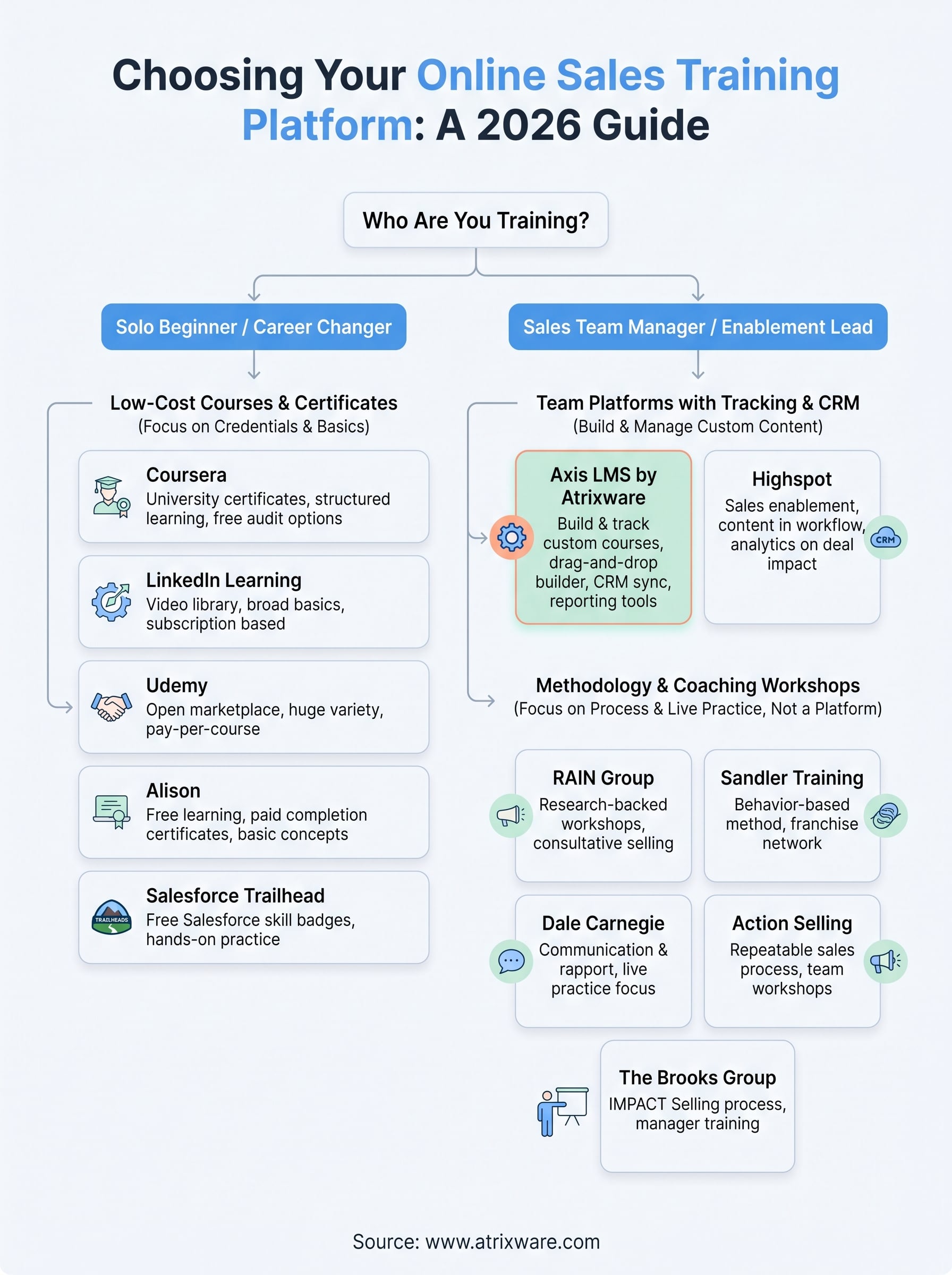
The best online sales training platform depends on who you are training and what you need to measure. Beginners and solo sellers do well with Coursera, LinkedIn Learning, Udemy, Alison, or Trailhead, where free or low-cost courses come with certificates. Teams that want a shared selling method should look at RAIN Group, Sandler, Dale Carnegie, Action Selling, or The Brooks Group.
Content is only half the job, though. Reps need assignments, reminders, and reports to turn lessons into results, and most providers on this list leave that gap open. A learning management system closes it, and it also hosts the playbook that is yours alone.
Ready to see where you stand? Take the LMS readiness assessment to find out which stage of the buying process you are in and what to look at next.
