Most companies say training matters, then treat it like an afterthought squeezed into onboarding week and forgotten after that. If your employees are stuck with outdated skills, compliance gaps, or a revolving door of new hires who never quite ramp up, the problem usually traces back to a weak or missing training strategy, not a lack of effort from your team.
Corporate training development is the structured process of building, delivering, and measuring the learning programs that keep your workforce capable and compliant. Done right, it covers everything from new hire onboarding to leadership development, product knowledge, and regulatory requirements like GDPR or FDA 21 CFR Part 11. Done poorly, it becomes a checkbox exercise that nobody remembers a month later.
This article breaks down what corporate training and development actually involves, why it directly affects retention and revenue, and what real programs look like in practice. You’ll see concrete examples across employee, customer, and compliance training, along with the key benefits organizations report once they build a real program. We’ll also cover what to look for in training providers and platforms so you can move from theory to something your team will actually use.
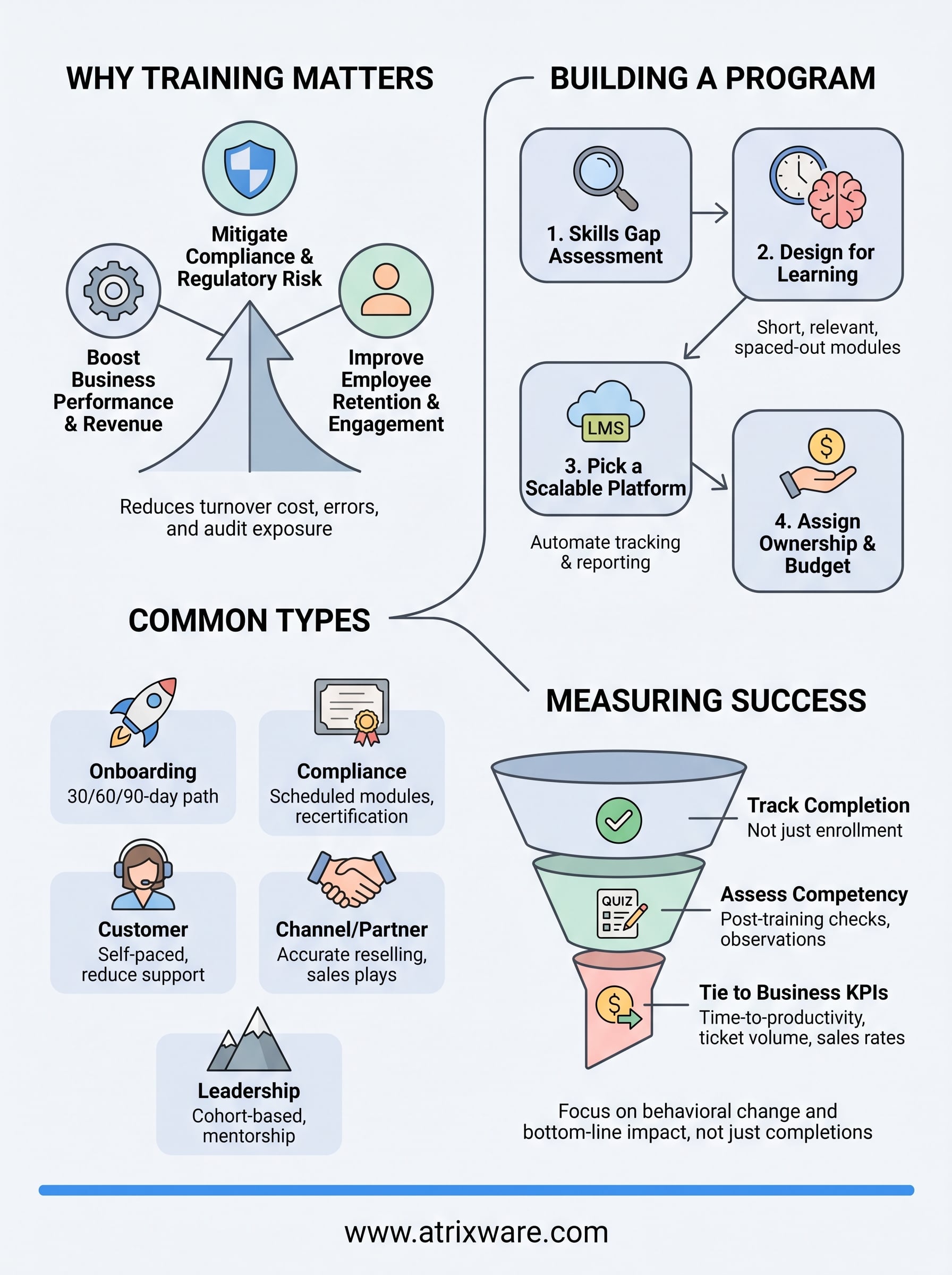
Why corporate training and development matters
A workforce that never grows becomes a liability, not an asset. Corporate training and development isn’t a nice-to-have HR initiative, it’s the mechanism that keeps your people capable of doing the job you actually need them to do six months or two years from now. Skip it, and you end up paying for the gap in other ways: slower onboarding, more errors, higher turnover, and compliance exposure that surfaces at the worst possible time.
Turnover and the cost of undertrained employees
New hires who don’t get structured onboarding take longer to become productive, and many leave before they ever hit full speed. Employee training programs that map out the first 30, 60, and 90 days give people a clear sense of what’s expected and how they’re progressing. Without that structure, managers end up training informally and inconsistently, which means quality varies wildly depending on who happened to show a new hire the ropes, and the true cost of poorly trained workers shows up in errors, rework, and early exits.
A company that trains its people well rarely loses them to a competitor who trains better.
Compliance risk and regulatory exposure
If your organization operates under regulations like GDPR, HIPAA, OSHA, or FDA 21 CFR Part 11, training isn’t optional, it’s documentation you need to produce if an auditor or regulator ever asks. A missed certification renewal or an untracked completion record can turn into fines, legal exposure, or a failed audit. This is where an LMS built for regulatory training earns its keep: automated reminders, recertification schedules, and audit-ready reports that prove your team did what the regulation requires, not just that you assume they did.
Employee engagement and retention
People want to grow, and a job that offers no path forward pushes your best performers toward the exit. Organizations that invest in learning and development consistently report stronger engagement scores and lower voluntary turnover, because employees see a future for themselves inside the company instead of outside it. This matters most with your highest performers, the ones who have options elsewhere and will use them if they feel stagnant, which is why training is closely tied to employee retention.
Direct impact on business performance
Training also shows up on the balance sheet, even if it takes longer to trace than a marketing campaign or a sales push. Sales teams that get regular product training close more deals and make fewer promises the product can’t keep. Customer support teams that understand the product deeply resolve tickets faster and escalate less. Channel partners who complete structured training sell your product more accurately and with less hand-holding from your team. None of this happens by accident, and none of it happens with a single onboarding session that never gets revisited.
The common thread across all four of these areas is that workforce training works best when it’s continuous, tracked, and tied to a real business outcome, not treated as a one-time event. Companies that get this right build training into the operating rhythm of the business, the same way they build in performance reviews or quarterly planning. The ones that don’t tend to rediscover the cost of skipping it, usually during an audit, a bad quarter, or an exit interview.
How to build an effective corporate training program
Building a real corporate training program starts before you write a single course. Most failed programs skip straight to content creation without first figuring out what gap they’re actually trying to close. Get the foundation right, and the rest of the process gets a lot easier.
Start with a skills gap assessment
Talk to managers, review performance data, and look at where errors, complaints, or missed targets keep showing up. That pattern tells you exactly where training and development needs to focus, instead of guessing based on what worked at your last company. Skipping this step is how organizations end up with generic courses nobody needed, since a training needs analysis is what points design at a real gap.
A training program built without a needs assessment is just content looking for a problem.
Design for how people actually learn
Adults retain more when training is short, relevant, and spaced out rather than delivered in one long session, which is the case for microlearning in corporate training. Build your program around these principles:
- Break content into modules under 15 minutes
- Mix formats: video, quizzes, live virtual sessions
- Reinforce with follow-up assessments 30 and 60 days later
- Let managers assign role-specific paths instead of one-size-fits-all courses
This approach keeps completion rates higher and prevents the information dump that employees forget within a week.
Pick a platform that can scale with you
Your delivery platform determines whether any of this holds together at scale. A learning management system like Atrixware’s Axis LMS lets you build courses with a drag-and-drop interface, automate enrollment and reminders, and pull reporting that shows exactly who completed what and when. Without a system like this, tracking falls apart the moment you go past a handful of employees, and compliance documentation becomes a manual scramble instead of an automatic report.
Assign ownership and a budget
A program with no owner drifts. Assign someone accountable for outcomes, not just course creation, and give them a real budget for content, tools, and time. Programs that survive past year one are the ones treated as an ongoing operational function, not a project that wraps up once the initial rollout is done.
Common types of corporate training programs
Not all training serves the same purpose, and lumping every program under one label is how companies end up with a bloated course catalog nobody uses. Corporate training development breaks down into distinct categories, each targeting a different business outcome, from ramping up new hires to keeping channel partners accurate on product details.
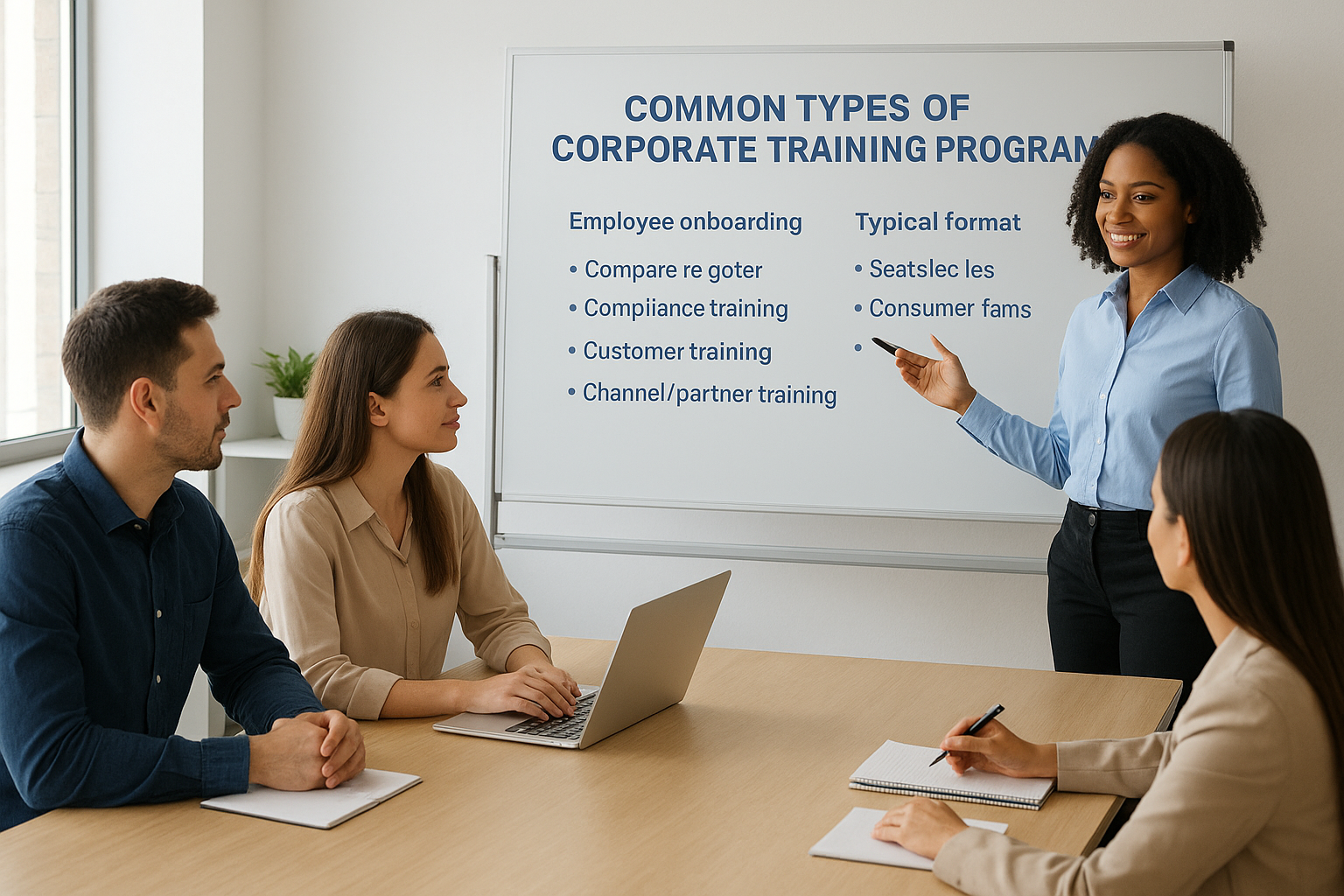
| Program type | Primary goal | Typical format |
|---|---|---|
| Employee onboarding | Get new hires productive fast | Structured 30/60/90-day path |
| Compliance training | Meet regulatory requirements | Scheduled modules, recertification |
| Customer training | Reduce support load, boost adoption | Self-paced courses, certifications |
| Channel/partner training | Accurate reselling, less hand-holding | Product courses, sales playbooks |
| Leadership development | Build internal bench strength | Cohort-based, mentorship-driven |
Employee and compliance training
Onboarding and staff training software anchor most corporate learning strategies because they directly shape how fast someone becomes useful on the job. Compliance training runs on a different clock entirely, driven by renewal dates and audit cycles rather than a new hire’s calendar, which is why it needs automated tracking instead of a manual checklist someone eventually forgets to update.
Skip compliance training and you’re not gambling with a fine, you’re gambling with your ability to prove you did the training at all.
Customer and channel training
Selling training to customers turns your product documentation into a revenue stream instead of a support cost, and it’s a use case Axis LMS supports directly through its e-commerce and seat-licensing features. Training your customers online cuts support tickets because users who complete a course understand the product before they ever open a help ticket. Reseller and distributor training follows the same logic from the other direction: partners who complete structured courses represent your product more accurately, which means fewer escalations and fewer deals lost to a reseller who guessed wrong on a spec sheet.
How to measure training and development success
Measuring corporate training development starts with picking metrics that connect to a business outcome, not just a completion percentage that looks good in a slide deck. A course finished isn’t the same as a skill gained, and organizations that confuse the two end up celebrating numbers that don’t move the needle on turnover, errors, or revenue.

Track completion and competency, not just enrollment
Enrollment tells you who signed up. Completion tells you who finished. Neither tells you whether the training actually changed behavior on the job. Pair completion data with post-training assessments, manager observations, or on-the-job error rates so you can see whether the learning and development effort produced a real skill, not just a certificate.
A completion rate only proves someone clicked through the course, not that they learned anything from it.
Tie training data to business KPIs
Good reporting connects training records to the metrics leadership already cares about:
- Time-to-productivity for new hires
- Support ticket volume after customer training rollouts
- Audit pass rates for compliance-driven courses
- Sales close rates following product training refreshers
When you can show a manager that a training cohort closed 15% more deals or cut ticket volume by a third, training stops being a cost center and starts being a business case, which is the whole point of aligning learning with bottom-line performance.
Use reporting tools instead of manual tracking
Spreadsheets break down fast once you’re managing hundreds of learners across multiple programs. Atrixware’s Axis LMS training reports and analytics generate on-demand and automated reports that show exactly who completed what, when certifications expire, and where completion rates are lagging by department or role. That kind of visibility turns training and development from a guessing game into something you can defend in front of an auditor or a budget committee.
Without this layer of measurement, most programs drift into anecdote territory, where success gets judged by a manager’s gut feeling instead of a number anyone can point to. Build the reporting habit early, and every future training decision gets easier to justify.
Making learning a business priority
Good corporate training development isn’t a single course launch or an onboarding packet you hand out once. It’s a system: a real needs assessment, a platform that tracks completions automatically, and reporting that ties learning back to turnover, compliance, and revenue. Skip any one of those pieces and you’re left with a program that looks good on paper but can’t prove it works when someone asks.
Treat training the way you treat any other operational function, with an owner, a budget, and metrics you check regularly, and it stops being a cost you tolerate and starts becoming a reason employees stay, customers succeed, and audits pass without a scramble. If you’re still running this off spreadsheets and manual reminders, that gap gets more expensive every quarter you wait.
Curious where your organization actually stands? Find out how ready you are for an LMS and see what your next step should be.
