
Corporate training is how organizations systematically educate employees to develop skills, expand knowledge, and improve job performance. It covers everything from onboarding new team members and teaching technical competencies to ensuring regulatory compliance and cultivating leadership talent. The fundamental goal is clear: bridge the gap between what your workforce can do today and what your business needs to achieve tomorrow.
Most organizations invest heavily in training programs, yet many struggle to see meaningful returns. The difference between effective training and wasted resources comes down to understanding core principles and executing with strategy. This guide breaks down everything essential about corporate training, explaining why it drives competitive advantage, how to design programs that engage learners and produce tangible results, what types and formats work across different industries, and proven methods for measuring actual impact. Whether you’re building your first training initiative or refining what already exists, you’ll gain actionable frameworks to create learning experiences that stick with employees and deliver measurable business outcomes.
Why corporate training matters
Your business faces constant pressure from competitors, evolving technologies, and shifting market demands. Corporate training directly impacts your ability to respond to these challenges by ensuring your workforce possesses the capabilities needed to execute strategy and drive results. Organizations that prioritize employee development consistently outperform those that don’t, achieving higher productivity, stronger innovation, and better financial outcomes. The corporate training definition extends beyond simple skill transfer; it represents a strategic investment in your organization’s capacity to compete and grow.

Business performance and competitive advantage
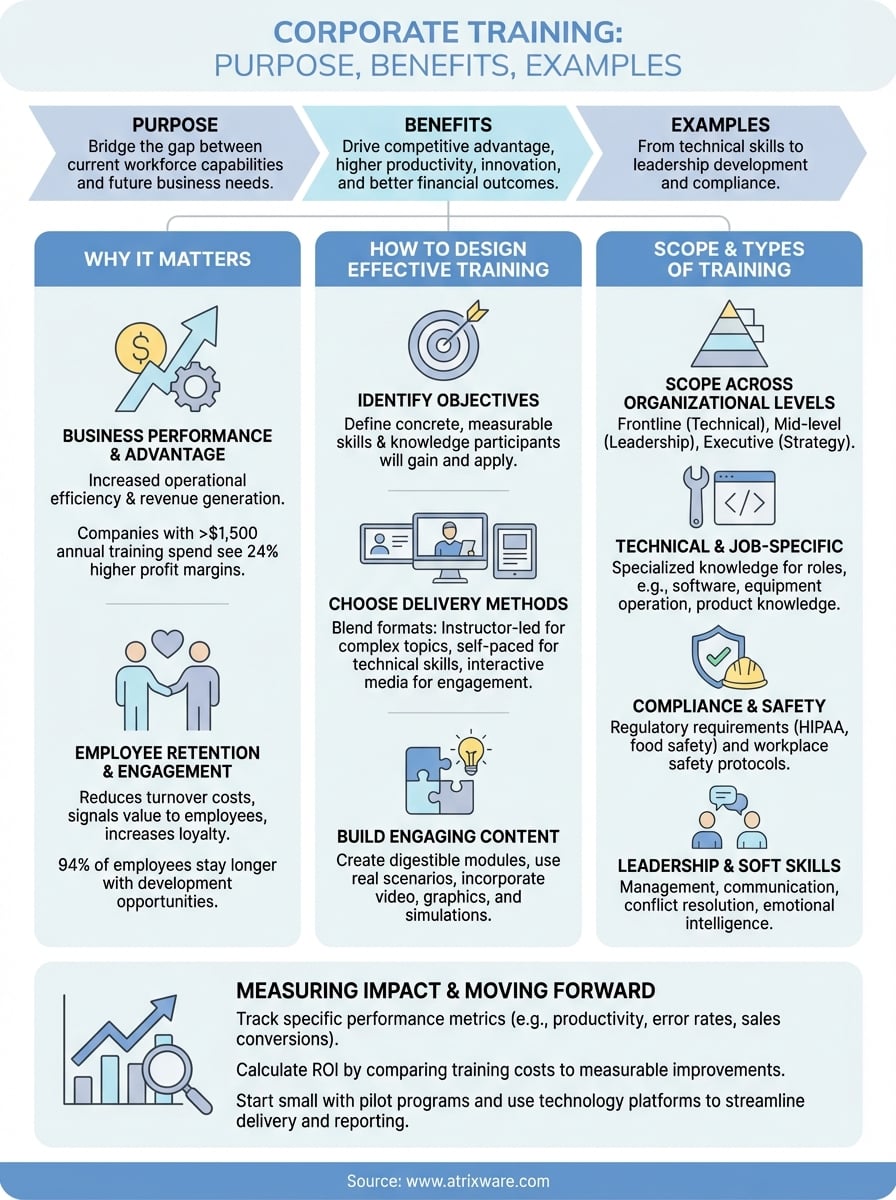
Training programs create measurable improvements in operational efficiency and revenue generation. When you equip employees with current knowledge and best practices, they complete tasks faster, make fewer errors, and identify opportunities for improvement. Your organization gains flexibility to adopt new technologies and methodologies because your workforce already possesses the foundational skills to adapt quickly. Companies that invest at least $1,500 per employee annually in training see 24% higher profit margins compared to those spending less, according to research from the Association for Talent Development.
Training transforms your workforce from maintaining current operations to driving strategic initiatives forward.
Employee retention and engagement
Talented professionals expect continuous learning opportunities as part of their employment experience. You reduce turnover costs significantly when you demonstrate commitment to employee growth through structured training programs. Workers who receive regular development opportunities are 94% more likely to stay with your organization longer, directly reducing recruitment and onboarding expenses. Development initiatives signal that you value employees as long-term assets rather than replaceable resources, which strengthens loyalty and increases discretionary effort across your teams.
How to design effective corporate training
Effective training programs start with deliberate design decisions that align learning activities with business outcomes. You need a structured approach that considers your workforce’s current capabilities, identifies specific performance gaps, and creates measurable paths to improvement. Too many organizations rush into training without clear objectives, resulting in disengaged learners and wasted resources. The process requires careful planning across multiple dimensions, from selecting content and delivery methods to measuring effectiveness and iterating based on results.
Identify specific learning objectives
Start by defining exactly what employees should accomplish after completing training, using concrete, measurable terms rather than vague aspirations. Your objectives should answer three questions: What specific skills or knowledge will participants gain? How will they apply these capabilities in their daily work? What business metrics will improve as a result? Link each learning objective directly to organizational priorities, whether that means reducing compliance violations, accelerating time-to-productivity for new hires, or increasing sales conversion rates. Vague goals produce vague results, so specify the exact behaviors and outcomes you expect to see.

Choose appropriate delivery methods
Your delivery format dramatically influences training effectiveness, and no single method works for every situation. Instructor-led sessions excel when teaching complex concepts that require real-time interaction and immediate clarification. Self-paced digital courses work well for technical skills and compliance topics where employees need flexibility to learn at their own speed. Blend multiple formats to maximize engagement and retention: combine video demonstrations with hands-on practice, interactive assessments, and peer discussions. Consider your workforce’s location, schedules, and technology access when selecting platforms, ensuring training remains accessible to everyone who needs it.
The best training programs match delivery methods to content complexity and learner needs rather than defaulting to convenience.
Build engaging content
Create training materials that capture attention and facilitate actual learning rather than simply presenting information. Break content into digestible modules that employees can complete in focused sessions, typically 15 to 30 minutes each. Use real workplace scenarios and examples that mirror the challenges your teams face daily, making abstract concepts immediately relevant and practical. Incorporate varied media types including video, graphics, case studies, and interactive exercises to maintain interest and accommodate different learning preferences. Replace lengthy text blocks with conversational explanations, demonstrations, and opportunities for participants to apply new knowledge through simulations or role-playing exercises. Test your content with a small group before full deployment to identify confusing sections and technical issues.
Corporate training definition and scope
Corporate training definition encompasses any structured learning initiative that organizations deploy to develop employee capabilities, from entry-level workers to executive leadership. This includes formal programs like classroom sessions and online courses, plus informal methods such as mentoring, job shadowing, and peer-to-peer knowledge sharing. The scope extends beyond teaching job-specific tasks to include developing critical thinking, communication abilities, and leadership competencies that prepare employees for current responsibilities and future advancement. You’re not simply filling knowledge gaps; you’re building organizational capacity to execute strategy, adapt to market shifts, and maintain competitive advantage through a skilled, knowledgeable workforce.

Core components of training programs
Every effective training initiative contains three fundamental elements: content that addresses specific performance needs, delivery methods that facilitate actual learning rather than passive information consumption, and assessment mechanisms that verify knowledge transfer and skill acquisition. Your content must connect directly to workplace challenges employees face, using relevant examples and scenarios they encounter daily. Delivery formats range from synchronous instructor-led sessions that enable real-time interaction to asynchronous self-paced modules that provide flexibility for distributed teams. Assessment goes beyond simple quizzes to include practical demonstrations, simulations, and on-the-job application that confirm employees can actually perform new skills under real working conditions.
Training programs succeed when they prioritize application over information delivery.
Scope across organizational levels
Training requirements differ significantly across organizational hierarchies, demanding tailored approaches for each level. Frontline employees need technical proficiency and operational procedures to complete daily tasks efficiently. Mid-level managers require skills in team leadership, project management, and tactical decision-making that bridge strategy and execution. Executive leaders benefit from strategic thinking development, organizational change management, and industry trend analysis that informs long-term direction. Your training strategy must address all levels simultaneously while recognizing that content, delivery methods, and time commitments vary based on roles, responsibilities, and business impact.
Common types and examples of corporate training
Organizations deploy diverse training formats to address different workforce needs and business objectives. The corporate training definition includes both mandatory programs like compliance education and voluntary development opportunities that build advanced capabilities. Your training portfolio typically spans multiple categories, each serving distinct purposes and requiring different approaches to content design and delivery. Understanding these common types helps you build a comprehensive strategy that addresses skill gaps across your entire organization while supporting both immediate operational needs and long-term strategic goals.
Technical and job-specific training
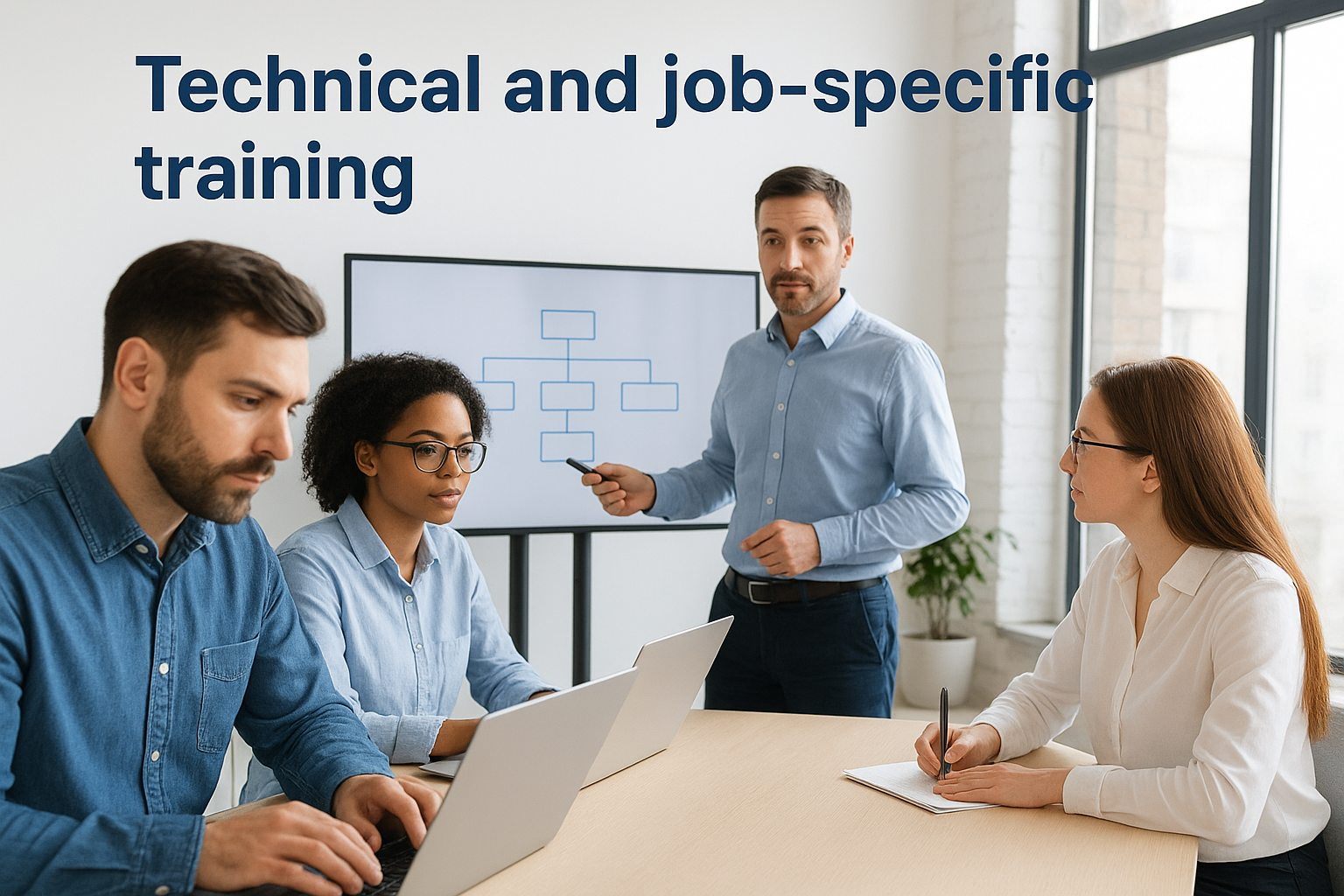
Technical training equips employees with the specialized knowledge needed to operate tools, systems, and processes specific to their roles. Software developers receive instruction on programming languages, frameworks, and development methodologies. Sales professionals learn product features, competitive positioning, and customer relationship management systems. Manufacturing teams master equipment operation, quality control procedures, and safety protocols. You invest in technical training to reduce errors, accelerate productivity, and ensure consistent performance standards across teams. Examples include certification programs for IT professionals, equipment operation workshops for warehouse staff, and product knowledge sessions for customer service representatives.
Compliance and safety programs
Regulatory compliance training protects your organization from legal liability while ensuring employees understand mandatory requirements for their industry. Healthcare workers complete HIPAA privacy training. Financial services teams learn anti-money laundering regulations. Food service employees receive food safety certification. Safety training reduces workplace injuries and associated costs through instruction on hazard identification, emergency procedures, and proper use of protective equipment. These programs typically require regular recertification to maintain compliance with evolving regulations and standards.
Compliance training serves dual purposes: protecting employees from harm and shielding your organization from regulatory penalties.
Leadership and soft skills development
Leadership training prepares employees for management responsibilities by teaching delegation, performance coaching, conflict resolution, and strategic decision-making. Communication workshops improve presentation skills, active listening, and professional writing abilities. Time management and problem-solving courses build productivity across all organizational levels. Examples include first-time manager bootcamps, executive coaching programs, and team collaboration workshops that enhance interpersonal effectiveness and emotional intelligence.
Benefits, challenges, and measuring impact
Training programs deliver tangible returns when executed properly, but organizations also face real obstacles during implementation and measurement. Understanding both sides of the equation helps you set realistic expectations and prepare for common pitfalls. The corporate training definition inherently includes both opportunities and challenges that affect every business differently based on size, industry, and organizational culture. Your success depends on anticipating difficulties while maintaining focus on the substantial benefits that effective training produces across your workforce and bottom line.
Key business advantages
Well-designed training increases productivity by 20 to 25% on average, according to research across multiple industries. Your employees complete tasks faster, make fewer costly mistakes, and require less supervision when they possess current knowledge and refined skills. Organizations report improved customer satisfaction scores following service training initiatives, directly connecting employee development to revenue growth. Compliance programs reduce regulatory violations and associated penalties, protecting your organization from legal exposure. Training also accelerates innovation as employees gain confidence to propose new solutions and challenge outdated processes.
Organizations that invest in comprehensive training programs experience 218% higher income per employee than those without formalized development initiatives.
Common implementation obstacles
Budget constraints represent the most frequent barrier to effective training programs, forcing difficult choices about scope and quality. Your teams face competing demands on their time, making it challenging to schedule training sessions without disrupting operations. Resistance from employees who view training as interrupting "real work" undermines engagement and learning outcomes. Technology limitations and poor learning platform experiences create frustration that reduces completion rates and knowledge retention across your workforce.
Tracking training effectiveness
Measure impact through specific performance metrics tied directly to training objectives rather than relying solely on completion rates or satisfaction surveys. Track changes in productivity indicators, error rates, customer complaints, or sales conversions before and after training interventions. Implement skills assessments at regular intervals to verify knowledge retention over time. Calculate return on investment by comparing training costs against measurable improvements in business outcomes, including reduced turnover expenses, decreased compliance violations, and increased revenue per employee.
Moving forward with corporate training
Understanding the corporate training definition and its practical applications positions you to build programs that deliver measurable business results. Your next step involves honest assessment of current training initiatives and identifying gaps between what exists and what your organization needs to achieve strategic objectives. Start small with pilot programs that target specific performance problems, measure results rigorously, and expand successful approaches across your workforce. Technology platforms streamline training delivery, tracking, and reporting while reducing administrative overhead that drains resources from content development.
Ready to evaluate your training infrastructure and identify opportunities for improvement? Take our LMS readiness quiz to determine where your organization stands and discover actionable steps to enhance your corporate training capabilities. The assessment takes five minutes and provides customized recommendations based on your current situation and future goals.
