If an EPA inspector showed up at your facility tomorrow, could you prove every employee handling hazardous materials completed the right training this year? Most compliance officers can’t answer that with confidence, and that gap is exactly why environmental compliance training online has become the standard rather than the exception. Regulations like RCRA, OSHA hazard communication, and DOT hazmat rules don’t leave room for guesswork, and paper sign-in sheets don’t hold up during an audit.
Online environmental compliance training simply moves that instruction, and the proof of it, into a system built for tracking, deadlines, and documentation. You get structured courses covering the specific regulations tied to your industry, delivered on a schedule that fits shift work and multiple locations, with automated records generated the moment someone finishes a module.
This article breaks down what environmental compliance training online actually includes, which regulations typically require it, and how the delivery and tracking process works from enrollment to certification. If you’re evaluating whether to move your program online or replace a system that’s not keeping up, you’ll walk away knowing exactly what to look for.
Why environmental compliance training matters
Skipping or shortcutting environmental compliance training doesn’t just risk a bad audit, it risks real money and real harm. The EPA and OSHA can levy fines that run into six figures per violation, per day, until a facility fixes the problem. Untrained employees mishandle hazardous waste, mislabel chemicals, or miss reporting deadlines, and any one of those mistakes can trigger an inspection that uncovers a dozen more issues you didn’t know existed, which is what poorly trained workers really cost a business.
The regulatory stakes are higher than most teams realize
Because the rules stack on top of each other. A single facility might fall under RCRA hazardous waste rules, OSHA’s training and Hazard Communication requirements, DOT hazmat shipping rules, and state-level environmental codes all at once. Online environmental compliance training exists specifically to keep those overlapping requirements straight, assigning the right course to the right role instead of running one generic session for everyone.
| Regulation | Who it typically covers | Common training requirement |
|---|---|---|
| RCRA (Hazardous Waste) | Waste handlers, generators | Annual refresher |
| OSHA HazCom | Anyone handling chemicals | Initial + as-needed |
| DOT Hazmat | Shipping and receiving staff | Every 3 years |
| EPA SPCC | Facilities storing oil/fuel | Annual review |
A missed training deadline doesn’t just fail an audit, it becomes evidence against you.
Untrained employees create liability you can’t undo
Moreover, the damage isn’t limited to fines. A spill that reaches groundwater, a chemical exposure that sends someone to the hospital, or a shipment flagged by DOT for improper labeling all trace back to the same root cause: someone didn’t get trained, or the training didn’t stick. Once that incident happens, no amount of paperwork reverses it.
Additionally, compliance training protects your reputation with regulators, insurers, and clients who audit their vendors before signing contracts. Consistent, documented, online environmental compliance training signals that your organization takes its obligations seriously, which matters when a customer’s procurement team is deciding between you and a competitor with a thinner training record. Given how much rides on it, treating training as a checkbox exercise instead of an operational priority is one of the more expensive mistakes a compliance program can make.
What environmental compliance training covers
Good environmental compliance training isn’t one course, it’s a curriculum built around the specific hazards and regulations your facility actually faces. A warehouse storing solvents needs different modules than a manufacturing plant generating hazardous waste, and a well-built program assigns each employee only the training relevant to their role.
Core topic areas you’ll typically see
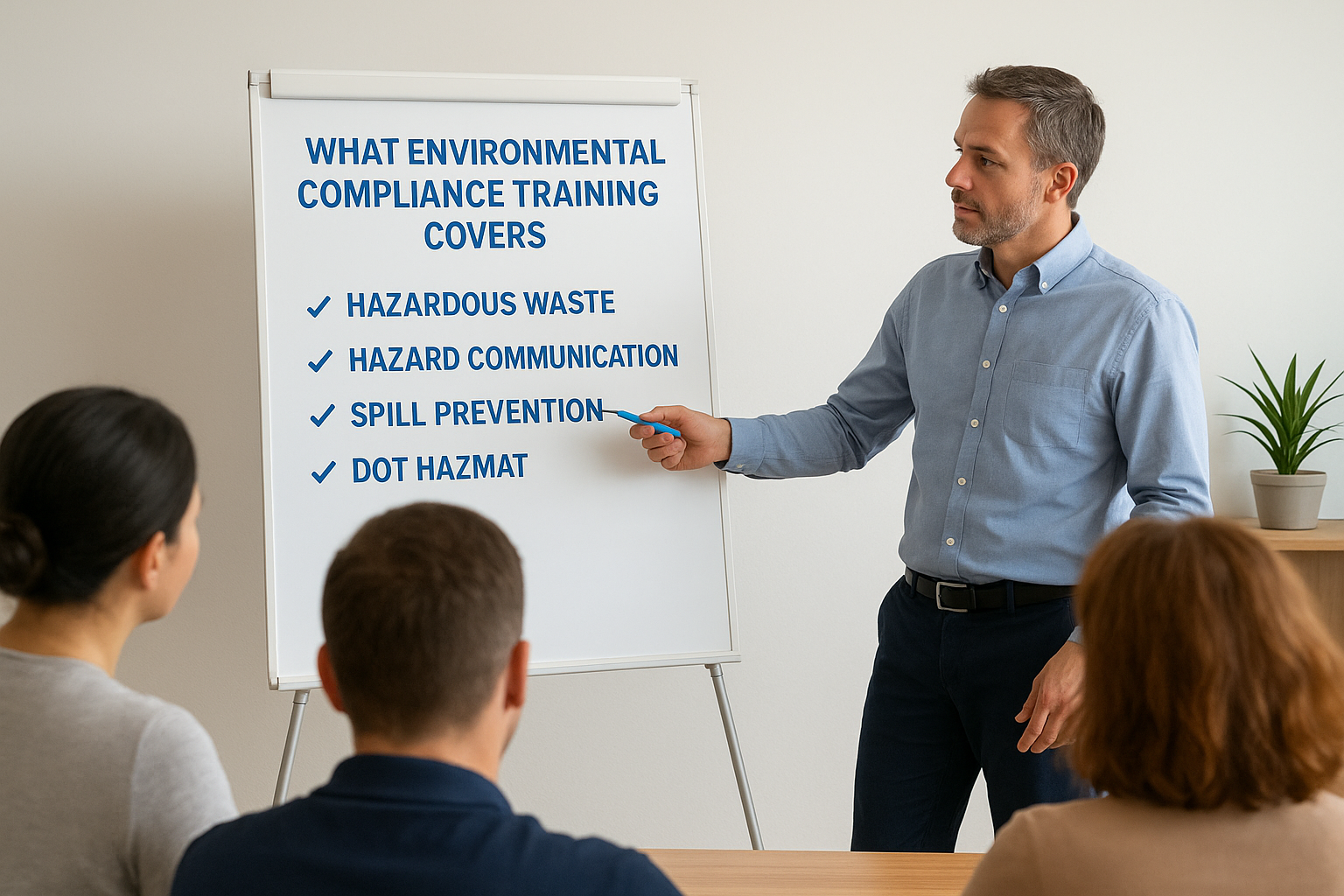
Specifically, most online environmental compliance training libraries include:
- Hazardous waste identification, labeling, and storage under RCRA
- OSHA Hazard Communication (GHS labels, safety data sheets)
- Spill prevention, control, and countermeasure (SPCC) procedures
- DOT hazmat shipping and packaging rules
- Air and water discharge permit obligations
- Emergency response and reporting requirements
Training that isn’t matched to a specific role usually gets ignored, and ignored training doesn’t hold up in an audit.
Role-based assignment matters more than course volume
Therefore, the strongest programs don’t just publish a course catalog, they map courses to job functions. A forklift operator moving drums of waste needs hands-on RCRA training and spill response steps. A shipping clerk needs DOT hazmat certification. An office manager might only need annual HazCom awareness. Axis LMS lets administrators build these role-based assignments once and have the system apply them automatically as new employees onboard.
Ultimately, coverage without structure creates gaps you won’t spot until an inspector does. The goal isn’t checking every box, it’s making sure the right person completes the right course before it becomes a liability.
How to complete environmental compliance training online
Completing environmental compliance training online follows a predictable path once your organization has the right system in place, and that predictability is exactly what makes it easier to defend during an audit than a stack of paper certificates. Enrollment starts the process, but the real value comes from what happens after someone finishes a course.
The typical path from enrollment to certification
Most programs follow the same sequence:
- Enrollment, either automatic based on job role or manual by an admin.
- Course completion, including videos, scenario-based modules, or interactive content.
- Assessment, usually a scored quiz confirming the employee understood the material.
- Certification, generated and tracked automatically once the passing score is met.
- Recertification scheduling, based on the regulation’s required interval, so credentials never quietly expire.
If a course doesn’t end in a stored, timestamped record, it doesn’t count during an audit.
Automated tracking removes the manual follow-up
Given how many employees and deadlines a mid-sized facility juggles, manual tracking eventually breaks down. A well-built LMS handles this differently: it flags overdue employees, sends automated reminders before certifications expire, and stores every completion record with a timestamp an inspector can verify on the spot. Axis LMS builds this tracking directly into its reporting tools, so online environmental compliance training completions and expirations show up in one dashboard instead of scattered spreadsheets across departments, which is how an LMS keeps training records audit-ready.
Handled this way, compliance stops depending on someone remembering to check a spreadsheet every quarter.
How to choose the right training program for your team
Picking a vendor for environmental compliance training online comes down to whether the system can actually prove compliance when it matters, not just deliver courses, so it helps to know how to pick the right learning platform for your organization. A slick course library means nothing if the reporting behind it can’t hand an auditor a timestamped record in seconds.
Questions to ask before you sign a contract
Before committing, run any vendor through these checks:
- Does it support role-based assignment so employees only see courses relevant to their job?
- Can it generate audit-ready reports without manual formatting?
- Does it send automated reminders before certifications expire?
- Will it integrate with your existing HR or shift-scheduling systems?
- Can it handle multiple locations and shift patterns without extra licensing headaches?
If a system can’t produce proof of compliance on demand, it isn’t a compliance system, it’s just a course player.
Match the platform to how your workforce actually works
Also weigh how your workforce operates day to day. A distribution center running three shifts needs a platform that doesn’t lock training behind a 9-to-5 schedule, while a multi-site manufacturer needs centralized reporting across locations that still report up to one dashboard. Axis LMS was built around exactly these constraints as a regulatory training platform, with automated recertification scheduling and integrations that pull employee data straight from your HR system instead of requiring manual uploads.
Ultimately, the right platform fits your compliance calendar and your workforce’s schedule, not the other way around.
Keeping your compliance training on track
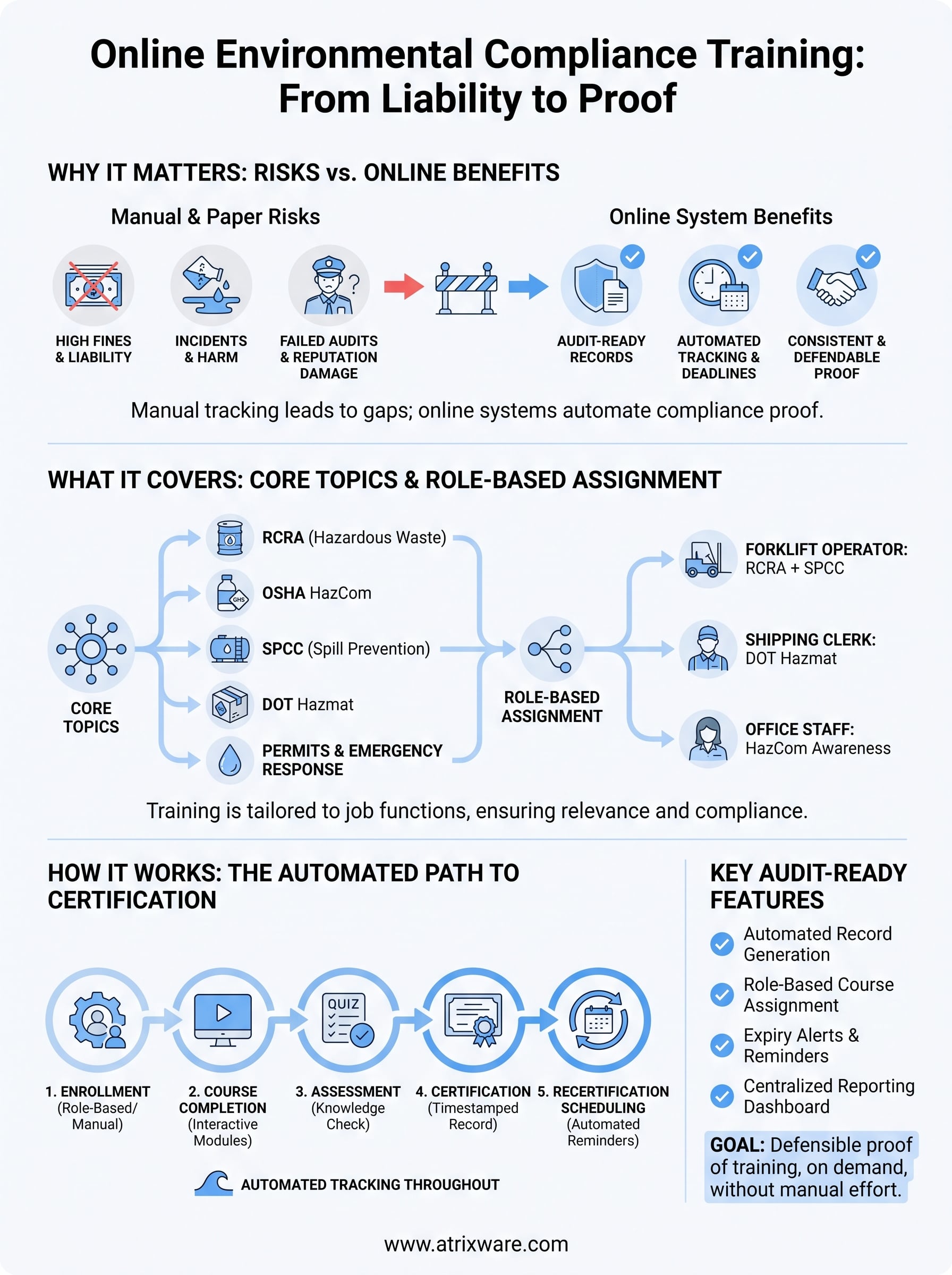
Environmental compliance training online works best when it’s treated as an operational system, not a once-a-year scramble before an audit. Role-based assignment, automated recertification, and timestamped records turn a stressful compliance season into a routine that runs quietly in the background.
Getting there doesn’t require ripping out your current process overnight. Start by mapping which regulations apply to which roles, then look for a platform that can automate the tracking you’re currently doing by hand. Handled correctly, online environmental compliance training stops being a liability you manage reactively and becomes proof you can hand an inspector without hesitation.
If you’re not sure whether your current setup can actually hold up under that kind of scrutiny, see how ready your organization is for an LMS and find out where your program stands before the next audit finds out for you.
