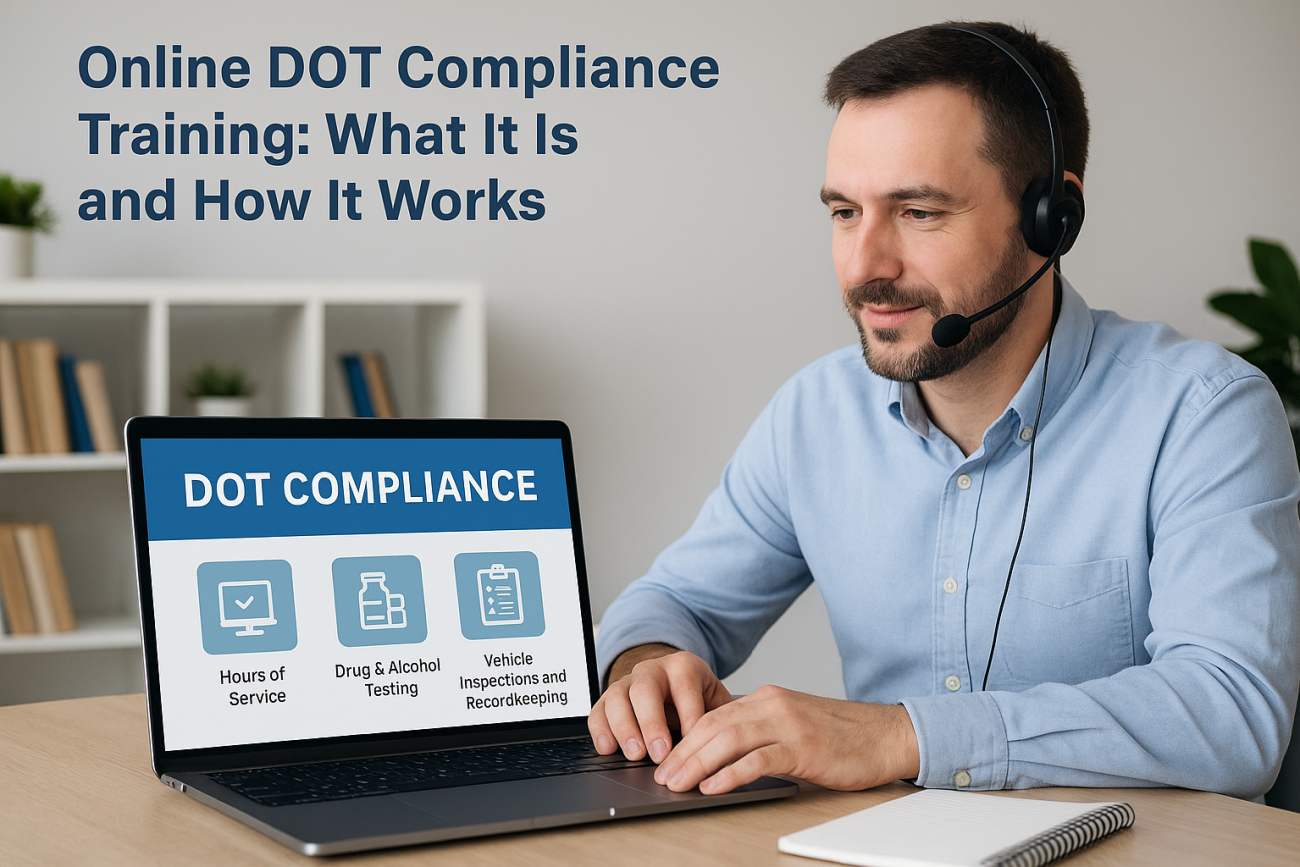
If you run a fleet or manage safety compliance, you already know FMCSA rules don’t leave much room for guesswork. Online DOT compliance training exists to solve a specific problem: getting drivers, safety managers, and dispatchers certified on federal requirements without pulling them off the road for in-person seminars. Whether you’re searching for dot compliance training online for a single safety officer or a full driver roster, the goal is the same, meet the regulation without wrecking your operations schedule.
So what does it actually involve? At its core, it’s structured coursework covering hours-of-service rules, drug and alcohol testing programs, vehicle inspection standards, and recordkeeping, delivered through a learning management system instead of a classroom. Programs built for dot compliance manager training online typically add tracking for certifications, renewal deadlines, and audit-ready reports, since compliance officers need proof, not just completion.
This article breaks down what online DOT training actually covers, how dot safety compliance training online programs are structured, who needs to complete which courses, and what to look for in a platform, especially if you’re evaluating an LMS like Axis LMS to manage certifications, automate renewals, and keep your compliance records audit-ready across your entire team.
Why online DOT compliance training matters
Regulators don’t grade on a curve. The FMCSA can pull a driver’s qualification file during a roadside inspection or a compliance review, so you need to prove compliance on the spot, and if the required certifications aren’t there, you’re looking at fines, out-of-service orders, or a hit to your Compliance, Safety, Accountability (CSA) score. That score follows your company and affects insurance premiums, contract eligibility, and even your ability to win freight from certain shippers. Skipping or half-documenting dot compliance training online isn’t a paperwork shortcut, it’s a direct risk to your operating authority.
Beyond avoiding penalties, online delivery solves a logistics problem that in-person seminars never could. Pulling drivers off routes for a half-day classroom session costs you fuel, freight, and payroll all at once. Digital courses let a driver in Ohio and a safety manager in Texas complete the same certification on their own schedule, without idling a truck. For carriers running dozens or hundreds of drivers, that scheduling flexibility is the difference between compliance being a quarterly scramble and a background process that just runs.
Recordkeeping is where most fleets actually get burned during audits, not lack of training itself. Auditors want dated completion records, renewal timelines, and proof tied to a specific driver, not a filing cabinet of certificates, which is exactly what keeping training records audit-ready means in practice.
A training program only counts as compliant if you can prove it happened, on demand, for any driver, on any date.
That’s why dot safety compliance training online platforms built with tracking and reporting baked in matter more than the course content alone. Content teaches the rule. Documentation proves you followed it.
How online DOT compliance training works
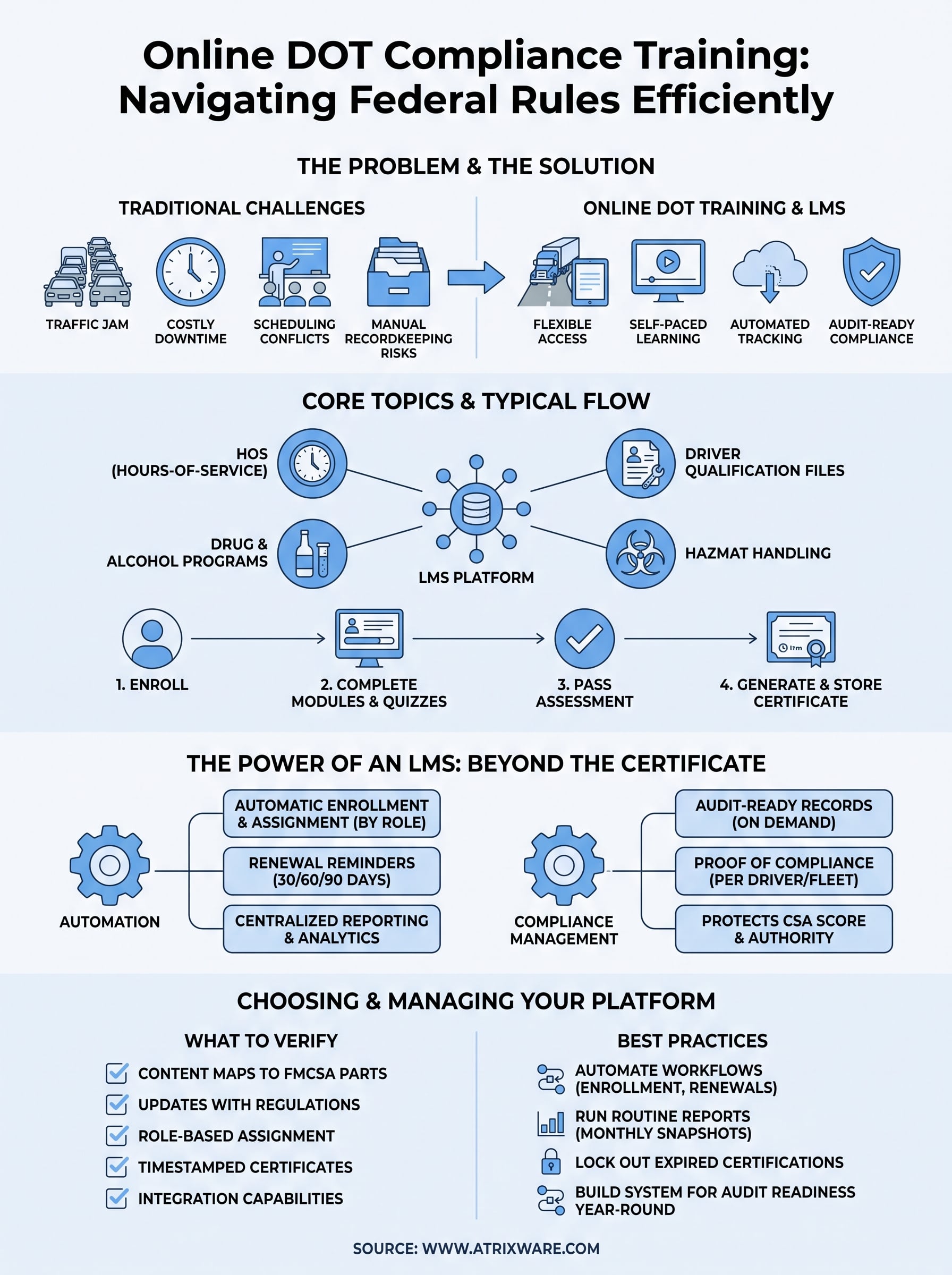
Most programs follow a straightforward path: enroll, complete self-paced modules, pass a quiz, and generate a certificate tied to that driver’s file. The difference between a good program and a mediocre one shows up in what happens after that certificate is issued, not before.
The typical course flow
A driver or manager logs into the training portal, works through video lessons or interactive modules at their own pace, and answers knowledge checks along the way. Assessment scores get logged automatically, and once a learner passes, the system generates a timestamped completion record.
Where the LMS does the heavy lifting
This is where a learning management system earns its keep, because certification tracking stops depending on anyone’s memory. Instead of someone manually tracking spreadsheets, the platform handles:
- Automatic enrollment based on job role or department
- Renewal reminders sent before certifications expire
- Centralized reporting pulled by driver, location, or course
- Digital certificates stored and searchable for audits
For dot compliance manager training online, this matters even more, since managers often need to prove oversight across an entire team, not just their own completion record. A system like Axis LMS handles that automation natively, so nothing depends on someone remembering a spreadsheet update.
Core topics covered in DOT compliance courses
Every FMCSA-focused program covers a similar core, though the depth shifts based on role. Drivers need practical, day-to-day rule application. Safety managers need policy-level understanding since they’re the ones certifying compliance across the fleet.

Regulations don’t leave much interpretation room, so course content maps directly to specific FMCSA parts. A driver training on hours-of-service needs to know the 11-hour driving limit and 30-minute break rule cold, not just recognize the term.
| Course Topic | Who Needs It | Typical Renewal Cycle |
|---|---|---|
| Hours-of-Service (HOS) | Drivers | Annual |
| Drug & Alcohol Testing (Part 382) | Drivers, Managers | Annual |
| Vehicle Inspection (Part 396) | Drivers, Mechanics | Annual |
| Driver Qualification Files | Safety Managers | Ongoing |
| Hazmat Handling | Applicable Drivers | Every 3 years |
Managers pursuing dot compliance manager training online typically add modules on driver qualification files and CSA score management, since they’re accountable for the whole roster, not just their own certification.
If a course doesn’t map to a specific FMCSA regulation, it doesn’t belong in your compliance training plan.
Getting this list right matters more than picking a flashy platform. DOT compliance manager training built around these exact topics keeps your fleet aligned with what auditors actually check.
How to choose the right online DOT training provider
Not every course library labeled "DOT compliant" actually maps to current FMCSA regulations. Picking a provider means checking their content against the actual code, not just trusting a marketing page, and weighing platforms side by side before you commit.
What to verify before you buy
Start with accreditation and content sourcing. A legitimate provider cites the specific FMCSA part each course covers, updates modules when regulations change, and offers dot compliance manager training online as a distinct track from driver-level courses. Ask these questions before signing a contract:
- Does the provider update content when FMCSA rules change?
- Can courses assign by role, driver, mechanic, or safety manager?
- Does the platform generate audit-ready reports on demand?
- Are certificates timestamped and stored per learner?
- Can it integrate with your existing HR or driver qualification systems?
If a provider can’t show you a sample compliance report before you buy, don’t expect one after you sign.
Match the platform to your fleet size
A five-truck operation and a five-hundred-truck carrier need different things from a learning management system for transportation delivering dot safety compliance training online. Smaller fleets often prioritize simplicity and low setup cost. Larger fleets need automated enrollment, role-based assignment, and integration with existing HR data. Vet the platform against your actual roster size, not the smallest package on the pricing page.
Best practices for managing DOT training with an LMS
Once you’ve picked a provider, the real work is setting up your LMS built for regulated training so training runs itself. Most compliance failures come from process gaps, not bad course content, so tighten the workflow before you scale to your full driver roster.
Automate the parts humans forget
Set renewal reminders 30, 60, and 90 days out instead of relying on a manager to check expiration dates manually, since automated learning paths guard against expired credentials. Assign courses by role automatically when someone joins as a driver, mechanic, or safety officer, so nobody starts a route without required certifications on file.
- Trigger enrollment from HR onboarding data
- Route completion alerts to both the driver and their supervisor
- Lock out expired certifications from active duty status until renewed
The best compliance workflow is the one nobody has to remember to run.
Build reporting into your routine, not your panic response
Run a monthly compliance snapshot instead of scrambling before an audit. Pull reports by location, department, or individual driver so gaps show up early, when they’re a five-minute fix instead of a fine. Platforms like Axis LMS handle this automation natively, tying enrollment, renewals, and reporting into one system instead of three disconnected tools.
Keeping your fleet audit-ready year-round
Getting online DOT compliance training right isn’t about finding the flashiest course library. It’s about building a system where certifications, renewals, and reports happen automatically, so an FMCSA audit never catches you scrambling for a filing cabinet full of paper certificates. Drivers stay on the road, managers stay accountable, and your CSA score reflects a fleet that actually runs compliance instead of chasing it.
Questions worth asking yourself now: does your current setup track renewals before they lapse? Can you pull a driver’s full training history in under a minute? If not, the gap isn’t your training content, it’s your platform. A dedicated learning management system closes that gap by tying enrollment, certification, and reporting into one workflow instead of three disconnected spreadsheets.
If you’re not sure whether your fleet needs a new LMS or just better configuration, find out how ready you are for an LMS and see exactly where you stand.
