Picking a healthcare learning management system is not the same as shopping for generic corporate training software. Your organization deals with rotating shift staff, mandatory certifications, and audits that can shut down a department if a single compliance record goes missing. A platform built for retail onboarding won’t cut it when you need to track CEUs, manage HIPAA training, or prove competency during a Joint Commission review.
This list narrows the field to five platforms actually built to handle healthcare training and compliance tracking at scale. Each one supports the workflows healthcare organizations depend on: automated re-certification reminders, role-based learning paths for clinical and non-clinical staff, and reporting detailed enough to hand to an auditor without extra work.
Below, you’ll find a breakdown of what each healthcare LMS software option does well, where it falls short, and which type of organization it fits best, whether you’re running a single clinic, a multi-site hospital network, or a healthcare staffing agency. We’ll also flag pricing structure, integration options with HR and credentialing systems, and how much setup time to expect before you can start assigning courses.
1. Axis LMS by Atrixware
Axis LMS is Atrixware’s flagship platform, and it’s built with the kind of flexibility that healthcare organizations need when training requirements shift by department, license type, and state. Hospitals, clinics, home health agencies, and healthcare staffing firms use it to manage everything from new-hire orientation to annual competency programs, all inside one learning management system for healthcare that doesn’t force you into a rigid template. The drag-and-drop course builder means your compliance team can update a policy module the same day a regulation changes, instead of waiting on a developer.

Key features
What sets Axis LMS apart for healthcare use is the depth of its compliance and reporting tools, paired with integrations that plug directly into existing HR and credentialing workflows.
- Automated re-certification tracking with expiration alerts for licenses, CEU credits and certifications, and mandatory annual training
- Compliance-ready features built for frameworks like GDPR and FDA 21 CFR Part 11 electronic records rules, useful for organizations handling clinical documentation
- On-demand and automated reporting that generates audit-ready records without manual exports
- HR and credentialing system sync through connections to ADP, BambooHR, Salesforce, and Zoho, plus a broader integration builder covering thousands of systems
- SSO support via SAML providers like Okta, Azure, and Ping Identity, which matters for larger health systems with strict IT policies
- Full UI branding, so the portal looks like it belongs to your organization, not a generic vendor
A healthcare LMS is only as good as the audit trail it produces when a surveyor asks for proof.
Best for
Organizations that need one system to handle multiple training types will get the most out of Axis LMS. It works well for hospital networks juggling clinical and non-clinical staff, healthcare staffing agencies onboarding traveling nurses on tight timelines, and multi-location clinics that need centralized reporting across sites. Teams that also want to sell CEU courses externally can use its built-in e-commerce tools without adding a separate platform.
Pricing
Atrixware doesn’t publish flat-rate pricing because Axis LMS scales by user count, feature set, and hosting preference (cloud or self-hosted). Most healthcare clients get a custom quote after a short discovery call, and the vendor offers a live demo so administrators can test the compliance and reporting tools before committing.
2. HealthStream LMS
HealthStream has built its reputation almost entirely within hospital systems, and that focus shows in how the platform is structured. Built specifically for healthcare workforce development, it ships with a library of accredited clinical content, so nursing staff and physicians can complete continuing education without you sourcing courses from third parties. Organizations already running large clinical operations tend to find the platform familiar, since healthcare providers rarely switch platforms once a system is embedded, and many hospital networks have used some version of it for years.
Key features
Content depth is where HealthStream separates itself from generic training software.
- Pre-built clinical course library covering nursing competencies, physician CME, and patient safety topics
- Credentialing and privileging tools that track licenses and certifications tied to specific clinical roles
- Competency management for skills checklists and hands-on assessments beyond simple course completion
- Scheduling tools for in-person and blended training across departments
Accredited content libraries save you sourcing time, but they also lock you into HealthStream’s catalog structure.
Best for
Large hospital systems and health networks with dedicated clinical education departments get the most value here. If your organization already needs CME tracking and accredited nursing content at scale, HealthStream reduces the work of building that library yourself. Smaller clinics or non-clinical training programs often find the platform more than they need.
Pricing
HealthStream doesn’t publish public pricing, and quotes are typically scaled to bed count or employee headcount. Expect a sales-driven quoting process with contract terms that favor larger, multi-year commitments rather than month-to-month flexibility.
3. Relias LMS
Relias built its name in post-acute and behavioral health, and the platform reflects that focus more than any general hospital system would. Long-term care facilities, home health agencies, and behavioral health providers use it because the content library maps directly to state-specific survey requirements, not just generic compliance categories. Relias LMS leans heavily on assessment data too, using it to flag and close skills gaps before they show up in an inspection.

Key features
Data-driven training assignments are the core selling point here, backed by a content library built for regulated care settings.
- Predictive analytics that flag employees at risk of falling behind on required training
- State-specific compliance content for skilled nursing, home health, and behavioral health providers
- Competency assessments tied directly to course completions, not just quiz scores
- Onboarding pathways built around specific job roles in post-acute care
Training software that only tracks completions misses the gaps that actually cause survey citations.
Best for
Providers in post-acute, long-term care, and behavioral health settings will recognize their own regulatory language in Relias’s content library faster than in a generalist platform. Facilities managing state surveys on a recurring basis benefit most from the predictive risk scoring.
Pricing
Relias quotes by employee count and content bundle, and pricing isn’t published publicly. Contracts typically run annually, with cost scaling based on which specialty content libraries you add beyond the core LMS.
4. ComplianceQuest LMS
ComplianceQuest built its platform on the Salesforce infrastructure, which explains why it leans harder into quality management than course delivery. Pharmaceutical manufacturers, medical device companies, and larger health systems use it because training records connect directly to their existing quality and compliance workflows, not as a separate system that needs manual reconciliation. If your organization already runs Salesforce for other operations, this learning management system healthcare teams often adopt fits into that ecosystem with far less friction than a standalone tool.
Key features
Quality management integration is the defining trait here, and it shows up across every feature ComplianceQuest ships.
- Native Salesforce integration that ties training records to quality management and document control modules
- Automated compliance workflows, much like a dedicated LMS for regulatory training, that trigger retraining when a policy or SOP changes
- Audit trail documentation built to satisfy FDA and ISO requirements in regulated manufacturing and clinical settings
- Role-based training matrices that assign courses based on job function and regulatory exposure
Training tied to your quality system catches gaps that a standalone LMS never sees.
Best for
Manufacturers and health systems already running Salesforce for quality management get the clearest payoff. Organizations without that existing infrastructure often find the platform heavier than they need for basic staff training.
Pricing
ComplianceQuest prices by user tier and module selection, with quotes issued after a scoping call. Contracts typically run annually, and implementation costs scale with how deeply you integrate quality management features alongside training.
5. Absorb LMS
Absorb LMS started as a general corporate training platform, and that broader background still shows in how flexible it is compared to the specialty tools above. Healthcare organizations that need a healthcare LMS software option without a rigid clinical-only structure often land here, especially when training extends beyond frontline caregivers to administrative, billing, and support staff. Its AI-driven course recommendations and modern interface appeal to organizations that want a polished learner experience alongside compliance basics.
Key features
Usability and content flexibility carry the platform more than deep clinical specialization does.
- AI-powered course suggestions that adapt to individual learner progress and role
- Custom learning paths for clinical and non-clinical departments alike
- Built-in authoring tools for building policy and procedure training in-house
- Robust reporting dashboards that export compliance data for internal audits
A flexible LMS only helps healthcare teams if compliance reporting stays just as strong as the learner experience.
Best for
Healthcare organizations with a mixed workforce, meaning clinical staff plus large administrative or corporate teams, tend to get the most value from Absorb. Groups less tied to specialty accreditation content and more focused on general onboarding, HR policy training, and internal upskilling will find it easier to configure than the clinically-focused platforms above.
Pricing
Absorb doesn’t list public pricing either, and quotes depend on user count and which modules you add, such as the authoring tool or e-commerce features, so it helps to know what implementing an LMS actually costs going in. Implementation typically includes onboarding support, though larger health systems should expect a longer setup timeline than smaller clinics.
Picking the right LMS for your organization
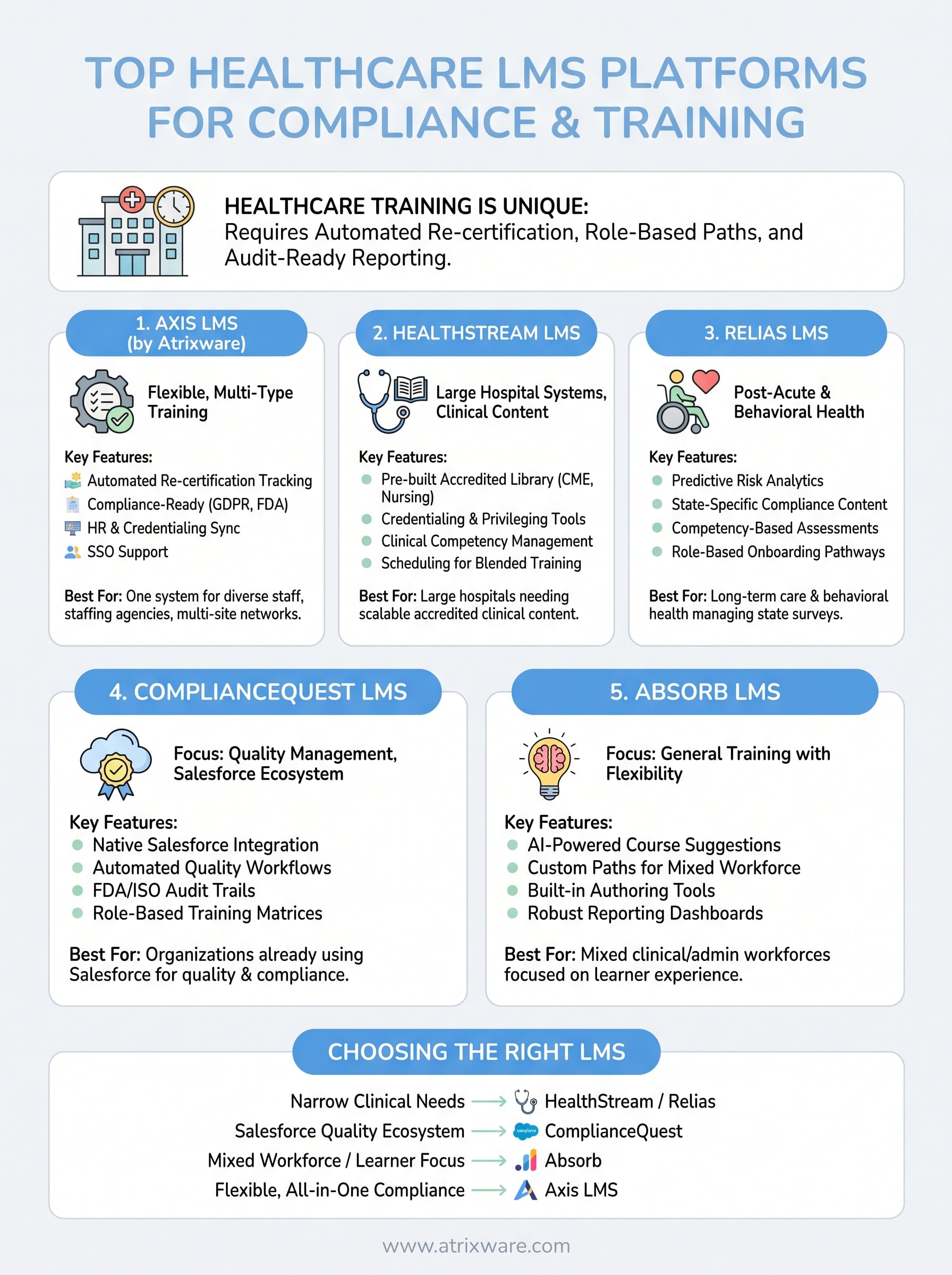
No single platform on this list wins for every healthcare organization. HealthStream and Relias make sense when your training needs are narrow and clinical, tied to nursing competencies or post-acute survey requirements. ComplianceQuest fits organizations already living inside Salesforce, while Absorb suits a mixed clinical and administrative workforce that doesn’t need deep specialty content.
Organizations that need one flexible system to handle compliance tracking, credentialing sync, and branded course delivery without bouncing between vendors tend to land on Axis LMS. Its combination of automated re-certification alerts, audit-ready reporting, and broad HR integrations covers most of what a healthcare learning management system needs to handle, from a single clinic to a multi-site hospital network.
If you’re still weighing options, don’t guess. Find out how ready your organization is for a new LMS and see exactly where you stand before you commit to a platform.
