Most companies run training because they have to, not because they’ve thought through what actually works. That’s why so many employee training programs end up as a checkbox exercise: a slideshow nobody remembers, a compliance module clicked through in record time, and no measurable change in performance afterward.
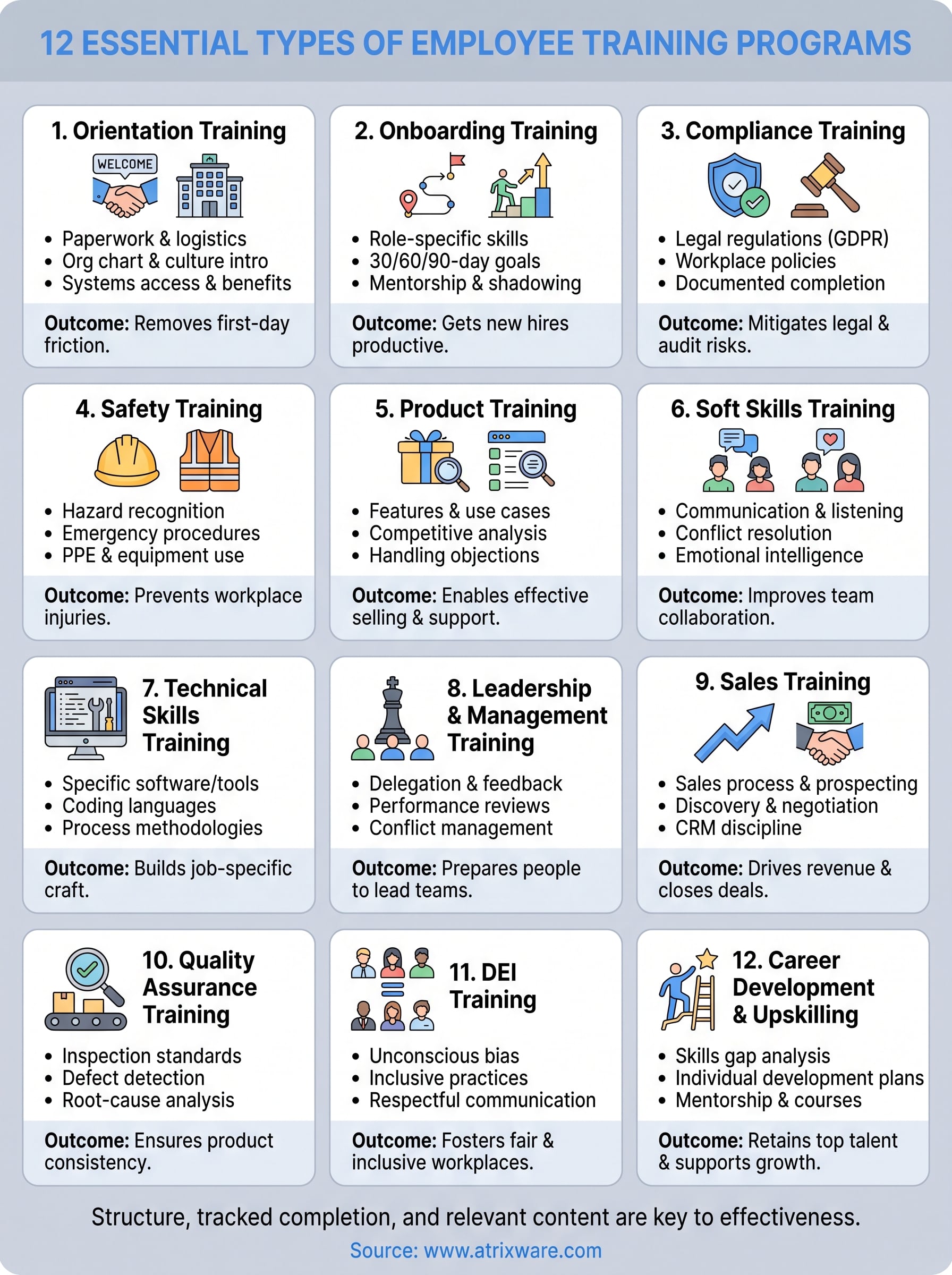
If you’re building or refreshing a training strategy, you need to know what your options actually look like before you pick one. This article breaks down 12 distinct types of training programs, from onboarding and compliance to leadership development and customer education, with real examples of employee training programs you can adapt for your own team.
We put this together because we build the systems that deliver this training every day. Whether you’re an HR manager designing a new hire curriculum or a compliance officer trying to keep certifications current, you’ll walk away with a clear picture of which corporate employee training programs fit your goals and how to structure them so people actually retain what they learn.
1. Orientation training
What it covers
Orientation training is the first official introduction a new hire gets to your company, and it’s narrower in scope than most people assume. It covers the paperwork, the org chart, the dress code, the building tour, the benefits enrollment deadlines, and the login credentials for whatever systems they’ll need on day one. It’s administrative by design. You’re not trying to build skills here, you’re trying to remove friction so a new employee doesn’t spend their first week confused about where the bathroom is or who their manager reports to.
Most orientation sessions run anywhere from a half day to a full week, depending on company size and how many departments a new hire needs to touch base with. A typical orientation checklist includes:
- Signing employment forms, tax documents, and confidentiality agreements
- Reviewing the employee handbook and code of conduct
- Setting up email, badge access, and core software accounts
- Meeting direct managers, HR contacts, and IT support
- Walking through benefits, PTO policy, and payroll schedules
Orientation answers "how does this company run," while onboarding answers "how do I succeed here."
Confusing the two is where a lot of employee training and development programs go wrong. Companies stretch orientation content across weeks, boring new hires with logistics long after they’ve already figured out the parking situation.
Who it’s for
Every new employee needs orientation, regardless of role or seniority. It applies equally to an entry-level warehouse associate and an incoming VP, because the administrative gaps it closes don’t care about job title. HR teams typically own this program, often with support from IT and facilities for the technical and physical setup pieces. If your organization runs multiple locations, orientation content should stay consistent across sites even if delivery format varies, since inconsistent policy information creates compliance headaches down the line.
Example in action
A mid-sized logistics company we’ve worked with runs orientation entirely through their LMS on a new hire’s first morning. The employee logs into Axis LMS, works through a self-paced module covering safety zones, badge policy, and benefits enrollment, then signs off electronically on each policy acknowledgment. HR gets a real-time completion report before lunch, so nobody chases down paper forms later. The whole sequence takes under two hours, and because it’s automated, new hires starting on different days all get the identical experience instead of whatever the office manager remembers to mention that week. That consistency matters more than it sounds, especially once you’re documenting compliance across dozens of hires a quarter.
2. Onboarding training
What it covers
Onboarding training picks up where orientation leaves off, and it’s where the real skill-building starts. This is the stretch, often 30, 60, or 90 days, where a new hire learns the actual job: how to use the tools, who to ask for what, what "good work" looks like on their specific team, and how their role connects to company goals. Good new employee training programs blend structured modules with hands-on practice, shadowing, and regular check-ins, rather than dumping a binder on someone’s desk and hoping it sticks.
A solid onboarding plan usually includes:
- Role-specific skill modules delivered in phases over the first few months
- Assigned mentors or buddies for informal questions
- Scheduled 30/60/90-day check-ins with a manager
- Access to a learning path inside your LMS that tracks progress automatically
Orientation gets someone through the door; onboarding gets them productive.
Organizations that treat onboarding as a single event rather than a process see higher early turnover, since new hires who feel lost in month two rarely stick around for month six.
Who it’s for
Every new hire benefits from structured onboarding, but the depth and length should scale with role complexity. A customer support rep might need three weeks of onboarding; a software engineer joining a legacy codebase might need three months. Direct managers usually own the content, while HR or L&D teams provide the framework and track completion across the organization.
Example in action
A regional healthcare provider built a 90-day onboarding path inside Axis LMS for new clinical staff, sequencing modules so advanced material only unlocks after foundational courses are complete. Managers get automated alerts when a new hire falls behind schedule, letting them intervene before a knowledge gap turns into a costly mistake on the floor.
3. Compliance training
What it covers
Compliance training exists to keep your organization on the right side of the law, and it’s non-negotiable in ways other training isn’t. This category covers anything tied to a regulation, industry standard, or legal requirement: data privacy rules like GDPR, workplace conduct policies, anti-harassment law, and industry-specific mandates like FDA 21 CFR Part 11 for regulated manufacturers. Unlike soft skills or product training, compliance modules typically require documented proof of completion, timed re-certifications, and audit trails that hold up if a regulator or plaintiff’s attorney comes asking.
Most hr employee training programs in this category share a few structural traits:
- Mandatory completion deadlines tied to hire date or calendar year
- Electronic signatures or quiz scores as proof of comprehension
- Automatic recurrence, often annually or biannually
- Escalation alerts to managers when staff fall behind
If you can’t produce a completion record on demand, your compliance training doesn’t count as compliance training.
Skipping the documentation piece is the single most common mistake companies make here, and it’s the one that costs the most when an audit actually happens.
Who it’s for
Compliance requirements vary by industry, so the audience shifts accordingly. Healthcare organizations need HIPAA training across nearly every role, financial firms need anti-money-laundering modules for client-facing staff, and manufacturers need OSHA-adjacent policy training tied to their specific processes. Compliance officers or legal teams usually define the content, while HR or L&D handles rollout and tracking.
Example in action
A financial services client uses Axis LMS to assign annual anti-money-laundering and data privacy modules automatically based on job role, with re-certification triggered 30 days before each certificate expires. Reports export directly for regulator review, cutting audit prep from weeks down to an afternoon.
4. Safety training
What it covers

Safety training exists to prevent injuries before they happen, not to check a box after someone gets hurt. It covers hazard recognition, proper equipment use, emergency procedures, and the specific physical risks tied to a given job, whether that’s operating a forklift, handling chemicals, or working at height. Unlike compliance training, which often deals in policy and documentation, safety training is hands-on by necessity. Reading a PDF about fire extinguisher use doesn’t teach someone to actually grab the right one under pressure.
A typical safety curriculum includes:
- Equipment-specific operation and lockout/tagout procedures
- Personal protective equipment (PPE) requirements by role
- Emergency evacuation routes and drills
- Incident reporting protocols
- Refresher courses tied to OSHA-mandated intervals
Safety training only works if it changes behavior on the floor, not just scores on a quiz.
Many corporate employee training programs in this category combine online modules for the theory with in-person or video-based demonstrations for the physical skills, since some things simply don’t transfer through text.
Who it’s for
Anyone working in a physical environment with real hazards needs this training, from warehouse staff and machine operators to lab technicians and delivery drivers. Office-based employees still need basics like fire evacuation and ergonomics, but the depth scales sharply with physical risk exposure. Safety officers or operations managers typically own the content, often working alongside compliance teams since OSHA violations carry real financial penalties.
Example in action
A manufacturing client runs machine-specific safety certifications through Axis LMS, requiring workers to pass a scenario-based assessment before their badge grants floor access to a given machine. Supervisors get instant alerts if anyone attempts access without an active certification, closing a gap that used to rely entirely on memory and trust.
5. Product training
What it covers
Product training teaches employees the details of what your company actually sells, so they can explain it, sell it, or support it without stumbling. This covers feature sets, use cases, pricing structures, common objections, and how a product compares to competitors. Sales reps, support agents, and customer success teams all need different slices of the same information, which is why product training programs usually split into role-specific tracks rather than one generic overview everyone sits through.
Core elements typically include:
- Feature walkthroughs tied to real customer use cases
- Objection-handling scripts for sales-facing roles
- Troubleshooting guides for support teams
- Release notes and update modules whenever the product changes
Product training fails the moment the product changes and the training doesn’t.
Because products evolve constantly, static training decks go stale within a quarter. Teams that keep content current inside an LMS avoid the awkward moment where a rep pitches a feature that got deprecated last month.
Who it’s for
Sales teams need the deepest product knowledge since they’re pitching directly to buyers, while support and success teams need equally strong knowledge focused on troubleshooting rather than selling. New hires in customer-facing roles usually get a concentrated product bootcamp in their first two weeks, then rolling updates as new features ship. Product marketing or enablement teams typically own the content, working closely with engineering to keep it accurate.
Example in action
A SaaS company we support pushes short product update modules through Axis LMS every time they ship a new feature, targeting only the roles that need to know. Support agents complete a five-minute module before the feature goes live to customers, so tickets don’t pile up from staff who haven’t caught up yet.
6. Soft skills training
What it covers
Soft skills training targets the human side of work: communication, conflict resolution, time management, adaptability, and emotional intelligence. Unlike technical skills, these abilities don’t show up on a certification, but they shape whether a team actually functions well together. Good employee development training programs in this category focus on practice, not lecture, since nobody improves their listening skills by reading a slide about active listening.
A well-built soft skills curriculum usually includes:
- Communication and active listening exercises
- Conflict resolution role-play scenarios
- Time management and prioritization frameworks
- Feedback-giving and feedback-receiving practice
- Emotional intelligence self-assessments
Soft skills training only sticks when people practice it on real conflicts, not hypothetical ones.
Because these skills apply across every department, this category often gets treated as optional filler. Companies that skip it tend to see the cost show up elsewhere, in missed deadlines, avoidable conflict, and managers who can’t deliver difficult feedback without damaging morale.
Who it’s for
Everyone benefits from soft skills training, but the framing shifts by level. Individual contributors need collaboration and communication basics, while people managers need deeper modules on feedback delivery and conflict de-escalation. HR or L&D teams typically build the curriculum, sometimes pulling in outside facilitators for live workshop components that pair well with self-paced digital modules.
Example in action
A professional services firm we work with built a quarterly soft skills track inside Axis LMS, rotating topics like difficult conversations, cross-team communication, and prioritization under pressure. Each module ends with a short scenario quiz rather than a multiple-choice recall test, since the firm wanted to measure judgment, not memorization. Completion rates climbed once they tied the modules to actual internal incidents, proving that relevance beats polish when it comes to effective employee training programs built around behavior change.
7. Technical skills training
What it covers
Technical skills training builds the hard, job-specific abilities employees need to run the tools, software, and processes their role actually depends on. Think coding languages for developers, CAD software for engineers, spreadsheet modeling for analysts, or equipment programming for machine operators. This category sits apart from product training because it’s not about what your company sells, it’s about the underlying craft employees use to do the work. Content usually moves through a clear progression:
- Foundational skill modules covering core tools and platforms
- Hands-on labs or simulations for practice without real-world risk
- Certification exams tied to specific software versions or methodologies
- Advanced tracks for employees moving into specialist roles
Technical skills training only counts if employees can apply it unsupervised afterward.
Good training resources for employee training programs in this space combine short video demonstrations with sandbox environments, since watching someone code isn’t the same as writing working code yourself.
Who it’s for
Engineers, IT staff, data analysts, and machine operators sit at the center of this category, but it stretches wider than most people expect. Marketing teams need training on analytics platforms, finance teams need it on ERP systems, and almost every department now touches some specialized software that requires real instruction rather than trial and error. Department leads or subject matter experts typically build the content, since generic L&D staff rarely have the depth needed to teach a specific tool correctly.
Example in action
A logistics software company we support built a certification path inside Axis LMS for new engineers learning their internal deployment pipeline. Each module pairs a short video walkthrough with a graded lab exercise, and engineers can’t advance to production access until they pass every stage. Onboarding time for new technical hires dropped by nearly two weeks once managers stopped relying on informal shadowing to fill the gap.
8. Leadership and management training
What it covers
Leadership and management training prepares people to run teams, not just do their own job well. It covers delegation, performance reviews, hiring decisions, coaching underperformers, and the harder skill of giving feedback that actually changes behavior instead of just documenting a complaint. Most corporate employee training programs in this category fail because they teach management theory without ever putting a new manager in a room with a real personnel problem. A solid curriculum usually includes:
- Delegation and prioritization frameworks for first-time managers
- Performance review and goal-setting practices
- Coaching and feedback delivery scenarios
- Conflict resolution between direct reports
- Succession planning and talent identification
A promotion doesn’t teach management skills; training does.
Organizations that skip this step and promote based purely on tenure or technical skill often end up with managers who were great individual contributors and mediocre leaders, which shows up fast in team turnover numbers.
Who it’s for
First-time managers need this training most urgently, since the jump from peer to boss trips up even strong performers. Mid-level managers benefit from refreshers on coaching and succession planning, while senior leaders need modules on organizational strategy and change management. HR or L&D teams typically design the curriculum, often bringing in executive coaches for live components that pair with self-paced digital modules covering the fundamentals.
Example in action
An IT services firm we support built a leadership track inside Axis LMS that new managers must complete within their first 60 days in the role. Modules cover feedback delivery and delegation, each followed by a scenario-based assessment graded by their own manager. Turnover among newly promoted managers dropped noticeably once the firm tied completion to their 90-day review, rather than treating leadership training as optional professional development that could wait indefinitely.
9. Sales training
What it covers
Sales training builds the specific skills reps need to move a deal from first contact to signed contract, and it goes deeper than the product knowledge covered earlier. This category focuses on the process itself: prospecting, qualifying leads, running discovery calls, handling pricing pushback, and closing without sounding scripted. Strong corporate employee training programs for sales teams also cover CRM discipline, since a rep who doesn’t log activity correctly makes forecasting impossible for everyone above them.
A typical sales training path includes:
- Prospecting and lead qualification frameworks
- Discovery call structure and question banks
- Objection handling and negotiation practice
- CRM data entry standards and pipeline hygiene
- Role-play recordings reviewed by a sales manager
A sales rep who can’t handle objections live hasn’t finished training yet, no matter how many modules they’ve clicked through.
Most sales orgs run this training in cohorts tied to hiring waves, then layer in refreshers whenever pricing, messaging, or the competitive landscape shifts.
Who it’s for
New sales hires need the full ramp, usually compressed into 30 to 60 days before they’re carrying a full quota. Sales development reps need a narrower slice focused on outbound prospecting, while account executives need deeper negotiation and closing content. Sales enablement or sales leadership typically owns this content, often pulling in top performers to record real call examples rather than relying on generic scripts.
Example in action
A B2B software company we support runs a 30-day sales ramp inside Axis LMS, requiring new hires to pass a graded role-play recording before they’re allowed to join live customer calls unsupervised. Managers review each recording against a rubric, and reps who fail a section get a targeted module instead of repeating the entire course. Ramp time to first closed deal dropped by three weeks after the change.
10. Quality assurance training
What it covers
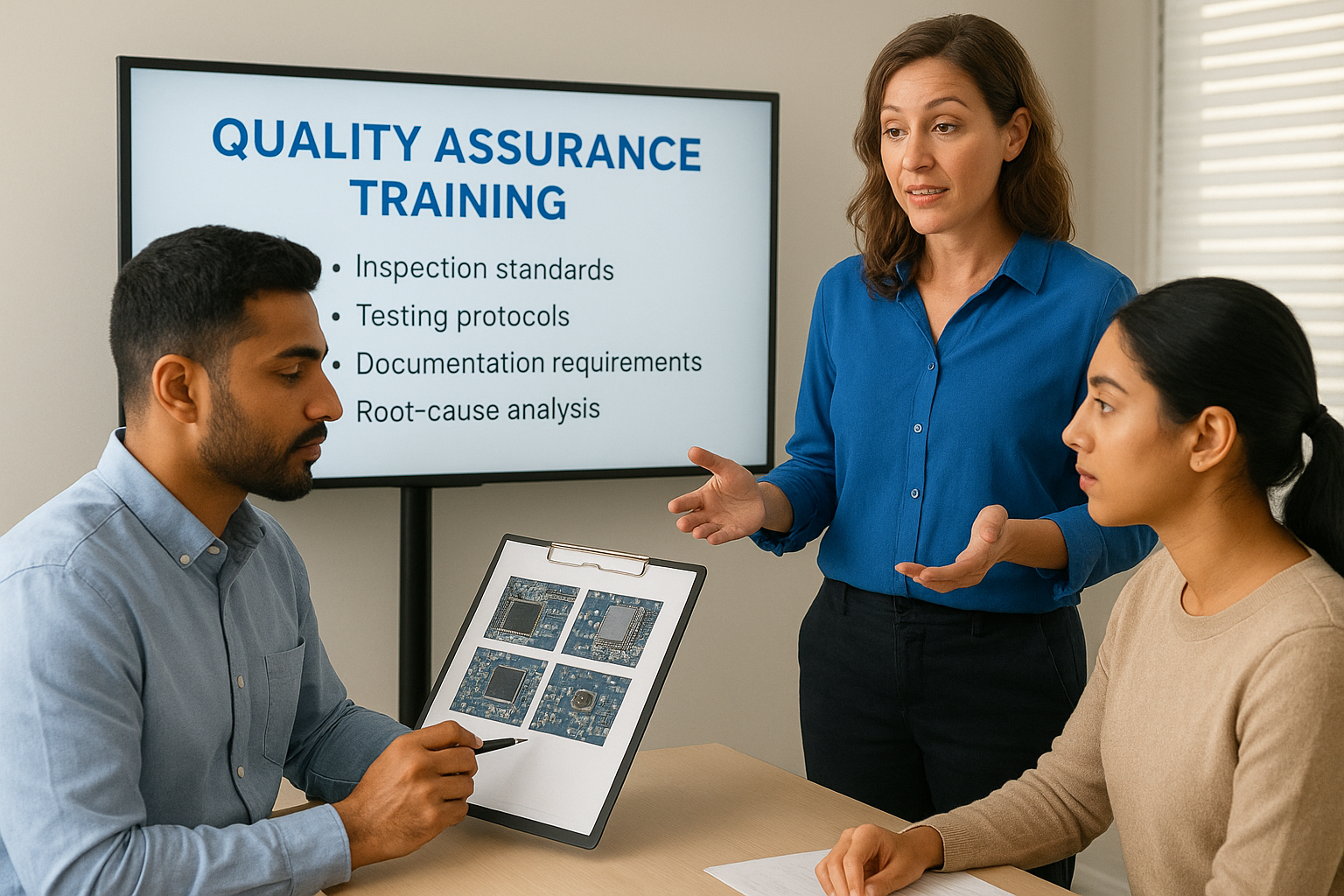
Quality assurance training teaches employees how to catch defects, inconsistencies, and errors before they reach a customer, and it applies far beyond manufacturing floors. This category covers inspection standards, testing protocols, documentation requirements, and the root-cause analysis skills that turn a caught mistake into a fixed process. Software teams need it for bug triage and release testing, manufacturers need it for physical inspection checkpoints, and service businesses need it for auditing call quality or order accuracy. A typical QA curriculum includes:
- Standard operating procedures for inspection or testing checkpoints
- Defect classification and escalation criteria
- Root-cause analysis frameworks like the five whys
- Documentation standards for audit trails
- Calibration training for measurement tools or testing software
Quality assurance training works when it stops the same defect from happening twice, not just when it catches one.
Good effective employee training programs in this space pair written standards with hands-on practice inspecting real or simulated defects, since spotting a flaw in a photo is easier than spotting it on a live production run.
Who it’s for
Quality inspectors, manufacturing technicians, and QA engineers sit at the core of this audience, but it extends to anyone whose output gets checked before it ships, including software testers, content editors, and customer service auditors. Quality managers or process engineers usually own the content, since they understand the specific failure points unique to their production line or workflow.
Example in action
An electronics manufacturer we support runs inspection certification through Axis LMS, requiring line workers to pass a photo-based defect identification test before working a new product line. Supervisors pull completion reports weekly, and defect rates on newly certified lines dropped noticeably within the first month of rollout.
11. Diversity, equity, and inclusion training
What it covers
Diversity, equity, and inclusion training addresses how people from different backgrounds work together fairly and respectfully inside your organization. This category covers unconscious bias, inclusive hiring and promotion practices, respectful communication across cultural differences, and how to recognize microaggressions before they erode team trust. Strong DEI programs go beyond a single awareness session and build ongoing habits into how managers hire, evaluate, and promote people. A well-structured curriculum usually includes:
- Unconscious bias recognition exercises tied to real hiring and review scenarios
- Inclusive language and communication guidelines
- Manager-specific modules on equitable promotion and pay decisions
- Scenario-based practice for addressing microaggressions or exclusionary comments
- Anonymous feedback channels to surface issues training alone won’t catch
DEI training fails the moment it becomes a one-time lecture instead of a habit built into how managers actually make decisions.
Companies that treat this as a single mandatory video tend to see attitudes unchanged six months later, since one session rarely shifts ingrained behavior.
Who it’s for
Everyone in the organization needs baseline DEI training, but managers need a deeper layer focused on hiring panels, performance reviews, and promotion decisions where bias does the most damage. Executive teams benefit from modules tied to workforce data, since leadership commitment shapes whether the rest of the company takes the training seriously. HR or dedicated DEI officers typically own the curriculum, often partnering with employee resource groups for input on real workplace scenarios.
Example in action
A retail chain we support built a manager-specific DEI track inside Axis LMS, requiring completion before any manager could sit on a hiring panel. Scenario-based assessments replaced multiple-choice quizzes, since the company wanted to test judgment on ambiguous situations rather than recall of policy language. Panel diversity improved within two hiring cycles after rollout.
12. Career development and upskilling training
What it covers
Career development and upskilling training helps employees grow beyond their current role, whether that means moving up, moving sideways into a new function, or simply staying current as their job evolves around new tools and expectations. This category covers skills gap analysis, individual development plans, mentorship programs, and access to courses tied to a defined career path rather than a single job description. Unlike most training on this list, it’s employee-driven as much as company-driven, which means the content has to flex around personal goals instead of a fixed curriculum. A strong program usually includes:
- Skills gap assessments tied to future role requirements
- Individual development plans reviewed quarterly with a manager
- Access to elective courses outside an employee’s current job scope
- Mentorship or job-shadowing opportunities across departments
- Tuition or certification reimbursement tracked through the LMS
Upskilling only works when employees can see a real path from the course to the next role.
Companies that treat this as a nice-to-have tend to lose their strongest performers to competitors who offer a clearer growth track, since ambitious employees rarely stay somewhere with no visible ceiling.
Who it’s for
High performers and employees flagged for succession planning benefit most, but any employee facing role changes from automation or shifting business needs should have access. Managers play a bigger role here than in most training programs for employee development, since they’re the ones who spot potential and steer people toward the right next step. HR or talent management teams typically own the framework, while managers customize it for their direct reports.
Example in action
A tech company we support built elective learning paths inside Axis LMS, letting employees pick tracks like data analysis or project management alongside their regular job. Managers approve enrollment and get progress reports tied to each employee’s development plan, and internal promotion rates rose noticeably once the paths launched.
Choosing the right training programs for your team
No company needs all 12 of these running at once. Start with the gaps that hurt most right now, usually orientation, onboarding, and whatever compliance requirements carry real legal risk, then layer in soft skills, leadership, or upskilling as your team matures. The common thread across every effective employee training program in this list isn’t the topic, it’s the structure: clear ownership, tracked completion, and content that gets updated as your business changes.
Trying to run 12 separate training tracks through spreadsheets and shared drives is how good programs quietly fall apart. A system built to assign, track, and report on training automatically is what turns this list from a plan into something that actually runs itself. If you’re not sure where your organization stands, take the LMS readiness quiz to see what stage you’re at and what to tackle next.
