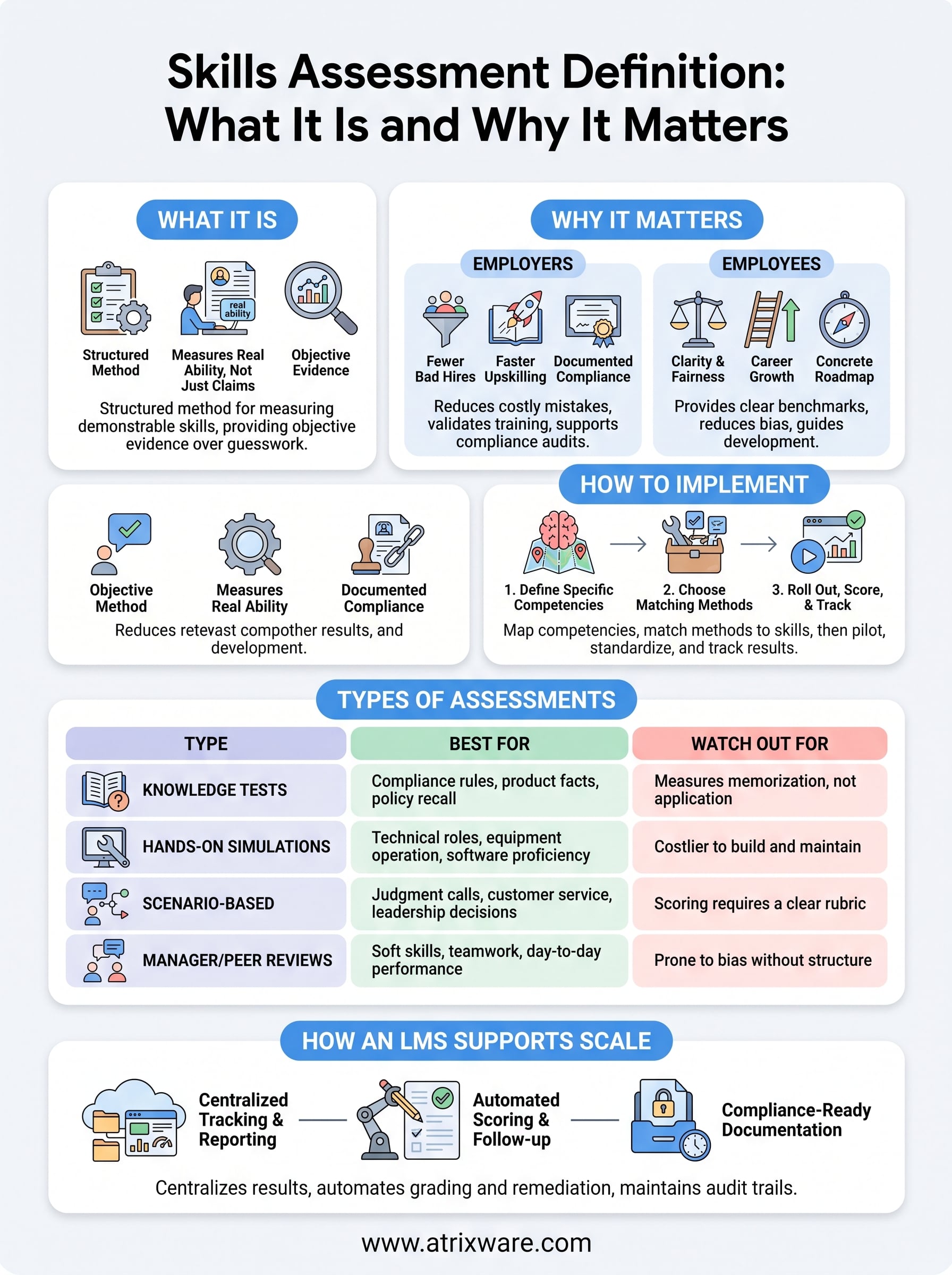
You hear the term thrown around in hiring meetings and training reviews, but what does a skills assessment definition actually cover? At its core, a skills assessment is a structured method for measuring what someone can actually do, not just what their resume or job title claims. Companies use it to evaluate candidates before hiring, check employee readiness after training, or spot gaps before they turn into costly mistakes on the job.
A solid skills assessment gives you objective evidence instead of guesswork. It can take the form of a knowledge test, a hands-on simulation, a manager review, or a scenario-based exercise, depending on what you need to measure. The goal is always the same: match real ability against the requirements of a role or a compliance standard, so decisions about hiring, promotion, or training rest on data rather than impressions.
In this article, we break down the full definition, walk through the main types of assessments you’ll encounter, and explain why they matter for L&D teams, HR managers, and compliance officers alike. If you’re building or refining a training program, you’ll also see how tracking assessment results inside a system like an LMS makes the whole process easier to manage and report on.
Why skills assessments matter for employers and employees
Organizations that skip formal skills assessments end up making decisions based on guesswork, and that guesswork gets expensive fast. A bad hire can cost tens of thousands of dollars in wasted training, lost productivity, and turnover, while an employee promoted past their actual skill level often struggles publicly before anyone admits the mismatch. Skills assessments close that gap by giving managers verifiable data before they commit resources to a person or a role.
The employer’s case: fewer bad hires, faster upskilling
Employers use assessments at nearly every stage of the employment lifecycle, from screening applicants to certifying compliance training. Recruiters rely on pre-hire testing to filter candidates who look strong on paper but can’t perform the actual tasks the job requires. Training managers use post-course evaluations to confirm that a certification or onboarding program actually changed behavior, not just attendance records. Compliance officers depend on documented results to prove, during an audit, that every employee handling a regulated process met the required standard.
- Screening candidates: filter for real ability, not resume keywords
- Validating training: confirm skills transferred after a course, not just completion
- Supporting promotions: base advancement on demonstrated competency
- Documenting compliance: keep audit-ready proof of certification status
A skills assessment turns "we think they’re ready" into "we can prove they’re ready."
The employee’s case: clarity, fairness, and career growth
Employees benefit just as much, even if the upside is less obvious at first glance. A well-designed assessment gives someone a clear benchmark against a role’s requirements, instead of leaving them to guess why they were passed over for a promotion. It also guards against evaluator bias, since a structured test or scenario applies the same standard to every candidate or employee, regardless of who happens to be reviewing the results. The U.S. Department of Labor points to standardized, job-related assessment tools as a core part of building fair and legally defensible hiring and promotion processes.
Feedback from an assessment also gives employees a concrete roadmap for growth. Instead of vague coaching like "communicate better," a scenario-based assessment might reveal that someone struggles specifically with de-escalating frustrated customers, pointing straight to the training module that fixes it. That kind of specificity keeps development plans focused and measurable, rather than aspirational statements nobody ever revisits.
How to implement a skills assessment strategy
Building a skills assessment program from scratch feels overwhelming until you break it into stages. Most organizations stall because they try to assess everything at once instead of starting with one role or one compliance requirement and expanding from there. A phased rollout gives you time to refine your questions, calibrate your scoring, and gather feedback before the program touches every department.
Define what you’re measuring before you build anything
Start by mapping the specific competencies tied to a role, not a vague job description. If you’re assessing customer service reps, break the job down into measurable behaviors like call resolution time, escalation handling, and product knowledge accuracy. Skipping this step is the single biggest reason assessment programs fail, because vague criteria produce vague results that nobody can act on.
An assessment is only as useful as the competency map behind it.
Choose methods that match the skill, not your budget
Don’t default to a multiple-choice quiz because it’s the easiest to build. A technical role calls for a hands-on simulation, while a leadership competency might need a scenario-based exercise or manager review. Match the testing format to the skill itself, then let cost and scale considerations narrow your options from there.
Roll out, score consistently, and close the loop
Use a consistent process every time you deploy an assessment:
- Pilot the assessment with a small group and review results for clarity issues.
- Standardize scoring with a rubric so two reviewers reach the same conclusion.
- Deliver feedback within days, not weeks, while the context is still fresh.
- Assign follow-up training tied directly to any gap the assessment revealed.
- Track results over time to see whether scores improve after intervention.
Following through on step four matters most. An assessment that identifies a gap but never triggers a fix is just paperwork, and employees notice the difference between a program built to develop them and one built to check a box.
Types of skills assessments and when to use them
Not every skill fits the same test format. Picking the wrong method wastes time and produces results nobody trusts, so match the assessment type to what you’re actually trying to measure. Below is a quick reference for the most common formats and where each one earns its keep.
| Assessment type | Best for | Watch out for |
|---|---|---|
| Knowledge tests | Compliance rules, product facts, policy recall | Measures memorization, not application |
| Hands-on simulations | Technical roles, equipment operation, software proficiency | Costlier to build and maintain |
| Scenario-based exercises | Judgment calls, customer service, leadership decisions | Scoring requires a clear rubric |
| Manager or peer reviews | Soft skills, teamwork, day-to-day performance | Prone to bias without structure |
| Certification exams | Regulated industries, licensing, formal credentials | Often requires third-party validation |
Knowledge-based tests
Knowledge tests work well when you need to confirm someone remembers a rule, a procedure, or a fact set, like OSHA safety codes or data privacy policy. They’re cheap to build and score automatically, which makes them the default choice for compliance training. The tradeoff is that passing a quiz proves recall, not whether someone applies that knowledge under pressure.
Practical and simulation-based assessments
Simulations put a person in front of the actual tools or software they’ll use on the job, which makes them the gold standard for technical and hands-on roles. A machine operator, a coder, or a nurse learning a new device all benefit more from a simulation than a written test. Building one takes more effort, but the results predict on-the-job performance far better than a quiz ever will.
Behavioral and scenario-based assessments
Scenario exercises drop someone into a realistic situation, like a frustrated customer or a conflict between coworkers, and score how they respond. This format captures judgment and soft skills that multiple-choice questions simply can’t reach. Pair it with a clear scoring rubric, or you’ll end up with inconsistent results between reviewers.
How an LMS supports skills assessment at scale
Running one assessment for one team is manageable with spreadsheets and email. Running assessments across hundreds of employees, multiple locations, and recurring compliance deadlines is not. This is where a learning management system earns its place, turning a manual process into something you can actually sustain year over year.
Centralized tracking and reporting
An LMS stores every assessment result in one place, so a training manager can pull a report on certification status across an entire department without chasing down spreadsheets from five different supervisors. Axis LMS, for example, offers on-demand and automated reporting that flags who passed, who needs a retest, and who’s overdue on a compliance deadline.
Scaling skills assessment isn’t about testing more people, it’s about tracking results without losing your mind.
Automated scoring and follow-up
Manual grading doesn’t scale past a few dozen learners. An LMS automates scoring for knowledge-based tests and triggers follow-up training the moment a gap shows up, so nobody has to remember to assign remediation by hand. That immediacy matters: a learner who fails an assessment and gets the corrective module within the hour stays engaged, while one who waits two weeks for a manager to notice often disengages entirely.
Compliance-ready documentation
Regulated industries need proof, not promises. An LMS keeps a timestamped audit trail of every assessment attempt, score, and certificate, which matters when an FDA or GDPR auditor asks for evidence rather than an assurance. Features built for compliance tracking, like automatic re-certification reminders, mean nobody in a regulated role slips through with an expired credential.
- Store every score, attempt, and certificate in one searchable record
- Trigger remediation automatically when a learner fails a benchmark
- Generate audit-ready reports without manual data entry
- Send re-certification reminders before credentials expire
Putting skills assessment into practice
A clear skills assessment definition only matters if you act on it. You now know what these tools measure, which format fits which skill, and why documented results protect both your hiring decisions and your compliance record. The next step is picking one role or one training program and running a small pilot, rather than waiting until you have a perfect system designed for every department at once.
Once you’ve got a process worth repeating, the real challenge becomes scale. Spreadsheets and manual grading work for a pilot group, but they break down fast once you’re tracking hundreds of learners across multiple locations and recurring re-certification deadlines. That’s the point where a platform built for this job starts paying for itself in saved hours and fewer missed deadlines. If you want to see how that works before committing to anything, try the Axis LMS admin demo and walk through the assessment and reporting tools yourself.
