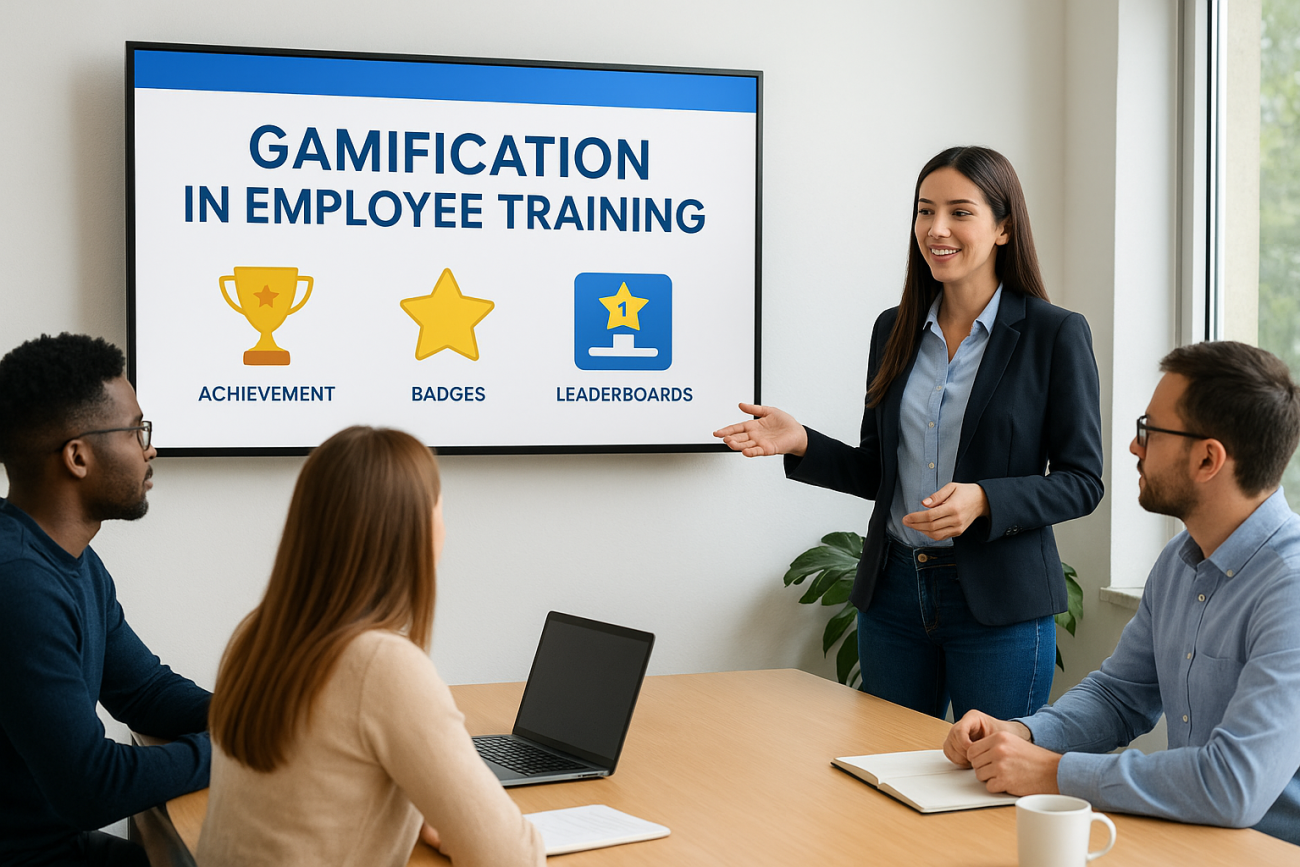
Most corporate training programs fail for the same reason: they’re boring. Employees click through slides, zone out during videos, and forget what they learned within a week. Gamification in employee training flips that script by applying game mechanics, points, badges, leaderboards, challenges, to learning experiences. The result? Higher engagement, better knowledge retention, and training that people actually want to complete.
But gamification isn’t about turning serious training into a video game. It’s about using proven psychological triggers, competition, achievement, progress, to motivate learners and reinforce key concepts. When done right, it transforms passive content consumption into active participation, which is exactly where real learning happens.
This guide breaks down what gamification looks like in practice, why it works, and how to implement it across your organization. We’ll cover specific benefits backed by real outcomes, walk through actionable ideas you can apply immediately, and share examples worth modeling. Whether you’re building training in Axis LMS from Atrixware or evaluating gamification strategies for the first time, you’ll leave with a clear picture of how to make your employee training programs more effective, and far less forgettable.
Why gamification works in employee training
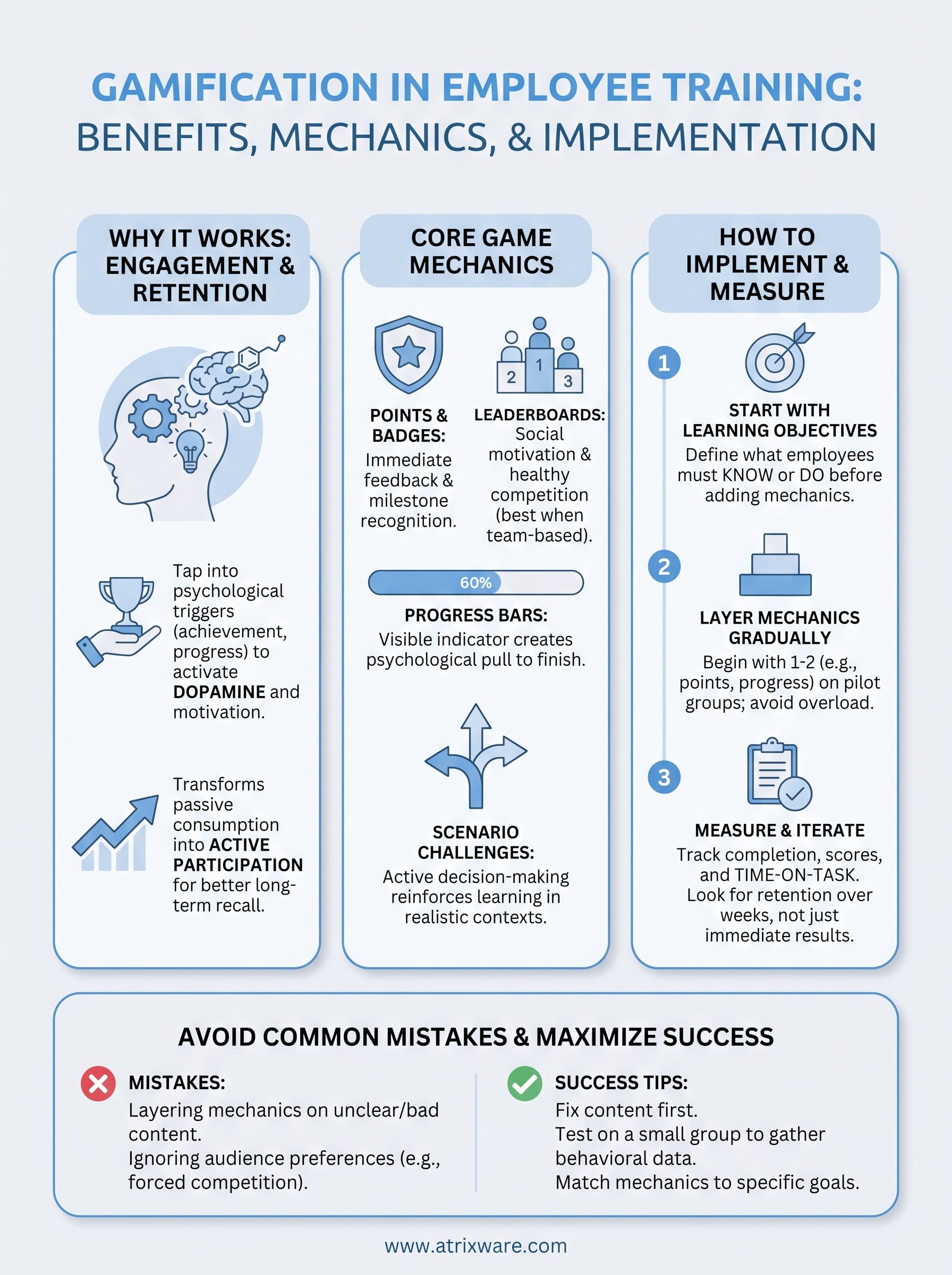
Gamification taps into how the human brain actually processes and stores information. When you introduce game mechanics like points, levels, and rewards, you activate the brain’s dopamine system, the same system that drives motivation and habit formation. That’s not an accident. It’s the core reason gamification in employee training consistently outperforms traditional methods when engagement and retention are the goals. Understanding the science behind it helps you make smarter decisions about which mechanics to use and where to use them.
The psychology of motivation
Learning stalls when people feel no sense of progress. Intrinsic motivation (the desire to improve and master a skill) and extrinsic motivation (rewards, recognition, and competition) both play a role in keeping learners engaged. Game mechanics address both at once. When an employee earns a badge for completing a module or climbs a leaderboard after a quiz, they feel recognized and challenged simultaneously. That combination keeps them returning to the next lesson rather than abandoning the course halfway through.
The moment a learner can see their own progress, their commitment to finishing increases significantly.
Retention versus passive learning
Traditional training asks employees to absorb information passively, reading slides or watching videos without any interaction. Passive learning produces poor retention, with research consistently showing that people forget the majority of what they read or watch within 24 to 48 hours if they never interact with the material. Gamified training flips this by forcing active recall and repetition through challenges, scenario-based tasks, and knowledge checks. Each time an employee answers a challenge question or replays a level to improve their score, they reinforce the neural pathways tied to that knowledge, which is where lasting retention actually comes from.
Engagement across a distributed workforce
One practical challenge every L&D team faces is maintaining consistent engagement across large, distributed workforces where employees span different roles, experience levels, and locations. Gamification handles this naturally because the core mechanics work on everyone. A new hire competing to reach the next training level and a tenured employee defending a spot on the company leaderboard are both driven by the same underlying triggers. You get measurable engagement signals at scale without needing a different training format for every audience segment. That scalability is what makes gamification especially valuable for organizations running compliance training, onboarding programs, or product certification tracks across hundreds or thousands of employees simultaneously.
What gamification is and is not
Before you build any gamified training program, you need a clear definition of what you’re actually working with. Gamification in employee training means applying game design elements to a learning context, not building a game. The goal is to use specific mechanics like points, badges, progress bars, challenges, and leaderboards to influence learner behavior and increase motivation. That distinction matters because it shapes every decision you make about design and delivery.
What gamification actually is
Gamification is a structured approach to motivation. You take elements that make games engaging, the sense of progress, the reward for achievement, the drive to compete or improve, and layer them onto your existing training content. An employee completing a compliance module earns points. A new hire unlocks a badge after finishing onboarding. A sales team competes on a leaderboard tied to product certification scores. Each mechanic reinforces the behavior you want without changing the core learning objective.
Gamification doesn’t replace good content. It gives learners a stronger reason to engage with it.
What gamification is not
Gamification is not the same as game-based learning, where employees actually play a purpose-built game to learn. It’s also not a shortcut for poorly designed content. Adding a leaderboard to a dull, confusing course won’t fix the course. It will just make employees aware that everyone else finds it confusing too. The mechanics only work when the underlying training is clear, relevant, and worth completing.
You also shouldn’t treat gamification as a one-size-fits-all solution. Some employees respond strongly to competition, while others are motivated by personal progress tracking. Knowing your audience determines which mechanics you deploy and how prominently you feature them.
Game mechanics that drive engagement and retention
Not every game mechanic belongs in every training program. The ones worth using are those that directly reinforce learning behaviors like completing modules, scoring well on assessments, and returning to practice. When you apply gamification in employee training intentionally, each mechanic serves a specific purpose rather than existing for decoration.
Points, badges, and leaderboards
Points give learners an immediate signal that their effort counts. Every quiz answer, completed module, or participation event can earn points, which creates a continuous feedback loop that keeps employees moving forward. Badges layer on top of points by marking specific achievements, finishing onboarding, passing a certification, or completing a streak of daily lessons. They give employees something to show for their progress beyond a percentage score.

Leaderboards work best when competition is opt-in or team-based, since forced individual rankings can discourage lower performers rather than motivate them.
Leaderboards drive social motivation by letting employees see where they stand relative to peers. Used well, they push high performers to stay sharp and give mid-level learners a visible, reachable target.
Progress bars and scenario challenges
Progress bars tap into something simple: people dislike leaving things unfinished. A visible completion indicator on a course or certification track creates a psychological pull toward the next step. Employees see they are 60% through a module and keep going because stopping feels like a loss.
Scenario-based challenges add decision-making stakes to training content. Instead of asking employees to read a policy, you present a realistic situation and ask them to choose how to respond. That active engagement reinforces retention far more effectively than passive review alone.
How to implement gamification step by step
Rushing straight to leaderboards and badges without a plan is the fastest way to waste time and confuse your employees. Successful gamification in employee training starts with a structured process that ties every mechanic back to a specific learning goal. Follow these steps to build a program that actually delivers results rather than just looking interactive.
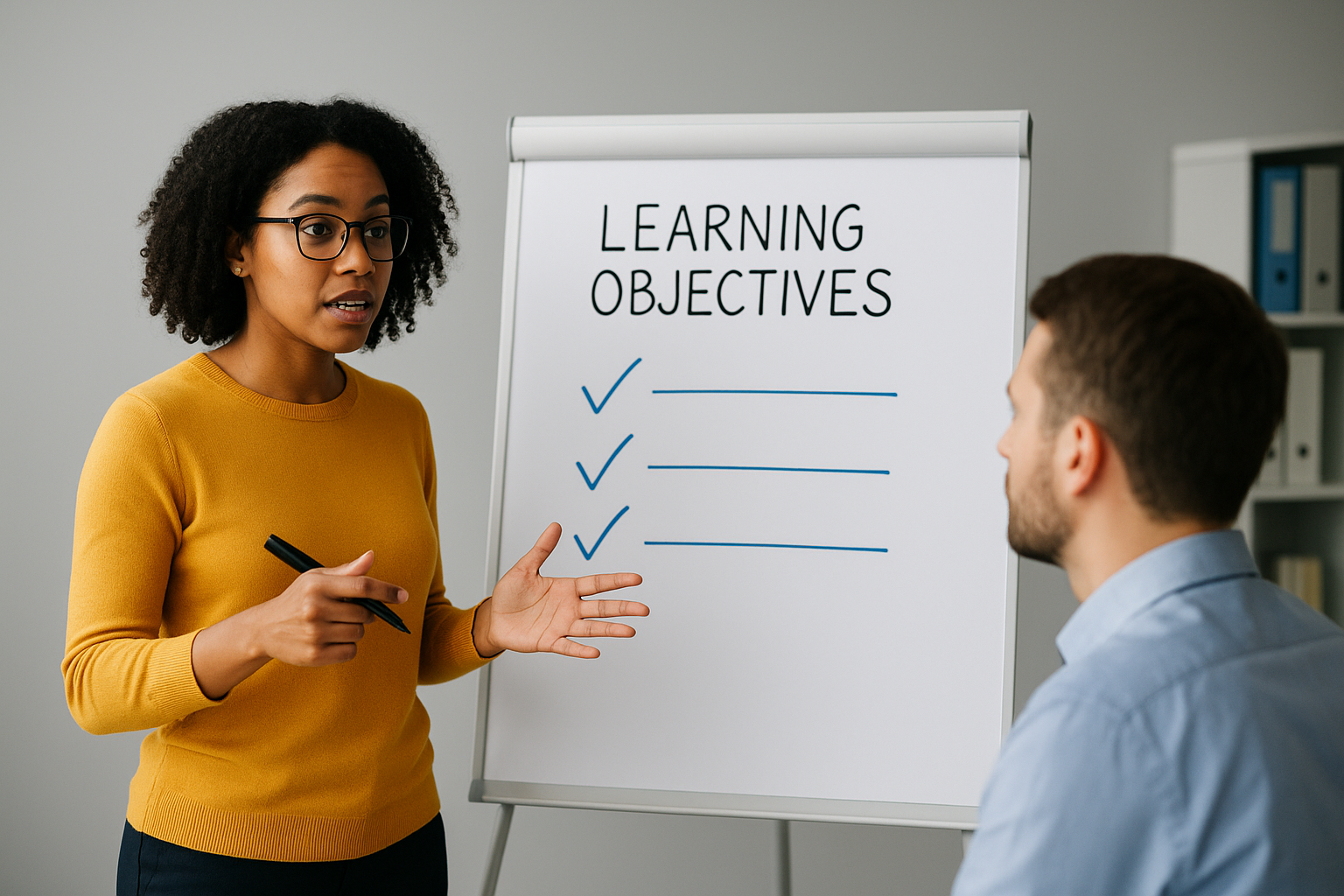
Start with your learning objectives
Define what you want employees to know or do differently before you pick a single mechanic. If your goal is faster onboarding, points and progress bars that mark milestone completions make sense. If you need stronger compliance scores, scenario-based challenges with immediate feedback are the right tool. Matching mechanics to objectives prevents you from decorating content that still doesn’t teach anything useful.
Once your objectives are clear, audit your existing training content to find weak spots. Identify which modules have the highest dropout rates or lowest assessment scores. Those are your highest-priority targets for gamification, because that’s where engagement is already failing and where improvement will show up fastest.
Build gamification onto your clearest, most relevant content first, then expand to weaker areas once you see what works.
Layer mechanics gradually
Start with one or two mechanics, such as points and a simple progress bar, before adding leaderboards or badge systems. Overloading employees with too many game elements at once creates confusion rather than motivation. Roll out your first gamified module to a small group, gather honest feedback, and adjust before scaling across the full organization. Testing on a pilot group saves you from repairing a broken rollout at full scale and gives you real behavioral data to guide every subsequent design decision.
How to measure results and avoid common mistakes
Launching gamification in employee training without a measurement plan means you’ll never know if it’s actually working. Track completion rates, assessment scores, and time-on-task before and after rolling out gamified elements. Those baseline numbers give you something concrete to compare against, and they make it straightforward to prove ROI to stakeholders who want data, not assumptions.
Track the right metrics
Completion rates and quiz scores are your first indicators, but they don’t tell the whole story. Also monitor knowledge retention over time by scheduling short assessments two to four weeks after a module closes. If scores drop sharply, the mechanics aren’t reinforcing the content effectively and you need to adjust the design.
You should also look at repeat assessment attempts, since employees who replay challenges are actively reinforcing what they learned, which is exactly the behavior gamification is designed to drive. Leaderboard activity and badge acquisition rates signal whether employees engage voluntarily or just click through to finish.
If your metrics don’t shift after introducing gamification, the mechanics aren’t matched to the right behaviors.
Mistakes that undermine results
The biggest mistake training teams make is layering game mechanics onto content that was already failing. Badges and points won’t fix a module that’s unclear, outdated, or irrelevant to an employee’s actual role. Fix the content first, then add the mechanics.
A second common error is ignoring your audience when choosing mechanics. Rolling out a competitive leaderboard for a team that values individual growth creates friction instead of motivation. Survey your employees about which mechanics they find engaging before you commit to a design. Collecting feedback mid-rollout rather than only at the end lets you catch problems before they spread across your entire training catalog.
Next steps
Gamification in employee training works because it connects learning to the same psychological triggers that drive everyday motivation: progress, achievement, and recognition. You now have a clear framework for why it works, which mechanics to use, how to roll them out, and what to measure to confirm your results are real.
The next move is yours. Start small: pick one underperforming module, apply one or two mechanics, and track what changes. Build from data, not assumptions. If your course completion rates climb and retention scores hold two weeks after training closes, you’ve found your proof of concept.
Choosing the right platform determines how much of this you can actually execute without fighting your own tools. Axis LMS was built to support gamification natively alongside robust reporting, so you can track every mechanic you deploy. Start your free Axis LMS admin demo and see exactly how it fits your training goals.
