Not every learner absorbs information the same way, at the same speed, or with the same background knowledge. Traditional training programs ignore this reality, they push identical content to everyone and hope it sticks. AI powered adaptive learning flips that model by using algorithms to adjust what each learner sees, when they see it, and how it’s presented. The result is training that responds to the individual, not the average.
For organizations using a platform like Axis LMS, understanding how adaptive learning works matters. It directly affects how well employees retain skills, how quickly new hires ramp up, and whether compliance training actually changes behavior. Atrixware builds Axis LMS to support the kind of data-driven, personalized training experiences that adaptive learning demands, giving administrators the reporting and automation tools they need to act on learner data at scale.
This article breaks down exactly what AI-powered adaptive learning is, how the underlying technology personalizes training paths, and which platforms and systems are putting it into practice. Whether you’re evaluating new tools or exploring what’s possible with your current LMS, you’ll walk away with a clear, working understanding of adaptive learning and concrete examples to reference.
Why AI-powered adaptive learning matters
Most corporate training programs measure success by completion rates, not by whether people can actually apply what they learned. That gap between "finished the course" and "changed behavior" is where traditional training falls short. When every learner gets identical content delivered at a fixed pace, some move too slowly, others move too fast, and most forget a significant portion of the material within days. AI powered adaptive learning addresses this directly by treating training as a dynamic process rather than a fixed event.
The problem with standardized training
Standardized training assumes your team starts from the same baseline. In reality, your new hire, your five-year veteran, and your recently promoted manager all bring completely different knowledge gaps to the same course. Forcing them through identical modules wastes time for experienced employees and overwhelms those who need more foundational support. Studies on personalized learning paths consistently show stronger skill retention and faster time-to-competency when compared to uniform delivery methods.
When training ignores individual differences, you’re spending money on content that doesn’t land for a significant portion of your workforce.
Why retention is the real metric
Completion rates are easy to track and easy to inflate. Actual skill retention is harder to measure but far more valuable. Adaptive learning improves retention because it reinforces concepts at the right moment, before knowledge fades, and adjusts difficulty based on how each learner is performing in real time. For compliance-heavy industries, this distinction carries real consequences. A learner who completed a module but cannot recall the key procedure presents a compliance risk, regardless of what the completion report shows.
What this means for your organization
For HR managers, training leads, and compliance officers, the case for adaptive learning comes down to return on investment. You invest in training to produce behavioral change and measurable outcomes, not to generate course completion certificates. Adaptive systems gather and act on learner data continuously, which means your training program improves over time rather than stagnating after the initial launch. The organizations seeing the strongest results are those that treat learning data as an operational asset. When your LMS surfaces actionable insights, you stop guessing about what’s working and start making targeted adjustments that actually move the needle on performance.
How AI-powered adaptive learning works
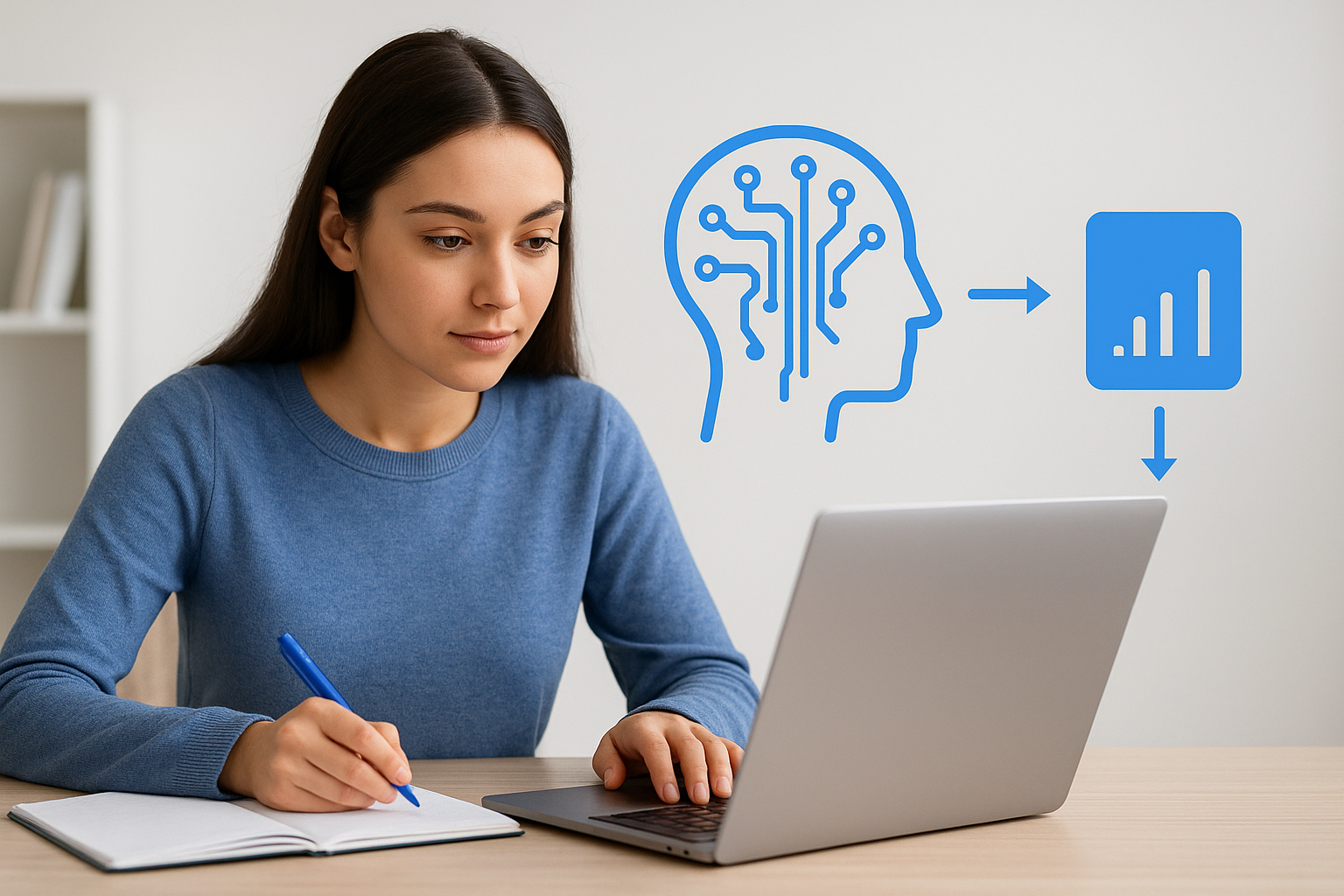
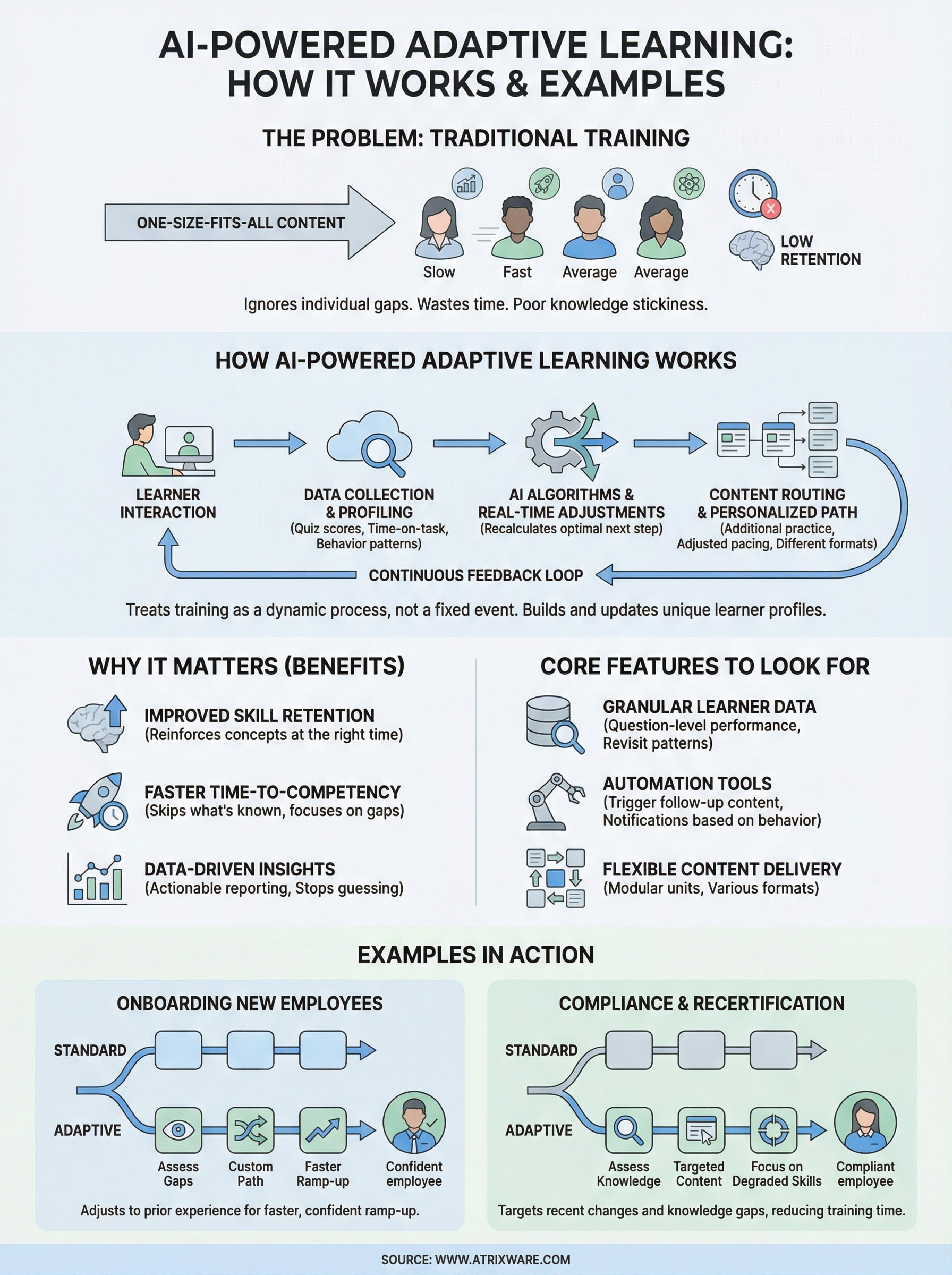
At its core, ai powered adaptive learning relies on a continuous feedback loop between the learner and the system. The platform collects data on every interaction, from quiz scores to time spent on a module to the order in which a learner revisits content, and uses that data to make decisions about what comes next.
Data collection and learner profiling
Before the system can adapt, it needs a baseline. When a learner starts a course, the platform gathers initial data points such as assessment performance, prior knowledge checks, and role-specific attributes. This builds a learner profile that the system continuously updates as training progresses.
The more interaction data the system processes, the more precisely it can route each learner toward content that actually addresses their gaps.
Over time, the algorithm identifies patterns in your behavior. If you consistently struggle with a specific concept, the system surfaces additional practice and adjusts the sequencing of future content to reinforce that area before moving you forward.
Real-time adjustments and content routing
Once the profile exists, the algorithm runs continuously in the background. Every time you answer a question, skip a section, or complete an activity, the system recalculates your optimal next step. This differs from branching scenarios where a human designer pre-builds every possible path. Adaptive systems generate routing decisions dynamically, which means the platform can respond to combinations of learner behavior that no designer anticipated in advance.
The practical result is that two people taking the same course can end up with significantly different learning paths, different pacing, different content formats, and different assessment timing, all driven by what the data shows each person actually needs.
Core features to look for in an LMS
Not every LMS that claims to support ai powered adaptive learning actually delivers it. Before you commit to a platform, there are specific features that separate systems capable of genuine personalization from those offering surface-level customization. Knowing what to look for protects you from investing in a tool that cannot scale with your training goals.
Learner data collection and reporting
The foundation of any adaptive system is granular learner data. Your LMS needs to track more than completion status. Look for platforms that capture assessment performance at the question level, time-on-task, content revisit patterns, and progression speed across sessions. Without this depth of data, the system cannot build accurate learner profiles, and without accurate profiles, adaptation is impossible. Strong reporting tools that surface this data in real time give your administrators something concrete to act on, rather than waiting until the end of a course cycle to spot problems.
An LMS that only tracks completions is not an adaptive system. It is a checkbox.
Automation and flexible content delivery
Once your platform collects learner data, it needs to act on that data automatically. Look for automation tools that trigger follow-up content, reassign modules, or send notifications based on specific learner behaviors or performance thresholds. Your administrators should not have to manually intervene every time a learner struggles with a concept. Equally important is content format flexibility. Adaptive learning works best when the system can route learners to different formats, such as video, written content, assessments, or interactive scenarios, based on what the data indicates will work for each individual. A rigid content structure limits how effectively the platform can personalize the experience, regardless of how sophisticated the underlying algorithm is.
Examples of AI-powered adaptive learning in action
Seeing ai powered adaptive learning in practice makes the concept concrete. Real-world applications show how platforms use learner data to drive outcomes that generic training simply cannot match. The following examples cover common workplace scenarios where adaptive systems consistently outperform standardized approaches.
Onboarding new employees
[New hire onboarding](https://www.training-central.net/2026/02/20/adaptive-learning-in-corporate-training/) is one of the clearest use cases for adaptive learning. When someone joins your organization, they bring different levels of prior experience and knowledge gaps that a fixed onboarding course ignores entirely. An adaptive LMS identifies where each new hire is struggling, adjusts the pacing, and surfaces additional resources automatically before moving that person forward. The result is a faster and more confident ramp-up period compared to the traditional approach of running everyone through the same sequence regardless of background.
Organizations that personalize onboarding consistently report higher 90-day retention and stronger early performance benchmarks than those using standardized programs.
Compliance and recertification training
Compliance training often gets reduced to an annual checkbox exercise where employees click through slides and pass a basic quiz. Adaptive systems change this dynamic significantly. Instead of delivering the same module to your entire team, the platform assesses existing knowledge first and routes experienced employees directly to content covering recent regulatory changes, while routing newer staff through foundational material they actually need.
When recertification cycles begin, the system identifies which specific competencies have degraded based on prior assessment data and targets those areas, rather than repeating content the learner already demonstrated competency in. This approach reduces training time for experienced employees while ensuring no real knowledge gaps slip through before the next audit or regulatory review.
How to roll it out in workplace training
Rolling out ai powered adaptive learning in your organization does not require a complete overhaul of everything you already have. Start by auditing your existing training content to identify what data points you need to collect and what learning outcomes you actually want the system to optimize for. Without clear goals, adaptive systems produce data you cannot act on.
Start with a focused pilot group
Avoid launching adaptive learning across your entire organization simultaneously. Pick a single team or department where you can closely monitor results, gather feedback, and make adjustments before scaling. Your pilot group gives you real performance data to validate that your content structure, assessment design, and routing logic are working as intended.
The pilot phase is where you discover whether your assessments actually differentiate knowledge gaps or just sort learners by test-taking speed.
Track specific metrics during the pilot: time-to-competency, assessment scores before and after adaptation kicks in, and whether learners who received adjusted content outperform those who did not. These numbers build the internal case for a broader rollout.
Align your content structure with how adaptation works
Adaptive systems need modular content to route learners effectively. If your courses are built as long, linear sequences with no breakpoints, the platform cannot redirect a learner mid-stream. Break your existing content into smaller, standalone units organized around single competencies or learning objectives. This structure also makes it easier to update content without rebuilding entire courses.
Your LMS administrator plays a critical role here. Make sure they understand which learner behaviors trigger which actions in your automation rules, so the system responds correctly when a learner falls below a performance threshold.
Final thoughts
AI powered adaptive learning is not a future concept you need to prepare for eventually. It is a practical approach to training that organizations are implementing right now to close real skill gaps, reduce wasted training time, and produce measurable behavioral change. The technology works because it treats each learner as an individual, not as one entry in a completion report. When your LMS collects granular data, acts on it automatically, and routes learners toward content they actually need, your training programs stop being a formality and start driving real outcomes.
Your next step depends on where you are in the process. If you are still figuring out what your organization needs from a learning management system, start by identifying your gaps. Axis LMS is built to support the kind of data-driven, personalized training this article describes, and you can see it directly by signing up for an Axis LMS admin demo today.
