
Every assessment you build starts with the same challenge: creating questions that are organized, reusable, and fair. Whether you’re running compliance training, onboarding new hires, or certifying channel partners, the quality of your assessments depends on how well you manage the items behind them. That’s where understanding what is a question bank becomes essential, it’s the foundation that separates a thrown-together quiz from a structured, reliable evaluation.
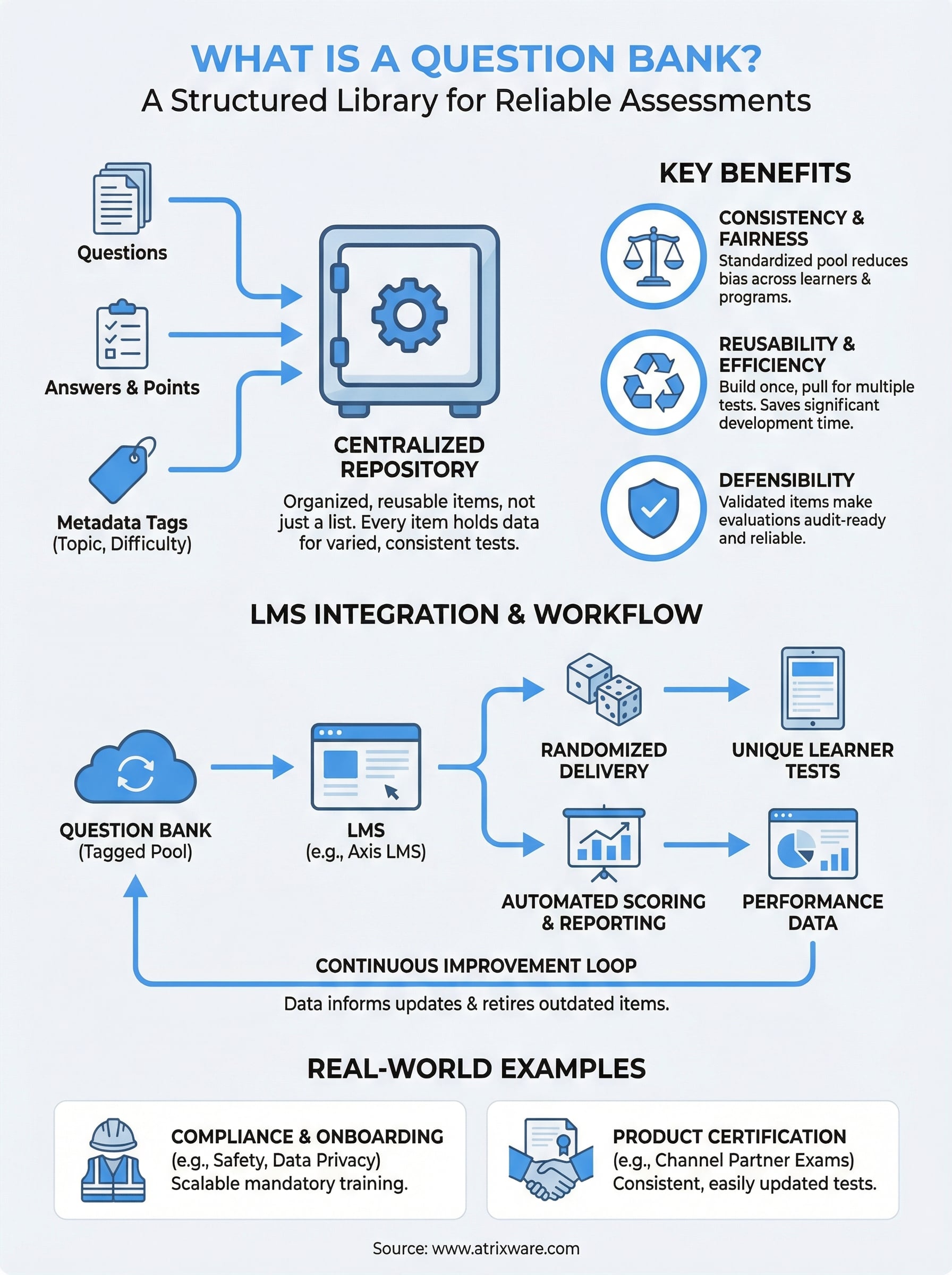
A question bank is a centralized repository of assessment items that you can pull from, randomize, and reuse across multiple tests and courses. Instead of writing new questions from scratch every time, you draw from a pre-built library that keeps your assessments consistent and your workload manageable. For teams using a platform like Axis LMS from Atrixware, question banks integrate directly into course building, making it straightforward to create varied assessments at scale.
This article breaks down how question banks work, where they’re used, and why they matter for anyone serious about delivering effective training and assessments.
What a question bank includes
When you ask what is a question bank, the answer goes beyond a simple list of questions. A question bank is a structured library where every item holds more than just the question text. Each entry typically includes the question itself, answer options, the correct answer, point value, difficulty level, and metadata tags that help you locate and organize items quickly. That depth of stored information is what makes the bank genuinely useful rather than a basic spreadsheet.
The types of questions you can store
A well-built question bank supports multiple question formats so you can match the assessment style to the specific learning objective you’re targeting. Common formats include multiple choice, true/false, fill-in-the-blank, matching, and short answer. Some platforms also support image-based or scenario-based questions, which are especially valuable for compliance and safety training where context is critical. Mixing question types within a single bank gives you the flexibility to build assessments that test both recognition and recall, covering a range of cognitive levels without starting from scratch each time.
The broader your question format library, the more flexible and accurate your assessments become across different training programs.
How questions are organized and tagged
Organization is what separates a useful question bank from a cluttered collection of content. Tagging each question with attributes like topic, difficulty, learning objective, or course module lets you filter and pull specific subsets when building an assessment. For example, you could tag 50 questions as "intermediate" under the "data privacy" topic, then configure a randomized quiz to draw 10 of them automatically each time a learner takes the test.

Metadata and categorization also make it far easier to audit your bank over time. You can identify coverage gaps, retire outdated items, and flag questions that learners consistently miss or answer too easily. When your bank is well-tagged and consistently maintained, building a new assessment takes minutes rather than hours.
Why question banks matter in training and testing
Understanding what is a question bank explains why it matters beyond simple organization. Without a centralized library, assessments become inconsistent across courses and instructors, making it harder to trust your data. A question bank gives your organization a single source of truth for assessment items, so every learner gets evaluated against the same validated standards.
Consistency and reusability across programs
When you pull from a shared, tagged question pool, you reduce the variation that comes from building tests by hand each time. Two learners taking the same certification may see different questions, but both come from the same validated set at equivalent difficulty levels. This makes your evaluations far more defensible when auditors or compliance reviewers examine your training records.
A consistent question pool removes the bias that comes from hand-selecting questions each time an assessment runs.
Your existing library also transfers across programs with minimal rework. A question built for this year’s compliance refresher can carry over to next year’s course or a similar onboarding module without rebuilding from scratch. Over time, your bank becomes a reusable asset that cuts development time on every new course you launch, while maintaining the quality and standards your organization already relies on.
How question banks work in an LMS
When you understand what is a question bank at the platform level, the mechanics become clear. An LMS like Axis LMS connects your question bank directly to the course builder, so you can link any assessment to your stored library and configure exactly how items get pulled, displayed, and scored, all without rebuilding the questions themselves each time.
Randomization and delivery settings
The most practical feature of a question bank inside an LMS is randomized delivery. You set a rule, say draw 15 questions from a tagged subset of 60, and the system handles the rest. Each learner gets a unique combination of items pulled from the same validated pool, which reduces answer sharing and makes your assessments more meaningful across a large group.
Randomization keeps assessments fair without requiring you to write an entirely new test for every session.
Scoring and reporting connections
Your LMS ties every question delivered back to learner records and reporting dashboards. When a question underperforms, say too many learners answer it correctly or incorrectly at unusually high rates, those patterns surface directly in your data. You can use that information to flag specific items for review, update them in the bank, and immediately improve every future assessment that draws from the same pool.
This feedback loop makes an LMS-connected question bank more powerful than a standalone document. Your assessment data continuously informs question quality, so the bank improves over time rather than staying static.
How to build and maintain a question bank
Building a question bank starts with a clear content audit. Before writing a single question, map your training objectives to the topics you need to assess, then determine how many items per topic you need to support randomization without repeating questions too quickly. A practical starting point is storing at least three times the number of questions you plan to deliver in any single assessment run.
Writing questions that hold up over time
When you think about what is a question bank at its most practical level, question quality determines long-term value. Write each item with a single, defensible correct answer and avoid phrasing that tips learners off without actually testing their knowledge. Tag every question immediately after writing it using consistent labels for topic, difficulty, and learning objective, so your bank stays searchable from day one.
Questions that are clear, unambiguous, and properly tagged from the start require far less rework as your training library grows.
Keeping your bank current
Your bank needs regular review cycles to stay accurate and relevant. Schedule a quarterly audit where you pull performance data from your LMS, retire questions that no longer reflect current policies or procedures, and replace outdated items with updated versions. Flagging questions based on pass rates and learner performance data makes those audits faster and more targeted than reviewing every item manually.
Examples of question banks in real programs
Seeing what is a question bank applied across real programs clarifies its value quickly. Organizations in different industries build question banks shaped by their specific training outcomes, from regulatory requirements to product knowledge and professional certification.
Compliance and employee onboarding programs
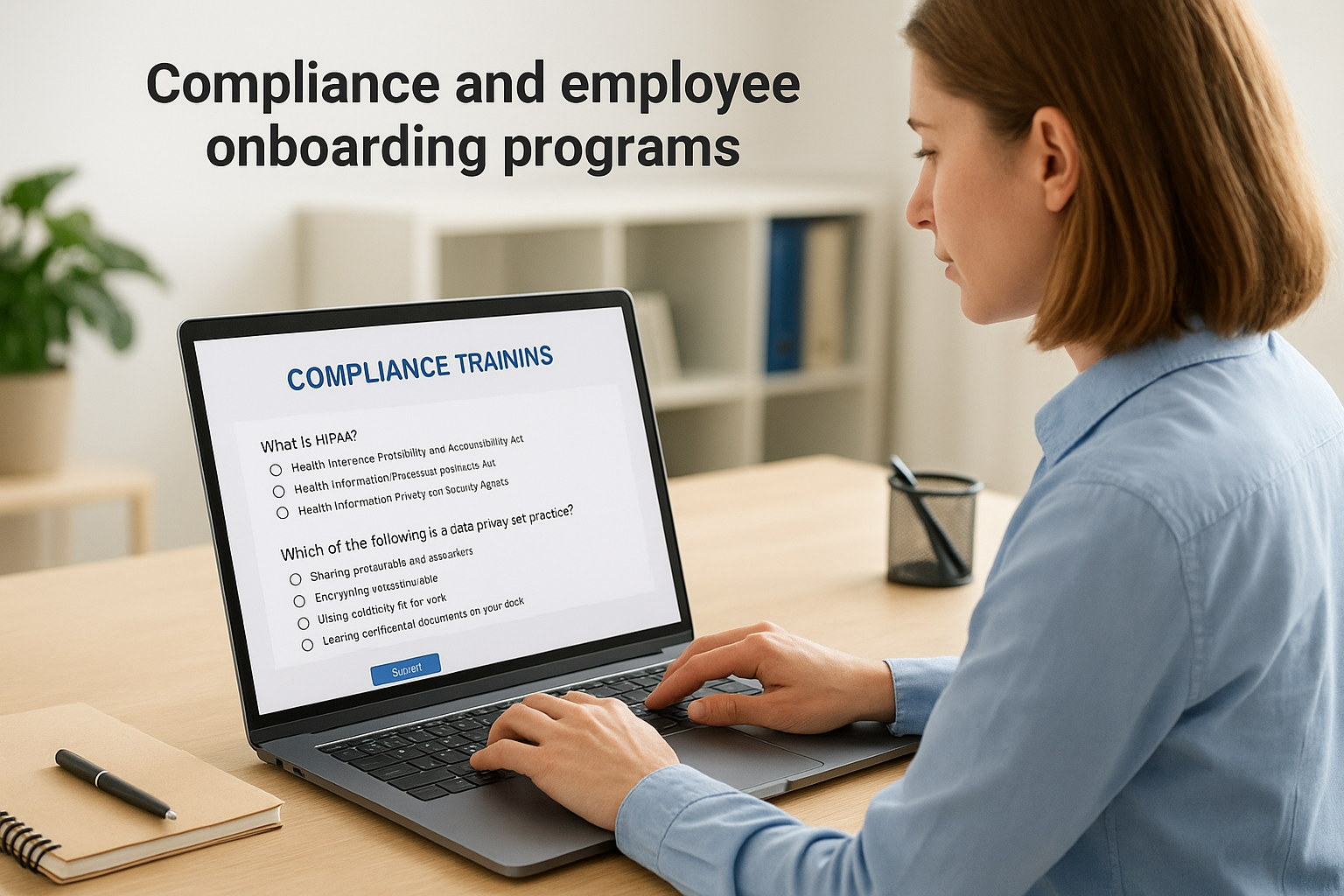
Companies running mandatory compliance training, such as HIPAA, workplace safety, or data privacy, maintain large question banks with hundreds of items tagged by topic and regulation. When a new hire completes onboarding, the system pulls a randomized subset from that pool so no two learners see an identical test while still covering every required area. Common training programs that rely on this approach include:
- Annual safety recertification
- GDPR and data privacy awareness
- Anti-harassment and workplace conduct
A well-maintained compliance bank lets you scale mandatory training across hundreds of employees without rebuilding assessments each cycle.
Product certification and customer training
Organizations that certify channel partners or customers on a product line use question banks to keep exams consistent across regions and cohorts. A software company might store 150 product knowledge questions tagged by module and difficulty, then configure a 30-question exam that draws proportionally from each area. When the product updates, they revise only the affected items in the bank, and every future exam reflects those changes automatically.
This same model applies to professional associations running continuing education exams, where the question bank stores hundreds of validated items and the exam engine handles delivery without manual rebuilding each cycle.
A quick recap
Understanding what is a question bank gives you a clearer picture of how well-structured assessments actually work. A question bank is a centralized library of tagged, reusable items that powers consistent, randomized testing across your entire training program. Instead of rebuilding evaluations from scratch, you draw from a validated pool that improves over time as you review performance data and retire outdated content.
Your question bank becomes more valuable the more intentionally you build and maintain it. Tagging questions by topic, difficulty, and objective from the start keeps your library searchable, your audits focused, and your assessment builds fast. When connected to an LMS like Axis LMS, that library feeds directly into automated delivery, scoring, and reporting, so your training data stays accurate and your assessments stay defensible.
If you’re ready to see how this works in practice, take the LMS readiness quiz to find out where you stand.
