The best new hire training ideas share three traits. They teach the job in small pieces, they connect the person to colleagues in week one, and they check back early so problems surface while you can still fix them. If you run a small team, start with a buddy and a 30-60-90 plan. If you hire in waves or across locations, start with a self-paced course path in an LMS. If culture is your weak spot, start with icebreakers and leader sessions.
Most new hires still get a stack of forms and a quick tour. Gallup found that only 12 percent of employees felt their company did a great job with onboarding, and only 29 percent of new hires felt prepared and supported to excel in their new role. That gap is your opening. The seven ideas below each come with steps you can run, the kind of team each one suits, and the mistakes that sink it.
Atrixware has served the learning management system industry since 1997, so the first idea draws on how companies move onboarding online. The list also covers the five C’s of onboarding that HR teams often cite: compliance, clarification, culture, connection and check-back. Pick two or three ideas, not all seven, and build from there.
1. Build a self-paced onboarding path in an LMS
A self-paced onboarding path gives every new hire the same core training from day one, without tying up a manager for each session. It handles the compliance and clarification parts of onboarding best, which leaves your people free for the human ideas later in this list.
Put the repeatable content in a course path, and spend manager time on coaching.
How to put it into practice
With Axis LMS, you build courses in a drag-and-drop interface, group them into a path, and bring in user data from HR systems such as ADP, BambooHR, Salesforce and Zoho, so new records appear without retyping. The built-in AI can generate quizzes, surveys and e-learning presentations from a topic or a document, which gives you a fast first draft of a course from your employee handbook. If you lack content, the Pick-100 Bundle lets you choose 100 titles from a library of 25,000, and the Professional and Career Dev collection offers 21 courses.
- Split orientation into modules of 10 to 15 minutes: company background, policies, safety and compliance, tools, and role basics.
- End each module with a short quiz and a passing score.
- Use automated messages to remind late learners and alert their manager.
- Pull a completion report for each cohort and review it at the 30-day check-in.
Who it suits and what to watch for
This idea suits companies that hire in waves, run several locations, or must prove that compliance training was completed. Axis LMS Lite is built for 25 to 100 employees and customers, while Axis LMS covers organizations of 150 to 100,000 users.
The risk is a path that feels cold. Courses cannot replace a welcome, so pair this idea with the buddy and check-in ideas below, and keep the whole path short enough to finish early in the first weeks.
2. Send a preboarding welcome before day one
Preboarding removes first-day anxiety before it starts. Send a personal welcome, the first-week schedule and the names of the people they will meet, then make sure equipment and accounts work on arrival. It covers the connection and clarification parts of onboarding.

A new hire who arrives to a working laptop and a friendly note has already learned that you were expecting them.
How to put it into practice
Start with the setup. SHRM reports that Facebook uses a "45-minute rule," meaning new employees can begin work within 45 minutes of arriving because their systems and devices are ready. You do not need that speed, but you do need accounts tested before the start date. Then add human touches that cost almost nothing:
- A welcome email from the manager with the schedule, where to go or how to log in, and who to ask for help.
- A short video greeting from the supervisor, so the new hire can match a face to a name.
- A brief questionnaire about favorite snacks or drinks, so a small treat waits at the desk.
- A team announcement with the new hire’s background and a fun fact or two.
Who it suits and what to watch for
It suits every company size, and it matters most for remote hires, who have no office to walk into. For them, ship the laptop early and book a video call for the first morning.
Keep it light. Required tasks before the start date can raise wage questions for hourly staff, so stick to optional, welcoming items unless you pay for the time, and ask your HR or legal adviser if you plan anything more.
3. Pair every new hire with a buddy
A buddy program pairs each new hire with a peer, not their manager, who answers the small questions people hesitate to ask a boss. It is the most direct answer to the fear of not knowing anyone, which is a common source of stress in the first weeks.
A buddy answers the questions a new hire would never put in an email to the boss.
How to put it into practice
Choose buddies who have been with the company at least a few months, so they still remember being new. Pairing across departments widens the new hire’s network beyond their own team. Give each buddy a one-page guide and protected time, or the program fades by week three.
- Day one: lunch together, or a virtual coffee for remote pairs.
- Week one: walk through unwritten rules such as meeting habits, who approves what, and where files live. Introduce five colleagues.
- Weeks two to four: a 15-minute chat each week.
- Day 30: the buddy shares a short note with the manager on how things are going.
Who it suits and what to watch for
Small teams without dedicated trainers get the most from this idea, because it costs time, not money. It also works for remote and hybrid teams if you schedule the calls instead of hoping they happen.
The usual failure is overload. Do not hand every new hire to your best performer, and rotate buddies so no one carries more than one newcomer at a time. A buddy is a guide, not an evaluator, so keep performance feedback with the manager.
4. Mix icebreakers and culture sessions into week one
Short, structured icebreaker activities and leader sessions teach culture faster than a slide about values. They also give new hires a reason to talk to people outside their team, which supports the culture and connection goals. This is the idea to pick when you want fun activities for new hire orientation.

Culture is learned from the people and stories a new hire meets in week one, not from the values poster.
How to put it into practice
Choose two or three activities, not six. Mix one that spreads over the week with one live session and one leader conversation, such as a Q&A where a founder or executive explains the company’s history and direction. A lunch with an executive works too.
| Activity | How it works | Time | Format |
|---|---|---|---|
| Org chart meet-up | New hire gets an org chart and collects one fact about each person on their team | Spread over week one | In person or remote |
| Scavenger hunt | Riddles lead to key places and people in the office | 45 minutes | In person |
| Bingo | Squares list experiences, such as "has lived abroad"; new hire collects signatures | 20 minutes | In person or chat |
| Two truths and a lie | Each person shares three statements about themselves | 15 minutes | Both |
| Fridge photo share | Everyone shares a photo of their fridge and talks about it | 15 minutes | Remote |
Who it suits and what to watch for
Cohort-style hiring suits this idea best, because new hires bond with each other as well as with veterans. A "100th day" celebration for everyone hired in the past 100 days extends the bonding beyond week one.
Respect introverts. Let people pass on any prompt, keep personal questions light, and avoid anything that forces disclosure. Each activity should run under 30 minutes, or it turns into a delay before real work.
5. Use job shadowing and a 30-60-90 day plan
A 30-60-90 day plan turns "learn the job" into three clear stages of increasing responsibility, with shadowing at the start. It gives the new hire clarity and gives the manager a way to see progress before the 90-day review.
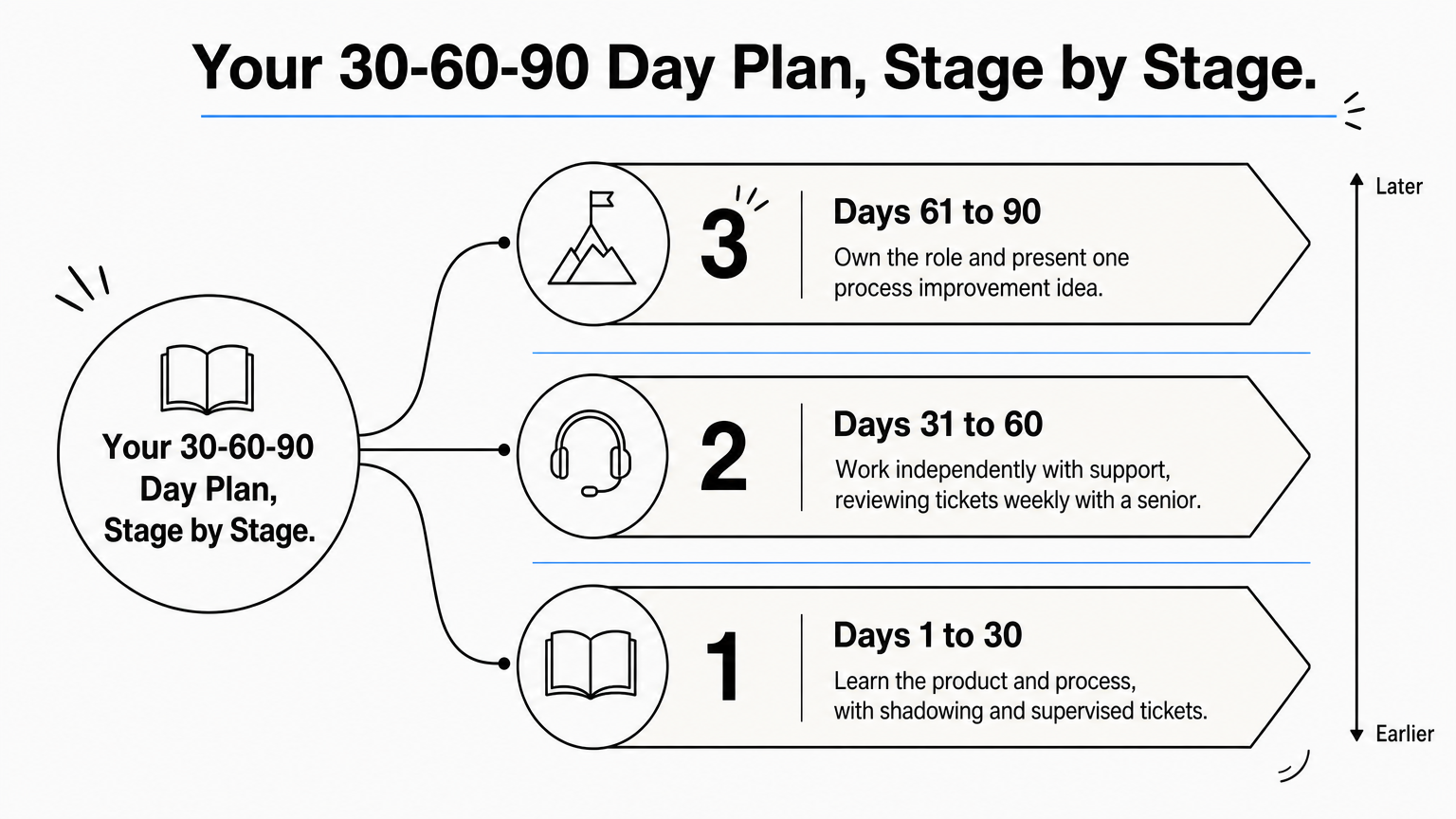
Give new hires a ladder of tasks, so they always know what the next rung is.
How to put it into practice
Write the plan before the person starts, and share it on day one. Each stage needs a goal, the training activities that lead to it, and one way to check it. The example below is for a customer support rep. Adjust the numbers to your role.
| Period | Goal | Training activities | How you check |
|---|---|---|---|
| Days 1 to 30 | Learn the product and process | Complete 8 course modules, shadow 10 customer conversations, handle 5 tickets with supervision | Quiz scores and buddy feedback |
| Days 31 to 60 | Work independently with support | Handle a personal queue, review 5 tickets a week with a senior, shadow one escalation | Quality review of sampled tickets |
| Days 61 to 90 | Own the role | Handle the full queue, present one process improvement idea | 90-day review with the manager |
Who it suits and what to watch for
It suits any role where the work can be broken into stages, including sales, support, operations and technical roles. Managers who juggle many hires gain the most, because the plan replaces improvised first weeks.
Do not set the plan once and forget it. Review it at each stage with the new hire, and adjust the pace if they move faster or slower than you expected. A plan that ignores reality becomes one more form to sign.
6. Turn product and policy training into games and microlessons
Gamified quizzes and microlessons make dense material stick because people retrieve answers instead of rereading slides. Use them for product knowledge, policies and process steps, where facts matter more than judgment.
Quiz new hires on what they just learned, and it sticks better than another slide.
How to put it into practice
Run a Jeopardy-style board after the first week, with categories drawn from your own training: products, policies, tools and company history. A "Coworker Feud" format works the same way, using fun facts about the company and its people. Between sessions, send lessons of three to five minutes that new hires can finish between tasks. If you use an LMS, the AI quiz generator mentioned in idea 1 can draft the questions from your documents.
- Mix new hires and veterans on teams of three or four.
- Draw 25 questions from real training content, five categories of five.
- Reward with recognition, not cash.
- Note the missed questions and re-teach them at the next check-in.
Who it suits and what to watch for
Roles heavy on product or policy knowledge benefit most, such as sales, support and regulated work. The game also shows you which topics your training explains badly, because the same questions get missed again and again.
Competition can stress people who are already nervous. Keep teams mixed, skip public leaderboards for individuals, and make wrong answers a teaching moment. Virtual reality simulations exist, but most teams get better returns from quizzes and scenario questions first.
7. Schedule check-ins and let new hires improve onboarding
Structured check-ins show whether your training works while you can still fix it. Hold a weekly one-on-one through the first 90 days, survey at 30, 60 and 90 days, and ask new hires what is missing. This is the check-back step of onboarding, and the one most companies skip.
Onboarding is finished when the new hire says it is, not when the checklist is.
How to put it into practice
Keep the one-on-one to 30 minutes and ask the same questions each time, so you can see change. Many structured onboarding checklists continue these meetings for six months, so you can decide how long yours should run. Invite new hires to present their ideas for improving onboarding to whoever owns it. They have the freshest view of the gaps, and you get a useful report for free.
- What has been clearer than you expected, and what less clear?
- Which training session helped most, and which could you cut?
- Who have you met, and who do you still need to meet?
- What would you change about your first week?
Who it suits and what to watch for
Every company can run this, and it costs only time. If you use an LMS, compare completion rates and quiz scores with the survey answers to spot modules that confuse people.
Asking without acting does damage. Tell each new hire what changed because of their feedback, and share the changes with the next cohort. When a point cannot be fixed, say why, and the feedback will keep coming.
Where to start with your new hire program
The ideas that work share a pattern. They put repeatable content in a course path, put people in contact with each other early, and check back before small problems grow. Start with the weakest link. If managers repeat the same walkthrough every month, build the course path. If new hires feel isolated, set up buddies. If you cannot tell whether training works, add check-ins.
You do not need all seven in the first quarter. Two ideas run well beat seven run badly, and a plan that your managers actually follow beats a perfect one that they skip.
If an online course path is your next step, see how it would look in your own system with an Axis LMS admin demo and start building your first onboarding modules.
