CSR is no longer a side project handled by one well-meaning employee. Boards ask about it, customers research it before buying, and job postings now list
1. Sustainable Business Strategy from Harvard Business School
Harvard Business School’s online offering through HBS Online tackles corporate social responsibility training from a strategy angle rather than a compliance one. It treats sustainability and social impact as core business levers, not side projects, which fits a school known for case-based rigor. If you want a program that carries genuine brand weight on a resume, this is the one most hiring managers recognize instantly.
What it covers
The course builds around case study methodology, using real companies to show how environmental and social commitments affect profitability, risk, and competitive position. Learners work through frameworks for stakeholder capitalism, shared value creation, and measuring social impact alongside financial returns. It’s less about writing a CSR policy and more about defending one in a boardroom.
Format and duration
Expect a self-paced online format spread across roughly 6 to 8 weeks, with a workload of 4 to 6 hours weekly. Sessions rely on video lectures, cold-call style discussion prompts, and written case analyses submitted through the HBS Online platform.
A course built on real boardroom decisions teaches CSR strategy better than any slide deck ever could.
Who it’s for
This program suits mid-career and senior professionals: directors, VPs, and executives who need to justify sustainability investments to a board or executive team. It’s a strong fit for anyone tasked with training corporate social responsibility initiatives across a leadership layer rather than a single department, then pushing that learning down through an employee training platform.
Cost and certification
Pricing sits between $1,750 and $2,400 depending on current promotions, and completers receive a Harvard Business School Online certificate of completion. There’s no accredited degree credit attached, but the certificate carries real recognition in corporate and executive circles, and it’s the kind of credential worth logging in a system built for CEU and certification tracking.
2. A strategic approach to CSR on edX
edX hosts a shorter, more affordable alternative built by RITx (Rochester Institute of Technology), and it’s aimed at people who want a working grasp of CSR frameworks without a Harvard-sized price tag. This course leans academic but stays practical, walking through how companies build responsibility into daily operations rather than just annual reports.
What it covers
The curriculum covers CSR theory and frameworks, stakeholder analysis, and the business case for sustainability initiatives. It also touches on corporate governance structures that support ethical decision-making, giving learners a foundation before they tackle implementation.
Understanding the theory behind CSR frameworks makes every later implementation decision easier to defend.
Format and duration
It runs self-paced over roughly 4 weeks, requiring 2 to 4 hours per week, all delivered through video modules and short quizzes on the edX platform.
Who it’s for
This fits early-career professionals, students, and anyone new to training corporate social responsibility concepts who wants a low-commitment entry point.
Cost and certification
Auditing the course is free; a verified certificate costs around $99. There’s no accreditation attached, but the certificate signals initiative to employers screening entry-level candidates.
3. Business strategies for social impact on Coursera
Coursera hosts this program from the University of Virginia’s Darden School of Business, aimed at professionals who want CSR training tied directly to measurable business outcomes. Darden built its reputation on case-based teaching, and that approach carries over here, with a heavy focus on turning social good into a genuine growth strategy rather than a marketing line.
What it covers
Learners work through impact measurement frameworks, partnership models between corporations and nonprofits, and strategies for embedding social impact into core operations, much the way L&D teams align learning metrics with bottom-line performance. The course also examines how companies balance shareholder pressure with stakeholder engagement, using real corporate examples throughout.
Social impact only sticks when it’s measured with the same rigor as revenue.
Format and duration
It runs self-paced across about 4 weeks, with a workload of 3 to 5 hours weekly, delivered through video lectures, peer-reviewed assignments, and discussion forums.
Who it’s for
This suits mid-level managers, sustainability coordinators, and nonprofit partnership leads who need practical frameworks rather than academic theory alone.
Cost and certification
Coursera offers this through a subscription model, typically $49 to $79 monthly, and learners earn a shareable Darden certificate upon completion, plus a 7-day free trial to sample the content first.
4. Corporate social responsibility certificate at CU Boulder
The University of Colorado Boulder offers this program through Coursera as a full specialization rather than a single course, giving learners a multi-course path into CSR instead of a quick overview. It’s built by business school faculty and leans into practical application, which makes it a solid middle ground between the academic edX option and Harvard’s executive-level pricing.
What it covers
The specialization walks through sustainability reporting, ethical supply chain management, and stakeholder communication strategies. Later modules focus on building a CSR program from scratch, including how to set measurable goals and report progress to leadership and investors, the same documentation habit behind any compliance training system.
A CSR credential only matters if it teaches you to report progress, not just define it.
Format and duration
Learners work through four courses self-paced, totaling roughly 3 to 4 months at 3 to 5 hours weekly, delivered via video lectures and applied projects.
Who it’s for
This suits professionals building a CSR function from the ground up, particularly sustainability managers and operations leads who need implementation skills, not just theory.
Cost and certification
Pricing follows Coursera’s subscription model, around $49 monthly, and completers earn a CU Boulder specialization certificate.
5. Master course in corporate social responsibility on Udemy
Udemy’s offering comes from independent instructors rather than a university, which means pricing drops sharply while the depth stays surprisingly solid. This option suits self-starters who want corporate social responsibility training without enrolling through an institution or waiting for a cohort start date.
What it covers
The course walks through CSR fundamentals, ethical business practices, environmental responsibility, and philanthropic strategy. It also covers CSR reporting basics and how smaller companies without dedicated sustainability teams can still build credible programs.
Format and duration
Expect roughly 6 to 8 hours of on-demand video, fully self-paced, with lifetime access once purchased. There’s no cohort, no deadlines, and no live discussion component.
A cheap course still teaches real skills if you actually finish it.
Who it’s for
Small business owners, freelancers, and early-career professionals who want a working understanding of CSR without academic overhead fit this course best, especially those later training staff through an LMS built for small businesses. It’s also useful for anyone comparing options before committing to training corporate social responsibility programs at a higher price point.
Cost and certification
Pricing typically runs $15 to $130 depending on sales, and completers receive a Udemy certificate of completion with no formal accreditation attached.
Choosing the CSR course that fits your goals
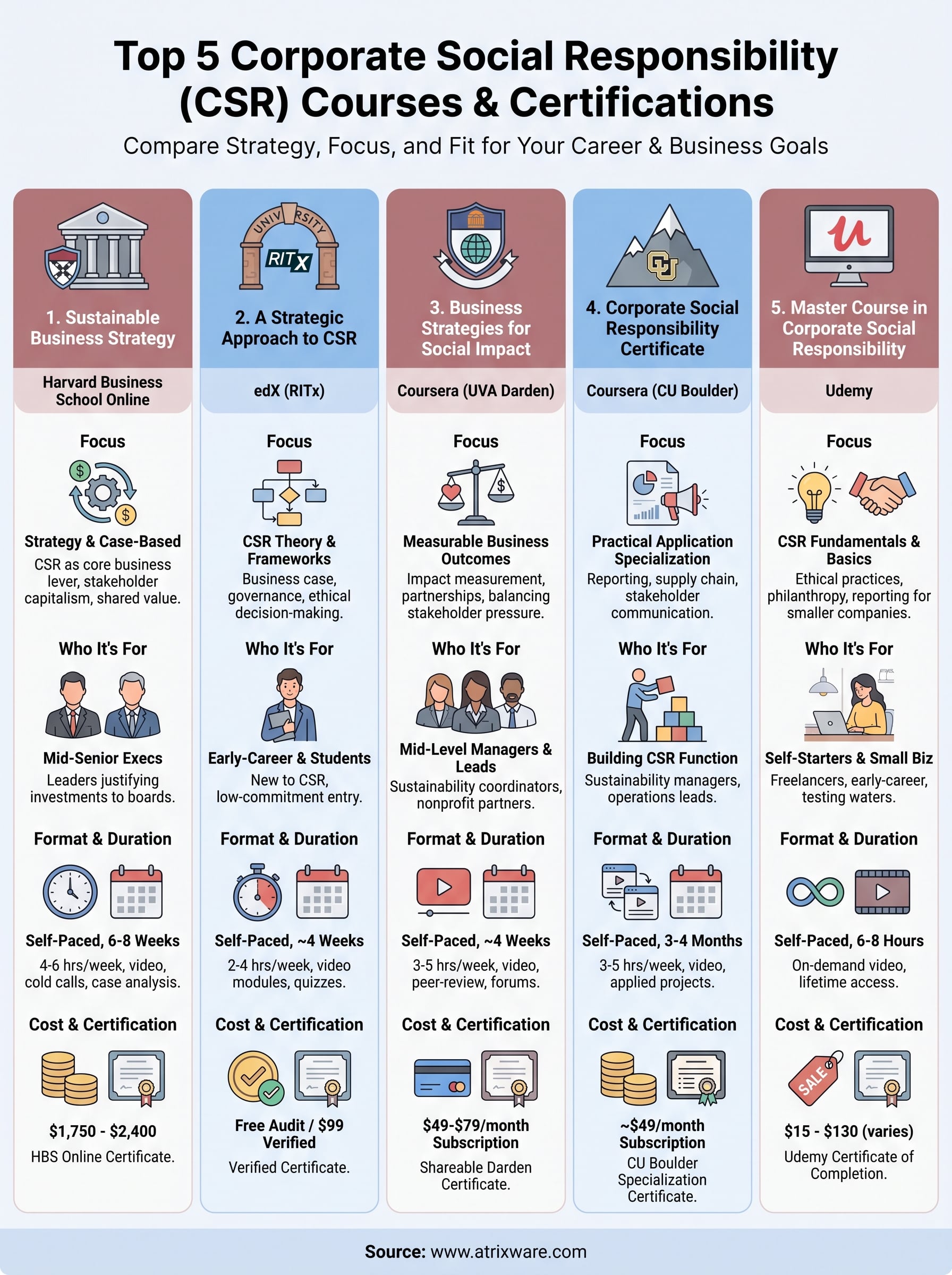
Picking the right course comes down to matching format and depth to your actual role, not the flashiest name on the list. Executives justifying budget to a board should lean toward Harvard’s case-based rigor, while a sustainability manager building a program from scratch gets more mileage from CU Boulder’s specialization or Coursera’s Darden course. Someone just starting out, or a small business owner testing the waters, does fine with edX or Udemy before spending real money.
Once you’ve finished any of these courses, the real work starts: rolling that corporate social responsibility training out to your own teams. That means tracking completions, managing certificates, and proving compliance to leadership, none of which a course certificate handles for you. If you’re weighing whether your organization needs a dedicated system to manage that rollout, find out if your organization is ready for an LMS before you spend anything.
