Searching for compliance training online confined space comes down to one decision: match the course to your OSHA role. Workers who stay outside a permit space need an awareness course. Entrants, attendants and entry supervisors each need training on their own duties. Rescue teams need hands-on practice that no online course replaces. A good pick cites 29 CFR 1910.146 (or the construction rule), issues a certificate with your name and date, and states its price and hours up front.
The trouble is that most course pages blur these roles. OSHA does not approve or certify individual online confined space courses, and the standard puts the duty on the employer to train people and keep records. Federal OSHA sets the baseline in 29 CFR 1910.146 for general industry. Construction falls under Subpart AA, and state-plan states such as California add their own rules.
This list covers five options. Four are role-based courses, and the fifth is a way to run your own site-specific training in a learning management system. Each item shows what it covers, who it suits, and the price and duration to expect.
1. Awareness-level course for non-entrants
What it covers
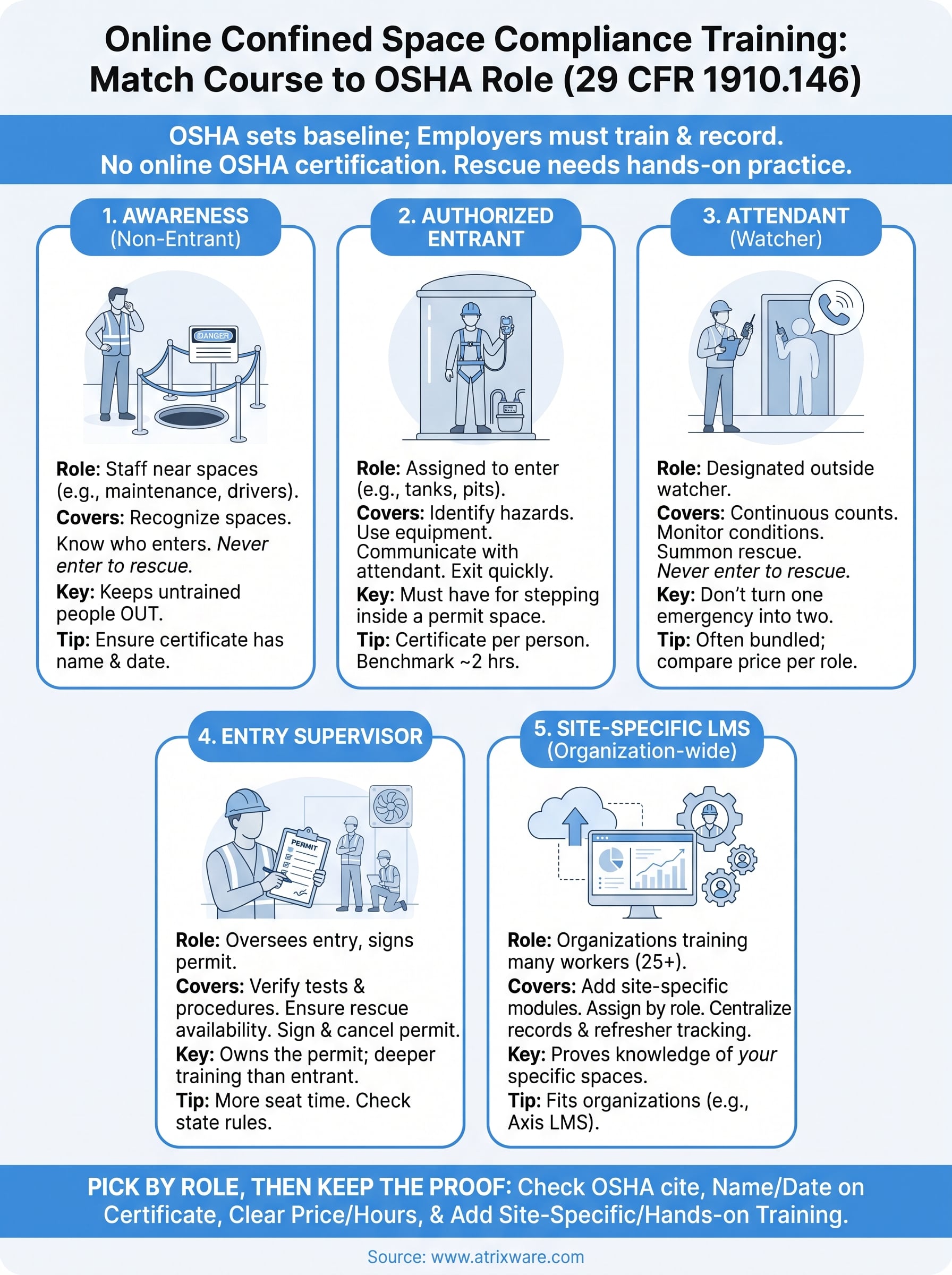
An awareness course teaches you to recognize a permit-required confined space and to know who may enter it, so you never walk in by mistake. A permit space is large enough to enter, has limited entry or exit, is not built for continuous occupancy, and carries a hazard such as a toxic atmosphere or engulfment risk. Expect modules on warning signs, the permit system, and why you never enter to rescue a coworker.
Awareness training keeps untrained people out of spaces they are not authorized to enter.
Who it suits
This is the right course for maintenance staff, custodians, drivers and contractors who work around manholes, tanks and vaults without entering them. Lion lists its awareness-level course for exactly this group: employees who work near hazardous confined spaces but are not authorized for entry.
Price and duration
Lion lists its course at $29, and the course page gives the seat time. Free awareness material also exists. Before you rely on it, check that it issues a completion record with your name and date, because your employer needs proof of training.
2. Authorized entrant course
What it covers
The entrant course is the core of any online confined space program. It covers identifying permit spaces, atmospheric and physical hazards, and permit-required entry procedures. Under 1910.146, an authorized entrant must be able to:

- Name the hazards of the space and the signs of exposure.
- Use the required equipment correctly, including testing, ventilation and protective gear.
- Communicate with the attendant.
- Alert the attendant when warning signs or a prohibited condition appear.
- Exit quickly when ordered or when danger shows up.
If you will step inside a permit space, an awareness course is not enough. You need entrant training.
Who it suits
Take it if you are assigned to enter tanks, pits, silos, sewers or vessels. Employers often enroll crews as a group, so this course must produce a certificate per person.
Price and duration
eTrainToday lists a two-hour online course for $20 that includes a certificate. It covers identification, atmospheric and physical hazards, permit-required entry procedures and personnel roles. That makes it a useful benchmark: if another provider charges far more, ask what the extra money buys.
3. Attendant course
What it covers
The attendant stays outside and protects the entrants. The course teaches continuous head counts, communication with entrants, monitoring conditions inside and outside the space, and summoning rescue when needed. It also drills the rule that attendants never enter to attempt a rescue. They also keep unauthorized people away and avoid any task that distracts from the watch.
An attendant who leaves the post or climbs in to help turns one emergency into two.
Who it suits
Choose it if you are the designated watcher on entry jobs. Smaller crews often cross-train one worker as both entrant and attendant, but one person cannot hold both roles during the same entry. Make sure the course you buy names attendant duties, not only general hazard awareness.
Price and duration
Attendant content is often bundled into a combined entrant and attendant course. When it is, compare price per role covered rather than the headline fee. A bundled course at a slightly higher price beats buying two separate certificates.
4. Entry supervisor course
What it covers
The entry supervisor owns the permit. This course covers verifying that tests were done, procedures are in place and rescue services are available before signing, plus canceling the permit when work ends and ending an entry when conditions change. Some providers label this course "competent person," so read the outline to confirm it covers supervisor duties.

The supervisor signs the permit, so the supervisor’s training has to go deeper than the entrant’s.
Who it suits
Foremen, safety coordinators and site managers who authorize and oversee entries need it. Compliance Training Online sells a dedicated entry supervisor course built around the OSHA regulations for this role. Check your state too, since state-plan states such as California may add requirements beyond the federal text.
Price and duration
Published supervisor course prices vary widely, so compare what the fee includes: certificate, retakes and access period. Plan for more seat time than the entrant course, because supervisors learn permit systems, not only hazards.
5. Site-specific training in your own LMS
What it covers
Generic online courses cannot cover your own permit program, your spaces or your rescue plan. Hosting that content in a learning management system lets you add site-specific modules, assign them by role and store completion records. The employer must certify training with the employee’s name, the trainer’s initials or signature, and the training dates, and must make those records available for inspection. The same system can flag refresher training when duties or hazards change. Axis LMS supports compliance training, tracking of re-certifications and automated reports.
Off-the-shelf courses teach the rules, but only your own training proves your workers know your spaces.
Who it suits
Choose this option if you train more than a handful of workers and want one record system. Axis LMS Lite fits organizations of 25 to 100 employees. Axis LMS fits 150 to 100,000 employees. Rescue practice still happens on site.
Price and duration
Axis LMS pricing is not listed here, so request a demo to see how it works. Atrixware usually sets up a system within 1 to 3 business days after purchase. Contracts run 1 to 3 years, and tech support is included. You can book an admin demo to see how it handles records.
Pick by role, then keep the proof
Start with your role: awareness for people who stay out, entrant, attendant or supervisor for those who work the permit. Then check four things before you pay: the course cites the right OSHA rule, the certificate shows your name and date, the price and hours are clear, and your employer adds site-specific and hands-on rescue training. If you manage a team, a central record system saves you from chasing certificates. You can see how Axis LMS handles compliance training before you commit.
