The best lms open source software for employee training is Moodle for most teams. Open edX fits very large audiences, Frappe Learning suits small teams that want a simple modern tool, Chamilo works for lightweight setups, and ILIAS handles structured learning paths. A good pick has no license fee, supports SCORM, tracks completions, and has an active community that ships security fixes. It also has to match the technical skill you already have in-house.
The catch is that "free" only covers the license. You still pay for hosting, updates, backups, and support, and many teams choose a platform from a feature list only to find that nobody owns the server. That is how a free tool turns into an expensive side project.
This guide compares five platforms on how they work, who they suit, and what they cost to run. A final section turns the comparison into a decision, with a table and a worked cost example. Atrixware provides the commercial Axis LMS, and we say plainly when paying for a managed platform makes sense.
1. Moodle
How it works
Moodle is a PHP-based LMS that you install on your own server or have a partner host. Moodle’s own site says there are no license fees or restrictions, and you only supply hosting and support or hire a Certified Service Provider. Courses, quizzes, SCORM packages, and completion tracking work out of the box, and the plugin directory fills most remaining gaps.
- Activity and course completion tracking with built-in reports
- SCORM and quiz support without extra software
- Themes and plugins to match your branding and connect other systems
Moodle is the safest default because its community is large enough that someone has already solved your problem.
Who it suits and what to watch for
Moodle suits teams with an IT person who can maintain a PHP server and training managers who want the widest range of options. It is the most widely used open source LMS, so consultants, documentation, and forum answers are easy to find. If you need corporate features such as multi-tenancy and automated rules, Moodle HQ sells a separate paid product called Moodle Workplace, so check its price before you assume the whole thing is free.
The default interface comes from an academic background, and a stock course page feels like a school portal. Budget time for theme and course design, and for scheduling updates, because every plugin you add is one more thing to test after an upgrade.
2. Open edX
How it works

Open edX is the open source platform behind many large public online courses. It is built on Python and organized around video, graded problems, and an authoring tool called Studio. The community installs and upgrades it with Tutor, a Docker-based deployment tool, which makes setup far more manageable than it used to be.
- Handles very large numbers of simultaneous learners
- Studio gives course authors a structured outline editor
- Strong fit for self-paced, course-style learning
Open edX scales further than the others, but it asks for the most engineering in return.
Who it suits and what to watch for
Open edX suits companies that train external audiences, such as customers, partners, or resellers, in the thousands. It also needs someone comfortable with containers, monitoring, and server sizing. A 200-person company with a part-time admin will struggle to keep it healthy.
Its model is course-centric, with learners enrolling themselves. HR-style workflows, such as assigning training by job role or sending automatic reminders, usually need extra configuration or custom development. Plan for developer time, not just server cost.
3. Frappe Learning
How it works

Frappe Learning is a newer open source LMS built on the Frappe Framework. It covers the basics in a clean interface: courses with chapters and lessons, quizzes, assignments, and certificates. It also supports batches, which let you run a cohort through the same program together.
- Simple course builder that non-technical authors can learn quickly
- Quizzes, assignments, and certificates included
- Managed hosting available through Frappe Cloud if you do not want to run servers
Frappe Learning is the easiest of the five to get running, and the thinnest on advanced training features.
Who it suits and what to watch for
Frappe Learning suits small teams and startups that want an online training platform without Moodle’s complexity. It also appeals to companies already using other Frappe-based business tools, since the stack is familiar to their developers.
The trade-off is maturity. The ecosystem of plugins and consultants is much smaller than Moodle’s, and detailed compliance reporting is limited. Test it with a pilot course before you commit your whole curriculum.
4. Chamilo
How it works
Chamilo is a PHP-based LMS that started in 2010 as a fork of the Dokeos project and has focused on simplicity ever since. It includes course sessions, quizzes, a gradebook, certificates, and SCORM support. The Chamilo Association coordinates development, and commercial providers offer hosting if you do not want to self-host.
- Straightforward admin area with fewer settings to learn
- Certificates and gradebook for basic completion records
- Runs on a standard PHP and MySQL hosting setup
Chamilo trades depth for simplicity, which is exactly what some training teams need.
Who it suits and what to watch for
Chamilo suits small and mid-sized teams that want a self-hosted LMS with a gentler learning curve than Moodle. It works well for onboarding courses, product training, and basic employee training management where requirements are plain.
Its community is smaller, so you will find fewer plugins, fewer integrations, and fewer consultants. If you need to sync with an HR system or a CRM, expect custom work. Check that the reports you need actually exist before you migrate content.
5. ILIAS
How it works
ILIAS is a PHP-based LMS with roots at the University of Cologne, now maintained by the ILIAS community. It is strong on structured learning paths, tests and assessments, and SCORM 1.2 and 2004 content. Permissions are role-based and detailed, which helps when different departments need different access.
- Learning sequences that guide people through content in order
- Rich testing and assessment tools
- Fine-grained roles and permissions
ILIAS rewards teams that want rigorous, rule-driven training and are willing to learn a heavy system.
Who it suits and what to watch for
ILIAS suits organizations with formal, sequenced training, such as certifications or multi-step qualification programs, and an admin who enjoys configuration. It has a long track record in education and public-sector settings.
The flip side is a steep admin learning curve. The feature set is large, the interface is dense, and most English-language community help is thinner than Moodle’s. Give your administrator a few weeks to learn it before launch.
How to choose and what free really costs
The right pick depends on three things: how many people you train, who you train, and who maintains the server. Answer those honestly and the choice usually narrows to one or two platforms.
Side-by-side comparison
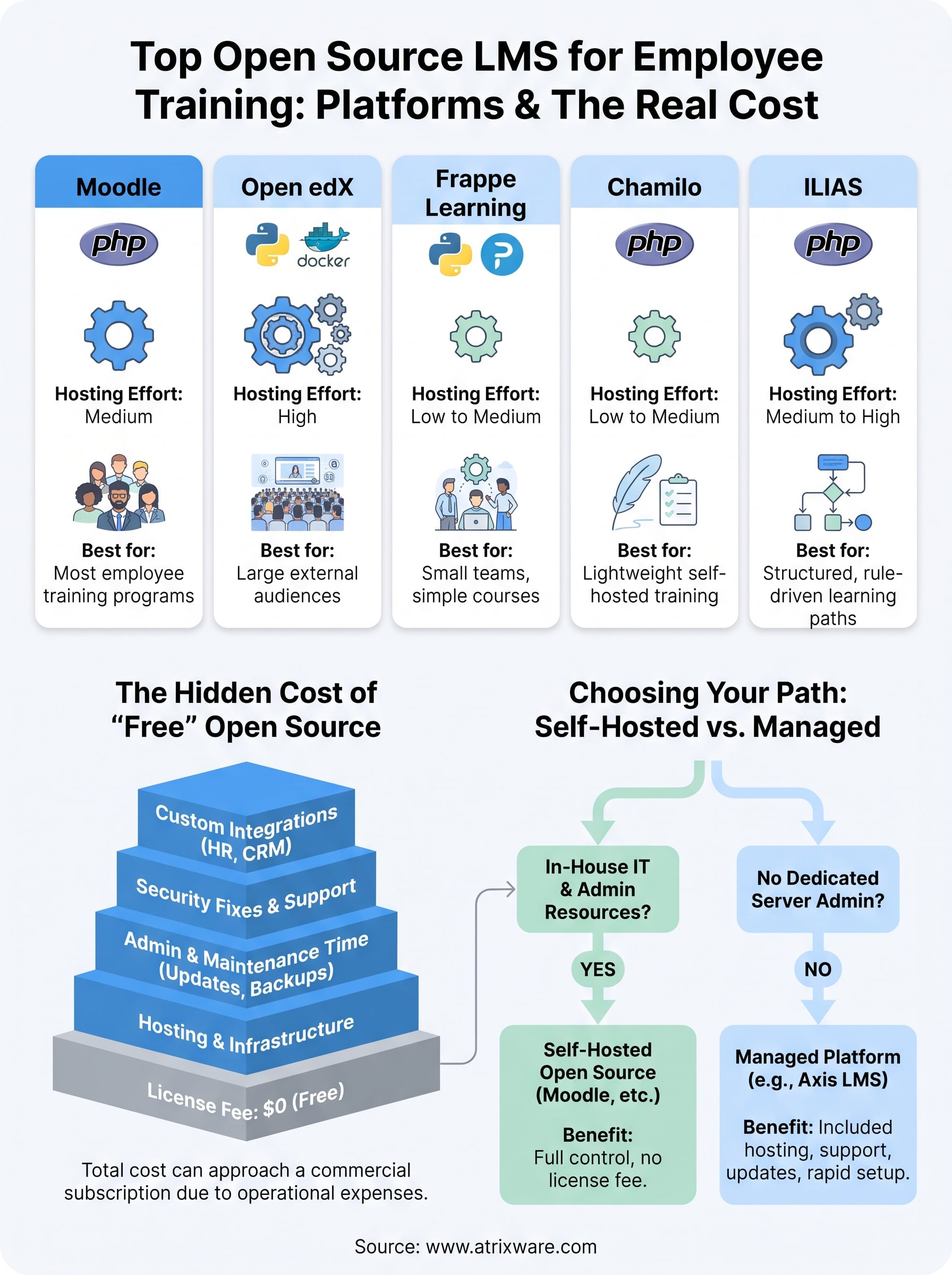
| Platform | Built on | Hosting effort | Best for |
|---|---|---|---|
| Moodle | PHP | Medium | Most employee training programs |
| Open edX | Python, Docker via Tutor | High | Large external audiences |
| Frappe Learning | Python (Frappe Framework) | Low to medium | Small teams, simple courses |
| Chamilo | PHP | Low to medium | Lightweight self-hosted training |
| ILIAS | PHP | Medium to high | Structured, rule-driven learning paths |
Use the table as a filter, not a verdict. Run a pilot with one real course on your top two choices before you move content.
The hidden cost of free software
Open source removes the license fee, but hosting, administration, and security updates stay with you. Here is a planning example with assumed numbers. Say an internal admin spends 6 hours a month on updates, backups, and user support, and that time is worth $60 an hour. That is $360 a month, or $4,320 a year, before you pay for hosting.
Add the cost of building integrations with your HR system and reporting the way your managers expect, and the total can approach a commercial subscription. Regulated training raises the bar again. If you need audit trails and validated records, an open source tool leaves the validation work with you.
When a managed LMS is the better call
If nobody on your team wants to own a server, a managed platform is the practical alternative. Axis LMS is not open source, but it removes the tasks above. Atrixware usually sets up a system within 1 to 3 business days, patches, updates, and upgrades it at no extra cost, and includes tech support with unlimited incidents.
Axis LMS Lite covers organizations of 25 to 100 employees, and its 25-user package for online training is listed at $209. Axis LMS serves organizations from 150 to 100,000 employees and offers 5,000+ system integrations. Compare that price and effort against your own hours from the example above.
Count your admin hours before you call open source cheaper.
Picking the right platform for your team
Moodle is the default for most employee training. Open edX fits large external audiences, Frappe Learning and Chamilo keep things light, and ILIAS suits formal learning paths. All five are free to license, and all five cost you hosting, maintenance, and admin time, so decide who owns those tasks before you choose.
If your answer is "nobody," a managed LMS may cost less in the end. To find out where you stand, take the LMS readiness quiz. It shows what stage of the buying process you are in, whether that points to self-hosting or a managed platform.
