The best regulatory compliance training online depends on who is learning and who has to prove it. If you train a team, pick a platform that delivers courses and keeps the completion records an auditor will ask for, such as Axis LMS. If you are building a career, a structured program like the University of Pennsylvania specialization on Coursera or an ICA qualification fits better. If budget is tight, free courses from edX, Alison and AWS cover single topics well.
The search itself is the problem. Google returns course catalogs, vendor sales pages, bank webinars and forum threads, and almost none of them explain how they differ. Regulators care less about whether an employee watched a video than whether you can show who trained on what, when, and whether the training was refreshed.
This article walks through six options and judges each one the same way: what it covers, who it suits, and what it costs and whether it issues a certificate. Atrixware makes an LMS, so Axis LMS comes first. It also says plainly where it is the wrong tool.
1. Axis LMS with a course bundle
What you get
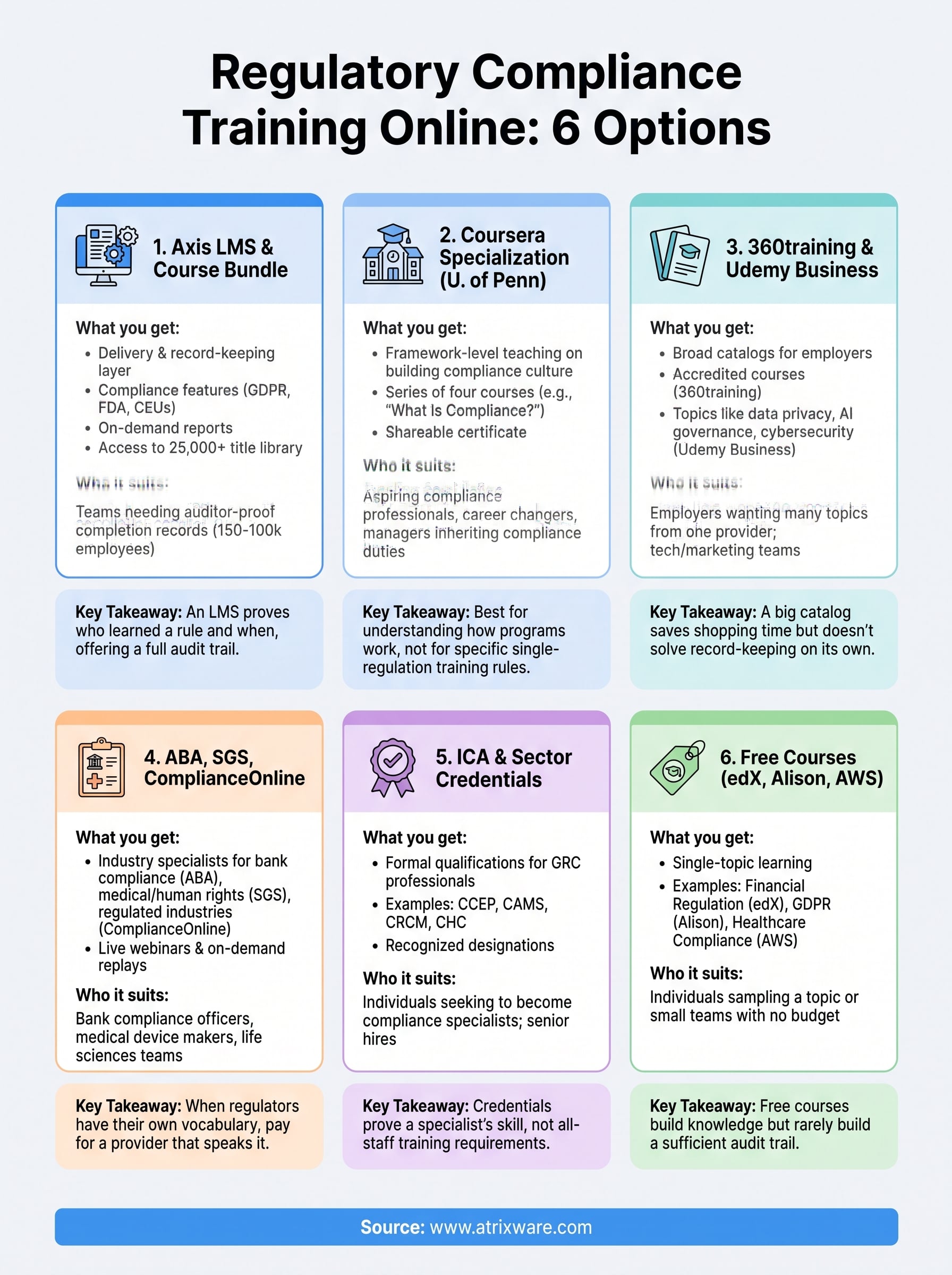
Axis LMS is the delivery and record-keeping layer for compliance training, not a single course. It includes compliance management features for training such as GDPR and FDA 21 CFR Part 11, tracking of Continuing Education Units (CEUs) and re-certifications, and on-demand or automated reports.

For content, Atrixware’s bundles let you load titles from a library of 25,000 courses. Pick-25 gives you any 25 titles, Pick-100 gives you 100 and is the most popular, and the 25,000+ bundle opens the whole library.
- Reports on learner progress, run on demand or automatically
- HR data sync with systems such as ADP and BambooHR, plus SSO through Okta or Azure
- HIPAA compliant and PCI compliant hosting options
A course teaches the rule. An LMS proves who learned it and when.
Who it suits
Teams that must prove completion to an auditor are the target. Axis LMS fits organizations of 150 to 100,000 employees, and Axis LMS Lite fits 25 to 100. Axis LMS for Government adds Gold Secure LMS Hosting for agencies that train employees and contractors.
Picture a 200-person company that retrains everyone on data privacy each year. It picks 25 titles with the Pick-25 bundle, assigns them by role, and uses reports to chase overdue learners. Confirm that the library holds titles for your specific regulation before you buy. A single learner after one certificate should look elsewhere on this list.
Cost and certificates
Bundles carry one per-user price, so no public figure appears here. Contracts run 1 to 3 years, setup usually takes 1 to 3 business days, and support with unlimited incidents is included.
Certificates depend on the course you load. What the LMS adds is the audit trail: completion dates, CEUs and re-certification due dates in one place.
2. Coursera’s Regulatory Compliance Specialization
What you get
The University of Pennsylvania teaches this specialization, and it focuses on building a culture of compliance and an effective compliance program. It runs as a series of four courses. The first, What Is Compliance?, is an introduction of about 10 hours in 4 units.
Those units cover why compliance matters through high-profile failures, the laws and regulations behind it, risk management, and where compliance risk is heading.
- Framework-level teaching, not rules for one industry
- Self-paced, with a shareable certificate on completion
- University branding that carries weight on a résumé
Who it suits
Aspiring compliance professionals get the most from it. New compliance officers, career changers and managers who inherit a compliance duty all need the framework before the details of any one regulation.
It is a poor fit if employees need a specific rule, such as HIPAA privacy or anti-money laundering procedures. It also gives an employer no central view of who finished, unless learners send you their certificates.
Choose Coursera when you need to understand how compliance programs work, not to meet one regulation’s training rule.
Cost and certificates
Coursera sets its pricing by enrollment model and changes it often. Check the specialization page for the current price and for what the free options include.
The certificate is the main deliverable here. Learners can share it with employers, which helps a job search more than it helps an audit file.
3. 360training and Udemy Business
What you get
These two are broad catalogs for employers. 360training describes itself as an online training provider of more than 25 years with 11 million learners, and it sells accredited regulatory courses. Udemy Business offers compliance content developed by legal experts and practitioners.
Udemy’s topics include data privacy, AI governance, anti-harassment, bribery and corruption prevention, insider trading and cybersecurity. Its own guidance on online regulatory compliance training is worth borrowing, whichever vendor you pick.
- Role-specific scenarios beat generic modules
- Train managers before you roll out to their teams
- Measure behavior change, not only completion rates
Who it suits
Employers who want many topics from one catalog should shortlist both. 360training suits those who need accredited courses. Udemy Business suits technology, marketing and product teams that face privacy and AI rules.
Neither replaces a system of record on its own. If you have 500 employees across five regulations, ask each vendor how completion data reaches your own reporting.
A big catalog saves shopping time, but it does not solve record-keeping.
Cost and certificates
Both vendors price by course or by seat. Use their current listings, or request a quote, rather than trusting a figure from a review. Ask three questions before you sign: which courses come with a certificate, whether completion data exports to your own system, and how often content is updated when a rule changes.
4. ABA, SGS and ComplianceOnline for your industry
What you get
Some regulations need industry specialists. The American Bankers Association offers live webinars on regulatory updates and bank compliance, which you can also view on demand. SGS trains on medical devices, anti-bribery and human rights. ComplianceOnline serves companies and professionals in regulated industries.

| Provider | Focus | Format |
|---|---|---|
| ABA | Bank compliance and regulatory updates | Live webinars, on-demand replays |
| SGS | Medical devices, anti-bribery, human rights | Professional training |
| ComplianceOnline | Regulated industries, GRC advisory | Online trainings for companies and professionals |
Who it suits
Bank compliance officers, medical device makers and life sciences teams get the most from these providers. The content tracks the rules of your sector, which general catalogs rarely do at the same depth.
The drawback is narrow scope. A webinar series on bank rules will not teach your sales team about advertising law. Pair a specialist with a broader catalog if your risks span several areas.
When your regulator has its own vocabulary, pay for a provider that speaks it.
Cost and certificates
Pricing is per webinar, course or seat, and it changes, so read the current listing. If a session must count toward a license requirement or an internal training policy, get written confirmation that it qualifies. Do not assume a certificate of attendance meets either one.
5. ICA qualifications and sector credentials
What you get
The International Compliance Association offers qualifications for governance, risk and compliance professionals at all levels. These are formal qualifications, not single courses. Other bodies issue credentials tied to a sector.
| Credential | Issuer | Focus |
|---|---|---|
| CCEP | SCCE | Compliance and ethics programs |
| CAMS | ACAMS | Anti-money laundering |
| CRCM | Institute of Certified Bankers | Banking regulatory compliance |
| CHC | HCCA | Healthcare compliance |
Who it suits
This route suits anyone asking how to become a regulatory compliance specialist. A sensible path is a foundation course such as the Coursera series, then the credential for your sector.
Employers should look here for senior hires, not for all-staff training. A credential proves one person’s expertise. It does not prove that your 300 employees completed their annual refresher.
Credentials prove a specialist’s skill. They do not satisfy an all-staff training requirement.
Cost and certificates
Expect exam fees and renewal requirements, which put credentials well above a short course in cost. Each issuer publishes its own fees and eligibility rules, so check them before you commit. The reward is a recognized designation, which a course certificate does not give you.
6. Free courses from edX, Alison and AWS
What you get
Yes, you can learn compliance online for free, one topic at a time. Three solid options:
- MIT’s Financial Regulation course on edX runs 8 weeks. It covers the goals and limits of financial regulation, post-2008 reforms and fintech.
- Get to Know GDPR on Alison has 6 modules, the last being an assessment, and covers user data rights and breach procedures.
- Intro to Healthcare and Life Sciences Compliance on AWS has four modules of about 20 minutes each. It is aimed at AWS Partners, but you can register with an AWS customer account.
Who it suits
Individuals who want to sample a topic and small teams with no budget get the most from free courses. They also work as pre-reading before a paid program.
Free courses are weak evidence for an auditor. You do not control the records, you cannot assign them, and you cannot chase late learners.
Free courses build knowledge. They rarely build an audit trail.
Cost and certificates
Learning is free, but certificates often are not. The edX verified certificate costs a fee. Alison asks you to register and sends frequent notification emails. Check each course page for current terms before you plan around a free certificate.
Picking the right option for you
Match the option to the job. Individuals who want to enter the field should start with Coursera or an ICA qualification. Teams in banking, medical devices or life sciences should look at an industry specialist. Anyone on a budget can learn a single topic from the free courses.
Once you train more than a few people on rules that auditors check, the records matter as much as the content. If you want to see how Axis LMS handles compliance assignments, CEU tracking and reporting, book an Axis LMS admin demo and walk through it with your own requirements in hand.
