Gamification in corporate training means adding game design elements to workplace learning, such as points, badges, levels, leaderboards, challenges and instant feedback. The goal is to get employees to take part, practice and remember more. The course content stays the same, and the structure around it changes. Done well, it modestly improves knowledge and motivation. Done badly, it teaches people to chase points instead of skills.
This article covers why gamified training matters and how to apply it step by step. It also shows which game elements fit which goals, what gamified modules look like for onboarding, compliance, sales and software adoption, and how to measure whether the program worked. It leans on controlled research, not vendor surveys, because the evidence is more mixed than most blog posts admit.
At Atrixware we build Axis LMS, a platform for delivering and tracking online and virtual training. Tracking, reporting and automation decide whether a gamified program survives past its first month, so we have a practical view of that side. You will find a short section on what to look for in a platform near the end.
Why gamification in corporate training matters
Gamification in corporate training matters because it targets the most common failure of workplace courses: people click through, pass and forget. Game elements add immediate feedback, visible progress and repeated practice. Those are the things that help adults retain skills. The evidence supports a real but modest benefit, not a miracle.
What the research shows
The strongest summary is a 2019 meta-analysis by Michael Sailer and Lisa Homner in Educational Psychology Review. Pooling controlled studies, they found small to medium positive effects on knowledge (Hedges’ g of 0.49), motivation (0.36) and behavior (0.25). The knowledge effect held up in the most rigorous studies. The motivation and behavior effects were less stable.
Treat that as a fair expectation. Gamification helps people learn somewhat more, and what it does for motivation depends on design. Most controlled studies come from classrooms, so you should verify the results in your own workplace.
Benefits you can reasonably expect
When the design is sound, gamified training tends to deliver four things:
- Higher voluntary participation, because progress is visible and sessions are short.
- Better practice on decisions, because scenarios show the consequence of a choice right away.
- Faster feedback for learners, and clearer data for managers and administrators.
- A reason to return, through spaced review rounds and streaks that keep knowledge fresh after the course ends.
None of these is automatic. Each depends on the mechanic matching the behavior you want, which the next sections cover.
Where gamification backfires
Workplace studies show the risks more clearly than classroom ones. Ryan Buell, Wei Cai and Tatiana Sandino ran a field experiment with a gamified training platform at a professional services firm. Across the firm, the platform had no significant effect on performance. In engaged offices, more platform use went with more new clients. In low-engagement offices, more use went with fewer. A company-wide average hid a split. Wafa Hammedi and colleagues studied gamified work with frontline employees in two field experiments. Gamification lowered engagement and well-being, and people who were willing to take part were harmed less.
Reward research explains part of this. A review of 128 experiments by Edward Deci, Richard Koestner and Richard Ryan found that expected tangible rewards reduced intrinsic motivation, while positive feedback increased it. A point should therefore work as feedback that says "you got this right." A prize for logging in only teaches people to log in.
Be careful with popular statistics too. The claim that "90% of employees say gamification makes them more productive" traces back to a vendor survey of people who already used gamified software, and it measures opinion, not performance.
Gamification works when points tell learners they got something right, and fails when they simply pay people to show up.
How to apply gamification in corporate training
To apply gamification in corporate training, pick one observable behavior, choose one job metric that shows it, match a single mechanic to that behavior, and launch it as a voluntary, fair pilot. Resist the urge to decorate every course with badges. Start small and prove it.
Choose one behavior and one job metric
Write the behavior so a manager could observe it, for example "reports a suspicious email the same day" or "logs every customer call in the CRM." Then name the metric that shows it, such as the same-day report rate. Record a baseline before launch. Without one, you cannot tell a better course from a better quarter.
A vague goal like "improve engagement" gives you nothing to design around. A specific behavior tells you which game element to use and what to score.
Match the mechanic to the behavior
Different behaviors need different mechanics. A leaderboard on a course that teaches a careful procedure rewards speed, which is the wrong lesson. Use this as a starting point:

- Decisions (customer calls, safety choices, security): a scenario with a visible consequence for each choice.
- Recall (product facts, policy details): short question rounds repeated over weeks, with streaks for completed rounds.
- Procedures (equipment, compliance steps): required steps in order, with points for correct sequence and first-try accuracy.
- Long learning paths (onboarding, certification): levels that unlock the next stage, so progress is visible.
If a mechanic does not support the behavior, leave it out.
Make points mean competence, and keep play voluntary
Award points for correct decisions and first-try accuracy, and explain why after every answer, right or wrong. Do not award points for logins, time on page or completed slides. Those teach exactly the wrong habits.
Then protect fairness, since the research shows results depend on whether people want to play. Let employees opt out of public rankings. Compare people at similar tenure, and prefer team boards to individual ones. Check with HR or legal before you publish names or scores, especially where privacy rules or a works council apply.
Pick one behavior, one metric and one mechanic, and prove the combination before you scale it.
Game elements and how to choose among them
The core game elements in corporate training are points, levels, badges, leaderboards, challenges with consequences, story and team goals. Each one rewards a different kind of behavior, so choose by fit, not by what looks familiar.
What each element does
| Element | What it gives the learner | Good fit | Watch for |
|---|---|---|---|
| Points or score | An immediate signal that an answer was right | Knowledge checks, procedure steps | Points for clicks or time spent teach people to click and wait |
| Levels and progress bars | A view of what is done and what comes next | Onboarding paths, certification ladders | Levels that count only completions are a checklist with a new name |
| Badges | A visible record of a skill | Certifications, skill milestones | A badge for every module stops meaning anything |
| Leaderboards | Comparison with peers | Short, opt-in contests among similar-level people | Ranking new hires against veterans |
| Challenges with consequences | Practice on a decision with the result shown | Safety, security, customer conversations | Unrealistic consequences teach the wrong lesson |
| Story or role | A reason the task matters | Compliance, security awareness | A theme that delays the content learners came for |
| Team goals | A shared target and a reason to coach each other | Sales and support teams | One strong player carrying the team |
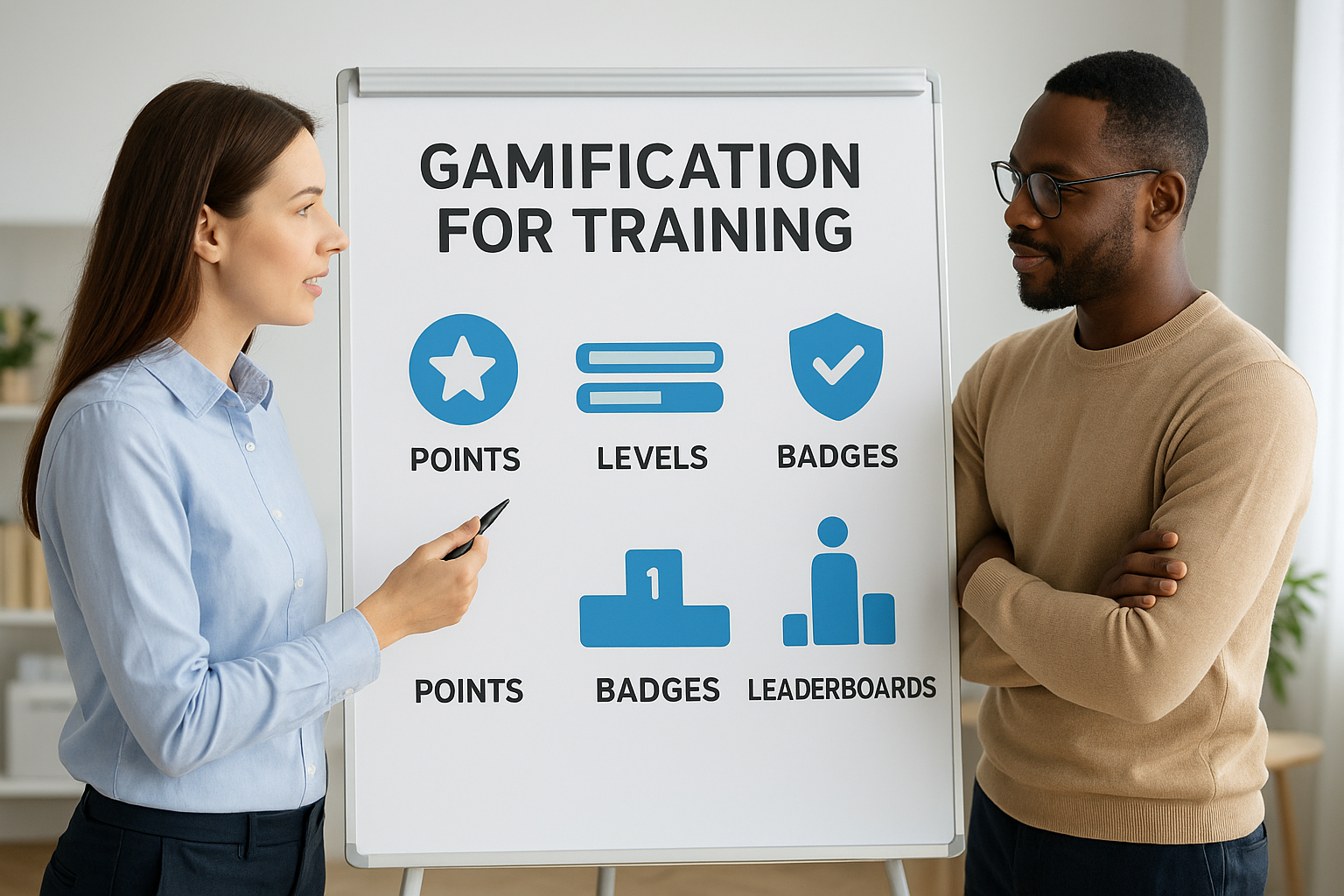
Gamification, game-based learning and simulation
People use these three terms loosely, and teams usually mix them. Gamification adds game elements to ordinary content, like a progress bar and points on a compliance course. Game-based learning has learners play a game built to teach the content, such as a product trivia game. A simulation models the real task, so a branching customer call changes each scene based on the learner’s reply.
Workplace gamification is wider than training. Sales contests and productivity apps use the same elements to drive output, not learning. Training is the subset where the goal is skill, which is why the measures in this article focus on competence.
The frameworks behind the "four types" lists
Articles name "four types" or "four pillars" of gamification, but the lists vary by author. Two frameworks are worth using. Karl Kapp separates structural gamification, which wraps rewards around unchanged content, from content gamification, which changes the content itself with stories and challenges. Structural is faster to build. Content gamification usually teaches more.
Richard Bartle’s four player types help you design for different employees: achievers, explorers, socializers and competitors. Achievers like progress bars and badges. Explorers like optional deep-dive paths. Socializers like team challenges. Competitors like opt-in contests. A mix serves more of your workforce than a single leaderboard.
Choose the element that rewards the behavior you want, then check what it would teach someone who games it.
Examples of gamified corporate training by use case
The best gamified training modules score one behavior each, so you can compare the result with job data. The examples below are designs you can adapt, not reported results.
Onboarding and compliance
For onboarding, replace a long orientation deck with a seven-day mission path. Each day is a level: set up tools, meet key people, walk through a process. New hires earn points for finishing tasks and passing a short check, and a progress bar shows what remains. Track time to first independent task and how many questions reach the help desk in week two.
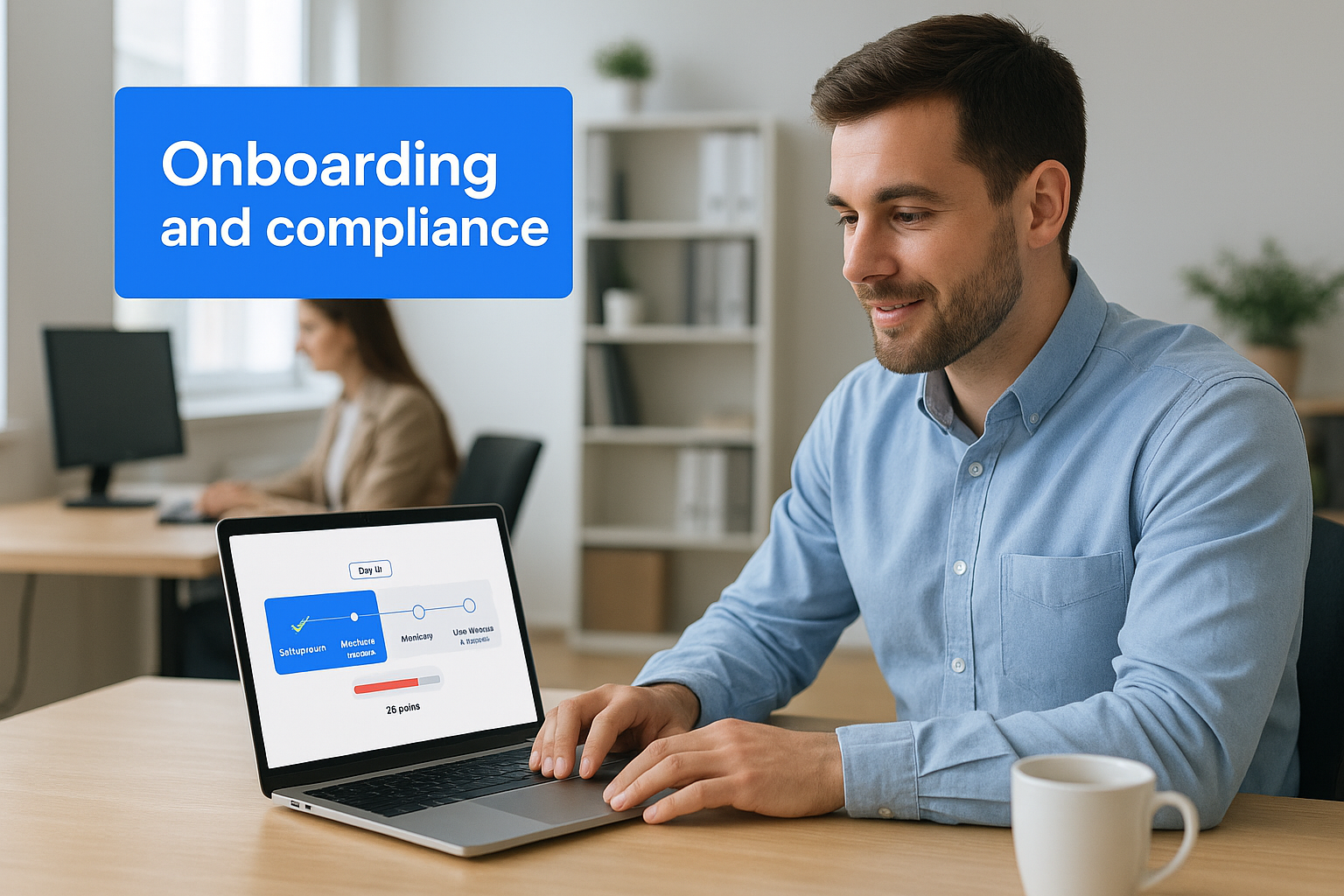
For compliance, replace "read the policy and click accept" with decision scenarios. A learner finds an open customer file on a shared screen and chooses what to do. Each choice plays its consequence, and the correct action earns the point. Then show the reasoning right after the answer. Set the pass mark where a wrong answer would cause harm on the job, and track the same-day report rate for the real behavior.
Sales, product knowledge and software adoption
For sales and product knowledge, build a ladder. Group questions into levels and open the next level only after the learner answers the current one correctly. Run it as a team contest where the team average counts. That gives strong reps a reason to coach weaker ones instead of racing ahead.
For software adoption, turn the rollout of a CRM or HR system into small challenges inside the live tool: "log your first lead," "schedule a task," "tag a teammate." Each action earns a point and shows the next shortcut. Track how many people complete each action and how helpdesk tickets change over the following month.
Retention after the course ends
Most knowledge fades within days if nobody uses it. A weekly recall round of two questions on the points people most often miss counters that. A large review of spaced practice by Nicholas Cepeda and colleagues found that the best gap between sessions grows with how long people must remember the material. A streak for completed rounds gives the habit a visible count.
| Use case | Mechanic | What to score | Job metric to watch |
|---|---|---|---|
| Onboarding | Mission levels, progress bar | Task completion, short checks | Time to first independent task |
| Compliance | Consequence scenarios | Correct decisions, first-try accuracy | Same-day report rate |
| Sales knowledge | Level ladder, team average | Correct answers per level | Win rate, ramp time |
| Software adoption | In-tool challenges | Actions completed in the live system | Helpdesk tickets, active use |
| Retention | Weekly recall rounds, streaks | Accuracy on missed topics | 30-day quiz scores |
A good gamified module scores one decision or one fact, and ties it to something a manager already measures.
How to measure whether gamification worked
Measure gamification by comparing a gamified group with a similar group on the current course, using both learning data and one job metric. Engagement alone proves little, because people can enjoy a course and still not change how they work.
Set a baseline and a comparison group
Run the gamified version with one team for a full training cycle, and run the standard course with a similar team. Keep tenure, role and workload as close as you can. Compare each group with its own baseline, and look at results by team, not just the company average, because the Buell study showed opposite effects hiding inside one firm.
Here is an illustrative example. You train 200 employees on customer data handling and split them into two groups of 100. Before launch, 40 of 100 in each group report a suspicious item the same day, a 40% baseline. After one cycle, 44 of the standard group report (44%) and 55 of the gamified group report (55%). The standard group gained 4 points and the gamified group gained 15, so the net difference is 11 points. Completion was 91 of 100 for the gamified group against 78 of 100 for the standard one. A gap that size justifies a second module. A gap near zero tells you to drop the mechanic.
Metrics worth tracking
| Metric | What it tells you | Where to get it |
|---|---|---|
| Completion rate | Whether people finish | LMS reports |
| First-try accuracy | Whether they make the right call unaided | Scored challenges |
| 30-day retention | Whether it stuck | Follow-up quiz |
| Time to productivity | How fast new hires become independent | Manager sign-off dates |
| Job metric | Whether behavior changed | CRM, HR or incident data |
Retire any mechanic that nobody uses or that does not tie training data to outcomes on the job metric. Keep the ones that do, and add the next module only after the first one pays off.
If the job metric did not move, the gamification did not work, however many badges were earned.
What to look for in an LMS for gamified training
For gamified training, look for an LMS that tracks learner activity accurately, reports on it flexibly, automates reminders and recognition, and connects to the systems that hold your job metrics. Game visuals matter less than this plumbing.
Capabilities to check
- Reporting: on-demand and scheduled reports on progress, scores and completion by team, so you can see splits and not just averages. Axis LMS includes on-demand and automated reporting for this.
- Automated communication: reminders, milestone messages and nudges triggered by learner activity. Axis LMS offers automated, real-time communication tools, plus automation workflows that scale with your plan.
- Integrations: a connection to your CRM or HR system, so you can compare training data with sales or performance data. Axis LMS offers 5,000+ system integrations, including Salesforce and BambooHR user sync.
- Course building: a drag-and-drop interface so your team can build and revise scenarios and question rounds without developers.
- Records for compliance: certificates, Continuing Education Units and re-certification tracking, for programs where an audit matters.
Questions to ask in a demo
Ask every vendor, including us, which game elements are built in and which you create through course design and workflows. Do not assume a platform has badges or leaderboards because a competitor does. Bring your chosen behavior and job metric to the demo, and ask the vendor to show how they would track and report on that case.
Size matters too. Axis LMS Lite suits organizations of 25 to 100 employees, while Axis LMS scales from 150 to 100,000.
Choose the platform that can prove your metric moved, then decorate the course.
Start with one behavior and one metric
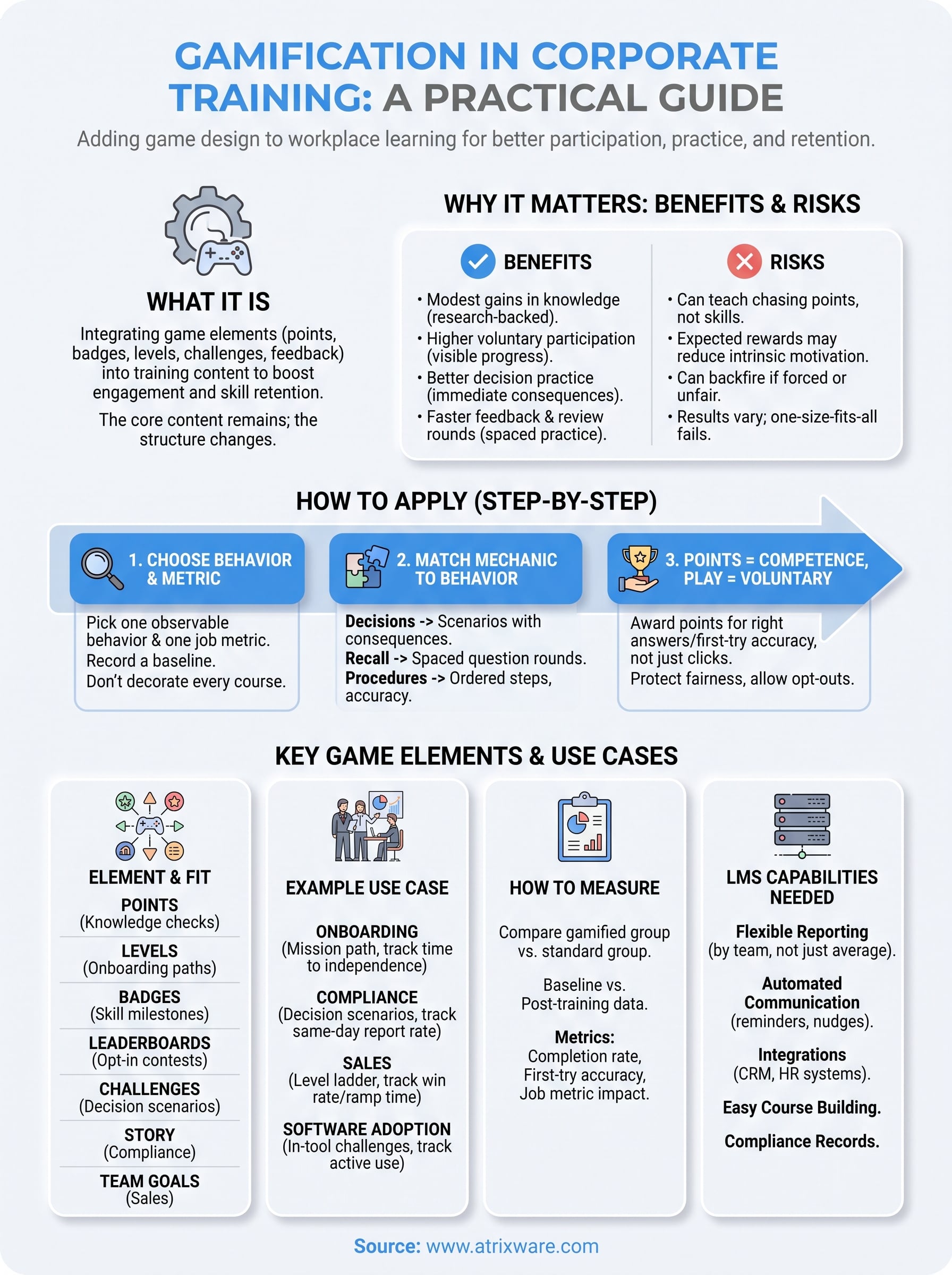
Gamification in corporate training works when game elements give learners honest feedback on a behavior your business cares about. The research shows a modest gain in knowledge and mixed effects on motivation and behavior, so design and fairness decide the outcome. Pick one behavior, match one mechanic, keep play voluntary, and compare against a similar group.
Gamified programs need accurate tracking and flexible reporting. If you are choosing or reviewing a platform for that, see Axis LMS in an admin demo and bring your first behavior and metric with you.
