Finding solid corporate training material shouldn’t eat up your whole week. Most training and L&D managers hit the same wall: generic templates that don’t match their industry, course libraries locked behind expensive subscriptions, or content so outdated it references software nobody uses anymore. If you’ve spent hours digging through forums and vendor sites trying to piece together a real employee development program, you already know the frustration.
This list gets straight to the point. You’ll find twelve resources for 2026 that cover everything from ready-made compliance courses to customizable manuals and interactive templates you can adapt for onboarding, sales training, or safety programs. Each one is chosen because it saves you build time or fills a specific gap most companies run into.
We’ll also flag where a strong learning management system matters just as much as the content itself. Great material delivered through a clunky platform still frustrates learners and buries your reporting. So alongside the resources, you’ll see what to look for in a system, like Axis LMS, that actually gets that content in front of employees, tracks completion, and proves your training works.
1. Axis LMS by Atrixware
Axis LMS isn’t a content library. It’s the platform that takes whatever corporate training material you build, buy, or borrow from the other resources on this list and actually gets it in front of your team. That distinction matters more than most buyers realize until they’re stuck with a folder full of great manuals and no way to track who finished them. Axis LMS exists to close that gap, turning scattered content into a structured, trackable training program, which is a big part of why businesses pick Axis LMS for employee training.
What it offers
The platform gives you a drag-and-drop course builder so you can upload PDFs, SCORM packages, videos, or slide decks and organize them into real courses without touching code. It also runs live virtual classroom sessions alongside self-paced content, which matters if your training mixes recorded material with instructor-led workshops. Reporting is where it earns its keep: automated and on-demand reports show completion rates, quiz scores, and time spent, so you can prove training effectiveness to leadership instead of guessing. Built-in compliance features handle certification and re-certification tracking, including CEUs, automatically, which saves the manual spreadsheet chasing that eats up an HR team’s month. The system also connects to tools you already run through API and SSO integrations, syncing with ADP, Salesforce, BambooHR, Zoho, and identity providers like Okta and Azure.
A great training manual delivered through a clunky system still fails your employees.
Branding controls let you customize the learner interface so the portal looks like your company built it, not like a generic vendor tool. For companies that also sell training online, Axis LMS includes e-commerce functionality for individual purchases and bulk seat licensing, turning your content library into a revenue stream if that’s part of your model.
Who it’s for
Axis LMS suits organizations that have outgrown ad hoc training, think shared drives full of PDFs and email reminders, but aren’t ready for the complexity or cost of enterprise-only platforms. It works well for HR managers building onboarding programs for new hires, compliance officers tracking FDA 21 CFR Part 11 or GDPR requirements, and sales enablement teams rolling out channel partner training. Companies with existing content from vendors like Coursera or SHRM’s resource directories, or homegrown manuals from earlier attempts at training, benefit most because they can centralize everything in one trackable system rather than managing five disconnected tools.
| Company size | Fit |
|---|---|
| Small business (under 50 employees) | Good fit for straightforward onboarding and compliance tracking |
| Mid-size (50-500) | Strong fit, especially with HR/CRM integration needs |
| Enterprise (500+) | Fit depends on custom integration and API requirements |
Pricing
Atrixware doesn’t publish flat rate cards because pricing depends on user count, hosting preference (cloud or on-premise), and which modules you need, like e-commerce or advanced compliance tracking. That’s typical for LMS platforms serving businesses of very different sizes. You can request a custom quote and start an Axis LMS demo directly from Atrixware to see actual numbers for your team size before committing to anything.
2. Corporate Training Materials
Corporate Training Materials is a straightforward resource for buying pre-built training modules outright instead of renting access through a subscription. It’s built for teams that need a soft-skills or management course tomorrow, not after weeks of instructional design work. If your gap is a single topic, like conflict resolution or time management, rather than a full learning library, this fits better than the bigger platforms further down this list.
What it offers
The site sells packaged training modules covering leadership, communication, sales, customer service, and workplace safety, each built as a complete kit: PowerPoint slides, a facilitator guide, handouts, and sometimes a quiz or activity sheet. You buy the module once and own it, then edit the slides and rebrand them however you want since most come as editable Office files rather than locked PDFs. Coverage leans heavily toward soft skills training in the workplace and management development rather than technical or compliance-heavy content, so don’t expect FDA or GDPR-specific courseware here.
Owning a training module outright beats renting access you lose the moment you cancel a subscription.
Because everything is editable, you can strip out generic examples and swap in your own company’s scenarios, which saves a facilitator from building slides from a blank screen.
Who it’s for
This resource suits small HR teams and independent trainers who need to run a workshop next week and don’t have a design budget. It also works for consultants who deliver training to multiple clients and want a customizable base they can rebrand for each engagement. Companies building out a broader corporate training material library piece by piece, rather than committing to one big platform, often use it to fill specific topic gaps.
Pricing
Modules are sold individually, typically in the range of $30 to $150 depending on length and complexity, with bundle discounts when you buy several topics together. There’s no recurring subscription fee, which appeals to smaller budgets, but you’ll pay again for updated content since revisions aren’t included automatically.
3. Training Course Material
Training Course Material is another off-the-shelf content shop, but it leans harder into full multi-session courses rather than single-topic modules. Where the previous resource fits a two-hour workshop gap, this one suits trainers building a multi-day program that needs to hang together as a coherent curriculum instead of a grab bag of unrelated slides.
What it offers
Each package bundles a trainer manual, participant workbook, PowerPoint deck, and assessment materials into one purchase, structured so a facilitator with no instructional design background can run the session cold. Topics skew toward management development, communication, and team building, with courses often broken into modules you can teach across several days or compress into a single intensive session. The materials come as editable Word and PowerPoint files, so you’re not stuck with a locked PDF when you need to swap in your own branding or examples.
A curriculum that already hangs together saves you the weeks it takes to sequence standalone topics into something coherent.
Because the content ships as a full curriculum rather than isolated slides, less rework goes into connecting curriculums into a logical flow, which matters if you’re running a management development track that needs to build skills progressively rather than jumping between unrelated subjects.
Who it’s for
Corporate trainers and L&D consultants who deliver multi-day management or leadership programs get the most value here, since the sequencing work is already done for them. Small businesses building their first structured corporate training material curriculum, rather than one-off sessions, also fit well because the packages give a repeatable framework to run year after year. It’s less useful if you need compliance-specific content or highly technical courseware, since the catalog stays focused on general professional development topics.
Pricing
Full course packages typically run from $200 to $600 depending on session length and how many modules the curriculum includes, again as one-time purchases rather than subscriptions. Some packages offer a license tier that permits use across multiple trainers or locations, which costs more upfront but avoids repurchasing the same material for every department running the program.
4. TrainingMaterials.com
TrainingMaterials.com rounds out the off-the-shelf category with a broader catalog than the previous two entries, covering technical and safety topics alongside the usual soft-skills fare. Unlike a shop built around a handful of leadership courses, this site stocks hundreds of ready-made kits, which matters if your training calendar covers a dozen different departments rather than one recurring workshop.
What it offers
The catalog spans workplace safety, OSHA-adjacent topics, customer service, sales, and general management, each sold as a bundle with slides, a leader’s guide, and printable handouts. Several kits include video segments in addition to slide decks, which helps when a topic like forklift safety or harassment prevention benefits from demonstration rather than a bulleted list. Files arrive in editable formats, so you can retitle a generic "Workplace Conduct" deck into something that matches your actual employee handbook language.
A catalog this wide only helps if you can still find the one course you actually need.
Search and filtering on the site are basic compared to subscription platforms, so budget extra time browsing categories rather than expecting a smart recommendation engine to surface the right kit.
Who it’s for
This resource fits HR generalists and safety coordinators at manufacturing, warehouse, or retail operations who need to cover a wide range of mandatory topics without hiring an instructional designer for each one, though tracking safety training and certifications still falls to your system. It also suits smaller training departments assembling a corporate training material library from scratch, since the breadth means fewer gaps to fill from other vendors. Companies needing deep compliance documentation, like FDA or GDPR-specific tracking, should pair this content with a system built for certification management rather than relying on the kits alone.
Pricing
Individual kits generally run $40 to $180 depending on length and whether video is included, sold as one-time purchases with no recurring fee. Site-wide license packages exist for larger organizations planning to distribute the same content across multiple locations, priced on request after you specify which topic bundles you need.
5. SHRM training materials and methods directory
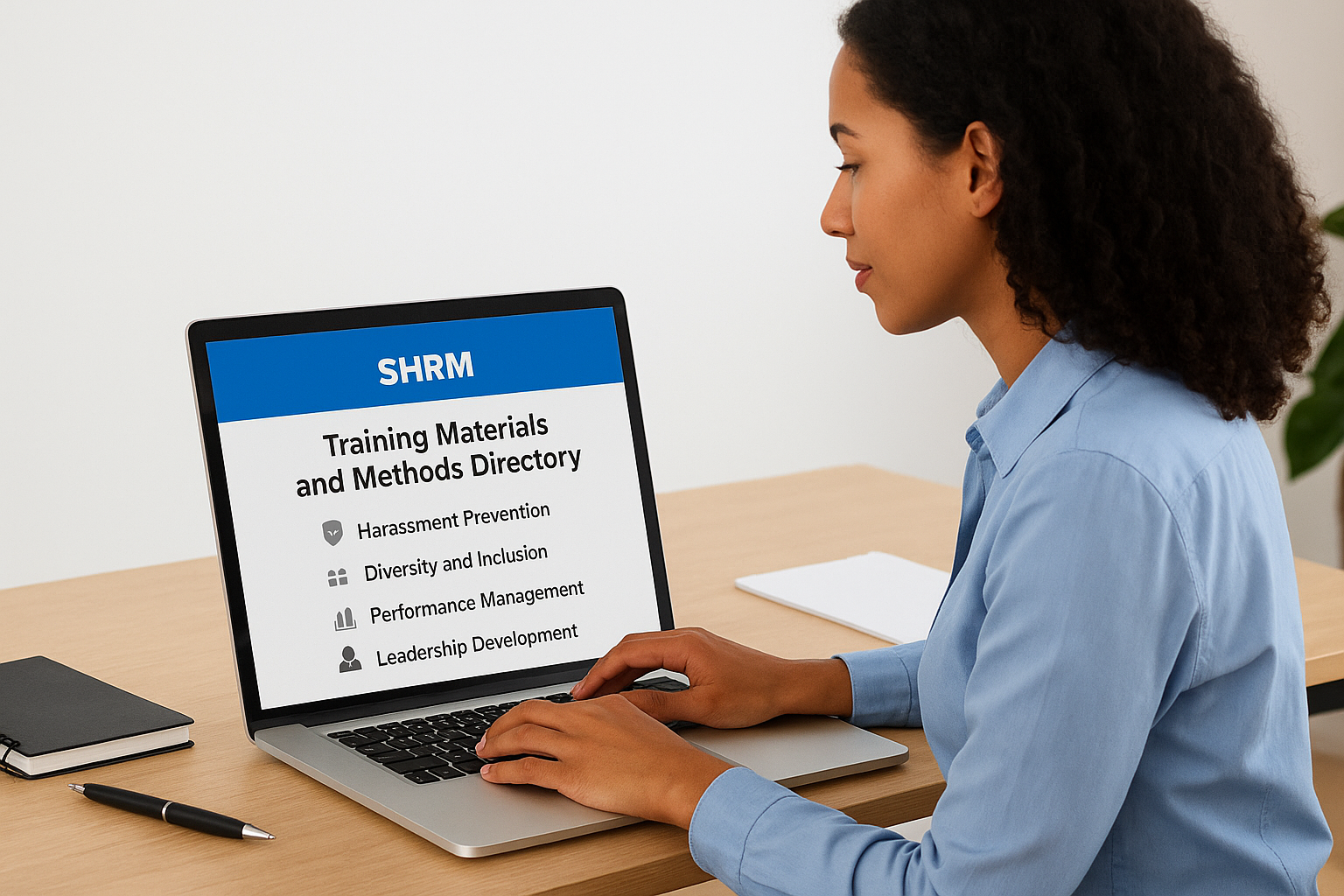
The Society for Human Resource Management runs a directory of training methods and materials aimed squarely at HR professionals, and it works differently than the shops covered above. Instead of selling packaged kits, SHRM curates research, toolkits, and vetted training approaches, so you’re getting guidance grounded in HR best practice rather than a generic slide deck built for any industry.
What it offers
SHRM’s directory organizes training methods by topic (harassment prevention, DEI, performance management, leadership development) and links each to toolkits, sample policies, and articles written or reviewed by HR practitioners. You won’t find polished PowerPoint decks ready to present tomorrow; what you get instead are frameworks, checklists, and research summaries that inform how you build your own corporate training material rather than replacing that work outright. Many toolkits include sample forms, like performance review templates or onboarding checklists, that you can adapt directly into your own documents.
Research-backed guidance beats a slick template when the topic carries legal or compliance risk.
Because SHRM ties its content to employment law and HR compliance standards, it’s a stronger source than most vendor catalogs when your training touches anything with legal exposure, like harassment policy or accommodation procedures.
Who it’s for
This resource suits HR managers and compliance officers who need their training grounded in defensible, research-backed practice rather than a vendor’s generic template, and it pairs well with HR training platforms that close skills gaps. It fits organizations building policy-heavy training, think workplace conduct, accommodation, or performance management programs, where getting the framework right matters more than a flashy slide deck. It’s a weaker fit if you need turnkey course content ready to deliver without additional development, since you’ll still need to build the actual presentation or workbook yourself.
Pricing
Much of the directory is accessible to SHRM members, with membership running roughly $219 to $299 per year depending on tier and certification add-ons. Non-members can access select free articles, but the deeper toolkits and sample documents typically sit behind the membership wall. Larger HR departments sometimes budget for organizational membership, which covers multiple staff seats at a discounted per-person rate.
6. Coursera for Business
Coursera for Business shifts the conversation from packaged kits to full course libraries built by universities and industry partners. Instead of buying a single workshop deck, you get subscription access to thousands of courses spanning technical skills, leadership, and data literacy, all produced by institutions like Yale, Google, and IBM rather than an in-house content team. That pedigree matters if your training audience expects rigor behind the material, not just a slide deck someone assembled last week.
What it offers
The platform bundles video-based courses, guided projects, and full professional certificates into curated learning paths you can assign by role, department, or skill gap. Admins get a dashboard showing completion rates and skill progress across teams, which covers some of the reporting need without a separate LMS, though it stays limited to Coursera’s own content rather than anything you upload yourself. Content updates automatically as partner institutions revise courses, so you’re not stuck teaching outdated software versions the way you might with a static purchased kit.
Subscription content stays current automatically, but you lose it the moment you stop paying.
Skill assessments built into many courses let you benchmark where employees stand before and after training, useful for upskilling without pulling teams off the job where you need to show measurable progress.
Who it’s for
Coursera for Business fits mid-size to large organizations investing in broad corporate training material for technical upskilling, data science, or leadership development rather than compliance-specific programs. It suits companies that want ready-made rigor over customization, since editing a university-built course isn’t an option the way it is with an editable PowerPoint kit. It’s a weaker fit for small businesses needing narrow, industry-specific content, since much of the catalog targets general professional and technical skills.
Pricing
Team plans typically start around $399 per user annually for smaller groups, with enterprise pricing scaled by seat count and negotiated directly for larger rollouts. Access ends when the subscription lapses, so budget for ongoing renewal rather than a one-time purchase like the earlier kit-based resources.
7. Udemy Business
Udemy Business takes a different approach than Coursera’s institutional pedigree: it draws on a marketplace of over 213,000 courses built by independent instructors, practitioners, and working professionals rather than universities. That marketplace model means you’ll find niche technical topics, like a specific coding framework or software tool, that broader platforms skip entirely because the audience is too small to justify university-level production.

What it offers
Subscribers get access to a curated business collection of roughly 17,000 courses covering technical skills, leadership, project management, and communication, filtered from Udemy’s full consumer catalog to keep quality consistent. Admins can assign learning paths by role or department, track completion through a dashboard, and layer in custom content built with authoring tools for corporate trainers by uploading your own videos or documents alongside the licensed courses. The Udemy Business Leadership Academy adds structured programs for management development, which fills a gap general course libraries often leave for people newly promoted into supervisory roles.
A marketplace built by working practitioners often beats polished corporate training material when the topic is narrow and technical.
Course quality varies more than on curated platforms since anyone can publish, so plan to spot-check a handful of courses in your priority topics before rolling them out company-wide.
Who it’s for
This resource suits companies with technical teams, think developers, IT staff, or data analysts, who need current, practitioner-level content faster than a university course library typically updates. It also works well for organizations wanting to blend licensed courses with their own corporate training material, since the upload feature lets you mix internal onboarding videos with external skills courses in one place. Smaller teams that need flexibility across wildly different topics, from Excel to Python to public speaking, get more mileage here than from a narrower leadership-focused platform.
Pricing
Udemy Business starts around $360 per user annually for teams of five to twenty, with enterprise pricing negotiated for larger headcounts and additional features like custom content hosting. There’s no per-course purchase option at the business tier, so smaller teams testing the waters should compare that annual commitment against buying individual kits from earlier entries on this list.
8. LinkedIn Learning
LinkedIn Learning brings a different advantage to the table: its course recommendations tie directly into LinkedIn’s professional network and skills data, so the platform can suggest content based on actual job roles and career trajectories rather than a generic catalog search. That connection to real workforce data sets it apart from marketplace-style libraries that rely purely on course popularity or keyword tags.
What it offers
The library holds over 21,000 video courses spanning business skills, creative software, and technology topics, taught by industry practitioners rather than academic instructors. Courses run short, usually broken into five to ten minute videos, the same bite-sized training logic that suits employees squeezing learning between meetings rather than blocking out a full afternoon. Admins get skills-gap reporting that maps completed courses against LinkedIn’s own skills taxonomy, showing where a team stands on in-demand competencies compared to industry benchmarks.
Short video lessons fit into a workday that never has a free afternoon for training.
Integration with LinkedIn profiles means employees can add completed courses directly to their public profile, which some companies use as a low-cost incentive for finishing optional development tracks.
Who it’s for
This resource fits organizations already using LinkedIn Recruiter or Sales Navigator, since the shared data makes onboarding new hires and mapping skill gaps smoother across the whole employee lifecycle. Companies building corporate training material around software skills, like Excel, Photoshop, or project management tools, get strong coverage without hunting for niche vendors. It’s a weaker fit for compliance-heavy training or highly customized content, since courses stay locked to LinkedIn’s own production and can’t be edited or rebranded the way purchased kits can.
Pricing
LinkedIn Learning for teams typically starts around $30 to $35 per user monthly when billed annually, with volume discounts kicking in for larger headcounts. Enterprise customers bundling LinkedIn Learning with Recruiter or Sales Navigator often negotiate blended pricing across the whole LinkedIn Talent Solutions suite, which lowers the per-seat cost compared to buying learning access alone.
9. Pryor Learning
Pryor Learning has run live business seminars since the 1970s, and that history shows in how the company structures its content today: a mix of scheduled webinars, on-demand video courses, and printed workbooks rather than a pure video library. Unlike the marketplace platforms covered above, Pryor built its catalog in-house over decades, which gives the content a consistent style even as topics range from compliance to communication skills.
What it offers
Subscribers to Pryor’s All-Access Pass get unlimited entry to live webinars plus a library of thousands of on-demand courses covering management, HR compliance, communication, and Microsoft Office skills. Live sessions run on a published schedule throughout the month, so teams can join a real-time Q&A instead of only watching pre-recorded video, the classic argument for instructor-led training, standalone or blended when a policy topic needs discussion rather than a one-way lecture. The catalog also includes downloadable corporate training material like workbooks and reference guides tied to specific seminars, useful for employees who want something to reference after the session ends.
A live seminar schedule gives employees a reason to show up, not just a video they’ll postpone indefinitely.
Certificate tracking comes built into the subscription dashboard, showing which employees completed which sessions, though reporting stays basic compared to a dedicated LMS.
Who it’s for
Pryor suits mid-size companies that want a mix of live and recorded training without building a seminar calendar from scratch. HR teams handling recurring compliance training needs, like harassment prevention refreshers, find the scheduled webinar format easier to mandate than optional on-demand video, though you still have to plan, execute, and document annual compliance training. It’s a weaker fit for companies wanting deep customization or industry-specific technical content, since the catalog stays focused on general business and compliance skills.
Pricing
Individual seminar registration runs roughly $99 to $249 per person per session, while the All-Access Pass subscription costs around $199 to $299 per person annually depending on volume. Group licensing brings per-seat costs down for larger departments booking access company-wide.
10. OpenSesame
OpenSesame flips the usual subscription model: instead of building its own course library, it aggregates content from hundreds of third-party publishers into one marketplace, then lets you buy exactly the courses you need rather than paying for an entire platform’s catalog. That structure makes it less a single content producer and more a curated storefront, which matters if your training needs span wildly different topics that no single vendor covers well on its own.
What it offers
The marketplace pulls together 22,000-plus courses from publishers specializing in compliance, safety, leadership, and technical skills, so you can mix a GDPR course from one publisher with a forklift safety module from another inside the same catalog. Courses come pre-built as SCORM packages, and SCORM compliance means they plug into most learning management systems without extra formatting work, a real advantage if you already run an LMS and just need fresh corporate training material to load into it. OpenSesame also curates topic-specific bundles, called Skill Bundles, that group related courses together so you’re not hunting through the full catalog course by course.
Buying only the courses you actually need beats paying for an entire library to get three good ones.
A recommendation engine suggests courses based on role and industry, though the sheer size of the catalog still means some manual filtering before you land on the right fit.
Who it’s for
This resource suits companies that already own an LMS and need a steady pipeline of licensed content to keep it stocked, rather than businesses starting from zero. It works especially well for organizations covering multiple compliance jurisdictions or industries at once, since pulling from many publishers fills gaps a single-vendor catalog leaves open. Smaller teams without an existing LMS get less value here, since OpenSesame sells content, not a delivery platform.
Pricing
Pricing runs per-course or per-bundle, with costs varying by publisher and topic complexity, typically landing between $10 and $50 per learner per course annually. Volume discounts apply for bulk course purchases across departments, and OpenSesame negotiates custom packages for larger enterprise catalogs on request.
11. SkillSoft
Skillsoft has built its reputation on large-enterprise learning libraries, and it shows in how the platform structures content around skill frameworks rather than a loose catalog of unrelated courses. Where OpenSesame lets you shop across publishers, Skillsoft develops most of its own library in-house, plus curated partner content like Harvard ManageMentor and MIT SMR, giving it a more consistent instructional style across thousands of titles.

What it offers
The Skillsoft library covers leadership development, technology and developer training, compliance, and business skills, organized into structured learning journeys called Skillsoft Aspire that map to specific job roles rather than random topic tags. Percipio, the platform’s delivery engine, adapts content format to the learner, mixing video, audio, and text-based lessons so someone can finish a lesson on a commute instead of needing a desk. Compliance content gets particular attention, with regulatory training built for industries like finance and healthcare that need documented, auditable completion records, the same reason corporate finance services run compliance training through an LMS.
Structured learning journeys built around actual job roles beat a random pile of unrelated courses.
Admins get reporting dashboards that track skill progression against benchmarks, useful when leadership wants proof that a leadership pipeline program is actually closing gaps rather than just logging hours.
Who it’s for
Skillsoft suits large enterprises and mid-size companies with dedicated L&D teams that need breadth across technical, leadership, and compliance topics under one contract instead of stitching together several vendors. It fits organizations building a formal corporate training material strategy tied to career pathing, since individual learning paths for employees support succession planning better than a flat course catalog. Smaller businesses without a dedicated training budget often find the platform’s scale and pricing structure heavier than they need, which raises the question of when to upgrade to an enterprise-level LMS at all.
Pricing
Skillsoft doesn’t publish flat rates publicly, pricing scales with seat count, content modules selected, and whether you add Percipio’s premium analytics tier. Expect enterprise-level contracts negotiated directly with a sales team rather than a self-service checkout, with most deployments running into the tens of thousands annually depending on organization size.
12. Docebo
Docebo closes out this list as a full learning platform rather than a content library, which puts it in the same category as Axis LMS but aimed at a different scale of deployment. The company built its reputation on AI-driven content curation, meaning the platform doesn’t just host courses, it actively suggests and organizes corporate training material based on how employees actually use it, pulling from internal uploads and third-party marketplace content in one interface.
What it offers
Docebo’s Learning Suite combines a course authoring tool, a content marketplace connecting to providers like OpenSesame and Skillsoft, and an AI engine that recommends courses based on role, past completions, and skill gaps, part of the broader shift from traditional LMS platforms to generative AI. The platform’s Coach & Share feature lets employees upload their own how-to videos and informal knowledge, blending peer-generated content with formal courses, which suits companies wanting to capture tribal knowledge that never made it into a manual.
AI recommendations only work as well as the content library feeding them, so the underlying material still needs to be good.
Reporting runs deep, with dashboards tracking learning impact against business metrics like sales performance or support ticket resolution, not just completion rates.
Who it’s for
Enterprise organizations with complex, multi-department training needs get the most from Docebo, particularly companies already juggling internal content, purchased courses, and informal knowledge-sharing across teams. It fits businesses wanting one platform to unify employee training and customer or partner education rather than running separate systems for each audience. Smaller teams without dedicated L&D staff often find the platform’s configuration options more than they need, similar to the complexity tradeoff you’d weigh against a simpler system like Axis LMS.
Pricing
Docebo prices by active users rather than total licenses, with plans starting around $25,000 to $30,000 annually for smaller enterprise deployments and scaling well beyond that for larger headcounts. Quotes require a sales conversation rather than self-service checkout, and most contracts run annually with tiered access to premium features like the content marketplace and advanced analytics.
Choosing the right resource for your team
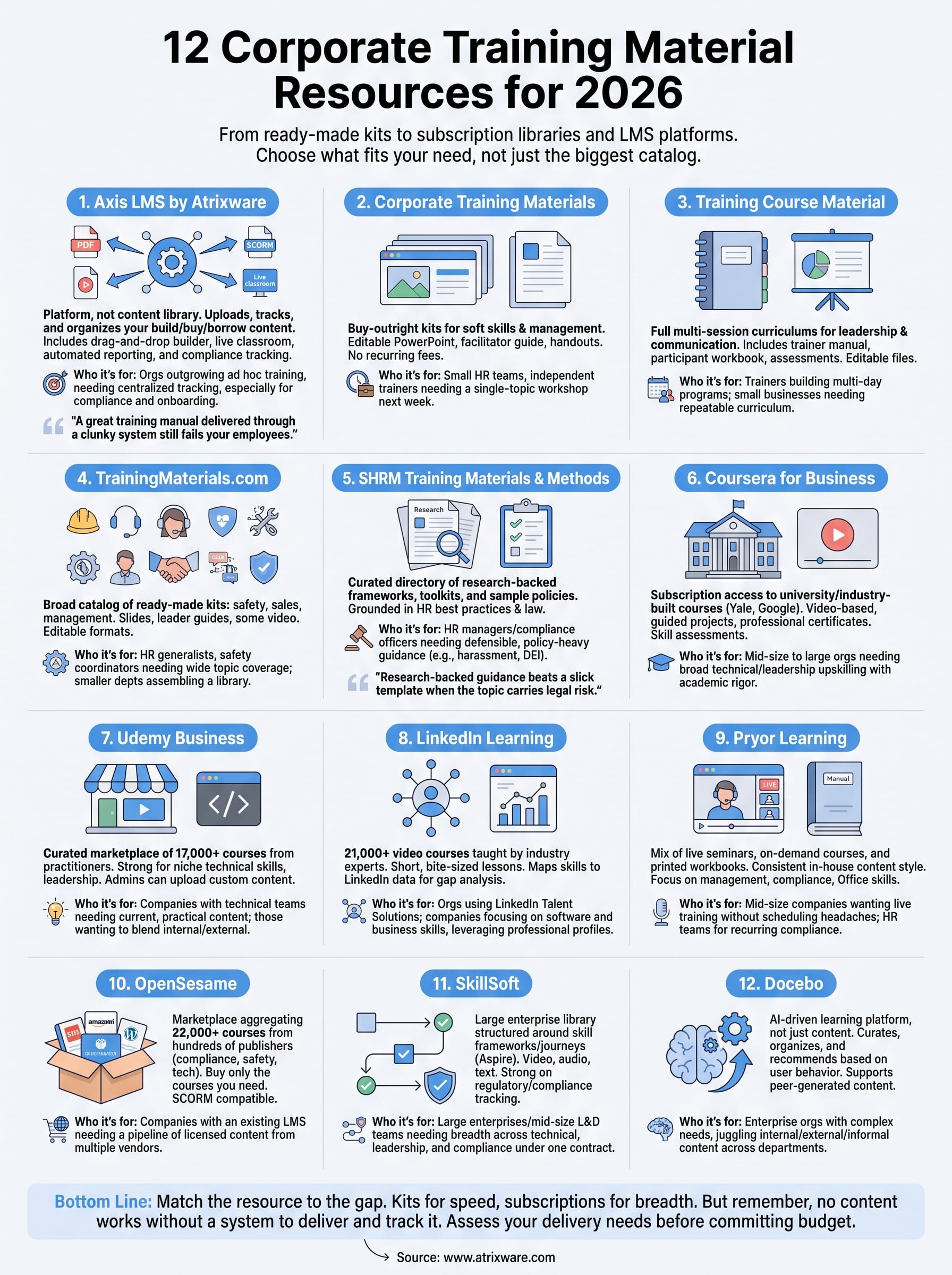
Match the resource to the actual gap, not the flashiest catalog. Off-the-shelf kits from Corporate Training Materials or TrainingMaterials.com solve a single-topic problem fast. Subscription libraries like Coursera or Skillsoft make sense when you need breadth across departments. But none of that corporate training material does much good sitting in a shared folder nobody tracks. You need somewhere to load it, assign it, and prove people actually finished it.
That’s the piece most lists like this skip, and it’s exactly where Axis LMS fits. Before you commit budget to another content subscription, figure out whether your delivery system can even handle what you already own. Run through the LMS readiness assessment to see where your team stands, and get a clear next step instead of another vendor comparison to sort through.
