
Most companies promote their best performers into management, then wonder why those new managers struggle. Technical skill and leadership skill are not the same thing, and without deliberate development, even talented employees flounder when they suddenly own a team’s output, morale, and growth. That gap is exactly why corporate training leadership programs exist, and why they’ve become a standing line item in serious L&D budgets rather than a nice-to-have.
So what actually counts as leadership corporate training? It’s structured instruction built around the specific skills managers need: giving feedback, delegating, resolving conflict, coaching direct reports, and making decisions under pressure. Done well, it’s ongoing and measurable, not a single off-site workshop that fades within a month.
This article breaks down what leadership training programs typically include, why organizations invest in them, and how leadership training corporate initiatives get delivered and tracked at scale. If you’re evaluating options or trying to justify the spend to leadership, you’ll walk away knowing exactly what to look for, including how a learning management system like Axis LMS turns scattered training into a repeatable, reportable program instead of a one-time event.
Why corporate leadership training matters for your organization
Gallup has spent decades studying why employees quit, and the answer keeps landing on the same factor: the manager. Poor management drives turnover far more reliably than pay, and turnover is expensive in ways that don’t show up on a single line item. Recruiting, onboarding, lost productivity during the ramp-up period, and the knowledge that walks out the door with a departing employee all add up. Corporate leadership training exists to interrupt that cycle before it starts, by giving new and existing managers the skills to actually manage instead of just supervise.
The real cost of undeveloped managers
Businesses that skip leadership development don’t save money, they defer the real cost of poorly trained workers and pay interest on it later. An untrained manager mishandles a conflict, and two good employees quit within a quarter. A manager who’s never learned to delegate burns out, misses deadlines, and blames the team. None of this shows up as a training expense, but it shows up in attrition reports, engagement surveys, and missed revenue targets. Structured leadership training replaces guesswork with a repeatable set of behaviors that managers can apply from day one.

Retention starts with the manager, not the paycheck
Organizations that invest in developing their managers see the difference in retention numbers, particularly among high performers who have options elsewhere, which is why training systems get judged on employee retention as much as on completion rates. A manager who knows how to give useful feedback, recognize good work, and coach through setbacks keeps people longer than one who simply hits deadlines. This is where corporate training leadership programs pay for themselves fastest: they’re not abstract culture initiatives, they’re direct retention tools.
Employees don’t leave companies, they leave managers who were never taught how to lead them.
Building a bench instead of a scramble
Every organization eventually loses a key leader to retirement, a competitor, or an internal move. Without a leadership pipeline, that departure turns into a scramble to backfill a role nobody was prepared to fill. With ongoing training tied to career stages, you build succession readiness into the organization instead of hoping the right person happens to be ready when the seat opens up. This matters just as much for a 40-person company as it does for a multinational, because losing your one strong operations lead hits a small business just as hard, proportionally, as losing a VP hits a large one.
Making the business case with data
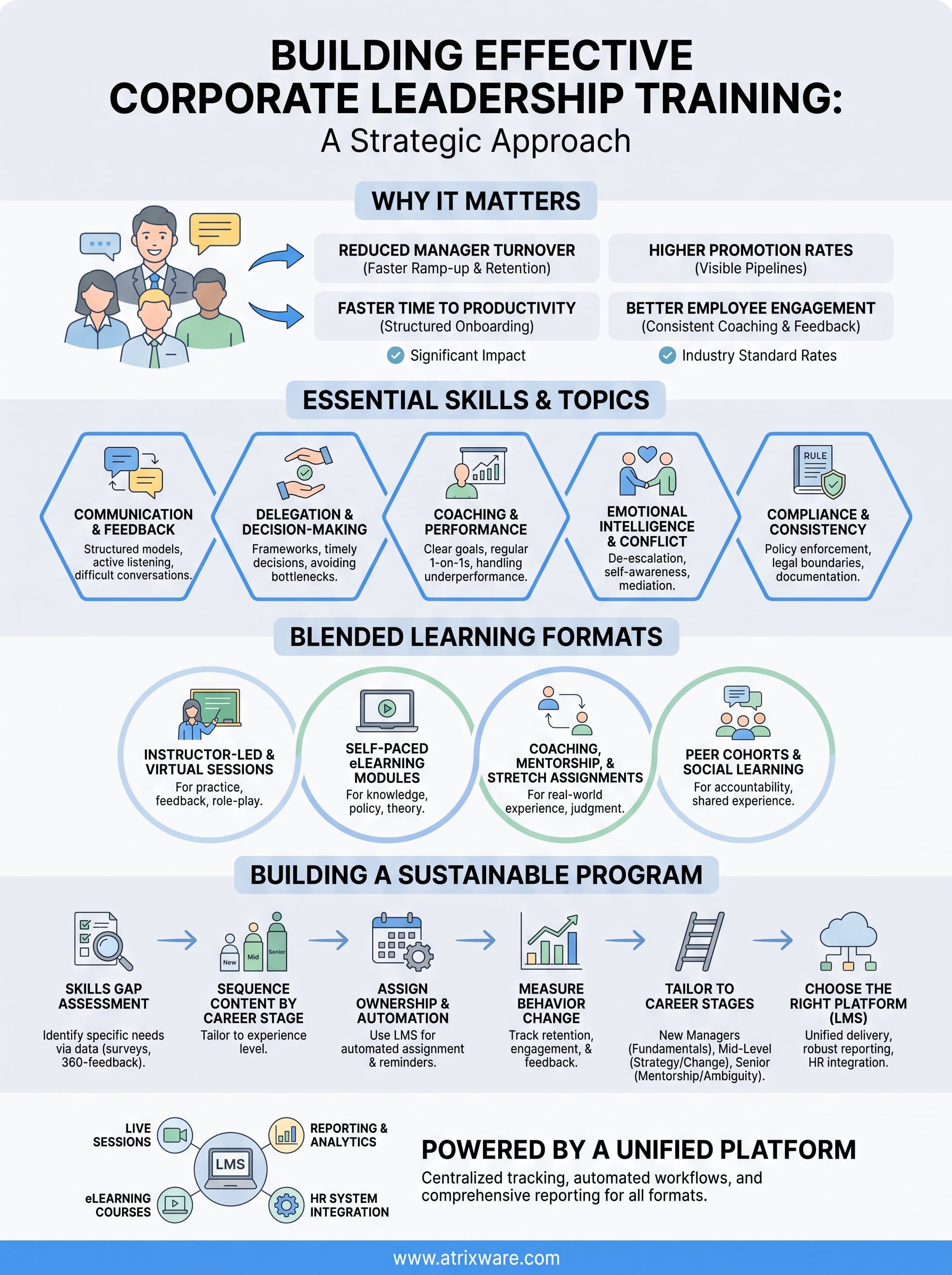
If you’re building the case internally, numbers move budget conversations faster than sentiment does, and it helps to know how to present training ROI to your CFO. Here’s how the impact typically breaks down when leadership training is treated as an ongoing program rather than a one-off event:
| Metric | Organizations without formal leadership training | Organizations with structured leadership training |
|---|---|---|
| Manager turnover in first 2 years | High, often exceeding 30% | Significantly lower, closer to industry-standard rates |
| Time to productivity for new managers | 6-12 months of trial and error | Weeks to a few months with structured onboarding |
| Internal promotion rate for leadership roles | Low, frequent external hires | Higher, driven by visible succession pipelines |
| Employee engagement scores under trained managers | Below average | Consistently above average |
Questioning whether these gains justify the investment misses the point: the cost is already being paid either way, either as tuition for training or as tuition for on-the-job mistakes made by unprepared managers.
Compliance and consistency across a growing team
Beyond retention and succession, leadership training also standardizes how policies get enforced. A manager who’s been trained knows how to document a performance issue correctly, how to handle a harassment complaint without making it worse, and how to apply company policy consistently across a diverse team. That consistency matters for legal exposure as much as it does for morale, and it’s a big reason compliance officers push for formal programs rather than leaving management style up to individual instinct.
Once leadership matters as much as it clearly does, the next question is what a program should actually teach. That’s where a lot of internal training efforts fall short, either covering too much surface material or missing the specific skills that separate a competent manager from a strong one.
Key skills and topics every leadership program should cover
A leadership program that tries to cover everything ends up teaching nothing well. The strongest corporate leadership training curriculums narrow in on a handful of skills that show up in a manager’s day-to-day work, then go deep on each one instead of skimming the surface. If your current program is a grab-bag of generic soft-skills modules, it’s probably not changing behavior on the floor.

Communication and feedback
Giving feedback that actually changes behavior is harder than it looks, and most new managers either avoid it entirely or deliver it so bluntly it damages trust. Training here should cover structured feedback models, how to run a difficult conversation, and how to communicate expectations clearly enough that a direct report never has to guess what "good" looks like. This is also where leadership training corporate programs teach active listening, since a manager who talks more than they listen misses the early warning signs of a disengaged employee.
Delegation and decision-making
New managers tend to either hoard tasks out of fear or dump work without context, and both patterns wreck a team’s output. Solid programs teach a framework for deciding what to delegate, how much context to hand off, and how to make timely decisions without waiting for perfect information.
A manager who can’t delegate isn’t protecting quality, they’re creating a bottleneck with their own name on it.
Coaching and performance management
Coaching is different from correcting, and most managers were never taught the difference. This module should cover setting clear performance goals, running one-on-ones that go beyond status updates, and handling underperformance before it becomes a termination conversation. Effective coaching skills are consistently the highest-leverage part of any leadership curriculum, because they compound: a manager who coaches well develops the next generation of managers without extra effort from HR.
Emotional intelligence and conflict resolution
Conflict between team members, or between a manager and a direct report, is inevitable. What separates a good manager from a mediocre one is whether they can de-escalate a disagreement instead of avoiding it or making it worse. This is where emotional intelligence training earns its keep, teaching managers to read a room, manage their own reactions under stress, and mediate a dispute fairly, and there are practical ways to develop soft skills through your LMS.
A practical checklist for program coverage
Before rolling out or renewing a leadership curriculum, check it against the fundamentals:
- Feedback delivery and difficult conversations
- Delegation frameworks and decision-making under uncertainty
- Coaching techniques and one-on-one structure
- Conflict resolution and emotional intelligence
- Change management and communicating during uncertainty
- Compliance basics: documentation, policy enforcement, and legal boundaries
Courses covering these topics can be built and tracked directly inside a system like Axis LMS, which lets you assign specific modules by role and pull completion data without chasing spreadsheets. Once the content is defined, the harder question becomes how to deliver it, and that’s where the format of training starts to matter as much as the material itself.
Types of corporate leadership training and how to blend them
No single training format develops a manager on its own. Live workshops build skills through practice, self-paced courses build knowledge on the manager’s own schedule, and mentorship builds judgment through real experience. The organizations getting the most out of corporate training leadership initiatives aren’t picking one format, they’re following a blended learning blueprint that combines several so each one covers a gap the others leave open.
Instructor-led and virtual classroom sessions
Instructor-led training, whether in person or through a virtual classroom, works best for skills that need practice and feedback in the moment: difficult conversations, conflict mediation, and negotiation. A facilitator can watch a manager fumble a role-play and correct it on the spot, which no self-paced course can replicate. The tradeoff is scheduling and cost, which is why most companies reserve live sessions for the highest-stakes skills and push everything else to other formats. Axis LMS supports scheduling live training alongside online courses, so both formats live in one system instead of two separate tools.
Self-paced eLearning modules
Self-paced courses, one of several e-learning methods for corporate training, handle the knowledge side of leadership development: compliance rules, company policy, performance management frameworks, and the theory behind coaching models. Managers move through them on their own time, which matters when you’re training people across shifts, time zones, or locations. The risk is treating self-paced content as the entire program. Watching a video on giving feedback doesn’t make someone good at giving feedback; it just gives them the vocabulary to practice with later.
Coaching, mentorship, and stretch assignments
Formal coaching and mentorship pair a developing manager with someone more experienced, and this is where most real leadership growth actually happens. Stretch assignments, like leading a cross-functional project before officially managing anyone, do the same thing by putting someone in a leadership position before the title exists. Neither of these scales through an LMS the way a course does, but tracking who’s paired with whom, and what milestones they’ve hit, still belongs in the same system as the rest of the training record.
A course teaches the theory of leadership; a mentor and a hard assignment teach the practice of it.
Peer cohorts and social learning
Grouping new managers into a cohort that moves through training together adds accountability and normalizes the fact that everyone struggles with the same things early on. Discussion boards, group coaching calls, and shared assignments turn a solitary course into a shared experience, which tends to improve completion rates on its own.
Matching format to skill
| Skill type | Best-fit format |
|---|---|
| Policy, compliance, frameworks | Self-paced eLearning |
| Difficult conversations, negotiation | Instructor-led or virtual classroom |
| Judgment, decision-making under pressure | Coaching, mentorship, stretch assignments |
| Accountability and shared learning | Peer cohorts |
Blending these formats, rather than betting everything on one, is what separates leadership training corporate programs that stick from the ones employees forget within a month.
How to build a corporate leadership training program that works
Knowing which skills to teach and which formats to use doesn’t automatically produce a working program. Building a corporate leadership training program that survives past its launch quarter takes a deliberate structure: an assessment of who needs what, a sequence that builds skills in order, clear ownership, and a way to measure whether any of it changed behavior, which is the backbone of a leadership development program run in an LMS. Skip any of these steps and you end up with a course library nobody finishes.
Start with a skills gap assessment
Before assigning a single course, find out where your managers actually struggle, since closing skills gaps starts with knowing which ones exist. Surveys, 360-degree feedback, and exit interview data usually surface the same handful of gaps: weak feedback delivery, poor delegation, or inconsistent policy enforcement. Building the curriculum around real gaps, instead of a generic template pulled from a vendor’s catalog, is what makes the training feel relevant instead of mandatory.
A leadership program built on assumptions instead of data trains the wrong skills for the right people.
Sequence the content by role and readiness
A new manager and a director need different starting points, so the program should route people into the right track based on their level rather than pushing everyone through the same modules. Axis LMS supports this through role-based course assignment, so a first-time supervisor gets the fundamentals while a senior manager moves straight into advanced coaching and change management content.
A typical build-out looks like this:
- Assess current managers and identify skill gaps by role
- Map required courses and formats to each leadership level
- Assign content automatically based on job role or promotion trigger
- Set completion deadlines tied to onboarding or review cycles
- Pull reporting on completion, quiz scores, and manager feedback
- Adjust the curriculum based on what the data shows
Assign ownership, not just content
A program with no owner drifts. Someone, usually in HR or L&D, needs to own the calendar, chase incomplete assignments, and report progress to leadership. Automated notifications handle a lot of this chasing on their own: automating online training in Axis LMS can trigger reminders when a course is overdue or automatically enroll someone in the next module once they finish the last one, so the program keeps moving without a person manually tracking spreadsheets.
Measure what actually changed
Completion rates tell you who finished a course, not whether they got better at managing people, which is why the metrics that matter tie learning to performance. Pair training data with downstream metrics: retention on a manager’s team, engagement scores, and 360-degree feedback collected a few months after training wraps. When those numbers move in the right direction, you have a case for expanding the program. When they don’t, you know which module to rebuild before rolling it out again.
Once the structural pieces are in place, the content itself still needs to match where someone actually sits in their leadership journey, which is a different problem than simply assigning courses by job title.
Tailoring leadership training to different career stages
A course built for a first-time supervisor will bore a director and confuse a brand-new team lead if you hand it to the wrong person. Career-stage-specific training, built around individual learning paths for employees, is what separates a program that feels relevant from one that feels like a compliance checkbox everyone clicks through without absorbing. The goal isn’t more content, it’s the right content at the right moment in someone’s growth, which is exactly why role-based routing matters as much as the curriculum itself.

New and first-time managers
Someone stepping into management for the first time needs the basics before anything else: how to run a one-on-one, how to delegate without micromanaging, and how to have a hard conversation without avoiding it. Skipping straight to advanced strategy content at this stage wastes the training and leaves the actual gap unaddressed. A new manager training track should be short, practical, and front-loaded in the first 90 days, since that’s when habits form and mistakes are cheapest to correct.
Mid-level and experienced managers
Managers who’ve been leading a team for a year or more already know the fundamentals, so repeating them insults their experience and kills engagement with the program. This group needs training on managing other managers, cross-functional influence, and handling underperformance that’s been left unaddressed too long. Conflict resolution and change management modules land better here than they do with brand-new supervisors, because experienced managers have already lived through enough friction to recognize why the frameworks matter.
Training that ignores where someone actually stands in their career teaches the wrong lesson at the wrong time.
Senior leaders and executives
Executives rarely need another module on giving feedback. What they need is training on organizational strategy, leading through ambiguity, and mentoring the next layer of managers coming up behind them. Peer cohorts and executive coaching tend to outperform self-paced courses at this level, since the value comes from discussing real, high-stakes decisions with people facing similar ones, not from watching another video.
High-potential and succession candidates
Employees identified as future leaders, whether or not they hold a management title yet, need a track of their own. Stretch assignments, mentorship pairings, and early exposure to leadership fundamentals prepare them before a role opens up, so you’re not scrambling to train someone after the promotion instead of before it.
| Career stage | Primary focus | Best-fit format |
|---|---|---|
| First-time manager | Feedback, delegation, one-on-ones | Self-paced plus live practice |
| Mid-level manager | Managing managers, conflict, change | Workshops, peer cohorts |
| Senior leader | Strategy, ambiguity, mentoring | Executive coaching, cohorts |
| High-potential | Foundational skills, exposure | Mentorship, stretch assignments |
Building these tracks manually across a growing organization gets unwieldy fast, which is why role-based learning paths inside a system like Axis LMS matter: tag someone’s role or promotion trigger once, and the right track follows them without HR reassigning courses by hand every time someone moves up.
Getting the content and sequencing right still leaves one decision unanswered: which platform actually delivers, tracks, and reports on all of it without becoming its own maintenance burden.
How to choose the right leadership training platform or provider
Picking a platform is where a lot of well-designed programs stall out. You can nail the curriculum, sequence it perfectly by career stage, and still end up with a program nobody trusts if the system behind it can’t handle live sessions, self-paced courses, and reporting in one place. The right platform doesn’t just host content, it enforces the structure you built in the previous steps.
Match the platform to your delivery mix
Given that leadership training blends instructor-led sessions, self-paced modules, and mentorship tracking, the platform needs to support all three without forcing you into separate tools for each. A system that only handles video courses will leave you managing live sessions in a spreadsheet and mentorship pairings in someone’s inbox. Unified delivery across formats is one of the features worth looking for in an LMS, because it keeps a program from fragmenting the moment it scales past a pilot group.
A platform that can’t handle every format you use will quietly become the format you stop using.
Reporting and compliance tracking
HR and compliance teams need proof that training happened, not just a sense that it probably did. When you evaluate LMS reporting and analytics, look for on-demand reporting that shows completion by role, department, or manager, plus automated alerts when someone falls behind schedule. This matters as much for a promotion pipeline as it does for regulated compliance training, since both eventually get audited by someone asking for documentation, not impressions.
Integration with existing HR systems
Manually enrolling every promoted employee into the right leadership track doesn’t scale past a handful of managers. A platform with the right HR system integrations, whether that’s ADP, BambooHR, or Salesforce, can trigger enrollment automatically the moment someone’s role changes. Axis LMS handles this through built-in HR system integrations and a REST API, so a promotion in your HR platform starts the right training track without anyone in L&D touching a spreadsheet.
Questions to ask before you sign
Before committing to a provider, run the decision through a short checklist:
- Does it support live, self-paced, and mentorship tracking in one system?
- Can courses be assigned automatically by role, department, or promotion trigger?
- Does reporting cover completion, quiz scores, and manager-level rollups?
- Does it integrate with your existing HR or CRM systems?
- Can the interface be branded to match your organization?
- What does support look like once you’re past the sales conversation?
Vendors will answer these questions confidently in a demo, so follow a step-by-step process for comparing LMS platforms, ask for a trial account, and test the reporting yourself before you sign anything. Trying to build corporate leadership training on a platform that can’t answer these questions cleanly just moves the maintenance burden from your training program to your IT team, and that’s a worse trade than it looks like on paper.
Building leaders your organization can count on
Good managers aren’t born fully formed, and hoping your best performers figure it out on their own is a bet most organizations lose. Corporate leadership training works when it’s built on real skill gaps, sequenced by career stage, delivered through a mix of formats, and tracked well enough that you actually know what changed. Skip any of those pieces and you’re left with a course library nobody finishes and a management bench nobody trusts.
The platform you build it on determines whether any of this holds together past the pilot stage. Structured, trackable training turns good intentions into a program that runs itself, instead of one that depends on someone in HR remembering to chase completions.
If you’re ready to see how that looks in practice, try the Axis LMS admin demo and walk through building a leadership track yourself before you commit to anything.
