Half your employees forget what they learned in training within a week. That’s not a knowledge problem, it’s an engagement problem, and it’s why so many L&D teams are looking to gamify corporate training instead of relying on another slide deck and a quiz nobody remembers. If your completion rates are low or your team treats mandatory training like a chore to click through, the format is working against you.
The fix isn’t complicated, but it does require intention. The gamification of corporate training works because it taps into competition, progress, and reward, the same instincts that make games addictive and the reason gamification boosts employee engagement, and applies them to skills your team actually needs. Done right, it turns passive learners into active participants who want to finish the course, not just pass it.
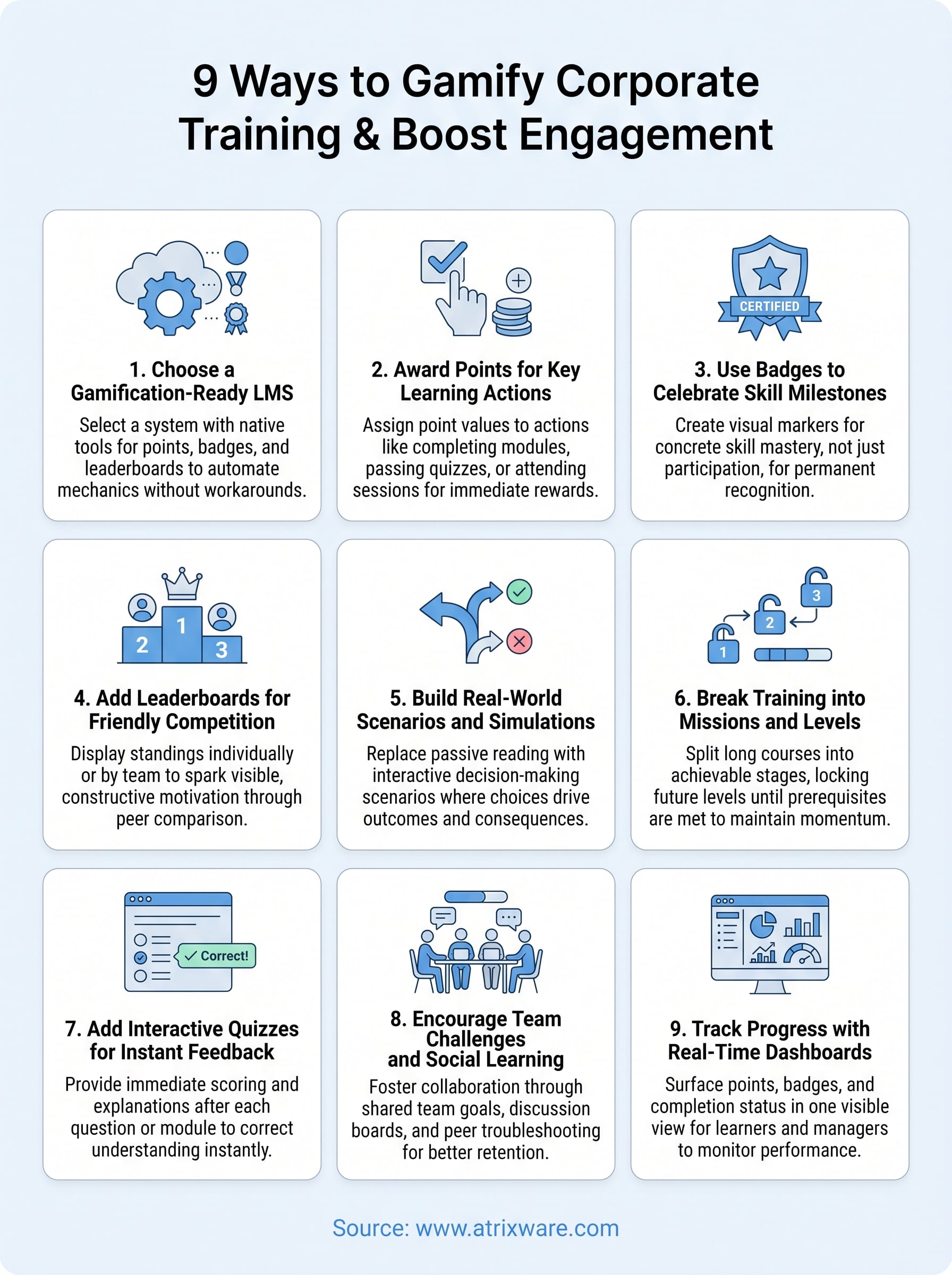
This list breaks down nine specific, practical techniques you can apply inside a learning management system, from leaderboards and badges to branching scenarios and progress tracking, so you can pick the ones that fit your training goals and start building courses your team will actually engage with.
1. Choose a gamification-ready LMS
Before you add a single badge or leaderboard, you need a system that can actually run the mechanics you’re planning. Bolting gamification onto a legacy LMS through workarounds and spreadsheets creates more admin work than it saves, and it usually falls apart within a few months. The right platform makes points, badges, and levels a built-in part of course design, not an afterthought you have to hack together.
How it works
A gamification-ready learning management system gives administrators native LMS tools to assign points to specific actions, issue badges automatically when learners hit milestones, and display standings without third-party plugins. In Axis LMS, for example, you can configure point values per course, quiz, or module directly in the course builder, set badge triggers tied to completion or performance thresholds, and turn on leaderboards at the group or organization level. None of this requires custom development. It’s a matter of checking boxes and setting rules inside the admin panel.
Why it works
Gamification only sticks when it’s consistent, and consistency requires infrastructure. If your team has to manually track who earned what and update a leaderboard in a shared document, the system breaks down the moment someone gets busy. A dedicated LMS automates the tracking, so rewards show up instantly and reporting stays accurate without extra headcount.
A gamification strategy is only as reliable as the platform running it.
This matters even more as your training program scales. What works for 20 employees on a spreadsheet becomes unmanageable at 200, and the gamification of corporate training needs to hold up whether you’re onboarding a small team or rolling out compliance training company-wide.
Example in action
Here’s what to look for in an LMS gamification engine when comparing platforms, since not every LMS handles gamification the same way:
| Feature | Why it matters |
|---|---|
| Native point systems | Assign values to actions without custom code |
| Automated badge triggers | Rewards issue instantly on completion, no manual tracking |
| Built-in leaderboards | Visible standings without third-party integrations |
| Reporting on engagement | Ties gamification data to actual training outcomes |
| API and integration support | Connects gamified data to HR or CRM systems |
A mid-size distributor rolling out product training to a 150-person sales team used Axis LMS to set point values for course completion, quiz scores, and certification renewals. Within the first quarter, they had a working leaderboard by region and automated badges for reps who completed advanced product modules, all configured without a developer or a support ticket. Course completion rates jumped because reps could see exactly where they stood against peers, and managers could pull reports showing which regions needed a push. That kind of visibility is hard to replicate manually, and it’s the reason picking the right platform is step one, not step nine, on this list.
2. Award points for completing key learning actions
Points are the simplest gamification mechanic to set up, and they’re often the most effective. Instead of a course that just tracks pass or fail, you assign point values to specific actions like finishing a module, passing a quiz, or logging in on time for a virtual session. The goal is to make progress visible in a way a completion checkbox never does.
How it works
Inside your learning management system, you define what earns points before you launch the course. Common actions worth assigning value to include:
- Completing a module or lesson
- Passing a quiz above a set score
- Finishing a course ahead of the deadline
- Attending a live virtual session
- Submitting an assignment or scenario response
Axis LMS lets administrators set these values directly in the course builder, so points accumulate automatically as learners move through the material, part of a broader approach to automating online training. No manual entry, no separate spreadsheet to reconcile at the end of the month.
Why it works
Points work because they turn an abstract goal, like "complete your compliance training," into a series of small, trackable wins. Each action gives learners immediate proof they’re making progress, which keeps them moving instead of abandoning the course halfway through.
Small, visible wins keep learners moving when a single end goal feels too far away.
Behavioral research backs this up too. The American Psychological Association has documented how immediate feedback and incremental rewards sustain motivation better than delayed, single-outcome evaluation, which is exactly the pattern quiz-and-certificate training breaks.
Example in action
A regional healthcare provider used point values in Axis LMS to reward nurses for completing HIPAA modules early rather than waiting until the deadline. Nurses who finished a full week ahead earned bonus points redeemable for a badge tied to their annual review. Early completion rates rose noticeably in the first cycle, and the compliance team stopped chasing stragglers in the final week, since the point structure did the nudging for them.
3. Use badges to celebrate skill milestones
Badges give learners something points alone can’t: a visual, permanent marker of a specific skill they’ve proven they have. Where points measure activity, badges mark achievement, and that distinction matters when you’re trying to signal real competence rather than just participation. A stack of points tells you someone showed up; a badge tells you they mastered something.
How it works
You define a skill or milestone worth recognizing, then set the criteria a learner has to hit to earn it, like scoring above 90% on a certification quiz or completing every module in a compliance track. In Axis LMS, admins configure how user badges are earned inside the course builder, so the system issues them automatically the moment a learner qualifies. Skill-based badges should map to something concrete, not vague participation, so the badge actually means something on a resume or performance review.
Why it works
Badges tap into a different motivator than points: status and identity. Employees display them on profile pages, reference them in reviews, and use them to signal expertise to managers and peers. That visibility creates a reason to chase mastery beyond just finishing the course.
A badge only motivates if it represents a skill worth bragging about, not just a box checked.
This works especially well for gamified compliance training and technical certifications, where a badge doubles as a record of who’s qualified for a task, useful when managers need to staff a project fast.
Example in action
A manufacturing company running safety training through Axis LMS created badges for each certified equipment type, forklift operation, hazardous material handling, and lockout/tagout procedures. Supervisors could scan a team roster and instantly see who held which certifications without digging through spreadsheets, the same benefit you get from automated certification tracking. Employees started requesting additional badge tracks on their own, since holding more certifications meant more opportunities for cross-training assignments. The badge system did double duty: it motivated learners and gave managers a real-time skills inventory they’d never had before, all without adding extra reporting work for the training team.
4. Add leaderboards for friendly competition
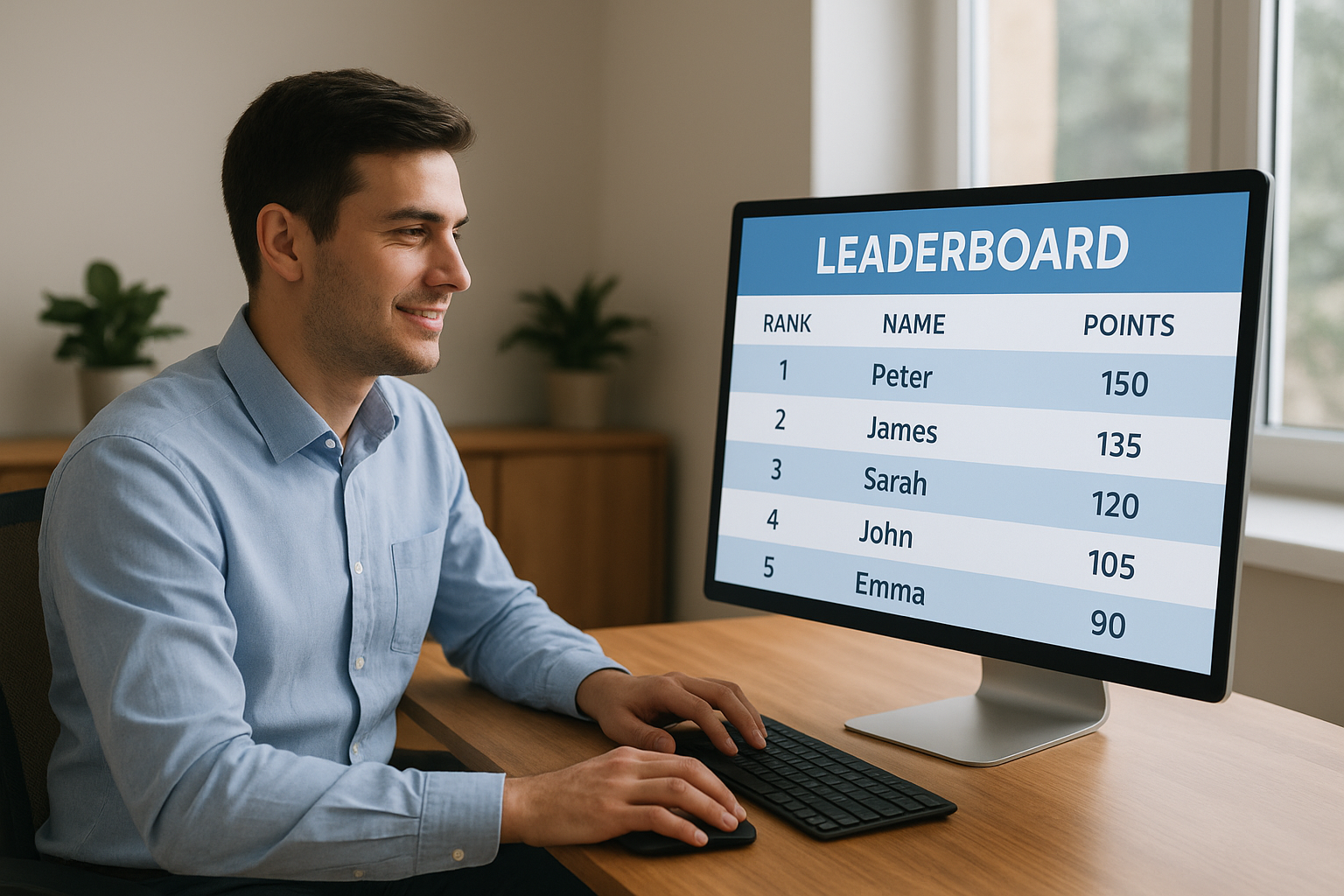
Leaderboards take individual points and put them in a shared context, letting learners see how they stack up against peers. That visibility changes behavior fast. A rep sitting in tenth place on a leaderboard inside your sales team training software has a concrete reason to finish one more module before Friday, something a private completion percentage never provides.
How it works
Most gamification-ready platforms let you display standings by individual, team, department, or region, so you can choose the scope that fits your culture. In Axis LMS, admins turn on leaderboard visibility at the group level and decide whether rankings show real names, team totals, or anonymized handles, useful when you’re driving compliance through competition and public scores might feel punitive rather than motivating.
Common leaderboard configurations include:
- Individual rankings within a single course
- Team or department totals across a training program
- Regional or branch comparisons for distributed sales teams
- Rolling weekly boards that reset to keep competition fresh
Why it works
Competition works because humans compare themselves to peers automatically, and a leaderboard just makes that comparison visible and constructive. Instead of guessing where they stand, learners get a real number, and that number pushes the ones near the middle to close the gap.
A leaderboard turns quiet comparison into visible motivation.
Managers benefit too. A live standings board flags who’s falling behind before a deadline, so coaching happens early instead of after a missed compliance date.
Example in action
A telecom company rolled out onboarding training for new call center hires through Axis LMS and activated a weekly leaderboard by cohort. New hires could see their ranking update in real time as they completed modules and passed knowledge checks. Cohorts started competing informally, with top performers coaching stragglers just to keep their team’s average score up. Onboarding completion time dropped by nearly a third that quarter, and managers credited the visible friendly competition for keeping stragglers from falling too far behind the group.
5. Build real-world scenarios and simulations
Badges and leaderboards reward speed and participation, but neither one proves an employee can actually apply what they learned under pressure. Branching scenarios and simulations close that gap. Instead of asking a learner to recall a policy, you put them inside a situation that mirrors their job and let their choices drive the outcome, which is often the fastest way to gamify corporate training for roles where judgment matters more than memorization.

How it works
You build a scenario around a realistic decision point, then branch the storyline based on what the learner picks. A customer service rep might face an angry caller and choose between three responses, each leading to a different consequence and a different score. Axis LMS supports this through its branching scenario tools in the course builder, letting admins map out decision trees, assign point values to each path, and show learners the outcome of their choice immediately rather than at the end of a long module.
Why it works
Simulations work because they replace passive reading with active decision-making, the kind of interactive learning where decisions stick better than definitions. Learners remember the scenario where they picked wrong and saw the fallout far longer than they remember a slide about the correct policy.
A choice a learner made and watched play out teaches more than a paragraph they read and forgot.
The Association for Talent Development has noted that scenario-based practice improves retention and transfer to real job performance compared to lecture-style content alone, which is exactly the outcome most compliance and sales training programs are chasing.
Example in action
A financial services firm used Axis LMS to build a fraud-detection simulation for call center staff. Reps worked through simulated calls with red flags hidden in the conversation, earning points for catching them and losing points for missing warning signs. Fraud-flagging accuracy improved measurably within two months, and managers used the scenario data to identify which reps needed one-on-one coaching before real calls went sideways.
6. Break training into missions and levels
A single long course feels like a wall, and most learners stall out somewhere in the middle. Splitting that same content into missions and levels turns one intimidating course into a series of achievable stages, each with a clear finish line. This is one of the simplest ways to gamify corporate training for content that’s naturally sequential, like onboarding, product certification, or multi-part compliance tracks.
How it works
You break a course into stages, then lock later levels until the learner clears the one before it, mimicking the progression structure of a video game. Axis LMS supports this through prerequisite settings and structured learning paths, so admins can chain modules into a sequence, label each stage as a level or mission, and require a passing score before unlocking the next one. A typical structure might look like:
- Level 1: Company policies and systems overview
- Level 2: Role-specific procedures
- Level 3: Applied scenarios and case studies
- Level 4: Certification exam
Why it works
Each unlocked level gives the learner a small sense of accomplishment before they tackle the next chunk, which keeps momentum going instead of letting the whole course feel like one long slog. Locking progression also stops learners from skipping ahead and missing foundational material they’ll need later.
Breaking one long course into levels turns a wall into a staircase.
Managers get a cleaner view of where people are too. Instead of a single completion percentage, a level structure shows exactly which stage someone is stuck on, so coaching can target the actual gap instead of the whole course.
Example in action
A logistics company used Axis LMS to restructure a six-hour compliance course into four unlockable levels, each capped at 90 minutes. Completion rates rose sharply once employees could see a finish line every 90 minutes instead of one distant deadline six hours out. Supervisors also noticed fewer employees stalling at the same point, since the level-based structure made it obvious where extra support was needed before someone got stuck.
7. Add interactive quizzes for instant feedback
Quizzes get a bad reputation because most of them are an afterthought bolted onto the end of a module. Done right, they’re a gamification tool in their own right, especially when they deliver instant feedback instead of a score that shows up days later in a report nobody reads. The gap between answering a question and finding out if you were right is exactly where engagement dies, so closing that gap is the whole point.
How it works
Inside Axis LMS, quizzes can trigger immediate feedback on quiz answers, explanations, and even point awards the moment a learner submits an answer, rather than waiting until the whole module wraps up. Common formats that work well for interactive quizzes include:
- Scenario-based multiple choice with branching feedback
- Timed knowledge checks that award bonus points for speed
- Drag-and-drop sequencing for process-based training
- Short-answer questions scored against keyword rules
Each format gives learners a result they can act on right away, whether that’s a correct badge, a point bump, or a quick explanation of why an answer missed the mark.
Why it works
Feedback loses most of its power the longer it takes to arrive. A learner who misunderstands a concept and doesn’t find out for a week has already built the wrong mental model and moved on. Instant scoring corrects course while the material is still fresh, which is a big part of why the gamification of corporate training leans so heavily on quizzes as a checkpoint tool rather than a final exam.
Feedback that arrives instantly corrects a mistake before it becomes a habit.
Example in action
A retail chain running product knowledge training through Axis LMS added short, five-question quizzes after every module instead of one long test at the end. Employees got instant scoring and a one-line explanation for any wrong answer, plus bonus points for finishing under two minutes. Retention on follow-up assessments improved noticeably compared to the old single-quiz format, and store managers stopped fielding the same repeated questions on the sales floor.
8. Encourage team challenges and social learning
Most of the mechanics so far reward individuals, but training doesn’t have to be a solo activity. Team challenges pull learners into small groups working toward a shared score, and social learning features let them ask questions, share tips, and troubleshoot together instead of guessing alone. Combining the two turns a mandatory course into something closer to a shared project, which is often the missing piece when you gamify corporate training for teams that already collaborate on the job.
How it works
You group learners into teams, then set a shared point pool or completion target the whole group has to hit together. Axis LMS supports this through group-based reporting and its communication tools, including the UserConnect social site, discussion boards, real-time messaging, and collaborative spaces tied directly to a course. A typical setup might combine:
- Team-based point pools that combine individual scores into a group total
- Discussion boards attached to specific modules for peer troubleshooting
- Group challenges with a shared deadline and a visible team score
- Peer recognition tools where teammates can flag helpful contributions
Why it works
People work harder when a teammate is counting on them, and a shared score creates that accountability without a manager having to enforce it. Collaborative learning also surfaces answers faster than a help desk ticket, since a coworker who just solved the same problem can explain it in plain language.
A shared score turns training into something a team finishes together, not something each person suffers through alone.
The Society for Human Resource Management has pointed to peer collaboration as a consistent driver of higher training completion and better knowledge retention, which tracks with what shows up in team-based course data.
Example in action
A software company running onboarding through Axis LMS split new hires into cohorts of six and set a shared point target for finishing product certification. Cohorts used the built-in discussion board to swap notes on tricky modules, and the group with the highest average score got recognized company-wide. Completion time dropped, and several new hires said the discussion board answered questions faster than opening a support ticket ever did.
9. Track progress with real-time dashboards
Every mechanic on this list generates data, points earned, badges issued, levels cleared, quiz scores, team standings, and none of it does much good if it’s buried in a report someone has to request. Real-time dashboards pull that data into one view so learners and managers can see progress the moment it happens, not days later in a spreadsheet export.
How it works
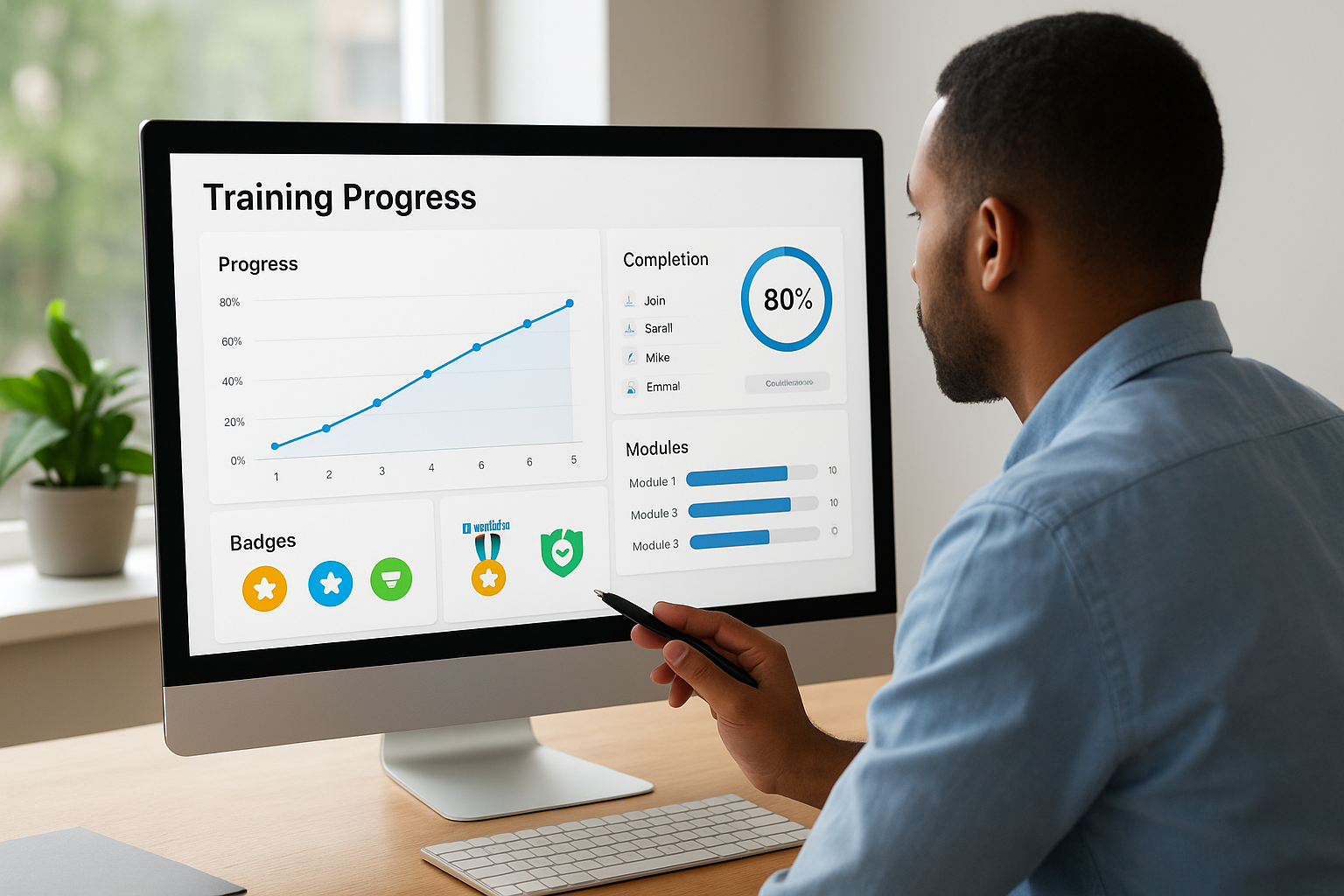
Dashboards surface the numbers behind every other gamification tactic in one place: current point totals, badges earned, leaderboard position, and completion status by module. Axis LMS builds this into its suite of training dashboards and reports, so admins can pull on-demand or automated reports and learners can check a personal dashboard without asking a manager for an update. Typical dashboard views include:
- Individual progress by course, module, and quiz score
- Team or department completion rates against a deadline
- Badge and certification status across a whole workforce
- Point totals feeding into leaderboard rankings
Why it works
Visibility changes behavior faster than a reminder email ever will. When a learner can see they’re 80% through a course with two modules left, finishing feels close instead of open-ended. Managers get the same benefit at scale, spotting stalled progress before a deadline instead of after a compliance audit flags it.
A dashboard turns training progress from a mystery into a number everyone can act on.
Real-time reporting also closes the loop on every mechanic covered above. Points, badges, and levels only motivate if learners can actually see them update, and a dashboard is what makes that visibility possible without manual tracking.
Example in action
A national retail chain used Axis LMS dashboards to monitor compliance training across 40 store locations. Regional managers pulled automated weekly reports showing completion rates by store, without waiting on corporate to compile numbers manually. Store managers with lagging teams got flagged early enough to intervene before deadlines slipped, and the chain cut its compliance follow-up time by more than half compared to the old spreadsheet-based tracking method.
Turning training into an experience employees choose
None of these nine tactics work in isolation, and you don’t need all of them on day one. Start with points and badges to build momentum, layer in leaderboards and team challenges once learners are used to the format, then round it out with dashboards that keep everyone honest about progress. The common thread is that gamify corporate training stops being a buzzword the moment learners start logging in without being told to.
What separates a program that sticks from one that fizzles after a month is the platform underneath it. Points that don’t track automatically, badges nobody sees, leaderboards that require manual updates, all of that collapses under its own weight fast. Before you build out any of these mechanics, it’s worth confirming your current setup can actually support them. Take the LMS readiness assessment to see where your training program stands and what to fix first.
