Picking the right online courses for corporate training shouldn’t take weeks of research, but with dozens of platforms claiming to be the best, it usually does. You’re probably comparing certification programs, trying to figure out which ones actually build skills your L&D team can use, and wondering if a course still matters if it doesn’t plug into the systems you already run training through.
This list narrows that search down to six programs worth your time in 2026, based on course content quality, certification value, and how well each one fits into a real training strategy rather than just looking good on a resume. Whether you’re upskilling your training team or building out a corporate training course for new hires, you’ll find options here that match different budgets and skill levels.
We’ll also point out where these courses fit alongside a learning management system like Axis LMS, since even the best course content needs a solid platform to track completions, manage certifications, and report on results across your organization.
1. Atrixware Axis LMS
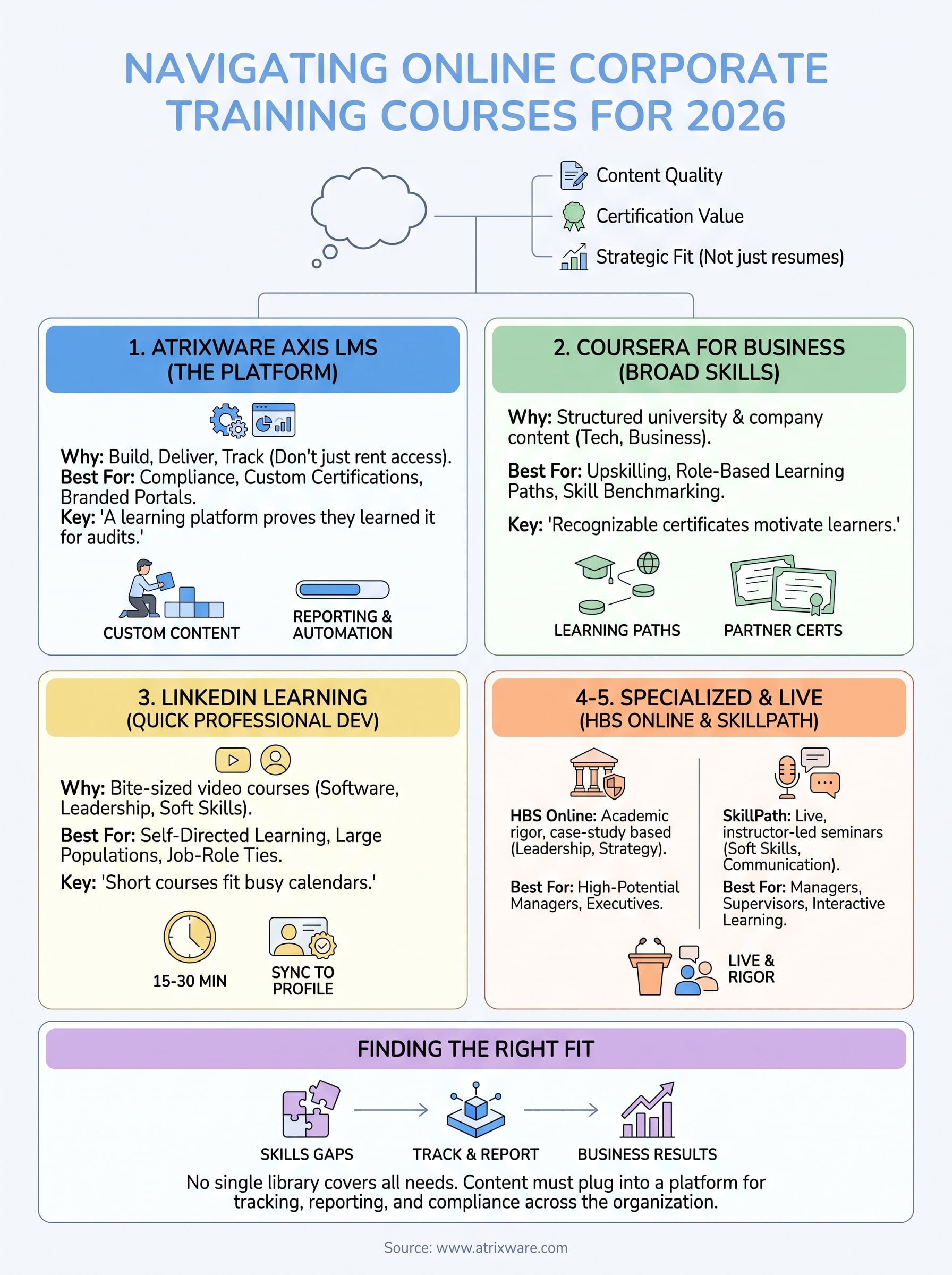
Atrixware’s Axis LMS earns the top spot because it does something most course libraries can’t: it lets you build, deliver, and track corporate training courses on your own terms instead of renting access to someone else’s catalog. Companies that need compliance tracking, custom certification paths, or a branded learning portal for employees and channel partners tend to outgrow generic course subscriptions fast. Axis LMS solves that by combining a drag-and-drop course builder with the reporting and automation an HR or L&D team actually needs to run online training corporate programs at scale.

What it offers
Unlike a fixed course catalog, Axis LMS gives you the tools to create your own training content or import existing SCORM and video-based courses, then manage everything from one dashboard. Administrators get automated enrollment rules, real-time progress tracking, and compliance features built for standards like GDPR and FDA 21 CFR Part 11, along with CEU and recertification tracking for industries that require it.
- Drag-and-drop course authoring for rapid content creation
- Automated and on-demand reporting on learner progress
- SSO support (SAML, Okta, Azure, Ping Identity) and integrations with ADP, Salesforce, BambooHR, and Zoho
- E-commerce tools for selling courses or seat licenses to external customers
- REST API and webhooks for custom integrations
A course library teaches people. A learning platform proves they learned it, and that’s the difference that matters for compliance audits.
Who it’s best for
Mid-size and large organizations juggling multiple training needs, employee onboarding, customer education, compliance, and partner training, are the best fit. Compliance officers and training managers who need airtight audit trails will appreciate the reporting depth, while sales enablement teams benefit from the e-commerce features when packaging training as a revenue stream. If your team already runs HR or CRM systems and needs training data flowing into them automatically, the integration builder makes that connection painless rather than a custom development project.
Pricing
Axis LMS doesn’t publish flat per-seat pricing because deployments vary so much between a 50-person team and a multinational with channel partners across continents. Pricing scales with user count, hosting preference, and the level of customization you need, and Atrixware provides quotes after a short discovery conversation. Most buyers find this more cost-effective long term than stacking per-course fees across a growing organization.
2. Coursera for Business
Coursera for Business packages content from universities and companies like Google, IBM, and Yale into structured learning paths that fit corporate skill-building goals. It’s less a training platform and more a massive course catalog with enough structure that L&D teams can assign paths without building anything from scratch. For teams looking for corporate online training that leans academic rather than compliance-driven, this fills that gap well.
What it offers
Businesses get access to thousands of courses across data, technology, leadership, and business skills, plus guided learning paths mapped to specific job roles. Skill assessments help managers benchmark where employees stand before and after training, and completion certificates carry weight because they’re tied to recognizable university and industry brands.
- Role-based learning paths for technical and business skills
- Skill benchmarking and gap analysis tools
- Certificates from partner universities and companies
- Team analytics dashboard for tracking engagement
A recognizable certificate motivates learners in a way a generic completion badge never will.
Who it’s best for
Organizations focused on upskilling in technical or business domains, think data analytics, project management, or leadership development, get the most value here. It suits companies without a dedicated content team who’d rather license quality courses than build their own.
Pricing
Coursera for Business runs on a per-user annual license, typically starting around $400 per learner per year for teams, with volume discounts for larger headcounts. There’s no free tier for business accounts, though individual learners can preview select courses before a company commits.
3. LinkedIn Learning
LinkedIn Learning bundles thousands of short, practical video courses into a subscription that plugs straight into the platform where most professionals already spend time job hunting and networking. Sitting under Microsoft’s ownership, it leans on LinkedIn’s own skills data to recommend courses tied to actual job titles, which makes it a fast option for teams that want online training corporate content without a heavy setup process.
What it offers
Courses run short, often 15 to 30 minutes, and cover software skills, leadership, marketing, and general professional development. Learners earn certificates that can post directly to their LinkedIn profile, and admins get a dashboard showing completion rates and skill trends across teams.
- Bite-sized video lessons built for busy schedules
- Certificates that sync directly to LinkedIn profiles
- Skill-based course recommendations tied to job roles
- Admin reporting on team-wide completion and engagement
Short courses fit busy calendars, but they rarely replace structured programs that need to prove compliance.
Who it’s best for
Companies wanting quick, self-directed skill-building for large employee populations do well here, especially when the goal is general professional development rather than deep certification tracking. It’s a weaker fit for compliance training or anything requiring detailed audit trails, since reporting stays fairly surface-level compared to a dedicated LMS.
Pricing
LinkedIn Learning for business runs on a per-seat annual license, generally landing between $20 and $35 per user per month depending on team size and contract length, with discounts for larger commitments negotiated through a Microsoft or LinkedIn sales rep.
4. Harvard Business School Online
Harvard Business School Online brings academic rigor to corporate training courses, turning case-study teaching methods into structured programs on strategy, finance, negotiation, and leadership. Unlike course libraries built for volume, HBS Online caps cohorts and builds in peer discussion, so it feels closer to an executive education program than a self-paced video library. This makes it a strong pick when you need courses in corporate training that carry genuine academic weight rather than a quick completion badge.

What it offers
Programs run six to twelve weeks and use the same case-based method HBS is known for, pairing video lectures with cohort discussions and graded assignments. Learners work through real business scenarios instead of passive video watching, and completion earns a certificate co-branded with Harvard Business School.
- Case-based courses in strategy, finance, leadership, and analytics
- Cohort-based learning with peer discussion boards
- Certificates co-branded with Harvard Business School
- CORe and CLIMB credential tracks for broader business fundamentals
Prestige earns attention in a resume, but it doesn’t replace the tracking systems compliance training demands.
Who it’s best for
Companies developing high-potential managers or executive talent get the clearest return here, since the content targets strategic thinking rather than task-based skills. It’s a poor fit for onboarding large frontline teams or tracking mandatory compliance training, where cost and pacing don’t scale.
Pricing
Individual courses generally cost between $1,750 and $3,000, with corporate bulk pricing available for teams enrolling multiple employees across cohorts.
5. SkillPath
SkillPath takes a different approach than the academic or catalog-based options above, focusing on live, instructor-led webinars and seminars aimed at practical workplace skills. It’s been running corporate training courses since the 1980s, mostly in soft skills, management, and communication, and it still leans on real instructors rather than pre-recorded video libraries. For teams that want corporate training online with a live element instead of another self-paced module, SkillPath fills that niche well.
What it offers
Most programs run as half-day or full-day virtual seminars, with an instructor teaching live and taking questions in real time. Topics center on management skills, communication, conflict resolution, and personal effectiveness rather than technical or compliance subjects.
- Live, instructor-led virtual seminars
- On-demand video library for supplemental self-paced learning
- Certificate of completion for each seminar attended
- Unlimited access plans for teams that train frequently
Live instruction builds engagement that pre-recorded video struggles to match, but it doesn’t leave behind the audit trail a compliance program needs.
Who it’s best for
Managers and supervisors needing soft skills training, think communication, delegation, or handling difficult conversations, get the most value from SkillPath’s format. It suits organizations that already have compliance and technical training covered elsewhere and want a lighter, more interactive option for people-management skills specifically.
Pricing
SkillPath offers individual seminar registrations starting around $199 per person, along with an unlimited annual access plan for teams that runs in the range of $700 to $1,000 per seat depending on headcount and contract terms.
Finding the right fit for your team
No single course library covers everything a growing company needs. Coursera and LinkedIn Learning work well for broad skill-building, Harvard Business School Online suits leadership development, and SkillPath fills the gap for live, soft-skills coaching. But content alone doesn’t solve compliance tracking, certification management, or reporting across departments, and that’s where most course subscriptions fall short once you’re training more than a handful of people.
Once you know which skills gaps you’re filling, the next question is where that training gets tracked, reported, and tied back to business results. That’s the role a platform like Axis LMS plays, sitting underneath whatever course content you choose and turning completions into real, auditable data. If you’re not sure whether your organization actually needs a dedicated LMS yet or just better course content, take our LMS readiness quiz and get a clear answer in a few minutes.
