Most training programs don’t fail because of bad content, they fail because of bad timing. Some learners need real-time interaction to stay engaged, while others retain more when they can learn at their own pace. That tension is exactly what synchronous and asynchronous blended learning resolves. It combines live, scheduled sessions with self-paced coursework, giving organizations the flexibility to meet learners where they are without sacrificing structure or accountability.
At Atrixware, we built Axis LMS to support both modes of training delivery, from virtual classrooms to on-demand courses, so businesses can design blended programs that actually work. Whether you’re onboarding employees, running compliance training, or educating customers, understanding how these two approaches fit together is the foundation of an effective training strategy.
This article breaks down what synchronous and asynchronous learning each look like, how they differ, and how to combine them into a blended model that drives real results. We’ll also cover practical implementation strategies you can apply right away.
What synchronous and asynchronous mean in training
Before you can design a blended program, you need to understand what each delivery mode actually involves. These two terms describe when and how learners interact with content and instructors, and getting them confused leads to poor scheduling decisions and frustrated participants.
Synchronous learning: real-time and scheduled
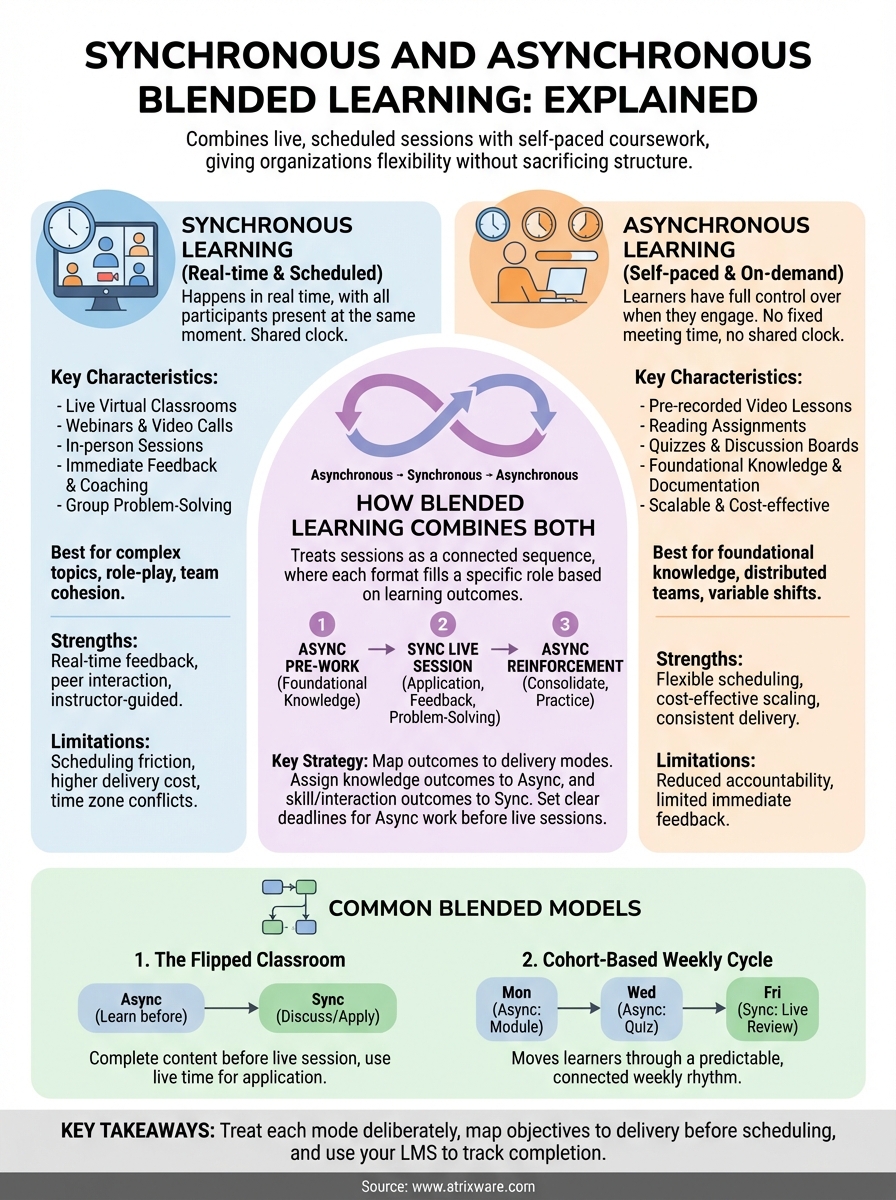
Synchronous learning happens in real time, with all participants present at the same time. This includes live virtual classrooms, video calls, webinars, and in-person sessions. The instructor delivers content, answers questions, and facilitates discussion on a fixed schedule, and learners must show up at that specific time to participate.
The defining feature of synchronous learning is not the location, it’s the shared clock. Everyone is learning at the same moment.
This format works well for complex topics that benefit from discussion, skills that require immediate feedback, or situations where team cohesion matters. Think of a new manager training session where role-play exercises and live Q&A help participants build confidence in real time.
Asynchronous learning: self-paced and on-demand
Asynchronous learning gives learners full control over when they engage with material. Pre-recorded video lessons, reading assignments, quizzes, and discussion boards that learners complete on their own schedule all fall into this category. There is no fixed meeting time, and no expectation that everyone finishes at the same moment.
Your team members in different time zones, or those with variable shifts, benefit most from this format. Asynchronous learning is also more cost-effective to scale, since you record or build the content once and distribute it to any number of learners without coordinating schedules. The trade-off is that learners lose the immediate feedback loop and social energy that live sessions provide.
Understanding both modes clearly puts you in a strong position to use synchronous and asynchronous blended learning intentionally, matching each format to the specific outcomes you need to achieve.
How blended learning combines both
Blended learning doesn’t alternate between modes randomly. It uses synchronous and asynchronous blended learning as a framework where each format fills a specific role. You assign the right mode to the right learning outcome rather than simply mixing formats for variety.
The strongest blended programs treat synchronous and asynchronous sessions as a connected sequence, not two parallel courses.
Building a connected learning sequence
When you design a blended program, asynchronous content handles foundational knowledge before learners reach a live session. That front-loading means synchronous time focuses on application, feedback, and group problem-solving instead of basic instruction. Learners arrive prepared, and instructors can spend live time on higher-value activities.
After each live session, asynchronous materials return as reinforcement tools, giving learners space to consolidate what they just practiced. This cycle of prepare, engage, and apply builds retention throughout the program.
Keeping the structure flexible
Your blended program doesn’t need a fixed ratio of live to self-paced content. Adjust the balance based on topic complexity and learner availability for each phase of training.
Different teams weight the two modes differently. A compliance program might rely more on asynchronous modules for consistent documentation, while a leadership track might lean toward live sessions for coaching and peer discussion.
Pros and cons of each mode
Understanding the trade-offs in synchronous and asynchronous blended learning helps you make smarter decisions about where to place content in your program. Neither mode is universally better. Each one has specific strengths that suit certain learning outcomes, and real limitations you need to account for when designing your curriculum.
Synchronous: strengths and limitations
Live sessions give you immediate feedback loops and create space for discussion, coaching, and group problem-solving. Learners who feel stuck can ask questions in real time, and instructors can adjust delivery on the spot.
- Strengths: real-time feedback, peer interaction, instructor-guided problem solving
- Limitations: scheduling friction, higher delivery cost per session, time zone conflicts
Asynchronous: strengths and limitations
Self-paced content scales efficiently because you build it once and deploy it to any number of learners without coordinating calendars. Learners in multiple time zones or with variable schedules can complete training when it fits their day.
Knowing where each mode falls short is just as important as knowing where it excels.
- Strengths: flexible scheduling, cost-effective scaling, consistent delivery across locations
- Limitations: reduced accountability without built-in deadlines, limited immediate feedback from instructors
How to design a blended program that works
Designing a blended program that holds learners’ attention starts with mapping your learning objectives before you schedule a single session. Every outcome in your synchronous and asynchronous blended learning program should connect to a specific delivery mode based on what that mode does best, not based on convenience or habit.
Match the format to the outcome first, then build the schedule around it.
Map outcomes to delivery modes
Start by listing every learning outcome your program needs to achieve, then assign each one to either live or self-paced delivery based on complexity and interaction requirements. Knowledge-based outcomes, such as understanding a policy or product feature, suit asynchronous formats. Skills that require coaching, peer feedback, or practice under pressure belong in a live session.
Think of this assignment process as building a two-column list: outcomes that need interaction on one side, and outcomes that need information transfer on the other. That distinction drives every scheduling and content decision that follows.
Set clear deadlines for async work
Asynchronous content loses its value if learners skip it before a live session. Build firm completion deadlines into your program calendar so participants arrive at live sessions ready to engage. Your LMS should track async completion automatically, flagging gaps before the scheduled session so instructors can address preparation issues without eating into live training time.
Common blended models and example schedules
Not every blended program structure fits every organization, but a few models appear consistently because they translate well across industries and team sizes. Knowing which model fits your context helps you apply synchronous and asynchronous blended learning without building your schedule from scratch.
The flipped classroom model
In a flipped classroom, learners complete asynchronous content before each live session rather than receiving instruction during the live event. They watch a recorded lesson, read assigned material, or finish a quiz on their own time, then use the scheduled session for discussion and applied practice.
This model works especially well for technical training where learners need baseline knowledge before hands-on work makes sense.
The cohort-based weekly cycle
This model groups learners into a cohort that moves through the program together on a weekly rhythm. Each week follows a predictable pattern that balances self-paced work with scheduled touchpoints.
A standard weekly cycle looks like this:
| Day | Activity | Mode |
|---|---|---|
| Monday | Release module + reading | Asynchronous |
| Wednesday | Quiz or short assignment | Asynchronous |
| Friday | Live review session | Synchronous |
This structure gives learners clear expectations each week while keeping the live session short and focused. Your LMS tracks async completions automatically, so facilitators can see who is prepared before the Friday session starts.
Key takeaways
Synchronous and asynchronous blended learning works best when you treat each mode as a deliberate choice, not a default. Synchronous sessions belong where real-time interaction and immediate feedback drive the outcome. Asynchronous content handles foundational knowledge, reinforcement, and flexible access for distributed teams. Mapping your learning objectives to the right delivery mode before you build anything saves you from redesigning a program midway through.
Your LMS plays a direct role in making this work. Tracking async completions before live sessions, automating reminders, and reporting on learner progress across both modes keeps your blended program running without manual follow-up. When your platform handles the administrative load, your instructors spend live time on high-value coaching instead of attendance checks.
If you want to see how Axis LMS supports both delivery modes in one platform, start your free Axis LMS admin demo and explore the tools firsthand.
