Most training programs fail not because the content is bad, but because the delivery method doesn’t match how people actually learn. Some skills click best through hands-on, in-person practice. Others stick when learners move at their own pace online. Blended learning instructional design solves this by intentionally combining both, but only when the design behind it is solid. Without a clear framework, blended learning turns into a disjointed mess of random Zoom calls and forgotten modules.
That’s where models and frameworks come in. They give structure to the mix of online and face-to-face experiences so each component serves a purpose. Whether you’re onboarding new employees, running compliance training, or educating customers, the design decisions you make upfront determine whether learners engage or check out. With Axis LMS from Atrixware, organizations already have the tools to build, deliver, and track the online side of blended programs, from drag-and-drop course building to automated reporting that shows what’s working and what isn’t.
This article breaks down the core models, proven frameworks, and practical strategies behind effective blended learning design. You’ll walk away with a clear understanding of how to structure programs that combine digital and in-person training without losing coherence. Whether you’re building your first blended curriculum or refining an existing one, these approaches will help you design training that actually drives results.
Why blended learning needs instructional design
Blending online and in-person training sounds simple in theory. You take some content, put part of it online, keep some activities face-to-face, and call it a blended program. In practice, that approach fails constantly because there’s no connecting logic. Without intentional design, learners experience two separate training worlds instead of one coherent journey, and the gaps between those worlds cost you real results.
The problem with mixing modalities without a plan
When organizations layer online modules onto existing classroom sessions without redesigning the experience, the online content typically becomes a compliance checkbox rather than meaningful learning. Learners click through slides to get a certificate, then show up to in-person sessions without the foundational knowledge that would make those sessions valuable. The in-person facilitator has to restart from scratch, and you’ve wasted both time and money.
A blended program with no instructional design behind it doesn’t reduce training costs. It just moves the failure to a different channel.
The same problem appears in reverse. Organizations that record live training sessions and post them online assume that makes the content "blended." But watching a recording of a classroom session is not the same as a purpose-built online learning experience. It’s passive, hard to navigate, and strips away the interactivity that made the original session work.
What instructional design actually adds
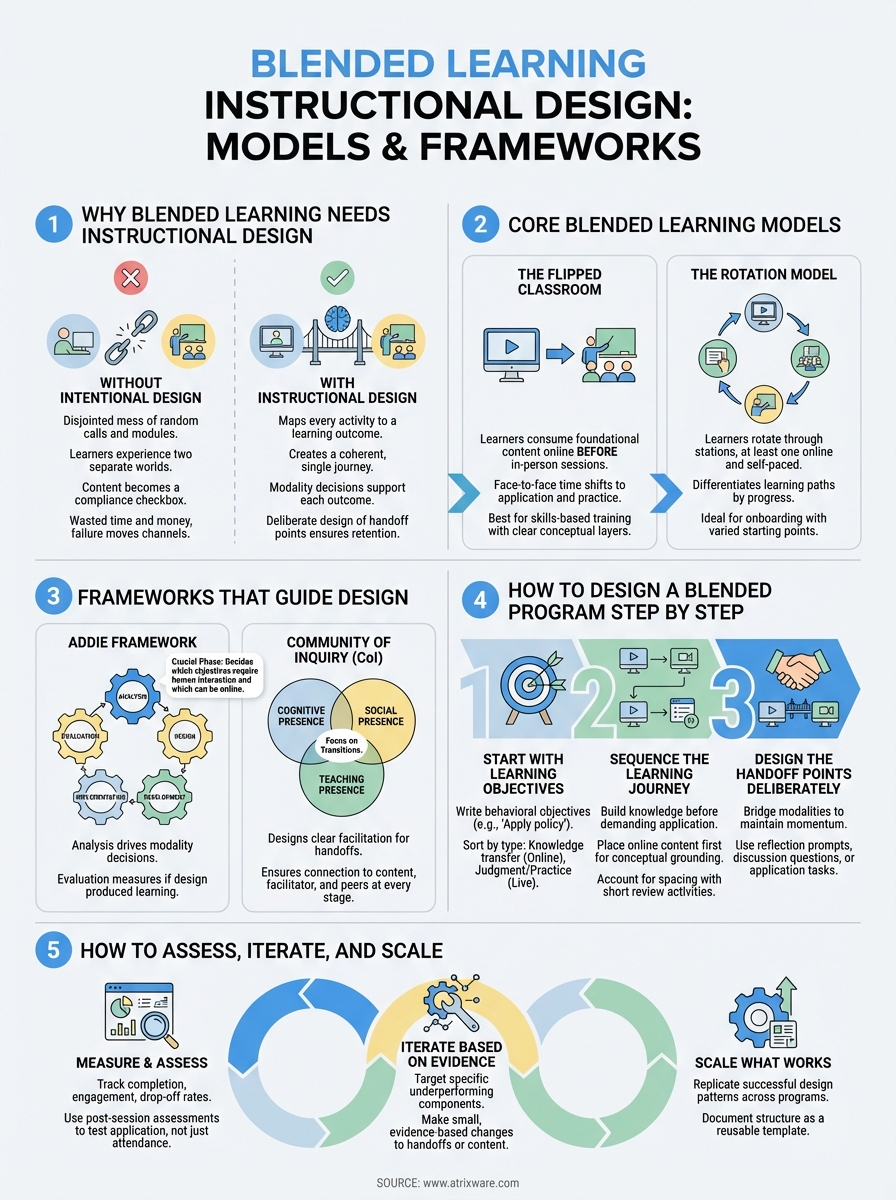
Blended learning instructional design is the process of deciding which learning objectives are best met online, which require face-to-face interaction, and how those two components connect to each other. This isn’t a cosmetic decision. It’s a structural one that affects everything from how you sequence content to how you assess whether learning actually happened.
Good instructional design maps every activity back to a specific learning outcome. That means before you build a single module or schedule a single workshop, you define what learners need to be able to do differently after completing the program. Then you choose the modality that best supports each outcome, not the one that’s most convenient to produce.
Designing the transitions between modalities matters just as much as designing the content itself. The shift from an online module to an in-person session is a moment where learners either carry knowledge forward or lose it entirely. Deliberate design decisions at those handoff points, such as pre-work assignments, discussion prompts, or structured reflection activities, keep the blend coherent and prevent learners from treating each component as a standalone event with no connection to the next.
Core blended learning models and when to use each
Not every blended program should look the same. Different models allocate time between online and in-person learning in fundamentally different ways, and choosing the wrong one for your context will undermine even the best-designed content. Understanding these core models gives your blended learning instructional design a starting point grounded in how learners will actually use the program.
The Flipped Classroom Model
The flipped classroom inverts the traditional sequence. Learners consume foundational content online before they arrive at the in-person session, so face-to-face time shifts to application and practice rather than passive listening. This model works best when your content has clear conceptual layers that learners can absorb independently before they need an expert in the room.

This model breaks down when the online pre-work is poorly designed or learners skip it, turning the in-person session into a re-explanation session instead of a practice session.
Use the flipped approach for skills-based training where guided practice drives retention. Compliance topics that require discussion, roleplay, or scenario-based problem solving are strong candidates. If your learners already have baseline familiarity with a subject, flipping the content delivery speeds up the in-person work considerably.
The Rotation Model
The rotation model sends learners through multiple learning stations on a fixed or flexible schedule, with at least one station being online and self-paced. Station rotation works inside a physical space, while lab rotation uses a dedicated computer lab as the online component. Both formats let you differentiate learning paths based on where individual learners are in their progress.
Rotation models suit training programs where learners arrive with different knowledge levels. Rather than pacing everyone to the same timeline, the model lets some learners go deeper online while others get more hands-on time with an instructor. This structure is practical for onboarding programs where new hires cover different roles and different starting points.
Frameworks that guide blended course design
Models tell you how to structure the time split between online and face-to-face learning. Frameworks tell you how to design the actual content and learning experiences within that structure. For blended learning instructional design, frameworks give you a repeatable process and a set of design principles that keep every component connected to real learning outcomes. Without one, even a well-chosen model produces inconsistent results because each piece gets built without a shared design logic.
ADDIE
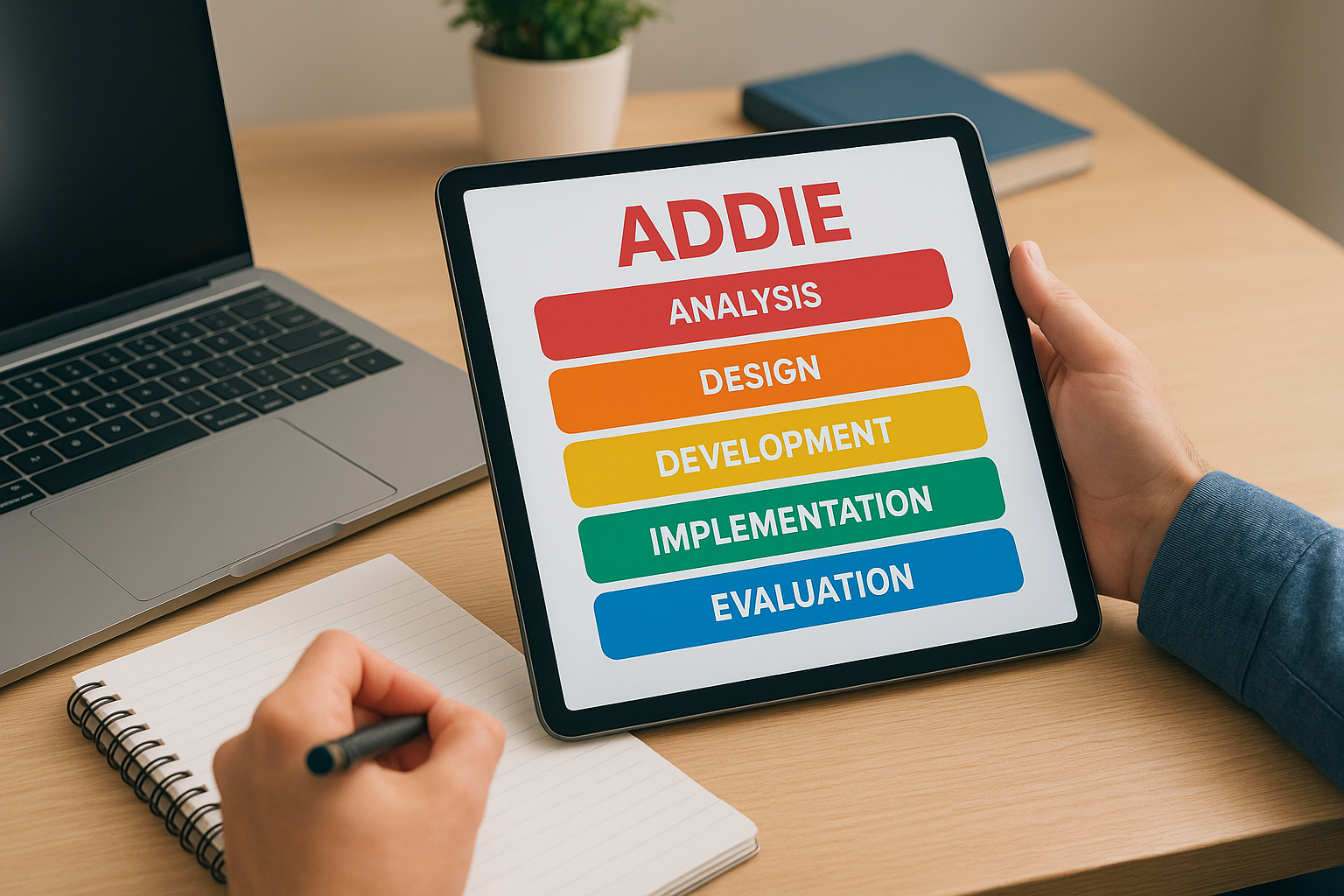
The ADDIE framework covers five phases: Analysis, Design, Development, Implementation, and Evaluation. In blended contexts, ADDIE is especially useful because the analysis phase forces you to examine which objectives require human interaction and which can be met independently online. That modality decision happens before you build anything, which saves significant rework later.
Skipping the analysis phase in ADDIE is the most common reason blended programs end up with the wrong content in the wrong channel.
Each subsequent phase refines that initial decision. During design, you map learning objectives to specific activities and choose whether each activity belongs online, in-person, or at a handoff point between both. During development, you build with that map as your guide, so nothing gets created without a clear purpose tied back to an outcome. ADDIE’s evaluation phase then closes the loop by measuring whether the design decisions actually produced learning.
Community of Inquiry
The Community of Inquiry (CoI) framework focuses on three interconnected elements: cognitive presence, social presence, and teaching presence. For blended programs, this framework helps you design both the online and in-person components so learners feel connected to the content, to each other, and to the facilitator at every stage.
Teaching presence matters most during the transitions between modalities. When you design clear facilitation strategies for how an instructor moves learners from an online module into a live session, CoI gives you the language and criteria to evaluate whether that guidance is actually working. You can audit each transition point against all three presences to find gaps before the program launches.
How to design a blended learning program step by step
Good blended learning instructional design doesn’t start with tools or platforms. It starts with a clear picture of what learners need to do differently after the program ends, and then works backward from that outcome to decide where online and in-person learning each pull their weight. Following a structured sequence prevents you from building content first and then scrambling to find a purpose for it.
Start with your learning objectives
Before you assign any content to a modality, write out every learning objective in behavioral terms. "Understand the policy" is not an objective. "Apply the policy correctly in three common scenarios" is. Once your objectives are specific and measurable, sort them by what they require: knowledge transfer objectives generally work well online, while objectives requiring judgment, peer interaction, or coached practice belong in a live setting. That sorting decision drives everything else.
The modality decision should follow the objective, not the other way around.
Sequence the learning journey
After you’ve matched objectives to modalities, arrange them in an order that builds knowledge before it demands application. Online content typically comes first, giving learners the conceptual grounding they need before a facilitator can push them into higher-order tasks. Your sequence should also account for spacing, placing short online review activities between live sessions so learners consolidate what they practiced before the program moves forward.
Design the handoff points deliberately
The moments where learners shift from one modality to the other are where most blended programs lose momentum. When learners finish an online module and walk into a live session with no bridge between the two, the transition breaks the learning arc. Design specific activities at each handoff: a reflection prompt at the end of an online module, a discussion question before a live session, or a post-session application task that sends learners back to the platform to document what they practiced. These handoff activities connect isolated components into a single, coherent program rather than a sequence of unrelated events.
How to assess, iterate, and scale the blend
Launching a blended program is not the finish line. The design decisions you made upfront were based on assumptions, and those assumptions need to be tested against what learners actually do and retain. Ongoing assessment is what separates a blended program that improves over time from one that stagnates and loses relevance after the first cohort.
Measure what the blend is actually doing
Start with your completion and engagement data from the online side of the program. Are learners finishing modules before live sessions? Are they returning to the platform after in-person work? If your online components show high drop-off rates, that signals either a content problem or a sequencing problem, not a learner motivation problem. Pair this data with post-session assessments that test whether learners can apply what they practiced, not just whether they attended.
What you measure after the program determines whether your next version is better or just different.
Iterate based on real evidence
When the data points to a weak spot, resist the urge to rebuild the entire program. [Targeted iteration](https://www.atrixware.com/learning-management-system-research.php) on the specific component that underperformed is faster and easier to evaluate than a full redesign. If learners consistently struggle with an application task that follows a particular online module, redesign that module’s handoff activity before touching anything else. Small, evidence-based changes let you confirm what fixed the problem before you scale the adjustment across the rest of the program.
Scale what works
Once you’ve validated that a design pattern produces strong outcomes, replicate that pattern across other parts of your blended learning instructional design. Document the structure of your highest-performing module: its objective type, its modality, its handoff activity, and its assessment format. That documentation becomes a reusable template your team can apply when building new training programs, cutting design time without sacrificing quality. Scaling a proven pattern is far more reliable than starting each new program from scratch and hoping the results hold.
Next steps
Blended learning instructional design works when you treat every decision as a design choice, not a logistical convenience. The models and frameworks in this article give you the structure to match learning objectives to the right modality, design deliberate handoff points, and build programs that get stronger with each iteration. None of that happens by accident. It happens because you set clear outcomes first and let those outcomes drive every build decision that follows.
The next move is to audit what you’re already running. Look at your current training programs and ask honestly whether the online and in-person components connect or just coexist. If they coexist, pick one program, apply the step-by-step design process outlined here, and measure the difference. To see how a purpose-built platform supports that kind of structured blended delivery, start your free Axis LMS admin demo and explore the tools firsthand.
