SCORM compliance ensures your eLearning content works seamlessly across different Learning Management Systems without custom coding or compatibility issues. Think of it like a universal language that lets training courses and LMS platforms communicate properly. When content is SCORM compliant, you can move it from one system to another, track learner progress accurately, and avoid vendor lock in.
This matters more than you might think. Without SCORM compliance, you risk building training programs that only work with one specific platform. That means rebuilding everything from scratch if you ever switch systems. You waste time. You waste money. You frustrate your learners with broken courses that won’t launch or track properly.
This guide walks you through what SCORM compliance actually means, how to achieve it, and how to verify that your LMS and content meet the standard. You’ll see real examples of SCORM compliance in action and learn what to look for when choosing a SCORM compliant LMS for your organization.
Why SCORM compliance matters
Understanding what is SCORM compliance means recognizing how it protects your training investment. When you build SCORM compliant content, you gain the freedom to switch LMS platforms without rebuilding courses from scratch. This saves you thousands of dollars in development costs and prevents vendor lock-in that restricts your future options.

You get true content portability
Your training becomes platform independent when it meets SCORM standards. Organizations that invested in proprietary formats often face painful migrations that cost six figures and delay critical training initiatives. SCORM compliant courses work across hundreds of different LMS platforms without modification.
SCORM compliance transforms your content into a long-term asset rather than a platform-specific expense.
Learner progress, quiz scores, and completion data all follow standardized tracking formats. Your reporting stays consistent even when you migrate platforms or consolidate systems after mergers. You maintain historical training records without complex data conversions or lost information.
How to achieve SCORM compliance
Understanding what is SCORM compliance leads directly to the practical steps for implementation. You achieve it by using authoring tools that export content in SCORM format and ensuring your LMS properly imports and tracks that content. Modern development platforms handle the technical specifications automatically, so you don’t need programming expertise.
Use SCORM authoring tools
Select authoring platforms like Articulate Storyline, Adobe Captivate, or iSpring Suite that build SCORM compliance directly into their export process. These tools generate the required manifest files and structure your content according to SCORM 1.2 or SCORM 2004 specifications without requiring manual coding.
Most authoring tools let you choose your target SCORM version during export. Pick SCORM 1.2 for maximum compatibility or SCORM 2004 if you need advanced sequencing features like conditional navigation between lessons.
Test your SCORM packages thoroughly
Upload your SCORM package to a testing environment before deploying to learners. Services like SCORM Cloud provide free validation that checks whether your content meets technical requirements and communicates properly with the LMS.
Testing reveals compatibility issues before they impact your learners and disrupt training programs.
Run through complete learner scenarios including starting courses, taking quizzes, bookmarking progress, and viewing results. Verify that your LMS receives and displays tracking data accurately for completions, scores, and time spent. Check multiple browsers and devices to confirm consistent performance across your learner population.
Fix any issues the testing reveals before your official launch. Most problems stem from authoring tool settings rather than content quality, so adjusting export options usually resolves compatibility gaps quickly.
Key elements of SCORM compliance
Understanding what is SCORM compliance requires knowing its three core components that enable interoperability. The manifest file describes your content structure, run-time communication handles data exchange during learning, and packaging standards ensure content portability across systems. Each element serves a specific technical purpose that makes SCORM work reliably.
The manifest file
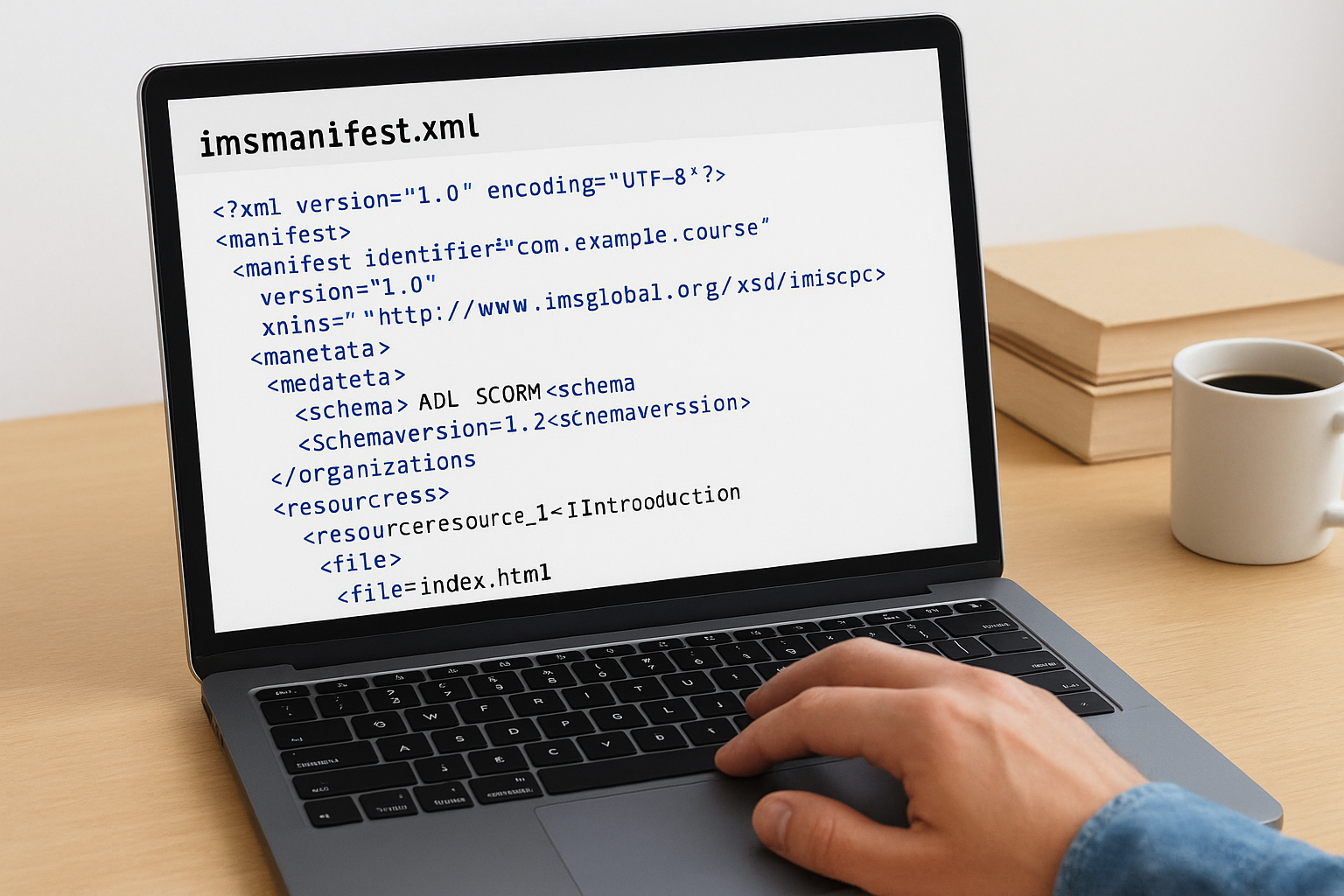
Your SCORM package includes an imsmanifest.xml file that acts like a blueprint for your content. This XML document tells the LMS which files to launch, how to organize the course structure, and what resources the content needs. The manifest contains metadata about your course title, version, and technical requirements that the LMS reads during import.
Run-time communication
The content “talks” to your LMS through a JavaScript API that follows SCORM specifications. This communication allows the course to retrieve learner information like names and track actions such as quiz scores, completion status, and time spent. Your LMS and content exchange data through standardized “get” and “set” commands that work consistently across platforms.
Run-time communication transforms passive content into interactive experiences that generate meaningful training data.
Content packaging standards
SCORM requires you to bundle all course files into a single ZIP archive following specific folder structures. This package includes your HTML pages, images, videos, and the manifest file in a format that any SCORM compliant LMS can import without modification. Proper packaging prevents broken links and missing resources when you move content between systems.
Real world SCORM compliance examples
Understanding what is SCORM compliance becomes clearer when you see how organizations apply it. A manufacturing company builds safety training in Articulate Storyline, exports it as SCORM 1.2, and deploys it across three different LMS platforms at regional facilities without rebuilding content. The tracking data syncs consistently across all locations, providing unified compliance reporting.

Healthcare certification programs
Hospitals use SCORM packages to deliver mandatory training that must meet regulatory standards. When a healthcare network acquires another hospital system, they migrate existing SCORM courses into their primary LMS within days instead of months. Quiz scores and completion records transfer seamlessly, maintaining accurate certification histories for thousands of medical staff.
Software vendor training
Technology companies create product certification courses as SCORM packages for their partner networks. Distributors and resellers import these courses into their own learning systems without technical support. The standardized format ensures consistent tracking whether partners use different LMS platforms across various countries and regions.
SCORM compliance turns training content into portable assets that survive organizational changes and technology transitions.
How to choose a SCORM compliant LMS
Selecting the right platform starts with understanding what is SCORM compliance and verifying that your LMS meets technical standards for the SCORM versions your content uses. You need to test actual SCORM packages in the system before making a purchase decision, not just trust vendor claims about compliance. Look for platforms that provide transparent documentation about their SCORM implementation and offer trial periods where you can upload and test your existing courses.
Verify certification and testing
Ask vendors for proof of SCORM conformance testing through recognized validation tools or third-party certification. Upload sample SCORM packages during your evaluation to confirm the LMS properly tracks completions, scores, and bookmarks across different content types. Systems that handle SCORM reliably will import courses quickly and display tracking data accurately without requiring technical support.
Testing your actual content reveals compatibility issues that vendor specifications alone cannot predict.
Consider version support
Your LMS should support SCORM 1.2, and if needed for certain content you may also need SCORM 2004 support in certain circumstances. Usually SCORM 1.2 support is sufficient.
Final thoughts
Now you understand what is SCORM compliance means for your training programs and why it protects your content investment. You’ve seen how the standard ensures your courses work across different platforms, tracks learner data consistently, and saves you from costly rebuilds when technology changes. The authoring tools, testing processes, and LMS selection criteria give you everything you need to implement SCORM successfully.
Your next step is putting this knowledge into practice. Choose an LMS that demonstrates real SCORM compliance through testing and verification, not just marketing claims. Build your content with proven authoring tools that handle the technical specifications automatically.
Ready to see SCORM compliance in action? Take our LMS readiness quiz to discover where you are in the selection process and which platform features matter most for your organization’s specific training needs.
