Your customers expect more than polite responses and quick fixes. They want agents who understand their needs, solve problems confidently, and turn frustrating moments into reasons to stay loyal. But most companies throw new hires into service roles with minimal preparation, hoping they figure it out. That approach leads to inconsistent experiences, burned out staff, and customers who take their business elsewhere.
Structured employee training for customer service changes this. When you invest time building skills, setting clear standards, and giving your team the right tools, you create a service culture that actually delivers. Your agents handle tough situations with confidence. Your customers get consistent help that solves their problems. Your business keeps more customers and spends less time fixing avoidable mistakes.
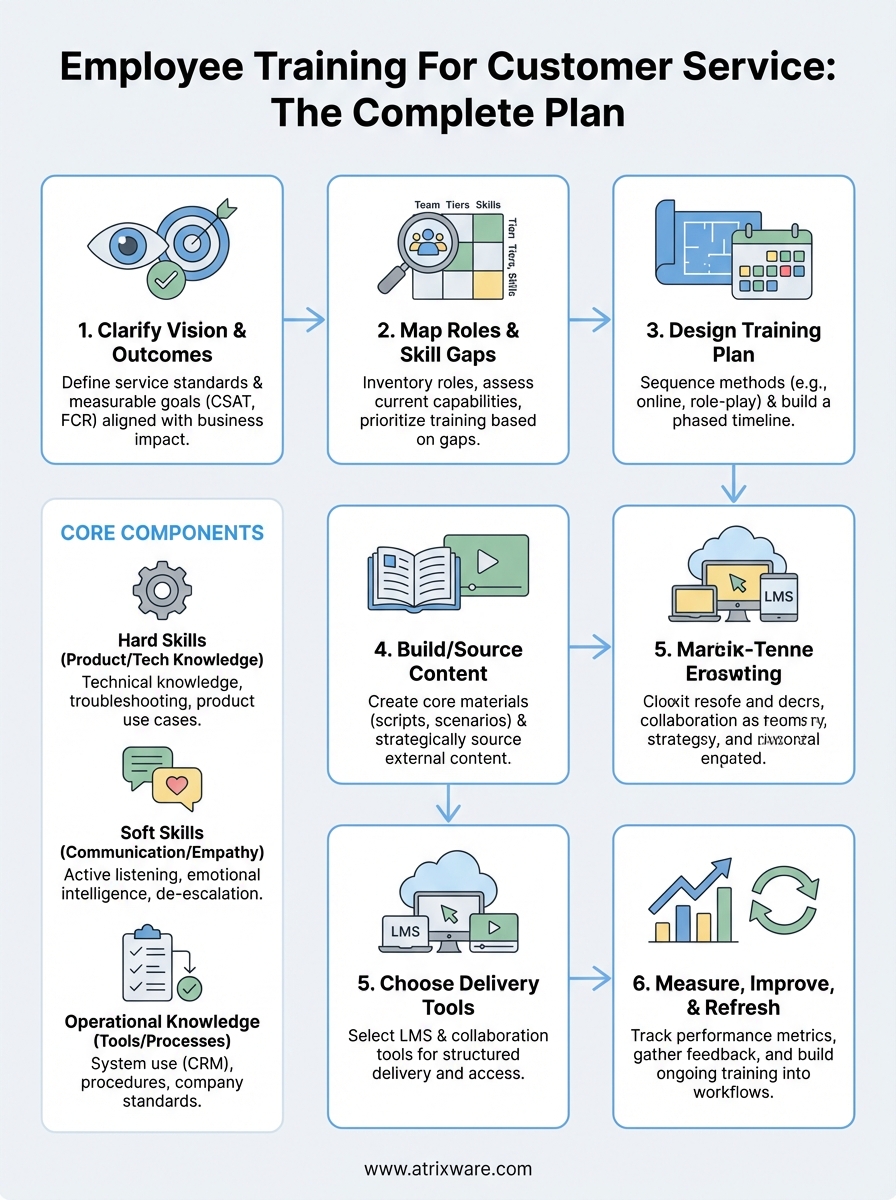
This guide walks you through building a complete customer service training plan. You’ll learn what skills matter most, how to assess your team’s current abilities, and how to design training that sticks. We’ll cover content creation, delivery methods, and measurement strategies that help you track real improvements. By the end, you’ll have a clear roadmap for turning your service team into a competitive advantage.
What to include in customer service training
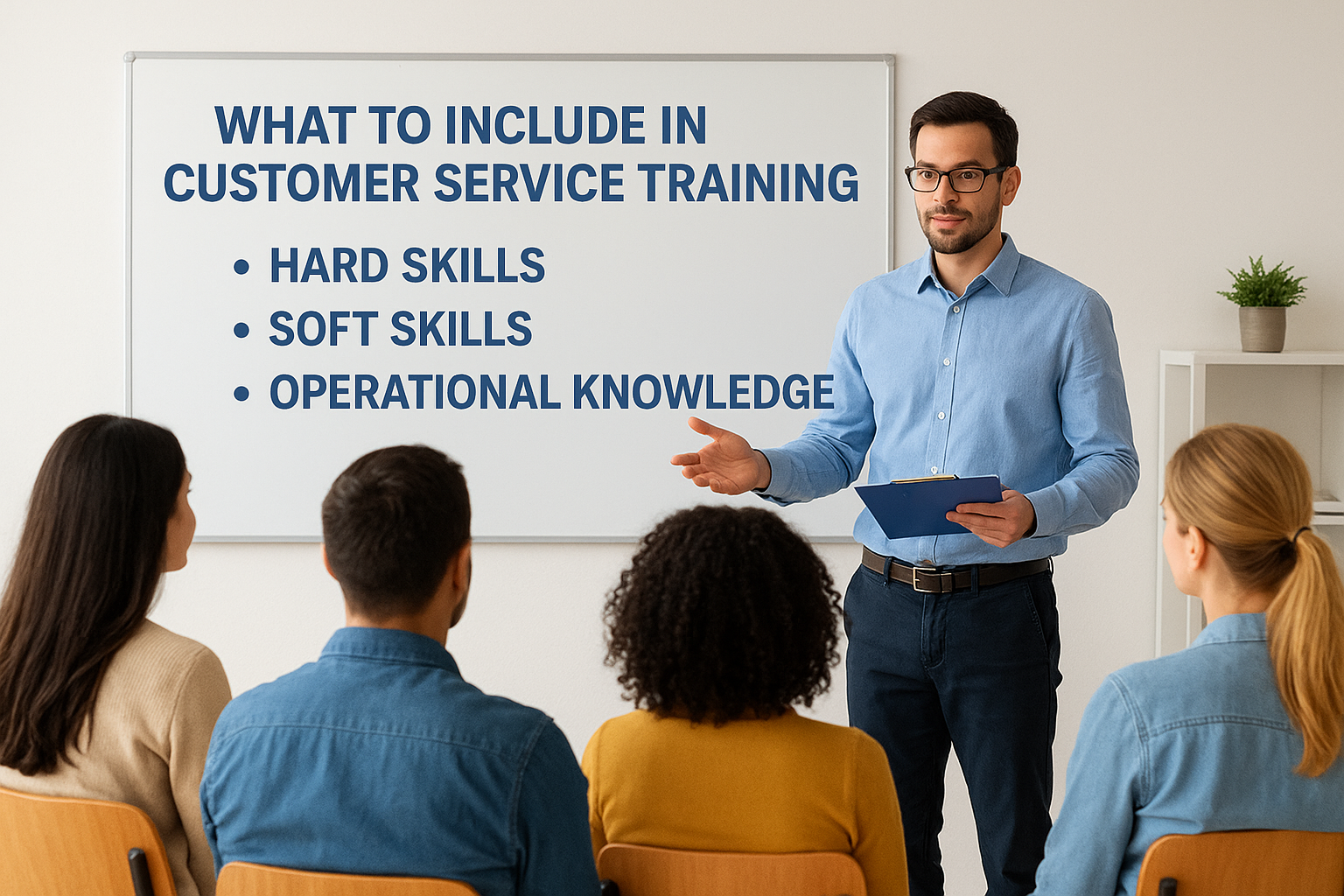
Your training program needs to cover three distinct areas that work together to create competent service agents. Hard skills give your team the technical knowledge they need to solve customer problems. Soft skills help them communicate effectively and manage difficult interactions. Operational knowledge ensures they understand your processes, tools, and standards. Each area requires different training methods and materials, but all three contribute equally to service quality.
Core communication and problem-solving skills
Your agents need strong active listening abilities to understand what customers actually need, not just what they say they want. Train them to ask clarifying questions, paraphrase customer concerns, and identify the root cause of issues before jumping to solutions. Empathy and emotional intelligence separate good service from great service, especially when dealing with frustrated or confused customers.
Problem-solving training should focus on structured approaches that work across different situations. Teach your team to gather information systematically, evaluate options, and explain their reasoning to customers. Include scenarios that require agents to balance company policies with customer satisfaction, because real-world service rarely fits neat templates.
Training in these foundational skills creates agents who can adapt to new situations without constant supervision.
Product and technical knowledge
Every employee training for customer service must include comprehensive product education that goes beyond basic feature lists. Your agents need to understand how customers actually use your products, common pain points, and the business value your solutions provide. Technical training should cover troubleshooting workflows for the most frequent issues your team encounters.
Build knowledge checks into this training to verify understanding before agents interact with customers. Use real customer scenarios and actual cases from your support history to make the training relevant and practical.
Tools, processes, and company standards
Train your team on every system they’ll use daily, including your CRM, ticketing platform, knowledge base, and communication channels. Show them where to find information quickly, how to document interactions properly, and when to escalate issues. Process training should cover your standard operating procedures, escalation paths, quality standards, and compliance requirements.
Include your company’s service philosophy and specific guidelines for tone, language, and brand voice. These operational details create consistency across your entire service organization.
Step 1. Clarify your service vision and outcomes
Your employee training for customer service will fail without clear direction on what "good service" means for your organization. Before you design any training materials or schedule sessions, you need to define exactly what success looks like for your service team. This foundation determines everything that follows, from which skills you prioritize to how you measure improvement.
Start by asking yourself what experience you want customers to have at every touchpoint. Do you want your team to resolve issues quickly, or invest time building relationships? Should agents follow strict scripts, or adapt their approach to each customer? Your answers shape every decision in your training program, so get specific about your service philosophy before moving forward.
Define your service standards and expectations
Write down specific behavioral standards that reflect your service vision. These standards should tell agents exactly how to interact with customers in common situations. Include guidelines for response times, communication tone, escalation triggers, and quality benchmarks that align with your brand.
Create a service standards document that covers these key areas:
Response and resolution expectations:
- First response time target (e.g., within 2 hours for email, 30 seconds for phone)
- Resolution time goals for different issue types
- Acceptable hold times and transfer procedures
Communication guidelines:
- Required greeting and closing phrases
- Tone and language standards (formal vs. conversational)
- Prohibited phrases or approaches
- How to handle profanity or aggressive customers
Quality requirements:
- Minimum accuracy standards for information provided
- Documentation and note-taking requirements
- When to offer proactive solutions vs. reactive fixes
Your standards become the measuring stick for every training activity and performance evaluation.
Set measurable training outcomes
Define concrete outcomes you expect from your training program. Vague goals like "improve customer satisfaction" give you no way to know if training works. Instead, specify measurable targets tied to business results.
List specific metrics you’ll track before and after training:
- Customer satisfaction score (CSAT) target percentage
- First contact resolution rate goal
- Average handle time range
- Quality assurance score requirements
- Product knowledge assessment pass rate
- Compliance audit success rate
Connect each outcome to a clear business impact. If you want agents to achieve 85% first contact resolution, explain how this reduces costs, improves satisfaction, and increases efficiency. When your team understands why these outcomes matter, they engage more seriously with training content.
Document these outcomes in a training charter that stakeholders review and approve before you invest resources in content development.
Step 2. Map roles, skill levels, and gaps in your team
You cannot design effective employee training for customer service without understanding who you’re training and what they already know. Skipping this assessment step wastes time teaching skills your team already has while leaving critical gaps unfilled. A proper mapping exercise shows you exactly where to focus your training resources for maximum impact.
Start by documenting every customer-facing role in your organization and the specific responsibilities each role handles. Your frontline chat agents need different skills than your technical support specialists or account managers. Understanding these distinctions helps you create targeted training instead of one-size-fits-all programs that satisfy nobody.
Inventory your current team structure
List every role that touches customers and define the scope of each position. Include not just your core service team, but also sales support, technical specialists, and anyone who responds to customer inquiries.
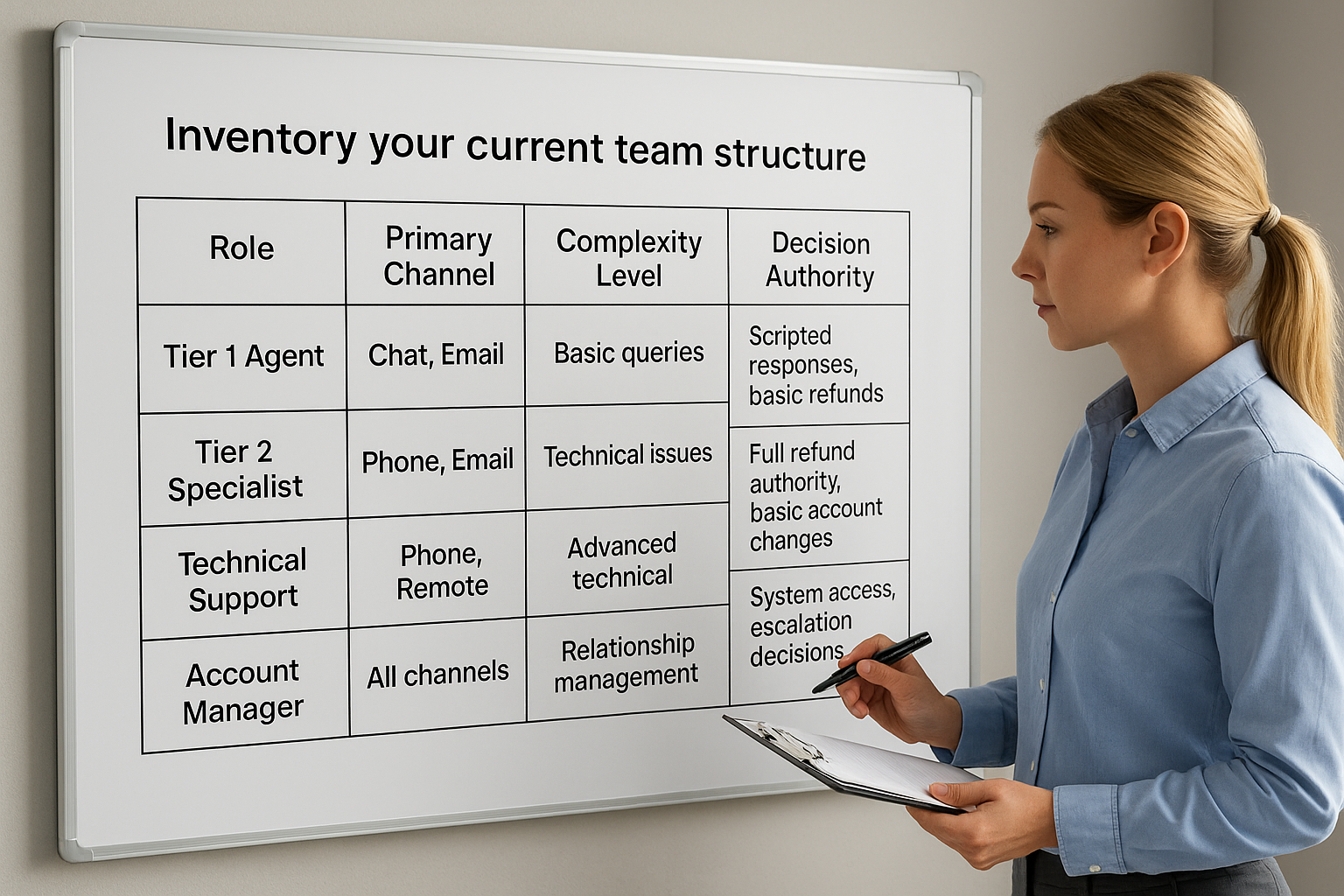
Create a simple role matrix that captures this information:
| Role | Primary Channel | Complexity Level | Decision Authority |
|---|---|---|---|
| Tier 1 Agent | Chat, Email | Basic queries | Scripted responses, basic refunds |
| Tier 2 Specialist | Phone, Email | Technical issues | Full refund authority, basic account changes |
| Technical Support | Phone, Remote | Advanced technical | System access, escalation decisions |
| Account Manager | All channels | Relationship management | Pricing, contract modifications |
This matrix helps you identify distinct training paths for different roles instead of forcing everyone through identical content.
Assess existing skill levels
Survey your team to understand current capabilities across core competencies. Use a simple self-assessment combined with manager observations to get accurate baseline data. Ask agents to rate themselves on key skills using a 1-5 scale (1 = needs significant development, 5 = can train others).
Build your assessment around specific observable behaviors rather than vague attributes. Instead of asking "How good are you at communication?", ask "How often do you successfully de-escalate frustrated customers without supervisor help?"
Accurate skill assessment prevents the frustration of advanced agents sitting through basic training they don’t need.
Identify training gaps and priorities
Compare your skill assessment results against the standards you defined in Step 1. Look for patterns where multiple team members score low on the same competency. These widespread gaps become your highest training priorities because they affect the most customers.
Create a priority matrix by plotting gaps on two axes: frequency of use and current skill level. Skills used daily with low proficiency scores need immediate attention. Rarely-used advanced skills can wait for later training phases.
Step 3. Design your customer service training plan
Now that you know your service standards and skill gaps, you need to design a structured plan that transforms those insights into actual learning experiences. Your plan determines how you’ll deliver training, in what order, and over what timeline. A well-designed training plan balances speed with retention, getting agents productive quickly without overwhelming them with information they’ll forget.
Your employee training for customer service plan should specify which training methods you’ll use for each skill area, how you’ll sequence topics, and how long each phase takes. Think of this as your blueprint for building competence in your service team. Without this roadmap, training becomes random and ineffective.
Choose your training methods and formats
Select different delivery methods based on what you’re teaching and how people learn best. Product knowledge works well in self-paced online modules where agents can review information multiple times. Communication skills require interactive practice through role-playing and live feedback sessions.
Match your methods to your content using this framework:
Knowledge-based content (product features, policies, procedures):
- Self-paced online courses with knowledge checks
- Video demonstrations showing common workflows
- Searchable reference guides for quick lookup
Skill-based content (communication, problem-solving, de-escalation):
- Live role-playing exercises with peer feedback
- Shadowing experienced agents during real interactions
- Group workshops analyzing recorded customer calls
Tool proficiency (CRM, ticketing systems, knowledge bases):
- Hands-on sandbox practice with simulated scenarios
- Step-by-step walkthroughs with screenshots
- Quick reference cards for daily use
Blend multiple formats to accommodate different learning preferences and reinforce concepts through repetition. An agent who watches a video, practices in a sandbox, and then shadows a peer will retain information better than someone who only reads a manual.
Sequence your training curriculum
Organize training topics in a logical progression that builds competence gradually. Start with foundational knowledge that agents need before they can handle any customer interaction. Move to more complex scenarios only after agents master basics.
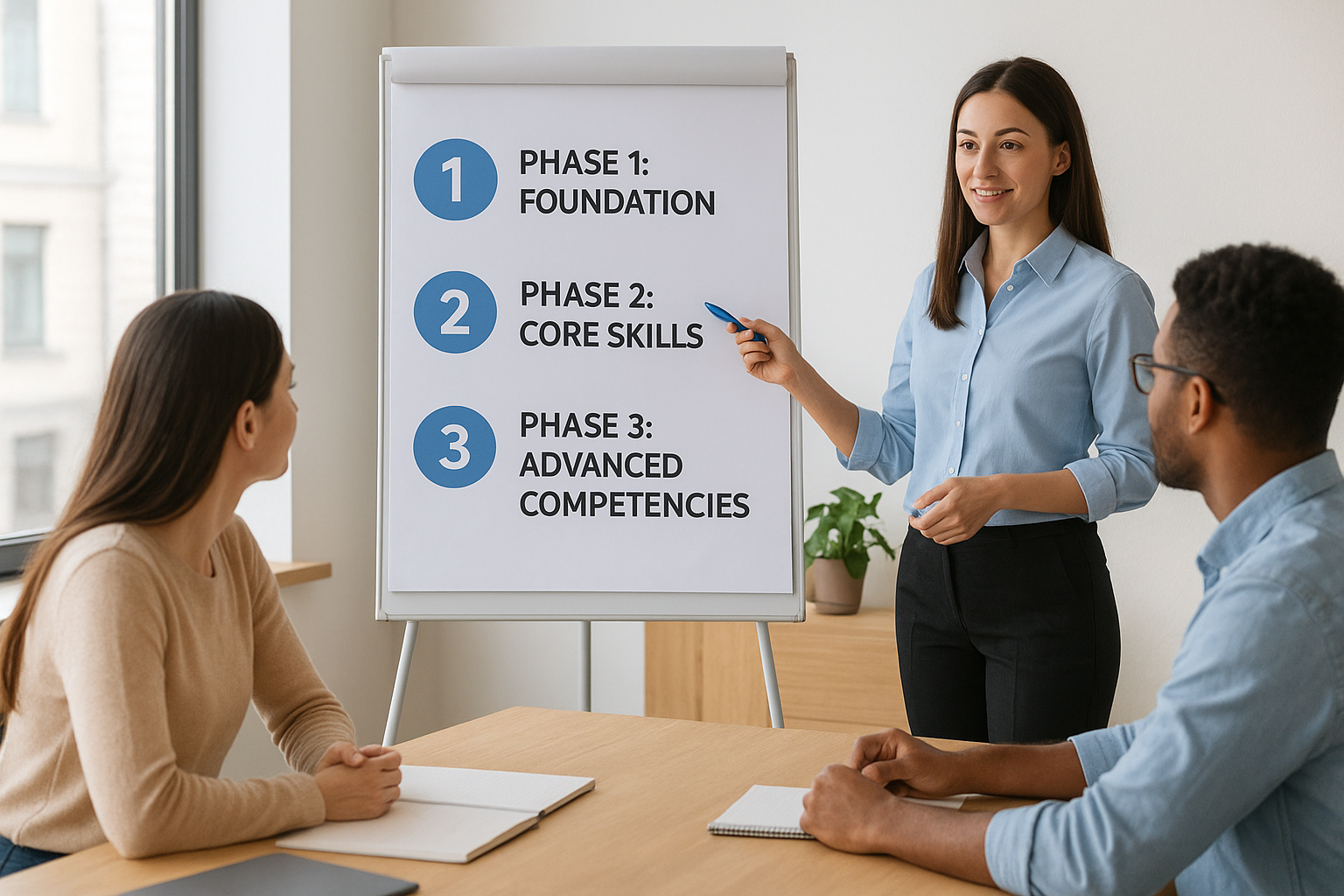
Structure your sequence this way:
Phase 1: Foundation (Week 1)
- Company values and service philosophy
- Core product/service knowledge
- Tool access and navigation
- Basic communication scripts
Phase 2: Core Skills (Weeks 2-3)
- Handling common customer scenarios
- Documentation and case management
- Quality standards and evaluation criteria
- Escalation procedures and decision trees
Phase 3: Advanced Competencies (Week 4+)
- Complex problem-solving techniques
- Difficult customer interactions
- Product edge cases and exceptions
- Continuous improvement practices
Build complexity gradually to prevent overwhelming new agents while maintaining momentum toward full productivity.
Build your training timeline
Create a realistic schedule that accounts for different learning speeds and operational needs. Most comprehensive customer service training programs run 3-4 weeks for new hires, with ongoing development continuing afterward.
Design your timeline with these considerations:
- Dedicate full days to training for the first week rather than splitting attention between training and live work
- Schedule shorter daily sessions (2-3 hours) once agents start handling real customers
- Build in buffer time for agents who need extra practice on specific skills
- Plan certification checkpoints where agents must demonstrate competency before progressing
- Include mentorship periods where new agents work alongside experienced team members
Document your timeline in a simple calendar format that shows exactly what happens each day and who owns each training component.
Step 4. Build or source your training content
You need actual training materials that teach the skills you identified in your gap analysis. This step transforms your training plan into tangible content that agents can consume, practice, and reference. Most companies make the mistake of starting with content creation before completing steps 1-3, which leads to generic materials that miss your specific needs. With your plan in place, you can now build or buy content that directly addresses your service standards and skill gaps.
Create your core training materials
Start by building foundational content that covers your unique business context, which you cannot buy off the shelf. Write documentation that explains your specific products, policies, escalation procedures, and quality standards. These materials form the backbone of your training program because they teach information that exists nowhere else.
Create these essential internal materials:
Service standards guide – A single document agents can reference that specifies your communication tone, response time requirements, escalation triggers, and quality benchmarks.
Product knowledge base – Structured information about your offerings organized by common customer questions and use cases, not just technical specifications.
Scenario library – 15-20 real customer situations your agents encounter regularly, with detailed walkthroughs showing how to handle each scenario according to your standards.
Call scripts and templates – Exact language for greetings, transitions, and closings that reflect your brand voice, plus templates for common email and chat responses.
Build interactive elements into your content rather than creating walls of text. Use screenshots with annotations, short video demonstrations of tool workflows, and decision trees that guide agents through complex situations. Record experienced agents handling actual customer interactions, then annotate these recordings to highlight what they did well.
Materials that show rather than tell cut training time significantly while improving retention.
Source external content strategically
You do not need to create everything from scratch. High-quality external training works well for universal customer service skills like active listening, de-escalation techniques, and emotional intelligence. Buy or license this content when it saves development time without sacrificing relevance.
Evaluate external content by testing it against your specific service standards. Generic customer service courses often teach approaches that conflict with your preferred methods. Preview any external materials thoroughly before adding them to your employee training for customer service curriculum. Look for content that allows customization or supplements it with your own context.
Build knowledge checks and assessments
Design practical assessments that verify agents can actually perform skills rather than just recall information. Create scenario-based questions where agents must diagnose customer issues, choose appropriate responses, and explain their reasoning.
Structure your assessments this way:
| Assessment Type | When to Use | Pass Requirement |
|---|---|---|
| Multiple choice quiz | After product knowledge modules | 85% correct |
| Role-play evaluation | After communication training | Meets 4 of 5 quality criteria |
| Simulated cases | Before handling live customers | Resolves 3 of 3 correctly |
| Tool proficiency test | After system training | Completes tasks in target time |
Include answer explanations that teach why incorrect choices fail. Your assessments become additional learning opportunities when agents understand their mistakes immediately.
Step 5. Choose tools and platforms for delivery
Your training content needs a delivery system that makes it easy for agents to access materials, complete assessments, and track their progress. The platform you choose affects how quickly agents complete training, how well they retain information, and how much administrative time you spend managing the program. Select tools that match your training methods and team structure rather than adopting popular platforms that don’t fit your specific needs.
Learning management systems for structured delivery
A learning management system (LMS) gives you centralized control over your employee training for customer service program. These platforms let you organize content into courses, assign training paths based on roles, automatically track completion, and generate reports showing who needs additional support. Look for systems that support multiple content formats including videos, documents, quizzes, and SCORM packages if you purchase external content.
Evaluate LMS options using these criteria:
- User experience – Can agents find and complete training without help?
- Reporting capabilities – Does it show completion rates, assessment scores, and time spent?
- Mobile accessibility – Can agents train on any device?
- Integration options – Does it connect with your HR system and communication tools?
- Content flexibility – Can you easily update materials as products change?
Choose platforms that let you customize learning paths so experienced agents skip basic content while new hires get comprehensive onboarding. This prevents the frustration of forcing your entire team through identical training regardless of skill level.
The right LMS eliminates manual tracking while giving you visibility into exactly where each agent stands in their development.
Live training and collaboration tools
Your synchronous training sessions need reliable video conferencing tools that support screen sharing, breakout rooms for role-playing exercises, and recording capabilities for agents who miss live sessions. Standard video platforms work fine for most organizations, but verify they handle your team size without connection issues.
Add collaboration tools that let trainers and agents communicate between formal sessions. Discussion forums where agents ask questions, shared documents for collaborative note-taking, and instant messaging for quick clarifications all support ongoing learning. These informal channels often surface confusion patterns that help you improve training materials before they become widespread problems.
Step 6. Measure, improve, and keep skills fresh
Your employee training for customer service program needs continuous measurement and refinement to stay effective. Training does not end when agents complete their initial onboarding. Customer expectations shift, products evolve, and new interaction channels emerge. Without ongoing measurement, you cannot tell if your training actually improves service quality or identify which agents need additional support.
Track performance metrics consistently
Monitor specific metrics that connect directly to the skills you trained. Compare performance data from before and after training to quantify improvement. Track both individual agent metrics and team-wide trends to spot patterns that indicate training gaps.

Measure these key indicators monthly:
| Metric | Target | What It Reveals |
|---|---|---|
| CSAT score | 90%+ | Customer satisfaction with interactions |
| First contact resolution | 75%+ | Agent ability to solve problems completely |
| Average handle time | Team baseline ±10% | Efficiency without sacrificing quality |
| Quality assurance score | 85%+ | Adherence to service standards |
| Knowledge assessment pass rate | 90%+ | Retention of product information |
Pull reports from your quality assurance reviews that show which specific skills agents struggle with most. These reviews reveal training weaknesses that aggregate metrics miss.
Regular metric reviews transform training from a one-time event into a system that continuously adapts to your team’s actual needs.
Build ongoing training into workflows
Schedule recurring micro-training sessions that reinforce critical skills without disrupting daily operations. Dedicate 30 minutes weekly to reviewing challenging customer scenarios, product updates, or new tool features. Short, frequent training beats lengthy quarterly sessions for retention.
Create a certification refresh cycle that requires agents to retake key assessments annually. Products change, policies update, and even experienced agents develop bad habits. Regular recertification catches these issues before they affect customers.
Use feedback loops for improvement
Collect agent input on training effectiveness through quick surveys after each module. Ask what helped, what confused them, and what they wish they had learned. Your frontline team knows exactly where training materials fall short because they face those gaps during actual customer interactions.
Review common escalation reasons quarterly to identify skills your training failed to develop adequately. When multiple agents escalate similar situations, your training content needs revision to cover those scenarios more thoroughly.
Put your training plan into action
You now have a complete framework for building employee training for customer service that actually works. The six steps you learned give you everything needed to transform your service team from inconsistent responders into skilled professionals who solve problems confidently. Start by documenting your service vision and current skill gaps, then design a structured plan that builds competence gradually through the right mix of content and delivery methods.
Your training program will only succeed if you commit to ongoing measurement and improvement. Set aside time each month to review performance metrics, update content based on agent feedback, and refine your approach as customer expectations evolve. The companies that maintain service excellence treat training as a continuous system rather than a one-time event.
Ready to deliver your training program? Take our LMS readiness quiz to determine which learning management platform features matter most for your specific situation. The right system makes everything you just learned faster to implement and easier to scale.
