
Creating assessments from scratch every time you need to evaluate learners is time-consuming and inefficient. That’s where understanding the question bank definition becomes essential for anyone managing training programs or e-learning initiatives.
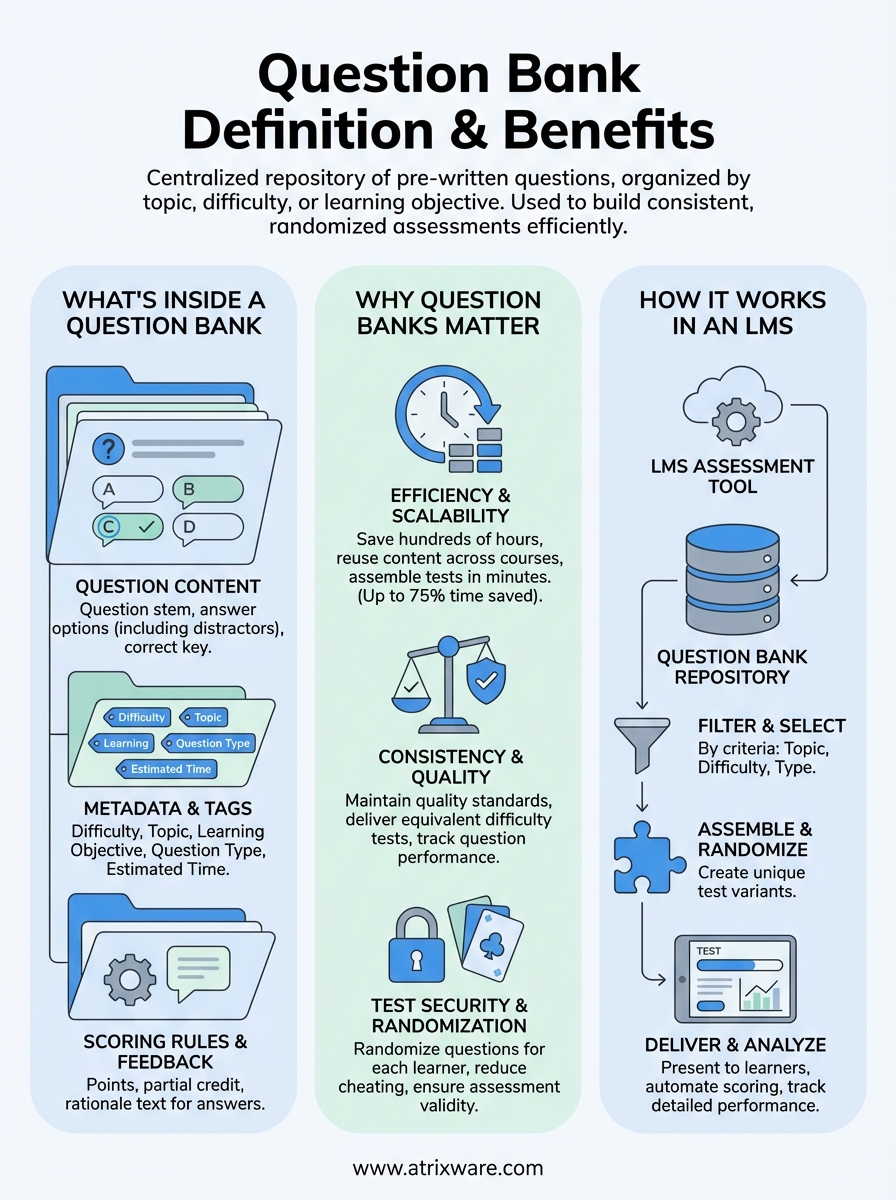
A question bank is a centralized repository of pre-written questions organized by topic, difficulty, or learning objective. Training managers and instructional designers use question banks to build consistent, randomized assessments quickly, without reinventing the wheel for each course or learner group. For organizations using a Learning Management System like Axis LMS, question banks streamline assessment creation and help maintain quality across all training content.
This article breaks down what a question bank is, how it works within assessment systems, practical use cases, and examples you can apply to your own training programs.
What a question bank includes
A question bank contains more than just questions and answers. You’ll find structured question items that include the question text, multiple answer options, correct answer keys, and detailed metadata that helps you organize and retrieve questions efficiently. Understanding the question bank definition means recognizing that each item in the repository works as a standalone assessment component you can reuse across different tests and learner groups.
Question content and metadata
Each question in your bank includes the question stem (the actual question or prompt), along with associated metadata like difficulty level, learning objective, and topic tags. This metadata allows you to filter and select questions based on specific criteria when building assessments. You also store information about question type (multiple choice, true/false, essay), estimated time to complete, and the cognitive level being tested (recall, application, analysis). Organizations using systems like Axis LMS leverage this metadata to create targeted assessments that align with specific training goals.

Proper metadata transforms a simple collection of questions into a powerful assessment tool that adapts to your training needs.
Answer choices and scoring rules
Your question bank stores all possible answer options for each question, not just the correct answers. Multiple-choice questions include distractors (incorrect options), while true/false questions contain both options with one marked correct. The bank also contains scoring rules that define point values, partial credit options, and feedback for correct and incorrect responses. Some organizations include rationale text that explains why an answer is correct or incorrect, which helps learners understand concepts more deeply.
Organizational structure and taxonomies
Question banks use hierarchical categories and tags to organize content logically. You might categorize questions by course module, compliance requirement, job role, or skill level. Many systems support custom taxonomies that reflect your organization’s specific training structure, making it easier to locate relevant questions when building assessments or updating existing content.
Why question banks matter in training
Your training program’s success depends on accurate, consistent assessments that measure what learners actually know. A well-maintained question bank ensures you deliver the same quality standards across all training sessions, locations, and learner groups. When you understand the question bank definition and implement one effectively, you eliminate the inconsistency that comes from instructors creating their own questions or reusing the same test repeatedly. Question banks also let you randomize assessments so each learner receives a different set of questions drawn from the same pool, which reduces cheating while maintaining equivalent difficulty levels.
Efficiency and scalability
Question banks save you hundreds of hours that you would otherwise spend writing new questions for each assessment. Instead of starting from scratch, you select relevant questions from your existing repository and assemble tests in minutes rather than days. This efficiency becomes critical when you scale training programs across multiple departments or locations. Your subject matter experts contribute questions once, and you reuse that content repeatedly across different courses, audiences, and time periods.
Building assessments from a centralized question bank cuts development time by up to 75% compared to creating each test individually.
Quality and compliance tracking
Question banks help you maintain consistent quality standards across all assessments by storing only vetted, reviewed questions. You track which questions perform well and which need revision based on learner response patterns and pass rates. For compliance-focused training, question banks ensure you test required competencies systematically and document that every learner was assessed on critical knowledge areas.
Common question bank types and formats
Your question bank can store multiple question formats that serve different assessment purposes. Most training organizations use a mix of objective and subjective question types to evaluate different levels of learner understanding. When you grasp the question bank definition fully, you realize it functions as a flexible assessment library that adapts to various testing scenarios, from quick knowledge checks to comprehensive certification exams.
Objective question formats
Objective questions include multiple choice, true/false, matching, and fill-in-the-blank items that have predetermined correct answers. These formats work well for testing factual recall, basic comprehension, and procedural knowledge because you can score them automatically. Multiple choice questions typically provide four to five answer options, while matching questions ask learners to pair related items from two columns. Your LMS can grade these question types instantly, giving learners immediate feedback and freeing your instructors from manual grading tasks.
Objective questions make up 70-80% of most question banks because they balance assessment rigor with automated scoring efficiency.
Subjective question formats
Subjective questions require written responses that instructors evaluate manually. Essay questions, short answer prompts, and case study analyses fall into this category. You use these formats when testing higher-order thinking skills like analysis, synthesis, and evaluation. Although subjective questions take longer to grade, they reveal deeper understanding and let learners demonstrate applied knowledge that objective formats cannot capture.
How question banks work in an LMS
Your Learning Management System connects question banks directly to assessment creation tools, letting you build tests by selecting questions from your repository instead of writing new ones each time. The LMS pulls questions based on filters you define (topic, difficulty, learning objective) and assembles them into coherent assessments. When learners take a test, the system retrieves questions from the bank, presents them to the user, and automatically scores objective question types. The question bank definition includes this integration layer that transforms stored questions into active assessment components within your training workflows.
Question randomization and test variants
Most LMS platforms let you randomize question selection from your bank, generating unique test versions for each learner. You specify how many questions to pull from each category, and the system creates different combinations that maintain consistent difficulty levels. This randomization prevents learners from sharing answers while ensuring everyone receives equivalent assessments. Your LMS tracks which specific questions each learner answered, storing that data for reporting and analysis purposes.

Randomized question delivery from a central bank reduces test security concerns while maintaining assessment validity across all learner groups.
Performance tracking and question analytics
Your LMS records detailed performance data for every question in your bank. You see which questions learners answer correctly most often, where they struggle, and how long each question takes to complete. This analytics capability helps you identify poorly written questions that need revision and spot knowledge gaps in your training content that require additional instruction or resources.
How to build and manage a question bank
Building an effective question bank requires systematic planning and clear organizational standards from the start. You begin by defining the scope of your question bank based on training objectives, then establish quality criteria for question writing. Understanding the question bank definition helps you structure your repository so questions remain accessible and reusable as your training program grows. Your initial setup determines how easily you can scale the bank and maintain quality as it expands.
Start with quality standards and templates
Your question bank’s value depends on consistent question quality across all contributors. Create writing guidelines that specify how to format questions, write clear stems, develop plausible distractors, and avoid common pitfalls like ambiguous wording. Establish templates for each question type that guide subject matter experts through the creation process while maintaining your organization’s standards. These templates ensure every question includes required metadata fields and follows your established format conventions.
Quality standards applied from the beginning prevent the costly work of revising hundreds of poorly written questions later.
Organize with clear taxonomies and regular reviews
You need a logical categorization system that makes questions easy to find and filter. Tag each question with relevant metadata including topic, difficulty level, learning objective, and last review date. Schedule quarterly reviews to analyze question performance data, retire outdated items, and update content that no longer aligns with current training goals or industry standards. Your LMS analytics reveal which questions perform poorly or confuse learners, guiding your revision priorities.
Wrap-up and next steps
Understanding the question bank definition gives you the foundation to build more efficient and consistent training assessments. You now know that question banks centralize your assessment content, include detailed metadata for organization, and integrate directly with your LMS to create randomized, scalable tests. These repositories save you significant development time while maintaining quality standards across all learner groups.
Your next step is evaluating whether your current LMS supports the question bank features you need for effective assessment management. Start by auditing your existing questions, establishing quality standards, and creating a taxonomy that matches your training structure. If you’re ready to see how a robust LMS handles question banks and assessments, explore an Axis LMS demo to experience these features in action. You’ll discover how the right system transforms scattered assessment content into a strategic training asset that scales with your organization.
