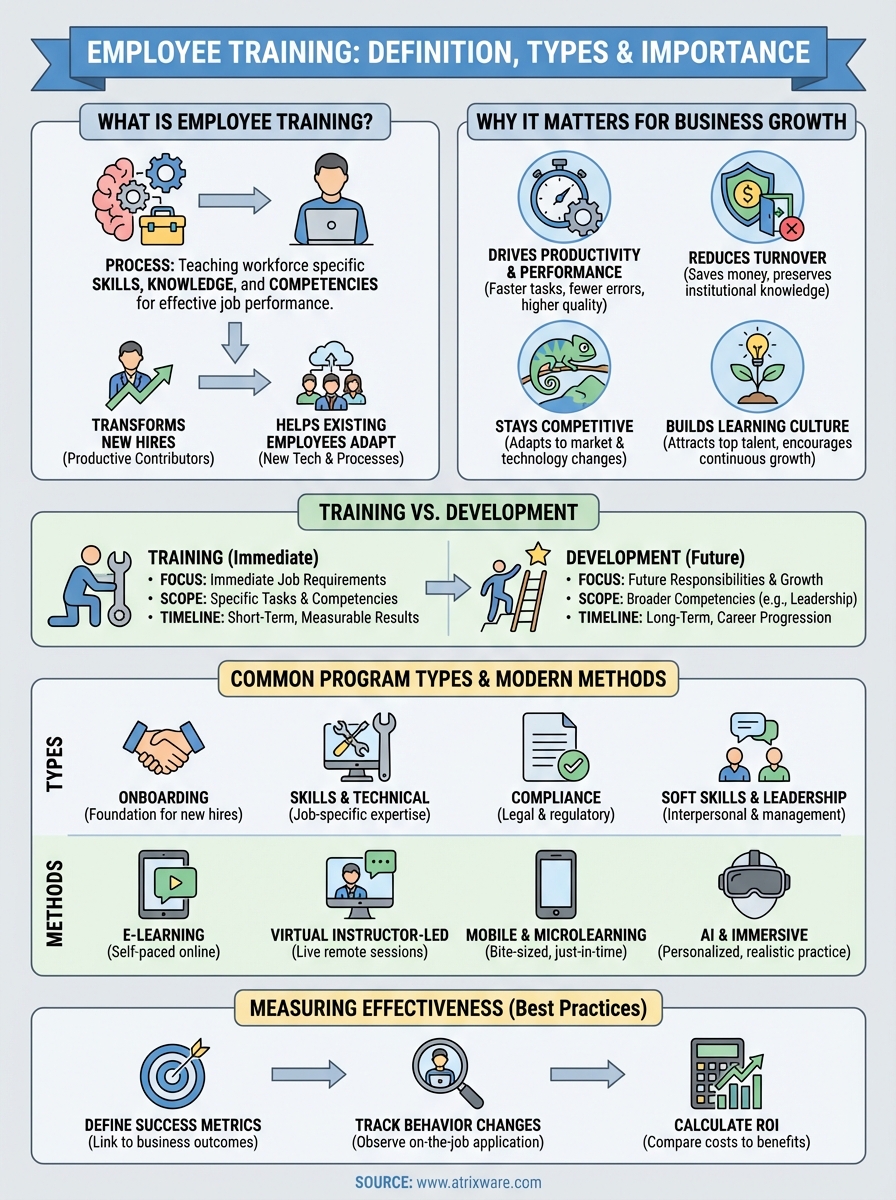
What is employee training? It’s the process of teaching your workforce the specific skills, knowledge, and competencies they need to perform their jobs effectively. Think of it as equipping your team with the tools they need to succeed, whether that’s technical expertise, soft skills, compliance knowledge, or product information. Training transforms new hires into productive contributors and helps existing employees adapt to new technologies, processes, and responsibilities.
This guide walks you through everything you need to know about employee training. You’ll discover why training matters for business growth, how to build effective training plans, and the difference between training and development. We’ll explore the various types and methods available, from onboarding programs to compliance courses. You’ll also learn best practices for measuring results and get insights into emerging trends that are shaping how organizations approach workplace learning. By the end, you’ll have a clear roadmap for creating training programs that drive real business outcomes.
Why employee training is crucial for business growth
Your organization’s success depends on how well your employees perform, and training directly impacts that performance. When you invest in developing your workforce, you’re not just improving individual skills. You’re building organizational capability that translates into measurable business outcomes. Understanding what is employee training and its strategic value helps you make smarter decisions about resource allocation and long-term planning.
Training drives productivity and performance
Well-trained employees complete tasks faster and with fewer errors. When your team knows exactly what to do and how to do it, they spend less time figuring things out and more time executing. This efficiency compounds across your organization. A sales team that masters your CRM system closes deals more quickly. Manufacturing workers who understand safety protocols reduce costly accidents and downtime.

Performance improvements extend beyond speed. Training helps your employees produce higher-quality work that meets or exceeds standards. Your customer service representatives handle inquiries more effectively when they understand products thoroughly. Your marketing team creates better campaigns when they’re trained on the latest analytics tools and strategies.
Organizations that prioritize employee training see direct improvements in both efficiency and output quality, creating a competitive advantage in their markets.
Reducing turnover saves money and preserves knowledge
Employee turnover costs you far more than recruitment expenses. You lose institutional knowledge, client relationships, and team cohesion every time someone leaves. Training addresses this by showing employees you’re invested in their future. When you provide opportunities to learn new skills and advance their careers, they’re more likely to stay.
The financial impact is significant. Replacing an employee typically costs 50% to 200% of their annual salary when you factor in recruitment, onboarding, and lost productivity. Your training programs create a retention strategy that protects this investment. Employees who receive regular development opportunities report higher job satisfaction and loyalty.
Staying competitive requires continuous adaptation
Markets change rapidly, and your competitors aren’t standing still. New technologies emerge, customer expectations shift, and regulatory requirements evolve. Training ensures your workforce can adapt to these changes instead of being left behind. Your IT team needs to understand cloud computing. Your compliance officers must stay current on data privacy laws.
Companies that fail to train their employees lose market share to more agile competitors. Your organization becomes more responsive to industry trends when employees possess up-to-date knowledge. This adaptability protects your business from disruption and positions you to capitalize on new opportunities.
Building a learning culture strengthens your organization
Training creates momentum that extends beyond individual skill development. When you establish regular learning opportunities, you build a culture where growth and improvement become the norm. Your employees start seeking out knowledge proactively rather than waiting for mandatory sessions.
This culture shift attracts top talent. Skilled professionals want to work for organizations that invest in their development. Your employer brand strengthens when you’re known for comprehensive training programs. You’ll find it easier to recruit high-performers who value continuous learning and career advancement opportunities.
How to build an effective employee training plan
Building a successful training plan requires more than scheduling a few courses. You need a structured approach that aligns employee development with your business objectives. Understanding what is employee training means recognizing it as a strategic investment that demands careful planning and execution. Your training plan should address specific gaps, deliver measurable results, and adapt as your organization evolves.
Identify specific skill gaps and business needs
Start by analyzing where your performance gaps exist. Talk to managers, review performance evaluations, and observe workflow bottlenecks to pinpoint areas requiring improvement. Your customer service team might need better product knowledge. Your sales force could lack effective closing techniques. Manufacturing employees may require updated safety training.
Link these gaps directly to business outcomes. If customer satisfaction scores are dropping, training on communication skills becomes a priority. When project deadlines slip, time management or technical skills training might be the solution. This connection ensures your training budget delivers tangible business value rather than checking boxes.
Set clear objectives and measurable outcomes
Define exactly what employees should be able to do after completing training. Vague goals like "improve sales skills" don’t work. Instead, specify concrete abilities: "complete product demonstrations that address all customer concerns" or "reduce safety incidents by 30% within six months."
Your objectives should follow a measurable framework. Include specific metrics like completion rates, test scores, behavior changes, or performance improvements. These measurements prove training effectiveness and justify continued investment.
Clear objectives transform training from an activity into a strategic tool that drives specific business outcomes.
Choose appropriate training methods and formats
Match your delivery methods to your learning objectives and workforce needs. Technical skills often require hands-on practice, while compliance training works well in online modules. Complex concepts benefit from instructor-led sessions that allow questions and discussion.
Consider practical constraints like budget, employee locations, and time availability. Remote teams need virtual training options. Shift workers require flexible scheduling. Budget limitations might mean starting with essential training and expanding later. Your chosen formats should balance effectiveness with feasibility, ensuring employees can actually complete the training while maintaining productivity.
Key differences between training and development
While people often use these terms interchangeably, training and development serve distinct purposes in your workforce strategy. Training addresses immediate job requirements, equipping employees with specific skills they need right now. Development takes a broader view, preparing your workforce for future responsibilities and roles. Understanding what is employee training versus development helps you allocate resources effectively and design programs that serve both current operations and long-term organizational growth.
Training focuses on immediate job requirements
Your training programs target specific tasks and competencies employees need to perform their current roles effectively. When you onboard a new customer service representative, you train them on your phone system, product catalog, and support protocols. This training delivers measurable, short-term results that improve job performance within days or weeks.
Training typically addresses concrete skill gaps with defined endpoints. Your manufacturing team needs safety procedures. Your sales staff requires product knowledge. Your IT department must understand security protocols. Each training initiative has clear objectives you can measure through tests, certifications, or performance metrics.
Training solves today’s problems by building the specific capabilities your organization needs to operate efficiently right now.
Development prepares employees for future growth
Development programs take a broader, longer-term perspective on employee capability building. You’re not just improving current performance but preparing employees for roles they’ll fill later. Leadership development programs prepare individual contributors for management positions. Cross-functional rotations build the versatile skill sets you need for complex projects.
Your development initiatives focus on transferable competencies rather than specific tasks. Critical thinking, strategic planning, emotional intelligence, and adaptability matter more than mastering particular software or procedures. These programs often span months or years, with outcomes measured through career progression and organizational advancement rather than immediate performance metrics.
Timing and scope differ significantly
Training happens when you need immediate capability improvements. New software rollout? Train employees before launch. Regulatory changes? Conduct compliance training immediately. Development operates on a continuous, long-term timeline without urgent deadlines driving the schedule.
Scope also differs. Training narrows in on job-specific skills within defined roles. Development expands across multiple competencies and career paths, building organizational bench strength. Your training budget addresses current operational needs. Your development investment builds the leadership pipeline and strategic capabilities that will drive your business three to five years from now.
Common types of employee training programs
Your organization needs different training programs to address varied learning objectives and business requirements. Understanding what is employee training means recognizing that no single program type fits all situations. The most effective training strategies combine multiple program types, each designed to develop specific capabilities that support your organizational goals and employee growth.
Onboarding and orientation programs
New hire training establishes the foundation for employee success from day one. Your onboarding programs introduce company culture, policies, systems, and role-specific responsibilities. These programs accelerate time-to-productivity by giving new employees the knowledge and tools they need to contribute quickly.
Effective onboarding extends beyond paperwork and administrative tasks. You should include mentorship components, department introductions, and hands-on training with core systems. Organizations with structured onboarding programs see higher retention rates and faster integration of new team members into productive workflows.
Skills training and technical development
Technical training builds the job-specific competencies your employees need to perform their roles effectively. Your sales team needs product training and customer relationship management skills. Manufacturing employees require machine operation and quality control training. IT staff must master programming languages, security protocols, and infrastructure management.
Skills training addresses both initial capability building and ongoing development as technologies and processes evolve. Regular technical training keeps your workforce current with industry standards and organizational tools.
Technical training ensures your employees maintain the expertise required to meet performance standards and adapt to technological changes.
Compliance and regulatory training
Compliance programs protect your organization from legal risks and regulatory penalties. You need mandatory training on workplace safety, data privacy, anti-harassment policies, and industry-specific regulations. These programs ensure employees understand legal requirements and company policies that govern their work.
Regulatory training requires documentation, regular updates, and tracking to demonstrate compliance during audits. Your compliance programs should include certification processes and refresher courses that keep employees informed of changing regulations and standards.
Soft skills and leadership training
Soft skills training develops interpersonal and professional competencies that improve workplace effectiveness. Communication, teamwork, problem-solving, and time management training benefit employees at all levels. Leadership programs prepare your emerging leaders for management responsibilities through training on delegation, conflict resolution, and strategic thinking.
These programs build the cultural and collaborative capabilities that drive organizational performance beyond technical expertise. Your investment in soft skills training creates more effective teams and stronger workplace relationships.
Modern training methods and delivery formats
Your training delivery options have expanded dramatically beyond traditional classroom sessions. Understanding what is employee training today means recognizing the diverse digital and hybrid formats that make learning more accessible, flexible, and effective. Modern technology enables you to deliver training when and where employees need it, matching delivery methods to learning objectives while accommodating different work environments and employee preferences.
E-learning and self-paced online courses
Online courses give your employees flexibility to learn on their own schedule while maintaining consistent content delivery across your organization. You can deploy e-learning modules for onboarding, compliance training, product knowledge, and technical skills. These programs include interactive elements like quizzes, videos, and simulations that keep learners engaged without requiring instructor availability.
Self-paced formats work particularly well for remote teams and distributed workforces. Your employees access training materials from any location, completing modules between tasks or during dedicated learning time. The scalability benefits are significant since you can train thousands of employees simultaneously without additional instructor costs or logistical complexity.
Virtual instructor-led training sessions
Virtual classrooms combine the engagement of live instruction with the convenience of remote access. Your employees participate in real-time sessions led by trainers who deliver presentations, facilitate discussions, and answer questions through video conferencing platforms. This format replicates traditional classroom benefits while eliminating travel costs and scheduling constraints.
You achieve better knowledge retention with virtual sessions compared to purely self-paced content because participants interact directly with instructors and peers. Complex topics requiring explanation and dialogue benefit from this format, making it ideal for leadership development, soft skills training, and advanced technical instruction.
Virtual instructor-led training delivers the personal connection and interaction of classroom learning without the logistical challenges and expenses of bringing employees to a physical location.
Mobile and microlearning approaches
Mobile learning puts training materials on the devices your employees already carry. Your workforce accesses short training modules, reference materials, and performance support tools through smartphones and tablets. This approach works excellently for just-in-time learning when employees need quick answers or refreshers while performing their jobs.
Microlearning breaks complex topics into bite-sized lessons that take five to ten minutes to complete. Your employees absorb information more effectively through focused, targeted content rather than lengthy courses. Manufacturing floor workers can review safety procedures between shifts. Sales representatives access product updates before client meetings. This format respects your employees’ time while delivering practical knowledge exactly when needed.
Best practices for measuring training effectiveness
Your training programs only deliver value when you can measure their actual impact on performance and business outcomes. Understanding what is employee training without measuring its effectiveness leaves you guessing about your return on investment. Successful organizations implement structured measurement processes that track both immediate learning gains and long-term behavior changes. These practices help you identify which programs work, where improvements are needed, and how training contributes to strategic objectives.
Define success metrics before training begins
You need to establish clear measurement criteria before launching any training program. Decide exactly what success looks like by linking training outcomes to specific business goals. Will you track reduced error rates, increased sales, improved customer satisfaction scores, or faster project completion times? Your metrics should align directly with the capabilities you’re building through training.
Baseline measurements provide the comparison point for assessing improvement. Document current performance levels, skill assessments, or knowledge tests before training starts. This data shows you the gap between current and desired performance, making post-training improvements quantifiable and defensible when reporting to leadership.
Track behavioral changes and on-the-job application
Knowledge retention alone doesn’t prove training effectiveness. You need to observe whether employees actually apply new skills in their daily work. Manager observations, performance reviews, and workflow analysis reveal if training translates into changed behaviors and improved outcomes. Your customer service representatives might pass product knowledge tests but fail to use that information during client interactions.
Follow-up assessments at 30, 60, and 90 days after training completion capture how well employees retain and apply learning over time. Immediate post-training scores often look impressive, but sustained behavior change matters more for business impact.
Training effectiveness reveals itself through sustained workplace behavior changes rather than test scores alone.
Gather feedback from multiple sources
Your measurement approach should include perspectives from learners, managers, and stakeholders who observe training outcomes. Employee surveys capture subjective experiences about content relevance, delivery quality, and practical applicability. Manager feedback provides insights into performance improvements and skill application within teams.
Combine quantitative data like completion rates, assessment scores, and performance metrics with qualitative feedback. This comprehensive view helps you understand not just whether training worked, but why certain programs succeed or fail and how you can improve future initiatives.
Calculate return on investment
Financial metrics prove training value to organizational leadership. Calculate your training ROI by comparing program costs against measurable business benefits like increased revenue, reduced errors, lower turnover, or improved productivity. Your calculation should include direct costs (instructor fees, platform subscriptions, materials) and indirect costs (employee time, administrative overhead).
Track cost-per-employee and cost-per-outcome to identify your most efficient training programs. These numbers guide budget allocation decisions and help you prioritize high-impact initiatives.
Emerging trends in workplace learning
Your training landscape continues evolving as new technologies and methodologies reshape how organizations develop their workforce. Understanding what is employee training in 2026 means recognizing these emerging trends that make learning more personalized, engaging, and measurable. Organizations that adopt these innovations gain competitive advantages through more effective skill development and higher employee engagement. These trends don’t replace traditional training but enhance it with capabilities that were impossible just a few years ago.
Artificial intelligence personalizes learning experiences
AI-powered platforms analyze your employees’ learning patterns, skill gaps, and performance data to create customized training paths. Instead of forcing everyone through identical courses, adaptive learning systems adjust content difficulty, pace, and format based on individual needs. Your marketing specialist receives different training recommendations than your finance team member, even when both need data analysis skills.

Machine learning algorithms identify knowledge gaps before they impact performance by analyzing work outputs and skill assessments. These systems suggest relevant training content proactively, helping your employees develop capabilities aligned with their career goals and organizational requirements.
AI transforms training from a one-size-fits-all approach into a personalized development experience that adapts to each employee’s unique learning needs and career trajectory.
Immersive technologies create realistic practice environments
Virtual reality and augmented reality platforms let your employees practice complex tasks in safe, controlled settings without real-world consequences. Manufacturing workers operate dangerous equipment virtually before touching actual machinery. Customer service representatives handle difficult client scenarios through VR simulations. These immersive experiences build muscle memory and confidence more effectively than videos or manuals alone.
AR applications overlay digital information onto physical environments, providing real-time guidance during actual work tasks. Your technicians access repair procedures through smart glasses while working on equipment. Warehouse employees receive visual picking instructions that reduce errors and improve efficiency.
Data analytics optimize training strategies
Advanced analytics platforms track learning behaviors, engagement patterns, and performance outcomes across your entire training ecosystem. You identify which content formats drive the best results, when employees prefer learning, and where completion rates drop. This data helps you refine programs continuously based on actual effectiveness rather than assumptions.
Predictive analytics forecast future skill requirements by analyzing market trends, technology changes, and organizational growth plans. Your training strategy becomes proactive rather than reactive, preparing employees for capabilities they’ll need before those skills become critical to business operations.
Final thoughts on employee training
Understanding what is employee training gives you the foundation to build programs that drive measurable business results and develop your workforce strategically. Throughout this guide, you’ve explored how training differs from development, examined the various program types available, reviewed modern delivery methods, and learned best practices for measuring effectiveness. Your success depends on aligning training initiatives with specific business objectives, choosing appropriate delivery formats that match your workforce needs, and continuously measuring outcomes to improve program performance.
The training landscape continues evolving rapidly with AI-powered personalization, immersive technologies, and advanced analytics transforming how organizations develop talent. Your organization’s ability to adapt and implement these innovations determines how effectively you build employee capabilities and maintain competitive advantages in your market. Start by identifying your most critical skill gaps, developing structured training plans that address both immediate needs and long-term growth, and establishing measurement frameworks that prove ROI to leadership.
Ready to transform your training programs? Take our LMS readiness quiz to discover where you are in your learning management journey and what steps will maximize your training effectiveness.
