You know your team needs better training. But choosing the right employee training methods feels overwhelming when you’re facing dozens of options, each promising different results. Some methods drain your budget with minimal impact. Others look great on paper but fall apart during implementation. Your training program’s success depends on matching the right method to your specific needs, team dynamics, and business goals.
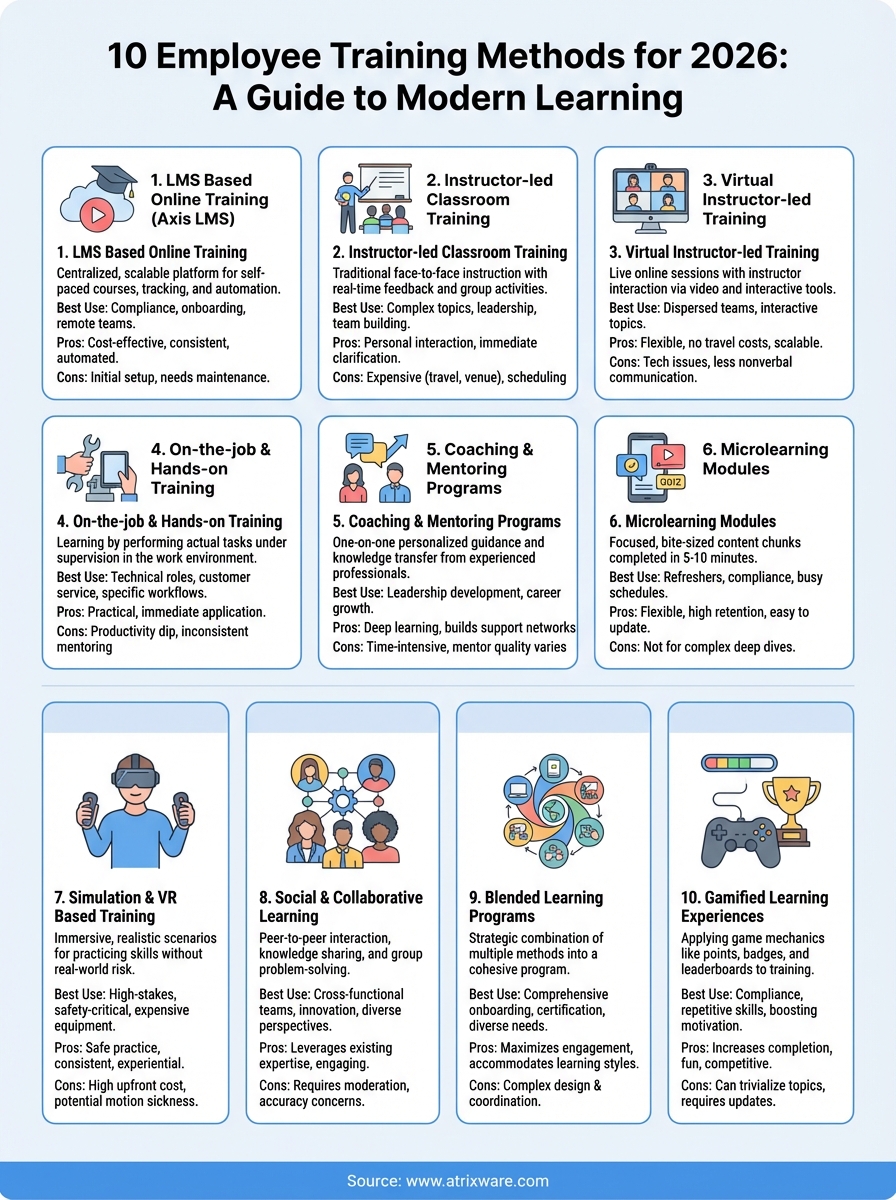
This guide breaks down 10 proven training methods you can implement in 2026, from LMS-based online training to gamified learning experiences. Each method includes clear examples, honest assessments of advantages and drawbacks, and practical implementation tips. You’ll discover which approaches work best for onboarding new hires versus developing leadership skills, when virtual training outperforms classroom instruction, and how to combine multiple methods for maximum impact. By the end, you’ll have a clear framework for building training programs that actually improve performance and drive measurable results.
1. LMS based online training with Axis LMS
Learning Management Systems deliver structured training content through a centralized digital platform that tracks progress, automates workflows, and scales to any team size. Axis LMS combines intuitive course building with powerful analytics, giving you complete control over your training programs without requiring technical expertise.
What this method involves
LMS-based training centralizes all your learning materials in one platform where employees access courses, complete assignments, and track their progress. You build courses using drag-and-drop interfaces, upload existing content, and organize learning paths that guide employees through required training. The system handles enrollment automation, sends reminders, and generates completion certificates without manual intervention.
How this method works with Axis LMS
Axis LMS streamlines course creation with templates and rapid-build tools that let you launch training in hours instead of weeks. You customize the learner interface to match your brand, integrate with your existing HR and CRM systems, and deliver both self-paced courses and virtual classroom sessions from a single platform. Real-time dashboards show you exactly who completed what, where learners struggle, and how training impacts performance.

Best use cases and audiences
This method excels for compliance training, employee onboarding, product knowledge programs, and customer education. Organizations with remote teams, multiple locations, or rapid growth benefit most because the system scales effortlessly without additional infrastructure costs.
Pros of this method
You reduce training costs by eliminating travel and instructor fees while maintaining consistent quality across all locations. The platform provides detailed analytics that prove ROI, automates administrative tasks that consume HR time, and gives learners the flexibility to train on their schedule.
LMS-based training reduces administrative overhead by up to 60% while improving completion rates through automated reminders and progress tracking.
Cons and limitations
This approach requires initial setup time to build courses and configure the system. Some learners need hands-on practice that purely digital content cannot provide, and you must maintain courses to keep information current.
Implementation tips for 2026
Start with one high-priority training program instead of migrating everything at once. Use mobile-responsive design so employees can learn on any device, and integrate your LMS with existing systems to automate user management and eliminate duplicate data entry.
2. Instructor led classroom training
Traditional classroom training brings employees together in person with a qualified instructor who guides them through material using lectures, discussions, and group activities. This face-to-face approach remains one of the most effective employee training methods for complex topics that require immediate feedback and real-time interaction between trainers and learners.
What this method involves
You gather employees in a physical training room where an instructor presents information using whiteboards, slide presentations, videos, and printed materials. Learners ask questions as they arise, participate in hands-on exercises, and work through case studies with their peers while receiving immediate guidance from the trainer.
Best use cases and audiences
This method works best for leadership development programs, technical skills training that requires equipment demonstrations, and situations where team building strengthens the learning experience. Organizations training small groups on high-stakes topics or introducing complex regulatory requirements see the strongest results from classroom instruction.
Pros of this method
You build personal connections between instructors and learners that create trust and engagement. The instructor adapts the pace and approach in real time based on group comprehension, addresses specific questions immediately, and facilitates networking opportunities among participants.
Classroom training achieves 70% higher engagement rates for complex topics compared to self-paced online courses because learners receive immediate clarification and peer support.
Cons and limitations
This approach requires travel expenses, venue costs, and instructor time that increase your per-learner investment substantially. You face scheduling challenges coordinating multiple employees, and training quality varies based on instructor skill rather than standardized content delivery.
Implementation tips for 2026
Limit class sizes to 15 participants or fewer to maintain interaction quality. Combine classroom sessions with pre-work assignments and digital follow-up materials to reinforce learning, and record sessions for employees who cannot attend live.
3. Virtual instructor led training
Virtual instructor-led training delivers the personal interaction of classroom learning through video conferencing platforms where instructors and learners connect in real time from different locations. This method combines the engagement benefits of face-to-face instruction with the flexibility and cost savings of remote delivery, making it one of the most versatile employee training methods for distributed teams.
What this method involves
You schedule live online sessions where an instructor presents material using screen sharing, video, and interactive tools while employees participate from their computers or mobile devices. Learners ask questions through chat or audio, work in breakout rooms for group activities, and complete exercises that the instructor monitors in real time.
Best use cases and audiences
This approach works exceptionally well for geographically dispersed teams, training programs that require instructor expertise but not physical equipment, and organizations reducing travel budgets without sacrificing interaction quality. Sales training, software demonstrations, and leadership development programs deliver strong results through virtual instruction.
Pros of this method
You eliminate travel costs and venue expenses while maintaining the real-time feedback that makes instructor-led training effective. The method scales easily to larger audiences, allows you to record sessions for future reference, and gives employees the flexibility to join from anywhere with internet access.
Virtual instructor-led training reduces per-learner costs by 40-60% compared to classroom training while maintaining similar completion rates and knowledge retention.
Cons and limitations
Technical issues can disrupt sessions if participants have poor internet connections or unfamiliar software. You lose some nonverbal communication cues that in-person instruction provides, and maintaining engagement becomes harder when learners face home or office distractions.
Implementation tips for 2026
Keep sessions under 90 minutes to prevent video fatigue and schedule regular breaks for longer programs. Use polling, quizzes, and breakout activities every 15 minutes to maintain engagement, and provide technical support contacts that participants can reach before sessions start.
4. On the job and hands on training
On-the-job training places employees directly into work environments where they learn by performing actual job tasks under supervision. This method delivers practical experience immediately applicable to daily responsibilities, eliminating the gap between theoretical knowledge and real-world application that other employee training methods often create.

What this method involves
You assign new or transitioning employees to work alongside experienced staff members who demonstrate tasks, explain processes, and provide feedback as learners practice skills in real time. Trainees use actual equipment, handle real customer interactions, and complete authentic work assignments while receiving immediate correction and guidance from supervisors or senior colleagues.
Best use cases and audiences
This approach works best for technical positions, manufacturing roles, customer service jobs, and any position where hands-on experience with specific equipment or processes proves essential. Organizations with standardized workflows and available mentors see the strongest results from on-the-job training.
Pros of this method
You eliminate the disconnect between training content and actual job requirements because employees learn using the exact tools and procedures they will use daily. The method requires minimal infrastructure, leverages existing staff expertise, and produces immediately productive employees who understand your specific processes rather than generic industry practices.
On-the-job training reduces time-to-productivity by 40% compared to classroom-only approaches because employees practice real tasks instead of simulated exercises.
Cons and limitations
This method depends heavily on the teaching ability of your current staff, who may lack formal training skills. Productivity temporarily decreases for both the trainee and the mentor, and inconsistent instruction across different supervisors can create quality variations in employee knowledge.
Implementation tips for 2026
Create structured checklists that mentors follow to ensure consistent coverage of essential skills. Rotate trainees through multiple supervisors to expose them to different approaches, and schedule regular check-ins where you assess progress using standardized evaluation criteria.
5. Coaching and mentoring programs
Coaching and mentoring pair employees with experienced professionals who provide personalized guidance, support, and knowledge transfer through ongoing relationships. This one-on-one approach creates deep learning experiences that adapt to individual needs and career goals, making it one of the most impactful employee training methods for developing talent.
What this method involves
You connect employees with coaches or mentors who meet regularly to discuss challenges, share expertise, and provide feedback on performance. The relationship focuses on professional growth through conversations, observations, and guided practice rather than formal curriculum.
Best use cases and audiences
This method excels for leadership development, succession planning, and helping high-potential employees advance into senior roles. Organizations with experienced staff who can share institutional knowledge and new managers transitioning into leadership positions benefit most.
Pros of this method
You build strong relationships that extend beyond training, creating support networks that boost retention. The personalized attention addresses each employee’s specific development needs, and mentors transfer tacit knowledge that no course can capture.
Mentored employees show 50% higher retention rates and advance five times faster than those without mentors because they receive customized guidance and ongoing support.
Cons and limitations
This approach requires significant time commitment from senior staff who serve as mentors. You need careful matching between mentors and mentees, and the quality varies based on the mentor’s coaching ability.
Implementation tips for 2026
Establish clear goals and meeting schedules at the relationship start. Train mentors on effective coaching techniques, and use structured check-ins to track progress without micromanaging the relationship.
6. Microlearning modules
Microlearning delivers training content in focused, bite-sized segments that employees complete in five to ten minutes. This method matches modern attention spans and busy schedules by breaking complex topics into digestible chunks that learners consume between tasks, making it one of the most flexible employee training methods for continuous skill development.
What this method involves
You create short learning units focused on single concepts or specific tasks that employees access on demand through mobile devices or computers. Each module uses videos, infographics, quizzes, or interactive exercises to teach one clear objective, then allows learners to immediately apply the knowledge before moving forward.
Best use cases and audiences
This approach works exceptionally well for compliance updates, product knowledge refreshers, software feature training, and ongoing skill development for remote teams. Organizations with employees who struggle to block out long training sessions or need just-in-time learning during workflow see the strongest results.
Pros of this method
You reduce completion barriers because employees fit learning into their existing schedules without disrupting productivity. The format increases retention rates through focused repetition and allows you to update content quickly when information changes.
Microlearning improves knowledge retention by 80% compared to traditional hour-long courses because learners absorb focused information without cognitive overload.
Cons and limitations
This method works poorly for complex topics requiring deep discussion or extended practice time. You need careful planning to ensure modules connect into coherent learning paths, and the short format limits relationship building between learners and instructors.
Implementation tips for 2026
Focus each module on one specific skill or knowledge point that employees can practice immediately. Use mobile-responsive design so learners access content anywhere, and organize modules into clear progression paths that guide employees through related topics systematically.
7. Simulation and VR based training
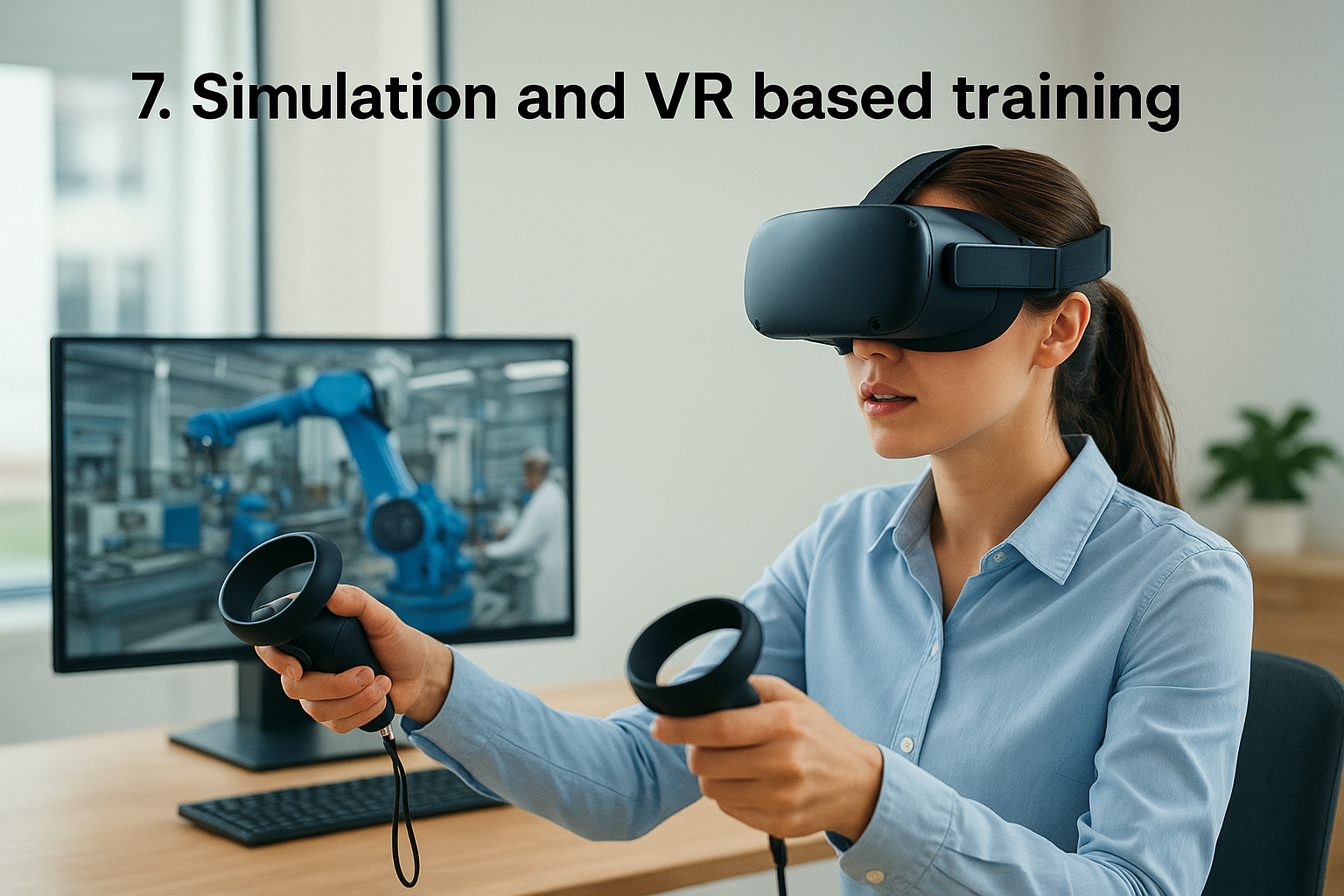
Simulation and virtual reality training immerse employees in realistic scenarios where they practice skills and make decisions without real-world consequences. This method creates experiential learning environments that replicate dangerous, expensive, or rare situations, making it one of the most innovative employee training methods for high-stakes roles.
What this method involves
You place employees in computer-generated environments using VR headsets or screen-based simulators where they interact with virtual equipment, customers, or situations that mirror their actual job responsibilities. The system responds to their actions in real time, providing immediate feedback on decisions and allowing them to repeat scenarios until they master the required skills.
Best use cases and audiences
This approach excels for safety-critical training in manufacturing, healthcare, aviation, and emergency response. Organizations training employees on expensive equipment, rare emergency procedures, or complex technical operations benefit most because simulations eliminate risk while providing unlimited practice opportunities.
Pros of this method
You reduce training risks by allowing employees to make mistakes in safe environments where errors cause no harm. The method provides consistent scenarios that every trainee experiences identically, and employees retain skills longer through immersive practice that engages multiple senses.
VR-based training improves skill retention by 75% and reduces training time by 40% compared to traditional methods because learners experience realistic consequences without actual danger.
Cons and limitations
This method requires significant upfront investment in hardware, software, and content development. Some employees experience motion sickness or discomfort with VR headsets, and you need technical support to maintain equipment and troubleshoot issues.
Implementation tips for 2026
Start with one high-priority use case where mistakes create significant consequences or costs. Partner with established VR training providers instead of building everything internally, and provide short orientation sessions that help employees adjust to the technology before actual training begins.
8. Social and collaborative learning
Social and collaborative learning harnesses peer interactions and group knowledge sharing to develop skills through discussion, teamwork, and collective problem-solving. This method creates learning communities where employees teach each other, share experiences, and build solutions together, making it one of the most engaging employee training methods for building both skills and team cohesion.
What this method involves
You create opportunities for employees to learn together through discussion forums, group projects, peer review sessions, and collaborative problem-solving activities. Learners share their expertise, ask questions in online communities or physical spaces, and develop understanding through conversations with colleagues who face similar challenges.
Best use cases and audiences
This approach works exceptionally well for cross-functional teams, organizations with distributed expertise, and situations where employees benefit from diverse perspectives. Companies building innovation cultures or developing solutions to complex problems that require multiple viewpoints see the strongest results.
Pros of this method
You leverage existing employee expertise without hiring external trainers while building stronger team relationships. The method scales naturally as communities grow, and employees retain information longer when they teach concepts to peers rather than passively receiving instruction.
Peer-to-peer learning increases knowledge retention by 90% because teaching others forces employees to organize and articulate their understanding clearly.
Cons and limitations
This method requires active moderation to ensure accuracy and prevent misinformation spread. You need critical mass for vibrant discussions, and some employees hesitate to participate in group settings where they fear judgment.
Implementation tips for 2026
Assign dedicated moderators who guide discussions and correct inaccuracies. Create structured activities with clear objectives rather than expecting spontaneous collaboration, and recognize employees who contribute valuable insights to encourage ongoing participation.
9. Blended learning programs
Blended learning combines multiple employee training methods into cohesive programs that leverage the strengths of different approaches while minimizing individual weaknesses. This method integrates online courses with face-to-face instruction, hands-on practice, and social learning to create comprehensive experiences that adapt to diverse learning preferences and organizational needs.
What this method involves
You design training programs that sequence different delivery methods strategically, such as starting with self-paced online modules for foundational knowledge, following with virtual instructor-led sessions for clarification, and concluding with on-the-job practice where employees apply skills. Each component reinforces the others while serving a specific purpose in the overall learning journey.
Best use cases and audiences
This approach excels for comprehensive onboarding programs, certification courses, and leadership development initiatives that require both knowledge acquisition and skill application. Organizations with diverse learner populations and complex training objectives that no single method can address effectively benefit most from blended programs.
Pros of this method
You maximize engagement by varying delivery formats to maintain learner interest throughout extended programs. The method accommodates different learning styles simultaneously, allows you to optimize costs by using expensive instructor time only where interaction adds maximum value, and produces better outcomes than single-method approaches through reinforcement across multiple channels.
Blended learning programs achieve 60% higher completion rates and 35% better knowledge retention than single-method training because learners engage with material through multiple modalities.
Cons and limitations
This method requires sophisticated instructional design to ensure components connect logically and support each other rather than creating confusion. You face increased coordination complexity managing multiple delivery channels, and tracking progress becomes harder when learners move between different platforms and formats.
Implementation tips for 2026
Map each program component to specific learning objectives it serves best. Use your LMS as the central hub that connects all elements and tracks progress across formats, and test the complete learner journey before launching to identify gaps or redundancies in the experience.
10. Gamified learning experiences
Gamified learning applies game mechanics like points, badges, leaderboards, and challenges to training content, transforming education into competitive and rewarding experiences. This method taps into intrinsic motivation by making learning fun and engaging, turning it into one of the most effective employee training methods for boosting participation and completion rates.

What this method involves
You integrate game elements into your training platform where employees earn points for completing modules, unlock achievements for reaching milestones, and compete on leaderboards that display progress. The system provides immediate rewards and visual feedback that creates momentum, encouraging learners to continue advancing through content.
Best use cases and audiences
This approach works exceptionally well for compliance training, sales enablement programs, and repetitive skill development where motivation typically drops. Organizations with competitive cultures or younger workforces who grew up with gaming experiences see the strongest engagement improvements.
Pros of this method
You increase completion rates dramatically by making training enjoyable rather than obligatory. The competitive elements create urgency that reduces procrastination, and the reward systems provide continuous positive reinforcement that traditional courses lack.
Gamified training programs achieve 90% completion rates compared to 50% for non-gamified courses because game mechanics trigger psychological motivators that sustain engagement.
Cons and limitations
This method requires careful design to avoid trivializing serious topics or creating excessive competition that damages team relationships. You need ongoing content updates to maintain novelty and interest, and some employees feel alienated by competitive elements.
Implementation tips for 2026
Balance competition with collaboration opportunities where teams work together toward goals. Offer multiple paths to earn rewards so different skill levels feel achievable success, and tie game achievements to real-world recognition or career advancement opportunities.
Next steps
You now have a complete framework for selecting and implementing the right employee training methods for your organization. The most successful training programs combine multiple approaches that match your specific goals, team size, and learning objectives. Start by identifying your highest-priority training needs, then select two or three methods that complement each other rather than deploying every option simultaneously.
Your next move depends on whether you need a centralized platform to manage and deliver training at scale. Modern LMS platforms like Axis LMS streamline the implementation of multiple training methods from a single system. Take our LMS readiness quiz to discover which training technologies and features will deliver the strongest results for your current situation. The assessment takes five minutes and provides specific recommendations based on your training challenges and organizational requirements.
