Most training programs fail not because the content is bad, but because learners disengage before the content has a chance to work. That’s the problem microlearning and gamification solve when used together, they make training shorter, more focused, and genuinely engaging.
Microlearning breaks content into small, targeted lessons. Gamification adds game-like elements, points, badges, leaderboards, to motivate learners to keep going. On their own, each approach improves training outcomes. Combined, they create a learning experience that sticks, because people actually want to participate in it.
Whether you’re onboarding new employees, running compliance training, or educating customers, understanding how these two strategies complement each other gives you a real advantage. At Atrixware, we built Axis LMS to support both approaches natively, so organizations can design training programs that hold attention and drive measurable results.
This article breaks down what microlearning and gamification are, how they differ, why combining them works, and how to put them into practice with concrete tips and examples.
What microlearning and gamification mean together
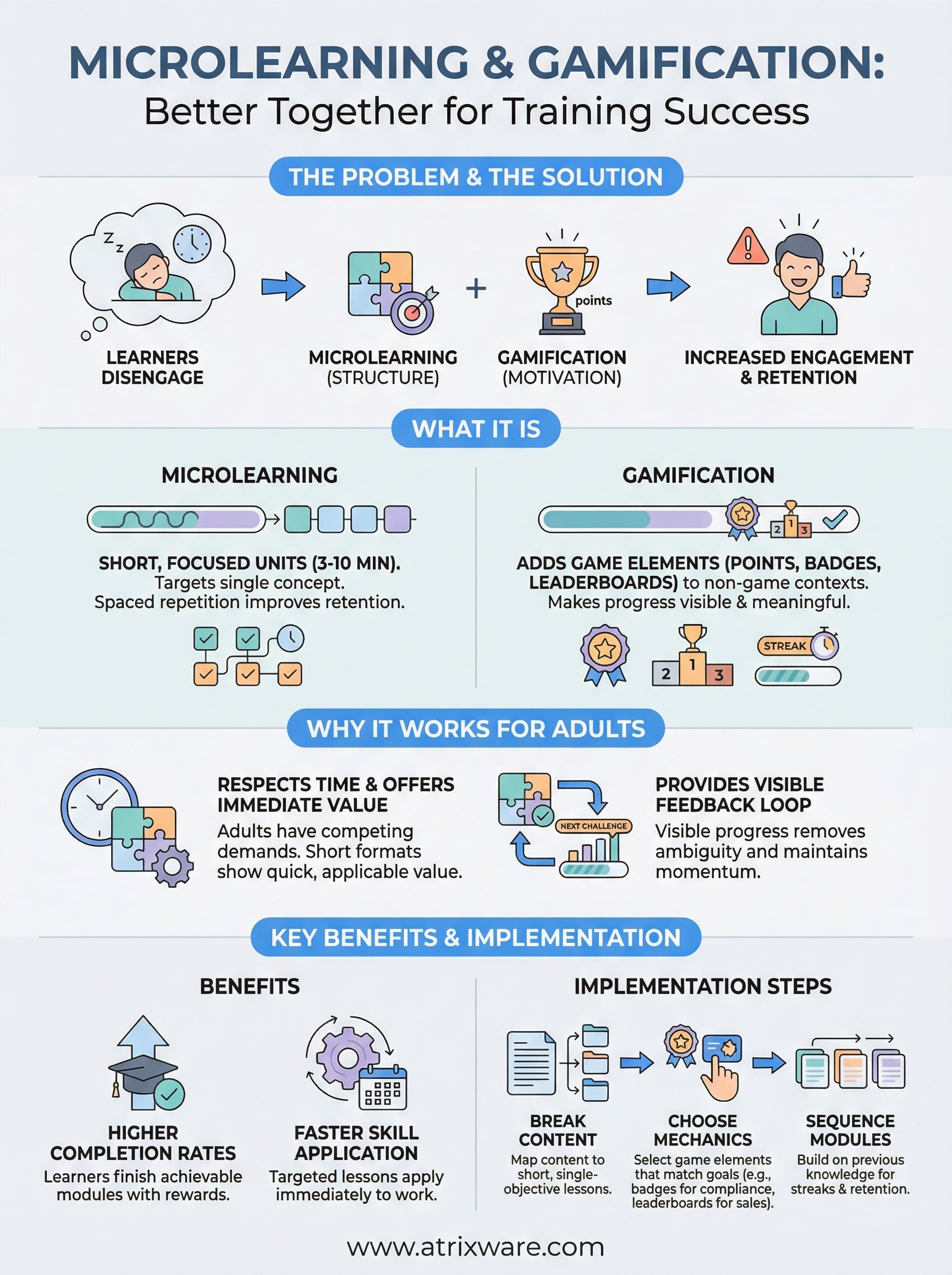
When you combine microlearning and gamification, you’re pairing two distinct learning design philosophies into one system. Microlearning controls how content is structured (small, focused, purposeful). Gamification controls how learners interact with that content (through rewards, progress, and competition). Together, they address both the attention problem and the motivation problem that undermine most training programs.
What microlearning actually is
Microlearning delivers content in short, focused units, typically between 3 and 10 minutes, each targeting a single concept or skill. Instead of sitting through a 90-minute course, a learner watches a 5-minute video, answers a few questions, and moves on. This format respects how adults actually learn: in short bursts, with clear goals, and on their own schedule.
Spaced repetition is a key advantage of microlearning. By revisiting concepts in short sessions over time, learners retain more compared to a single long training session. Each module feels manageable, which lowers resistance and keeps completion rates high.
What gamification adds to the mix
Gamification applies game mechanics to non-game contexts like training. That means adding points, badges, leaderboards, progress bars, streaks, and challenges to your learning content. These elements tap into learners’ natural drives for achievement, recognition, and friendly competition.

Gamification does not make training feel like play; it makes progress visible and achievement feel meaningful.
The motivational layer gamification provides is what turns a completed microlesson from a checkbox into a reward. When a learner finishes a module and earns a badge or climbs a leaderboard, they have a reason to come back for the next one. That cycle of small effort and immediate feedback is what makes the combination so effective.
Why this combo works for adult learners
Adults learn differently than students in a classroom. They have competing demands on their time, limited patience for content that feels irrelevant, and a strong preference for applying what they learn immediately. Microlearning and gamification address each of these realities directly, making them a natural fit for workplace training.
Adults need clear, immediate value
Short-format learning respects that your employees are not students: they have jobs to do. When a module takes five minutes and covers one specific skill, learners can see the value before they finish it. Immediate applicability is one of the strongest predictors of adult engagement, and microlearning delivers it by design.
The shorter the learning unit, the easier it is for adults to justify spending time on it.
Feedback drives continued effort
Gamification gives adult learners the feedback loop they need to stay motivated. Points, progress bars, and badges tell learners exactly where they stand and what comes next. Visible progress removes ambiguity and replaces it with momentum, keeping learners on track to finish rather than dropping off partway through.
Your training program benefits too. When learners complete more modules consistently, your overall training outcomes improve and your reporting data becomes more actionable.
Microlearning vs gamification: key differences
People often treat microlearning and gamification as interchangeable, but they solve different problems. Understanding the distinction helps you apply each one where it creates the most value in your training program.
One shapes structure, the other shapes motivation
Microlearning is a content design strategy. It determines how you break up, sequence, and deliver information to learners. The goal is to reduce cognitive load and improve retention by keeping each lesson short and focused on a single outcome. It answers the question: how should training be built?
The structure microlearning provides also determines how gamification elements map to your content. When each lesson covers one skill, awarding points or badges per lesson creates a natural and meaningful reward structure.
Microlearning changes what learning looks like; gamification changes how learners feel about doing it.
Gamification works on top of any content format
Gamification is a behavioral engagement strategy. It layers game mechanics, such as points, badges, and leaderboards, onto existing content to drive motivation and completion. Gamification does not change the content itself; it changes the environment and incentives surrounding the content. That distinction matters when you design your system, because each strategy requires different decisions from you as a training designer.
Benefits you can expect in workplace training
When you apply microlearning and gamification in your workplace training, the results show up in measurable ways. Completion rates rise, knowledge retention improves, and learners carry skills into their daily work faster than they would with traditional training formats.
Higher completion rates
Short modules with built-in rewards remove the friction that causes learners to abandon training midway. When each lesson takes five minutes and ends with a visible achievement, learners have a clear reason to start the next one. You see this across multiple training types:

- Employee onboarding: new hires complete required training before their first week ends
- Compliance training: learners finish mandatory modules without reminders
- Product training: sales teams absorb new product information in short, repeatable sessions
When training feels achievable, learners finish it.
Faster skill application
Targeted microlessons focus on a single skill at a time, which means learners can apply what they learned the same day. Add gamification rewards tied to real-world application challenges, such as completing a job task to unlock a badge, and you close the gap between training and on-the-job performance quickly.
Reduced training costs are another benefit, since short digital lessons cut down on scheduling overhead, travel, and instructor time.
How to implement gamified microlearning
Putting microlearning and gamification into practice does not require starting from scratch. You need a clear plan for how your content is structured and which game mechanics support your specific training goals.
Map your content to short lessons
Break your existing training content into modules that each cover one skill or concept. Keep each module under 10 minutes and write a single, measurable learning objective for it. Shorter units make it easier to assign points, badges, or progress milestones to each completed step.
The cleaner your content structure, the more naturally your gamification layer fits into it.
Once your modules are mapped, sequence them so learners build on previous knowledge. This supports both retention and the streak-based motivation that gamification mechanics rely on.
Choose mechanics that match your goals
Not every game mechanic fits every training scenario. Use leaderboards for sales or product training where competition drives performance. Use badges and certificates for compliance training where individual achievement and documentation matter more than ranking.
Match the mechanic to what motivates your specific learners and what outcome you are trying to drive. A simple points system tied to module completion is often enough to increase both engagement and completion rates significantly.
Next steps for your training program
You now have a clear picture of how microlearning and gamification work together, why they fit adult learners, and how to put them into practice. The next move is deciding where to start in your own training program. Pick one training course that has low completion rates or poor retention scores and redesign it using short modules with a basic points or badge system. That single change gives you real data to measure before you scale the approach across your organization.
Choosing the right LMS makes this process significantly faster. Axis LMS supports both microlearning formats and gamification mechanics natively, so you spend less time building features and more time designing training that works. If you are not sure where your program stands today, take the LMS readiness quiz to find out exactly what your next step should be.
