Online quizzes are only as valuable as the results they produce. When learners game the system, sharing answers, searching the web mid-test, or having someone else take the assessment entirely, your training data becomes unreliable, compliance certifications lose their meaning, and skill gaps go undetected. Knowing how to prevent cheating in online quizzes isn’t just an academic concern; it’s a business-critical problem for any organization running remote or digital training.
The good news: you don’t need to choose between assessment integrity and a smooth learner experience. The right combination of quiz design, platform settings, and proctoring strategies can dramatically reduce dishonesty without turning every test into a stressful lockdown. At Atrixware, we’ve built many of these safeguards directly into Axis LMS, giving administrators real control over how quizzes are delivered, timed, and secured.
This article breaks down six proven methods to keep your online quizzes honest, from simple question design changes you can make today to platform-level features that automate the hard work. Each strategy is practical and implementable, whether you’re training ten employees or onboarding thousands across multiple locations.
1. Use Axis LMS to lock down quiz delivery
Axis LMS gives administrators direct control over how quizzes run, not just what they contain. Before you explore complex proctoring solutions, check whether your platform settings are already doing the heavy lifting. Many of the most effective techniques for how to prevent cheating in online quizzes start at the delivery layer, where the right configuration removes the easiest opportunities before learners ever see the first question.
The quiz settings that matter most
Time limits, randomized question order, and single-attempt rules are your first line of defense. In Axis LMS, you configure each quiz independently so that no two learners see the same experience, and no one can leisurely browse the web between questions.
Key settings to activate:
- Strict time limit per question or per quiz
- Randomized question and answer order
- Attempt limits with no automatic reset
- Disabled back navigation between questions
How to control access and confirm identity
Restricting quiz availability to specific dates, IP ranges, or prerequisite completions ensures learners only reach an assessment when they’re supposed to. Tie access to individual accounts so every attempt maps to one verified person, and combine that with a required login step that cannot be bypassed or shared.
Requiring a prerequisite module before unlocking a quiz stops unqualified or unauthorized participants from reaching the assessment entirely.
How to use reporting to spot suspicious attempts
Axis LMS logs attempt timestamps, completion durations, and score patterns, which makes unusual behavior visible without manual monitoring. If someone finishes a 30-question quiz in 90 seconds or retakes it six times within an hour, the data surfaces it. Review attempt reports on a regular schedule rather than waiting for a complaint to prompt the investigation.
How to use SSO, roles, and permissions to reduce sharing
SAML-based SSO through providers like Okta, Azure, or Salesforce ties every session to verified corporate credentials, making account sharing impractical. Combine SSO with role-based permissions so learners only see the quizzes assigned to their specific role, removing the temptation to forward quiz links or login credentials to colleagues.
What to document so your policy holds up
Your platform settings only protect you if a written policy backs them up. Require learners to confirm they’ve read the rules through a mandatory acknowledgment step before the quiz launches. Axis LMS records that confirmation with a timestamp, giving you a clear reference point if you ever need to act on a suspected violation.
2. Build large question banks and randomize
A small, fixed question set is one of the easiest things for learners to share. When a colleague passes along screenshots, every answer is reusable by the next person taking the quiz. Building a large question bank with randomized delivery closes that gap without adding significant administrative overhead.
Why pools and randomization work better together
Randomization alone only shuffles order. Question pools go further by ensuring each learner draws from a large set rather than seeing every question. Combine both, and no two quizzes look alike, which makes a shared answer sheet nearly worthless to whoever receives it.
A bank of 60 questions where each learner sees 20 in random order produces thousands of possible combinations.
How to structure pools by topic and difficulty
Organize your bank by topic area and difficulty level so random draws still produce a balanced, fair quiz. Group questions to mirror your learning objectives, then pull an equal number from each group per attempt. Every learner gets tested on the same concepts, even when the specific questions differ across individual attempts.
How to randomize without changing what you assess
Write several questions that target the same learning objective at the same difficulty, then pull one per objective per quiz. This approach keeps your assessment valid while varying the experience, and it directly supports how to prevent cheating in online quizzes without sacrificing measurement accuracy.
How often to refresh questions and retire old ones
Add new questions each quarter and retire any item learners flag or that shows suspiciously high pass rates relative to overall quiz performance. That pattern typically signals answer sharing rather than genuine understanding, and a refreshed bank removes the advantage entirely.
3. Tighten timing and availability windows
Timing and availability settings are two of the most underused tools for preventing quiz fraud. Controlling when and how long you allow learners to access a quiz removes the opportunity to coordinate answers or search for solutions mid-attempt.
How to set a time limit that discourages searching
A strict per-question or per-quiz time limit forces learners to rely on what they already know rather than what they can find online. Set your limit tight enough to discourage searching but realistic enough for a well-prepared learner to finish without unnecessary stress.
How to use short access windows to stop collaboration
A quiz available for two weeks gives learners plenty of time to share answers across teams. Narrow that window to 24 to 48 hours, and coordinating answers becomes much harder to pull off before the opportunity closes.
Short, defined access windows are one of the simplest answers to how to prevent cheating in online quizzes without adding proctoring overhead.
When to split quizzes into timed sections
Long quizzes with a single timer invite learners to rush through early questions and spend remaining time researching harder ones. Timed sections remove that flexibility by locking each block independently so learners cannot reallocate time across the assessment.
How to handle accommodations and make-ups fairly
Document your accommodation rules in writing before any quiz launches. Learners who need extra time or a different window should receive a separate, equally randomized version rather than the same assessment circulating among peers.
What to do when a learner reports a technical issue
Require learners to submit a written report within 24 hours of any technical problem. Log the timestamp and cross-reference it against your attempt data before you authorize any retake.
4. Control navigation, attempts, and feedback
Navigation settings and feedback timing are two places where many administrators leave the door open without realizing it. Locking down how learners move through a quiz and when they see results directly removes common tactics people use to cheat during online assessments.
When to show one question at a time
Displaying one question at a time prevents learners from scanning the full quiz, prioritizing easy items, and photographing the whole set to share with others. This single setting reduces the most common form of screenshot-based answer sharing with minimal configuration effort.
When to block backtracking and when not to
Disabling back navigation stops learners from leaving hard questions open while they search for answers elsewhere. Reserve open navigation only for low-stakes practice assessments where looking back supports genuine learning rather than gaming results.
Blocking backtracking is one of the simplest and most effective answers to how to prevent cheating in online quizzes without adding any proctoring overhead.
How to set attempt limits and reset rules
Set a fixed attempt limit and require a manual administrator reset for any exception. Automatic resets let learners use repeated attempts to memorize and reconstruct the full question pool, undermining your entire bank over time.
How to delay feedback so you do not leak answers
Hold score reports and correct answer displays until after the access window closes. Releasing results immediately hands learners a ready-made answer key to pass along to teammates who haven’t taken the quiz yet.
How to give helpful review materials without giving away the quiz
Provide concept summaries and reference guides as post-quiz resources rather than showing which specific questions a learner missed. This approach reinforces learning without exposing the exact items your question bank depends on.
5. Write questions that are hard to Google
Question design is one of the most overlooked strategies for how to prevent cheating in online quizzes. When every question has a searchable answer, you’re building a quiz that rewards internet access rather than actual knowledge. Rewriting your questions so they require application instead of recall removes the value of searching entirely.
How to turn recall questions into applied questions
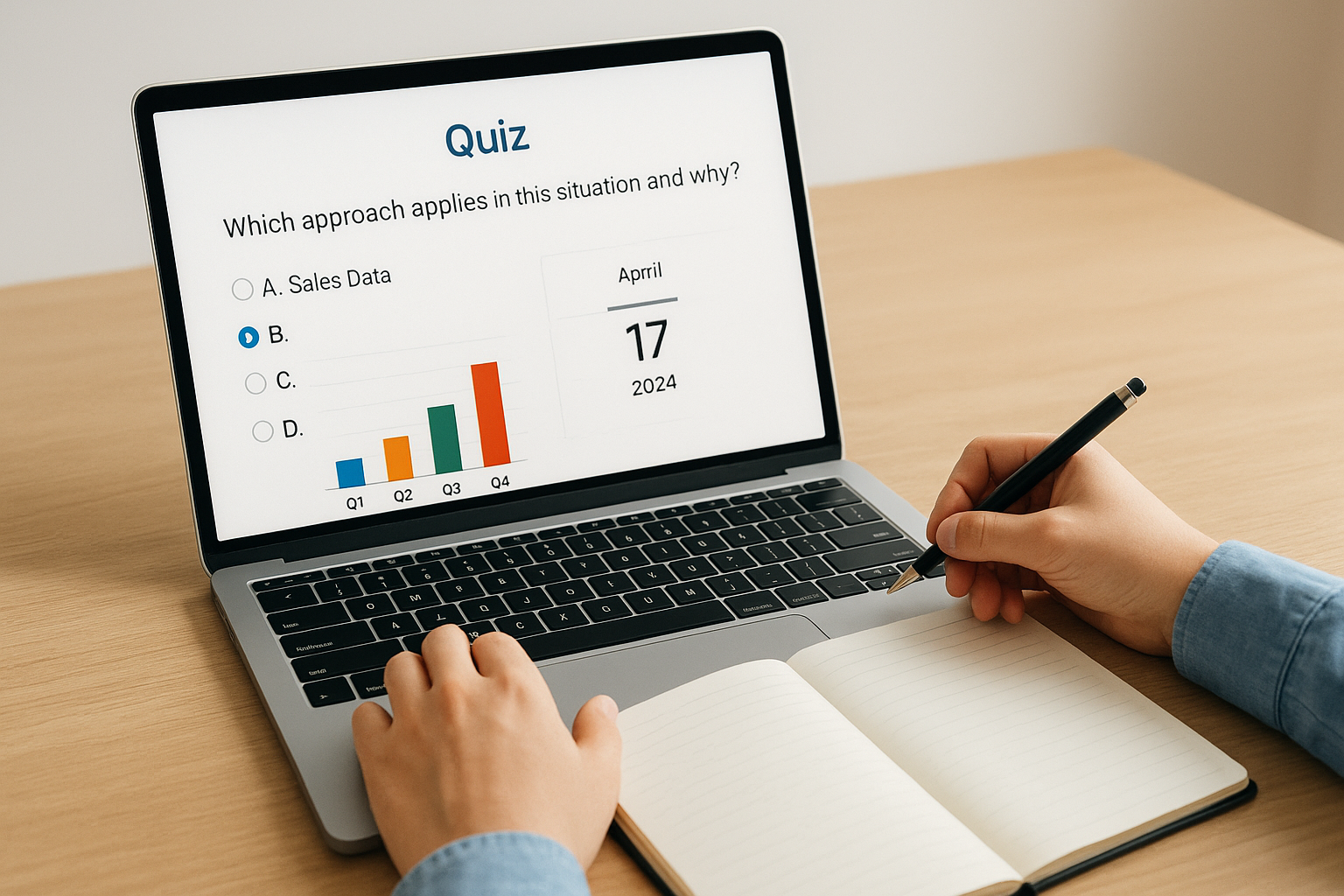
Replace "What is the definition of X?" with "Given this situation, which approach applies and why?" Applied questions demand reasoning, not memory retrieval, so copying a definition from a search engine won’t help a learner select or justify the right answer.
How to use scenarios that match your workplace context
Build scenarios around your specific processes, tools, and team structures. A question referencing your company’s approval workflow or internal terminology has no answer on Google, making it genuinely difficult to cheat without real on-the-job knowledge.
Workplace-specific scenarios are among the strongest deterrents against search-based cheating because the answers simply don’t exist outside your organization.
How to use unique data, rotating values, and artifacts
Insert rotating numbers, dates, or case-specific variables into questions so each version produces a different correct answer. Attaching a screenshot, report excerpt, or diagram as a required reference adds another layer that a search engine can’t replicate.
How to mix objective items with short answers
Short-answer items force learners to produce a response rather than select one, which makes copying far harder to disguise. Mix two or three into each quiz alongside multiple-choice items.
How to grade in a way that discourages copied responses
Score short answers on reasoning quality and specificity, not just keywords. When learners know you’re evaluating their logic rather than checking for a single correct phrase, generic copied responses earn no credit.
6. Lower the incentive to cheat with better assessment design
When the entire grade rests on a single quiz, learners feel enormous pressure to perform, and that pressure increases the temptation to cut corners. Spreading assessment across multiple lower-stakes touchpoints reduces that pressure and gives you a more accurate picture of what each learner actually knows.
How to shift from high-stakes quizzes to frequent check-ins
Replace one large end-of-course exam with several shorter quizzes spaced throughout the training. When each quiz carries less weight, the incentive to cheat drops significantly because no single attempt determines whether someone passes or fails.
How to scaffold work so you can see progress over time
Build assessments that build on each other sequentially, requiring learners to apply earlier knowledge before moving forward. This progression makes it obvious when someone skips steps, since later work won’t hold up without genuine understanding of earlier content.
Scaffolded assessments make cheating visible because inconsistent performance across connected tasks flags itself automatically.
How to add short explanations, reflections, or justifications
Ask learners to briefly explain their reasoning after selecting an answer or completing a task. A copied or guessed response rarely comes with a coherent justification, so this small addition strengthens the validity of every scored item in your quiz.
How to use discussions and group work without inviting copying
Assign group tasks where each member submits an individual reflection on their specific contribution. This structure rewards collaboration without allowing one person’s work to substitute for another’s.
How to set clear rules for collaboration and tool use
Publish a written policy stating exactly what resources learners may use, when collaboration is permitted, and what constitutes a violation. Knowing the rules in advance is one of the most direct ways to prevent cheating in online quizzes, because removing ambiguity removes the easiest excuse.
Quick recap and next steps
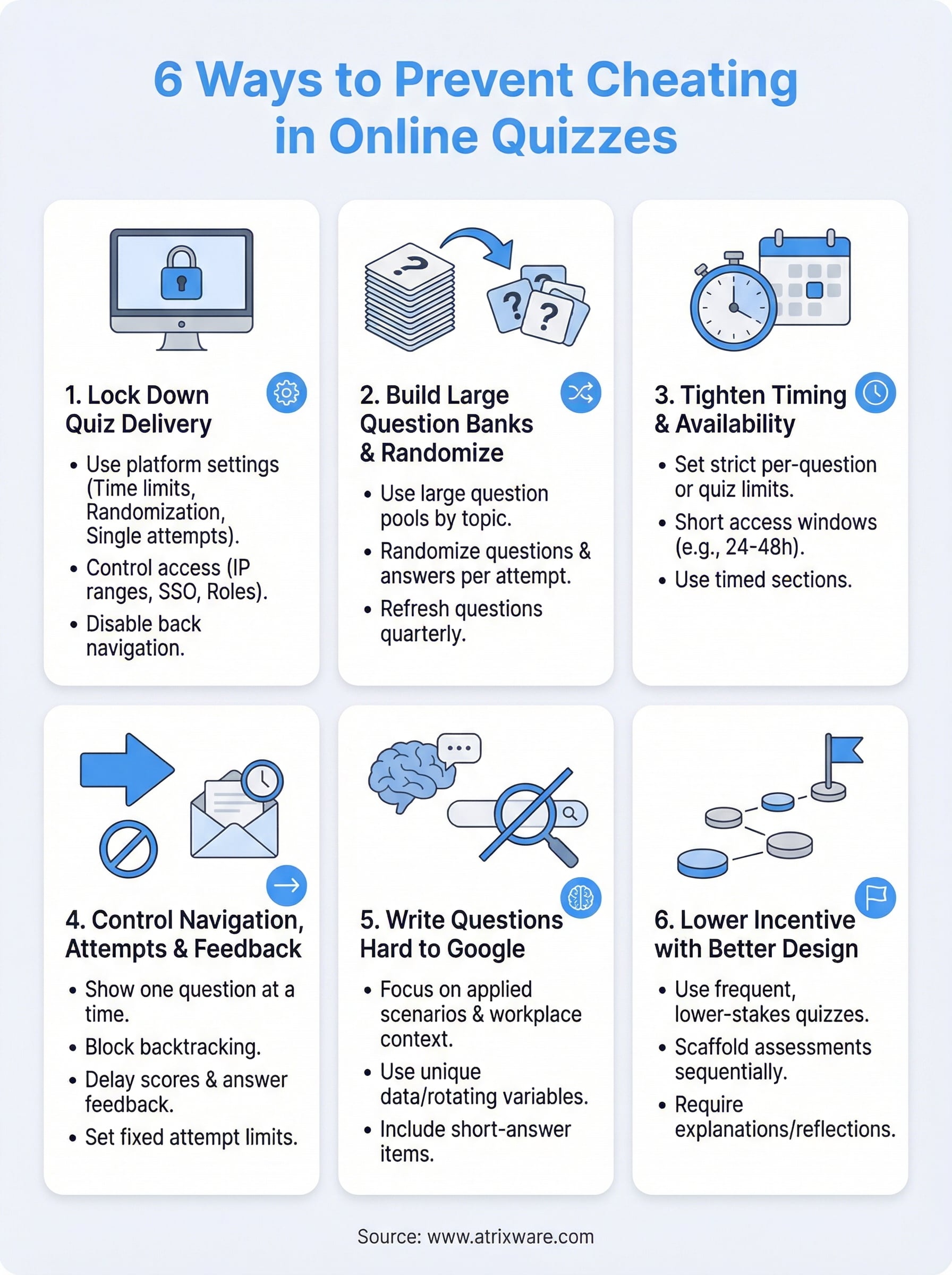
Preventing dishonesty in digital assessments doesn’t require a single silver bullet. Combining platform-level controls, smart question design, and thoughtful assessment structure is the most reliable approach to how to prevent cheating in online quizzes. Each of the six methods in this article works on its own, but they’re most effective when you layer them together: tight timing reinforces randomized question banks, and a clear written policy backs up every technical setting you configure.
Your next move is to audit your current quiz setup against the strategies above and identify the quickest gaps to close. Start with your platform settings, since those changes take minutes and deliver immediate impact. From there, work through your question bank, your feedback timing, and your overall assessment structure. If you’re not sure whether your current LMS can support these controls, take the Axis LMS readiness quiz to find out where you stand and what to do next.
