Choosing an enterprise LMS platform is one of those decisions that touches every corner of your organization, from onboarding and compliance to customer education and revenue-generating training programs. Get it right, and you unlock scalable learning that actually drives performance. Get it wrong, and you’re stuck with a system nobody wants to use, burning budget on workarounds and manual processes.
The problem isn’t a lack of options. It’s the opposite. There are dozens of platforms competing for your attention, each claiming to be the most intuitive, the most powerful, the most everything. Cutting through that noise requires a clear look at what each platform actually delivers, the features, the integrations, the reporting, and the flexibility to grow with your business. That’s exactly what this comparison is built to do.
We put together this list of 12 enterprise LMS platforms worth evaluating in 2026, and yes, our own product, Axis LMS, is on it. We’ve spent years building a system designed to handle everything from compliance tracking to e-commerce-based training sales, so we know what separates a capable LMS from one that just checks boxes. That firsthand experience shaped how we evaluated every platform on this list, fairly, and with the details that actually matter to the people making the decision.
1. Axis LMS
Axis LMS is Atrixware’s flagship enterprise lms platform, built for organizations that need more than a basic course library. It handles employee training, customer education, compliance tracking, and revenue-generating training programs within a single system. If your business spans multiple training audiences or carries strict compliance requirements, Axis LMS is designed with that complexity in mind.

What Axis LMS is best for
This platform fits businesses of all sizes that need a flexible, scalable training solution without a bloated administrative experience. It works especially well for organizations running compliance-heavy programs, scaling onboarding, delivering customer education, or training channel partners. It also supports companies that want to sell training directly to external learners through built-in e-commerce tools.
Standout features for enterprise training
The platform gives you a drag-and-drop course builder that lets your team move fast without sacrificing quality. You also get virtual classroom support, automated workflow tools, and extensive branding controls that match the learner interface to your organization’s identity. These aren’t surface-level options; they’re built into the core product.
The combination of rapid course building and deep customization makes Axis LMS a strong fit for teams that need to launch training quickly without looking generic.
Integrations, API, and SSO options
Axis LMS connects with over 5,000 systems through its Integration Builder, including Salesforce, Zoho, ADP, and BambooHR. The platform supports a REST API and webhooks for custom integrations and real-time data sync. For single sign-on, you get native SAML SSO support across Okta, Azure, Salesforce, and Ping Identity.
Compliance, security, and audit readiness
Built-in support covers GDPR and FDA 21 CFR Part 11 requirements, making Axis LMS a reliable option for regulated industries. It tracks CEUs and re-certifications automatically, and configurable security settings give your IT team control over access and data handling. The platform also maintains automated backups and data redundancy.
Reporting and analytics depth
You get both on-demand and scheduled automated reports covering learner progress, completion rates, and training effectiveness. Reports are built to give administrators clear, actionable data without requiring custom development work or manual log-ins to pull results.
Pricing and licensing approach
Atrixware structures pricing around your organization’s specific scale and use case, so you won’t find a one-size-fits-all tier chart. You can offer individual course purchases or B2B seat licenses through the built-in e-commerce functionality. Pricing is available directly from Atrixware by contacting their team.
2. Docebo
Docebo is a cloud-based enterprise lms platform built around AI-driven personalization. It targets mid-to-large organizations that want to reduce manual administration while delivering tailored learning experiences across multiple audiences from one system.
What Docebo is best for
Docebo fits large enterprises and global organizations that need to train employees, partners, and customers simultaneously. It works well for companies that prioritize personalized learning paths and want social learning capabilities baked into their platform.
Standout features for enterprise training
The platform’s AI-powered content recommendations adjust what each learner sees based on role and behavior. You also get skills mapping, a built-in content marketplace, and social learning tools that support peer-driven knowledge sharing across your organization.
Docebo’s AI engine genuinely separates it from more rigid platforms when you’re managing large, diverse learner populations.
Integrations, API, and SSO options
Docebo connects with Salesforce, Workday, and BambooHR, along with a broad range of CRM and HR tools. It offers a REST API for custom builds and supports SAML-based SSO for enterprise identity providers.
Compliance, security, and audit readiness
The platform holds ISO 27001 certification and provides configurable access controls. Its compliance tooling is functional but less specialized than platforms designed specifically for regulated industries like life sciences or financial services.
Reporting and analytics depth
Reporting covers learner engagement, completion rates, and learning impact data. Custom dashboards are available, though advanced analytics features are locked behind higher-tier subscription plans.
Pricing and licensing approach
Docebo uses custom enterprise pricing based on user volume and selected features. No public pricing is listed, so you need to contact their sales team directly for a quote.
3. D2L Brightspace
D2L Brightspace is an enterprise lms platform with strong roots in both higher education and corporate learning. It targets organizations that want deep instructional design flexibility combined with robust data tools, particularly those managing complex blended learning programs at scale.
What D2L Brightspace is best for
Brightspace works best for large organizations and extended enterprises that run sophisticated training programs requiring detailed curriculum design. It’s a solid pick for companies whose training managers come from an instructional design background and want granular control over learning paths and assessments.
Standout features for enterprise training
The platform offers adaptive learning tools that adjust course content based on individual learner performance, along with video-based learning and competency tracking built directly into the course structure. Its accessibility compliance features stand out for organizations with legal obligations around inclusive design.
Brightspace’s adaptive learning engine makes it a practical choice when you need to serve learners with vastly different skill levels within the same program.
Integrations, API, and SSO options
Brightspace supports SAML SSO and LTI integrations, along with connections to HR and productivity tools through its API. It works with Microsoft and Google ecosystem tools, which matters when your organization already runs on one of those stacks.
Compliance, security, and audit readiness
The platform maintains SOC 2 Type II certification and supports WCAG 2.1 accessibility standards. Its audit trail features cover completion records and assessment data, which helps regulated industries meet basic documentation requirements.
Reporting and analytics depth
D2L provides Brightspace Insights, a dedicated analytics layer that visualizes learner engagement and performance trends. You can track at-risk learners and course effectiveness without exporting raw data to a third-party tool.
Pricing and licensing approach
D2L does not publish standard pricing. Enterprise contracts are negotiated directly based on user count, features, and implementation scope, so you need to contact their sales team for a custom quote.
4. Cornerstone OnDemand
Cornerstone OnDemand is a mature enterprise lms platform with a long track record in large organizations. It covers talent management, learning, and performance in a unified suite, making it a common choice for HR-led teams looking to connect training directly to workforce development goals.
What Cornerstone OnDemand is best for
Cornerstone fits large enterprises running integrated talent strategies where learning, performance reviews, and succession planning need to share data. Organizations with dedicated HR and L&D teams that want a single system to manage the full employee lifecycle will find the most value here.
Standout features for enterprise training
The platform gives you skills-based learning recommendations tied to job roles and career paths. You also get a content marketplace with thousands of ready-made courses, plus tools for virtual instructor-led training and blended program management.
Cornerstone’s skills framework is one of the more developed options on the market if workforce planning is a core part of your training strategy.
Integrations, API, and SSO options
Cornerstone supports SAML SSO and REST API access, along with pre-built connections to major HRIS platforms like Workday and SAP SuccessFactors. Its integration depth reflects years of enterprise deployment across complex IT environments.
Compliance, security, and audit readiness
The platform maintains SOC 2 Type II compliance and offers configurable role-based access controls. Regulated industries get audit trail functionality and certification tracking, though setup requires dedicated administrative effort.
Reporting and analytics depth
Cornerstone provides workforce analytics dashboards that connect learning activity to performance and retention data, giving HR leaders visibility beyond basic completion metrics.
Pricing and licensing approach
Cornerstone uses custom enterprise pricing negotiated based on user volume and modules selected. No public rates are available, so you contact their sales team for a quote.
5. SAP Litmos
SAP Litmos is a cloud-based enterprise lms platform designed for fast deployment and straightforward administration. It targets companies that need to get training running quickly without months of configuration work, and it draws on SAP’s broader ecosystem for organizations already invested in that stack.
What SAP Litmos is best for
SAP Litmos suits mid-to-large businesses that prioritize speed to launch over deep customization. It works well for customer training and sales enablement programs where simplicity and branded learner portals matter more than complex instructional design workflows.
Standout features for enterprise training
The platform includes a pre-built content library with hundreds of ready-to-use courses covering compliance, leadership, and professional skills. You also get automated learning path assignments based on user roles, which cuts down on manual admin work when onboarding large groups.
Litmos’s out-of-the-box content library gives teams a practical shortcut when they need compliant training delivered fast without building everything from scratch.
Integrations, API, and SSO options
Litmos connects natively with SAP SuccessFactors and Salesforce, along with HRIS and CRM tools through its API. It supports SAML-based SSO, which covers most enterprise identity provider requirements.
Compliance, security, and audit readiness
The platform carries SOC 2 Type II certification and supports GDPR compliance requirements. Audit trails cover course completions and certification records, giving compliance officers a clear documentation path.
Reporting and analytics depth
Litmos delivers standard completion and engagement reports through its dashboard. Deeper analytics require exporting data or connecting to a third-party BI tool.
Pricing and licensing approach
SAP Litmos uses tiered subscription pricing based on user count and feature access. You need to contact their sales team for exact enterprise rates.
6. Absorb LMS
Absorb LMS is a cloud-based enterprise lms platform built for organizations that want a clean, modern learner experience backed by strong administrative tools. Its design prioritizes ease of use for both administrators and learners, which makes it a practical option when adoption is as important as capability.
What Absorb LMS is best for
Absorb works best for mid-to-large organizations focused on employee training and extended enterprise programs. It fits companies that want a polished learner interface without spending months on configuration, particularly when learner engagement and course completion rates are top priorities.
Standout features for enterprise training
The platform includes an AI-powered course recommendation engine that surfaces relevant content based on each learner’s role and history. You also get a built-in content library and tools for instructor-led training management, which covers scheduling, enrollment, and virtual session tracking in one place.
Absorb’s learner-first interface consistently drives higher completion rates compared to platforms with more complex navigation structures.
Integrations, API, and SSO options
Absorb supports SAML SSO and a REST API for connecting to your existing HR and CRM systems. Pre-built connectors cover tools like Salesforce and BambooHR, reducing the custom development work your IT team needs to handle.
Compliance, security, and audit readiness
The platform holds SOC 2 Type II certification and supports GDPR requirements. Certification tracking and automated re-enrollment rules give compliance officers a reliable documentation trail without manual follow-up.
Reporting and analytics depth
Absorb delivers visual dashboards and scheduled automated reports covering completion, engagement, and learner progress. Most reporting needs are met within the platform without requiring a separate BI tool.
Pricing and licensing approach
Absorb uses custom pricing based on your user volume and selected feature set. You contact their sales team directly for a quote tailored to your organization’s scale.
7. Moodle Workplace
Moodle Workplace is an open-source enterprise lms platform built on the widely-used Moodle core, but extended with features designed specifically for corporate training. It gives organizations the flexibility of open-source software with a layer of workplace-focused tools on top, making it appealing for teams that want control over their learning environment.

What Moodle Workplace is best for
Moodle Workplace fits IT-savvy organizations that want to self-host or work with a Moodle Partner for a managed deployment. It works well for companies with existing Moodle familiarity or those in sectors like government, education-adjacent industries, and nonprofits where open-source tools are a strategic priority.
Standout features for enterprise training
The platform provides multi-tenancy support, letting you run separate training environments for different departments or business units from a single installation. You also get dynamic rules for automated enrollment and certification management, which reduces repetitive administrative tasks across large learner groups.
Moodle Workplace’s multi-tenancy capability makes it a practical option when your organization needs to serve distinct learner audiences without managing multiple separate systems.
Integrations, API, and SSO options
Moodle Workplace supports SAML SSO and a REST API, along with a plugin-based integration ecosystem that covers HR, productivity, and content tools. Integration depth depends on your deployment setup and available plugins.
Compliance, security, and audit readiness
The platform supports GDPR compliance and configurable role-based access controls. Audit trail depth varies depending on your hosting configuration and installed plugins.
Reporting and analytics depth
Moodle Workplace delivers custom report builder tools covering completions, learner progress, and certification status. Advanced analytics typically require a third-party tool or additional plugin.
Pricing and licensing approach
Moodle Workplace is free as open-source software, but most organizations pay Moodle Partners for hosting, implementation, and support. Total cost depends heavily on your deployment scale and support requirements.
8. LearnUpon
LearnUpon is a cloud-based enterprise lms platform built around delivering training to multiple audiences simultaneously. It targets mid-to-large businesses that need to train employees, partners, and customers from one centralized system without juggling separate tools for each group.
What LearnUpon is best for
LearnUpon fits organizations running extended enterprise training programs across multiple audiences. It works particularly well for customer education, partner enablement, and internal onboarding when you want a consistent experience delivered from a single platform without heavy administrative overhead.
Standout features for enterprise training
The platform provides multi-portal functionality that lets you run distinct branded training environments for different learner groups from one account. You also get gamification tools and automated learning path enrollment, which reduces manual setup when you’re scaling training across a large user base.
LearnUpon’s multi-portal setup is a practical advantage when your organization trains both internal employees and external partners but needs to keep those experiences completely separate.
Integrations, API, and SSO options
LearnUpon connects with Salesforce, BambooHR, and Workday, and supports a REST API for custom integrations. SAML-based SSO covers most enterprise identity provider requirements without additional configuration work from your IT team.
Compliance, security, and audit readiness
Compliance coverage includes SOC 2 Type II certification and GDPR support. Completion records and automated certification tracking give your compliance team a reliable audit trail without manual follow-up.
Reporting and analytics depth
Built-in dashboards cover enrollment activity, completion rates, and learner progress in a straightforward format. Deeper analysis requires exporting data to a third-party business intelligence tool.
Pricing and licensing approach
Pricing follows tiered subscription plans based on active user count. Enterprise-scale rates require direct contact with their sales team for a custom quote.
9. 360Learning
360Learning is a collaborative enterprise lms platform that centers its entire approach around peer-driven learning. Rather than pushing top-down content creation, it gives subject matter experts inside your organization tools to build and share courses directly with their colleagues.

What 360Learning is best for
360Learning fits companies that want to capture internal knowledge and turn it into structured training fast. It works particularly well for organizations where frontline employees or team leads hold practical expertise that formal L&D teams lack the bandwidth to document and scale on their own.
Standout features for enterprise training
The platform lets internal experts author courses in minutes using a guided creation interface, cutting the time between identifying a training need and delivering a solution. Collaborative learning tools also allow learners to flag gaps, ask questions, and improve course content through direct feedback loops.
360Learning’s collaborative authoring model shortens the distance between what your teams know and what gets formally trained, which traditional top-down LMS platforms struggle to replicate.
Integrations, API, and SSO options
360Learning supports SAML SSO and a REST API for connecting to your HR and CRM stack. It includes integrations with tools like Salesforce and BambooHR, reducing manual data entry across systems.
Compliance, security, and audit readiness
The platform provides GDPR-compliant data handling and role-based access controls. Audit trail features cover completion records and learner activity, meeting baseline requirements for most corporate compliance programs.
Reporting and analytics depth
Built-in dashboards track course completion, learner engagement, and content quality ratings. Peer feedback metrics add a dimension most standard reporting tools skip entirely.
Pricing and licensing approach
360Learning charges per active user on a monthly basis, with enterprise plans available through direct negotiation with their sales team.
10. Adobe Learning Manager
Adobe Learning Manager, formerly known as Adobe Captivate Prime, is a cloud-based enterprise lms platform that fits naturally into organizations already using Adobe’s broader product ecosystem. It targets companies that want polished content delivery tied to skill development and personalized learning experiences at scale.
What Adobe Learning Manager is best for
Adobe Learning Manager works best for content-forward organizations that produce high-quality training materials and want a platform built to showcase them. It suits enterprises already invested in Adobe’s Creative Cloud and analytics tools, where tight product integration adds immediate practical value.
Standout features for enterprise training
The platform’s Fluidic Player supports a wide range of content formats, from video and PDF to SCORM and xAPI packages, without requiring format conversion. You also get AI-driven skill recommendations that surface relevant learning based on each learner’s role and progress history.
Adobe Learning Manager’s multi-format content support gives L&D teams flexibility to deliver training in whatever format their subject matter experts produce without additional processing steps.
Integrations, API, and SSO options
The platform connects with Salesforce and Workday, and supports a REST API for custom integrations. SAML-based SSO covers standard enterprise identity provider requirements across your organization.
Compliance, security, and audit readiness
Adobe Learning Manager provides GDPR-compliant data handling and role-based access controls. Completion records and certification tracking meet baseline documentation requirements for most corporate compliance programs.
Reporting and analytics depth
Built-in dashboards cover learner progress, completion rates, and skill gap data. Deeper reporting leverages Adobe’s analytics integrations for teams that need more granular performance visibility.
Pricing and licensing approach
Adobe Learning Manager uses custom enterprise pricing based on your user volume and selected features. You contact their sales team directly for a quote.
11. TalentLMS
TalentLMS is a cloud-based enterprise lms platform known for its simplicity and fast setup. It targets small-to-mid-sized businesses and growing enterprises that need a capable training system without a steep learning curve or heavy IT involvement.
What TalentLMS is best for
TalentLMS fits organizations that want a straightforward, capable LMS without sacrificing core functionality. It works well for employee onboarding, compliance training, and skills development programs that need to launch quickly and run with minimal administrative overhead.
Standout features for enterprise training
The platform gives you a branch-based structure for managing multiple teams, departments, or business units from one account. You also get gamification tools and built-in course authoring that lets your team create training content directly inside the platform without switching tools.
TalentLMS’s branch structure makes it practical for organizations managing distinct learner groups under one administrative roof without the complexity of full enterprise multi-tenancy setups.
Integrations, API, and SSO options
TalentLMS connects with Salesforce, BambooHR, and Zapier, and supports a REST API for custom integrations. SAML-based SSO covers standard identity provider requirements including Okta and Azure Active Directory.
Compliance, security, and audit readiness
The platform supports GDPR compliance and provides role-based access controls. Completion records and certification tracking cover documentation requirements for most standard corporate compliance programs without significant configuration work.
Reporting and analytics depth
Built-in reports track learner progress, completion rates, and course performance through a clean dashboard. More advanced analysis requires exporting data or connecting to a third-party BI tool.
Pricing and licensing approach
TalentLMS offers tiered subscription plans at accessible price points for smaller organizations, with enterprise pricing available through direct contact with their sales team for larger deployments.
12. CYPHER Learning
CYPHER Learning is a cloud-based enterprise lms platform that combines AI-driven personalization with rule-based automation tools. It targets businesses and organizations that want to reduce manual training administration while delivering adaptive learning experiences tailored to each learner’s role and performance history.
What CYPHER Learning is best for
This platform fits mid-to-large organizations that want intelligent automation capable of adapting content and learning paths without constant administrator intervention. It works particularly well for teams running blended learning programs that mix self-paced content with instructor-led sessions across multiple departments.
Standout features for enterprise training
An AI engine drives personalized learning paths based on each learner’s behavior, performance, and role. You also get a competency-based learning framework that ties course completions directly to measurable skills and business outcomes rather than tracking seat time alone.
CYPHER Learning’s competency-based approach gives L&D teams a practical way to connect training activity to workforce performance without custom reporting workarounds.
Integrations, API, and SSO options
CYPHER Learning supports SAML-based SSO and a REST API for connecting to your existing HR and CRM tools. Standard integrations cover Salesforce and Zoom, reducing the setup time your IT team needs to get the platform running within your current tech stack.
Compliance, security, and audit readiness
The platform provides GDPR-compliant data handling and configurable role-based access controls. Completion records and certification tracking meet standard documentation requirements for most corporate compliance programs.
Reporting and analytics depth
Built-in dashboards track learner progress, completion rates, and skills development across your organization. Advanced reporting needs typically require exporting data to a third-party analytics tool.
Pricing and licensing approach
Pricing follows a custom model based on your organization’s size and selected features. You contact their sales team directly for a quote tailored to your deployment needs.
Final takeaways
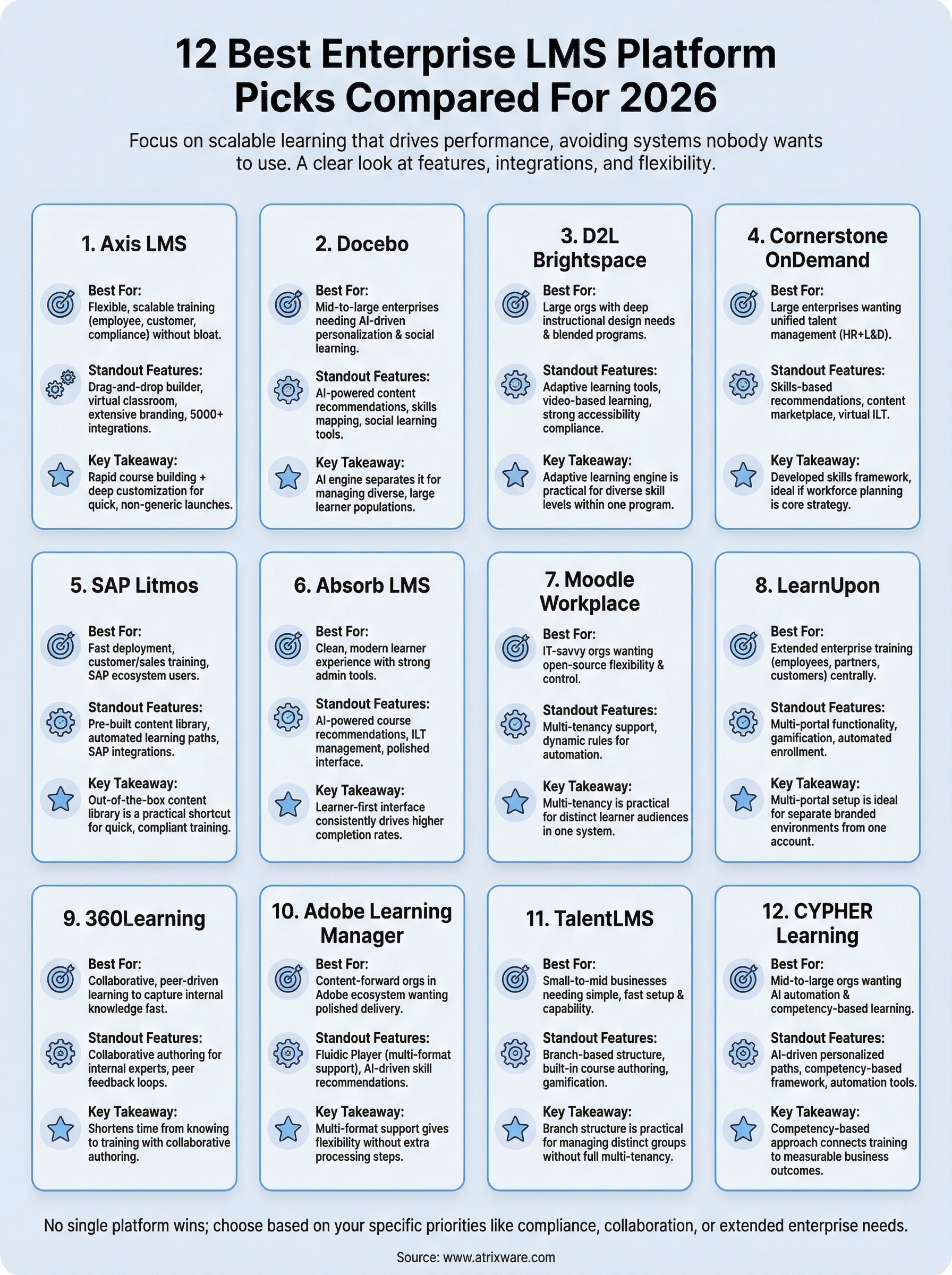
No single enterprise lms platform wins across every category. The right choice depends on your organization’s specific training priorities, whether that’s deep compliance tracking, collaborative content creation, extended enterprise programs, or full integration with your existing HR and sales tools. Each platform on this list handles certain requirements better than others, and the differences become clear fast once you map features against your actual use cases.
If you need a scalable system that handles compliance, e-commerce, and multi-audience training without requiring a complex implementation project, Axis LMS is worth a close look. It gives you the administrative control and learner experience that most organizations need without the overhead that comes with larger talent suite platforms. Before you start comparing demos, it helps to know where you actually stand in the buying process. Take the LMS readiness quiz to get a clearer picture of what your organization needs next.
