Choosing where to buy LMS software can feel overwhelming when dozens of vendors are competing for your attention, each claiming to be the best fit for corporate training. The reality is that every organization has different priorities, whether that’s compliance tracking, e-commerce capabilities, scalability, or ease of use. A wrong pick means wasted budget and frustrated learners.
We built Axis LMS at Atrixware to solve exactly these challenges, so we know what separates a great platform from a mediocre one. That hands-on experience gives us a sharp perspective on what matters when you’re evaluating your options. Still, we believe you should compare before you commit, and an informed buyer is our best customer.
This guide breaks down 12 of the best places to buy LMS software for corporate training. For each option, you’ll find a look at core features, strengths, and ideal use cases so you can match the right platform to your organization’s specific training goals and budget.
1. Axis LMS by Atrixware
Axis LMS is the platform we built at Atrixware specifically for businesses that need a flexible, scalable training solution without the complexity that slows down larger enterprise systems. It runs on a cloud-based infrastructure designed to grow with your organization, whether you have 50 learners or 50,000.

What it is
Axis LMS is a full-featured learning management system built for corporate use. It handles everything from course creation and delivery to compliance tracking and e-commerce, all within a single platform. The drag-and-drop course builder means your training team can launch new content fast, without waiting on developers or outside vendors to make it happen.
Best for
Axis LMS fits organizations that need broad training capabilities across multiple use cases without juggling several different tools. It works particularly well for:
- Employee onboarding and ongoing development for teams of any size
- Compliance training with built-in tracking for standards like GDPR and FDA 21 CFR Part 11
- Customer and partner training delivered through a branded learner portal
- Selling training directly to individuals or businesses through built-in e-commerce tools
If your organization needs to consolidate compliance, sales enablement, and internal development training under one roof, Axis LMS is a strong match.
Standout features for corporate training
Axis LMS gives you a reporting suite that delivers on-demand and automated reports so you always know exactly where each learner stands. The platform also includes robust communication and collaboration tools, real-time notifications, and learner engagement features that keep training from becoming a passive checkbox exercise.
The integration library connects Axis LMS to over 5,000 systems, including HR platforms like ADP and BambooHR, CRMs like Salesforce and Zoho, and SSO providers like Okta and Azure Active Directory.
Beyond integrations, the branding and UI customization options let you build a learner experience that reflects your organization’s identity. You can configure the interface around your colors, logo, and navigation structure, which matters for both internal adoption and professional credibility when you are training customers or channel partners externally.
Pricing and how to buy
Atrixware offers tiered pricing plans based on the number of active learners and the features your training program requires. You can request a demo directly on the Atrixware website to see the platform in action before committing. For teams that want to buy LMS software with clear implementation support from day one, Atrixware also provides onboarding assistance and custom integration services for connecting Axis LMS to your existing systems.
Pricing is transparent and scalable, meaning you are not locked into a rigid contract that does not match your actual usage. Small businesses can start with a plan that fits a limited learner count, then expand the platform as their training needs develop over time.
2. TalentLMS
TalentLMS is a cloud-based learning management system developed by Epignosis. It has earned a solid reputation among small to mid-sized businesses that want to get training programs up and running fast, without dedicating weeks to configuration or relying on outside technical support.
What it is
The platform centers on a clean, drag-and-drop course builder that supports SCORM, xAPI, video, and quiz-based content. Administrators can build and publish courses in hours rather than days, and the cloud-hosted setup means your IT team does not need to manage servers, updates, or maintenance on the backend.
Best for
TalentLMS works best for growing companies that need a practical training solution without a heavy learning curve. It fits organizations that want to prioritize speed of deployment over deep customization, especially for internal employee training, onboarding, and straightforward compliance programs.
- Employee onboarding and skills development
- Basic compliance training for smaller teams
- Organizations building their first structured online training program
Standout features for corporate training
The platform includes gamification elements like points, badges, and leaderboards that help drive learner engagement without requiring extra tools. You can also run blended learning programs that pair online courses with instructor-led sessions, making it a workable option for teams that still combine digital and in-person training formats.
TalentLMS offers a free plan that supports up to 5 users and 10 courses, which gives you a genuine opportunity to test the platform before you buy LMS software and commit to a paid tier.
Pricing and how to buy
TalentLMS uses a tiered subscription structure based on registered users, with plans scaling up in both user capacity and available features. Paid tiers unlock custom domain support, advanced reporting, and priority customer support, while annual billing brings the per-month cost down compared to paying monthly. Pricing is listed publicly on the TalentLMS website, which makes it easy to build a budget estimate before reaching out to their sales team.
3. Litmos
Litmos is a cloud-based LMS owned by SAP that focuses on corporate compliance and employee training at scale. Large organizations use it to handle high learner volumes without sacrificing administrative control or reporting visibility across departments.
What it is
The platform combines a course authoring tool with a ready-to-use content library, giving training teams both a creation environment and pre-built material under one subscription. It supports SCORM and xAPI standards, video-based learning, and automated workflows for assigning and tracking course completions across large workforces with minimal manual effort.
Best for
Litmos suits mid-size to enterprise organizations that prioritize compliance training and need a platform capable of handling regulatory documentation and audit trails reliably. It works well for the following use cases:
- Compliance-heavy industries like healthcare, finance, and manufacturing
- Organizations that want pre-built content alongside custom course creation
- HR teams managing training across multiple departments or global locations
Standout features for corporate training
The built-in course library includes hundreds of pre-built courses covering topics like workplace safety, leadership development, and HR compliance. That ready-made content cuts the time it takes to launch a structured training program from scratch, which matters when you are rolling out training to a large workforce quickly. You also get automated learner paths, real-time reporting dashboards, and mobile-ready delivery so employees can complete training from any device without friction.
If your organization needs audit-ready compliance tracking with minimal setup time, Litmos gives you a strong foundation without requiring heavy customization work upfront.
Pricing and how to buy
SAP does not publish standard Litmos pricing publicly, which means you need to contact their sales team directly to get a quote based on your learner count and required feature set. When you are ready to buy LMS software at an enterprise scale, that custom pricing model lets you negotiate terms that match your actual deployment size and contract length. Demos are available through the Litmos website so you can evaluate the platform before committing to a contract.
4. Absorb LMS
Absorb LMS is a cloud-based learning management system built to deliver a polished experience for both learners and administrators. The platform targets mid-size to enterprise organizations that need a scalable, ready-to-deploy system without sacrificing usability on either side of the training equation.
What it is
The platform gives training teams a centralized hub for building, delivering, and tracking online courses across an entire organization. It supports SCORM, xAPI, and video-based content, and its interface is designed to make course navigation intuitive for learners at every technical skill level. Administrators get a clean dashboard that consolidates enrollment, reporting, and learner management in one place rather than jumping between separate tools.
Best for
Absorb LMS fits organizations that want a professional, feature-complete platform that does not require months of setup work before your first training launches. It performs particularly well for:
- Mid-size and enterprise companies scaling up employee and partner training
- Organizations managing multi-language training programs for global workforces
- HR and L&D teams that need both internal and external training delivery from a single system
Standout features for corporate training
The platform includes an AI-powered course recommendation engine that surfaces relevant content to learners based on their role and training history, which cuts the time managers spend manually assigning courses. Absorb also offers a built-in e-commerce module, so organizations selling training externally can handle it without bolting on a separate tool. Reporting covers individual learner progress as well as department-level summaries, giving compliance teams and HR managers the data visibility they need without building custom reports from scratch.
Absorb LMS connects with major HR and CRM platforms including Salesforce and BambooHR, so learner data stays synced across your systems without manual entry.
Pricing and how to buy
Absorb LMS does not list standard pricing publicly, which means you contact their sales team directly for a quote based on your learner volume and feature requirements. If you are ready to buy LMS software at a mid-market or enterprise scale, that custom pricing model lets you negotiate terms that match your actual deployment size. Demos are available through the Absorb LMS website before you commit.
5. Docebo
Docebo is an AI-powered learning management system built for large enterprises that need to deliver training at scale across employees, customers, and partners. The platform combines deep automation capabilities with a learner experience that adapts to individual behavior, making it one of the more sophisticated options in the corporate LMS market.
What it is
Docebo positions itself as an enterprise learning platform rather than a standard LMS. The system uses AI to personalize content delivery, automate administrative tasks, and surface learning recommendations based on each user’s role and activity.
It supports SCORM, xAPI, and video-based content, and its multi-audience architecture lets you run separate training programs for internal employees and external customers from a single platform without duplicating your administrative work.
Best for
Docebo fits large enterprises and fast-growing companies that need a scalable platform capable of handling complex, multi-audience training programs without heavy manual oversight. It works well for:
- Organizations delivering employee, customer, and partner training from one system
- Companies that need AI-driven personalization at scale
- Enterprises managing training across multiple regions or languages
Standout features for corporate training
The platform’s AI engine, called Docebo Shape, automatically converts raw content like videos, documents, and web pages into structured learning modules, which cuts the time your team spends building courses manually. Docebo also includes robust analytics dashboards that connect learning activity to business outcomes, giving L&D teams concrete data to justify training investments to leadership.
Docebo integrates with Salesforce, Workday, and other enterprise systems, so learner data flows directly into the tools your HR and sales teams already rely on.
Pricing and how to buy
Docebo does not publish standard pricing publicly. When you are ready to buy LMS software at an enterprise level, contact their sales team for a custom quote based on your active learner count and required features.
Demos are available through the Docebo website, and the sales team typically walks you through a tailored platform tour before asking you to commit to any contract terms.
6. 360Learning
360Learning is a collaborative learning platform that takes a different approach from most traditional LMS vendors. Rather than pushing content down from administrators to learners, it puts subject matter experts inside your organization in the driver’s seat for course creation and ongoing content improvement.
What it is
360Learning combines standard LMS functionality with collaborative course authoring tools that let your internal experts build and update training content without needing a dedicated instructional design team. The platform supports video, quizzes, SCORM content, and discussion-based learning, all wrapped in an interface that encourages ongoing feedback loops between learners and course creators after every training session.
Best for
360Learning fits organizations that rely on internal knowledge sharing as a core part of their training strategy. It works well for:
- Companies where subject matter experts need to create and maintain training content on a regular basis
- Organizations building peer-to-peer learning programs alongside traditional top-down training delivery
- Businesses in fast-moving industries where training content needs frequent updates without waiting on external content teams or agencies
Standout features for corporate training
The platform’s standout capability is its collaborative course creation workflow, which routes feedback from learners directly back to course authors so content improves continuously over time. 360Learning also includes learning program analytics that track completion rates, learner engagement scores, and content effectiveness across your entire workforce without requiring a separate reporting tool.
If your training program depends on keeping internal knowledge current and accessible, 360Learning’s collaborative model cuts the lag between what employees know and what actually lives inside your LMS.
Pricing and how to buy
360Learning publishes a Team plan starting at $8 per registered user per month, which covers up to 100 users and includes core course creation and learner management features. Larger organizations looking to buy LMS software for enterprise-scale deployments contact the sales team directly for a custom quote based on learner volume and integration requirements. A demo is available through the 360Learning website before you sign a contract.
7. LearnUpon
LearnUpon is a cloud-based LMS designed specifically for businesses that need to train multiple audiences from a single platform. The company built the system with customer, partner, and employee training in mind simultaneously, which sets it apart from platforms that focus narrowly on internal learning programs.
What it is
LearnUpon gives training teams a centralized platform for building, managing, and delivering courses across distinct learner groups without requiring separate systems for each audience. It supports SCORM, xAPI, video, and webinar-based content, and its portal architecture lets administrators create separate branded environments for different learner audiences while managing everything from one admin dashboard.
Best for
LearnUpon fits organizations that need to run parallel training programs for different groups, such as internal employees and external customers, without building out separate LMS instances for each one. It works particularly well for:
- Companies managing employee onboarding alongside customer education programs
- Organizations that need multiple branded portals for different partners or client groups
- Mid-size businesses looking for a clean setup process with responsive customer support
Standout features for corporate training
The platform includes automated learner enrollment and course assignment rules that reduce the manual work involved in managing large training programs across multiple groups. LearnUpon also provides detailed reporting and completion tracking at both the individual learner level and the group level, so compliance managers and HR teams can pull the data they need without building custom report structures from scratch.
If keeping distinct learner audiences organized without overcomplicating your admin setup is a priority, LearnUpon’s portal structure handles that cleanly without requiring extra configuration work.
Pricing and how to buy
LearnUpon does not publish standard pricing on their website, so you contact their sales team for a quote based on your active user count and required features. When you are ready to buy LMS software for multi-audience training delivery, LearnUpon’s team will walk you through a demo and tailored pricing options before you commit to a plan.
8. Moodle Workplace
Moodle Workplace is the corporate-focused edition of the open-source Moodle platform, maintained by Moodle HQ. It takes the familiar Moodle foundation and layers on enterprise-grade features specifically built for workplace training, compliance management, and multi-organization deployments.

What it is
Moodle Workplace runs as a hosted or self-hosted learning management system that gives organizations full control over their training environment. Unlike the standard open-source Moodle build, Workplace includes a ready-to-use set of corporate training tools out of the box, so your team spends less time configuring plugins and more time delivering actual training. It supports SCORM, xAPI, and H5P content formats alongside instructor-led training management.
Best for
Moodle Workplace fits organizations that want open-source flexibility with built-in corporate features and are comfortable managing a more technical platform than most cloud-based LMS options. It works well for:
- Large organizations or government and education-adjacent enterprises that need full data control
- Companies with internal IT resources to manage hosting, customization, and ongoing maintenance
- Teams that need a highly customizable platform without paying per-user licensing fees at scale
Standout features for corporate training
The platform includes multi-tenancy support, which lets you run separate training environments for different departments, subsidiaries, or client groups from one central installation. Moodle Workplace also provides automated workflows for course completion, certification tracking, and role-based learning paths, giving compliance teams the documentation structure they need without manual overhead.
If your organization needs complete control over learner data storage and platform customization, Moodle Workplace gives you that flexibility without being locked into a proprietary vendor’s infrastructure.
Pricing and how to buy
When you buy LMS software through the Moodle Workplace route, pricing depends on whether you choose a Moodle-certified partner for hosting and support or manage deployment internally. Moodle HQ does not sell directly to end users for Workplace editions. Instead, you work with an authorized partner who handles setup, hosting, and ongoing support. Contact the Moodle partner network through the official Moodle website to get a quote based on your learner count and deployment requirements.
9. Skilljar
Skilljar is a customer education platform built specifically for companies that need to train external audiences like customers and partners rather than internal employees. It occupies a distinct niche in the LMS market by focusing almost entirely on product adoption and customer onboarding as the primary training outcome.
What it is
Skilljar gives your training team a dedicated platform for building external-facing learning academies that guide customers through product onboarding, feature adoption, and ongoing skill development. The platform supports video content, SCORM, and assessment-based learning paths that move learners through structured curricula tied directly to your product experience. Its architecture prioritizes the learner’s journey from signup to course completion with minimal friction.
Best for
Skilljar fits SaaS companies and technology vendors that need to reduce customer churn and support costs by training users to get more value from their products faster. It works well for:
- Customer success teams running structured onboarding programs at scale
- Companies building certification programs that validate customer or partner expertise
- Organizations that need a branded external learning portal separate from their internal training environment
Standout features for corporate training
The platform includes built-in analytics that connect course completion data to customer health scores, so your customer success team can see which training milestones correlate with product adoption and renewal rates. Skilljar also supports e-commerce functionality for organizations that charge for certification programs or premium training content, with native payment processing built into the platform.
If your organization’s primary training challenge is getting customers to actually use your product effectively after purchase, Skilljar’s external education focus gives you tools that a general-purpose LMS typically does not prioritize.
Pricing and how to buy
Skilljar does not publish standard pricing publicly, so you contact their sales team directly for a quote. When you are ready to buy LMS software designed for customer education specifically, Skilljar offers demos through their website to help you assess fit before committing to a contract.
10. Cornerstone OnDemand Learning
Cornerstone OnDemand is one of the most recognized names in enterprise learning management, with a platform built to handle the scale and complexity that large organizations demand from a corporate training system.
What it is
Cornerstone OnDemand Learning is a cloud-based talent and learning management platform used by some of the world’s largest enterprises to deliver, track, and report on training across massive workforces. It supports SCORM, xAPI, and video-based content alongside instructor-led training management, giving your L&D team a broad set of delivery options without needing separate tools for different content formats.
Best for
Cornerstone fits large enterprises and global organizations that need a centrally managed learning platform capable of handling complex training hierarchies and compliance requirements across multiple regions. It works well for:
- Enterprise HR and L&D teams managing thousands of learners across multiple locations
- Organizations that need deep integration with broader talent management systems including performance reviews and succession planning
- Compliance-heavy industries that require detailed audit trails and certification tracking at scale
Standout features for corporate training
The platform includes a content marketplace with thousands of pre-built courses covering topics from technical skills to leadership development, which reduces the time your team spends building training content from scratch. Cornerstone also provides skills-based learning recommendations that align course suggestions with each employee’s role and career development goals, connecting training directly to broader workforce planning initiatives.
If your organization manages training as part of a larger talent strategy rather than as a standalone program, Cornerstone’s integration between learning and performance data gives you a unified view that most standalone LMS platforms do not offer.
Pricing and how to buy
Cornerstone does not list standard pricing publicly, so you contact their sales team directly for a custom quote. When you are ready to buy LMS software at enterprise scale, Cornerstone offers structured demos through their website before you commit to a contract.
11. SAP SuccessFactors Learning
SAP SuccessFactors Learning is the learning management component within SAP’s broader Human Experience Management (HXM) suite. It targets large enterprises that already operate within the SAP ecosystem and want their learning programs tightly connected to HR, payroll, and talent management data without running separate systems.
What it is
SAP SuccessFactors Learning is a cloud-based enterprise LMS that handles compliance training, formal learning programs, and informal learning delivery within one platform. It supports SCORM, xAPI, and video-based content, and its architecture is built to manage high learner volumes across complex organizational structures, including multi-region and multi-language deployments that large global companies require.
Best for
SuccessFactors Learning fits large enterprises already using SAP HR or SAP ERP systems that want to unify their learning data with the rest of their workforce management infrastructure. It works best for:
- Global organizations managing compliance training at scale across multiple regions and regulatory environments
- Enterprise HR teams that need learning tightly integrated with performance reviews and succession planning
- Companies running SAP-centric technology stacks where a native integration reduces data sync complexity
Standout features for corporate training
The platform includes built-in compliance tracking with audit-ready reporting, which matters for organizations operating in regulated industries like finance, healthcare, and manufacturing. SuccessFactors Learning also connects directly to SAP’s broader talent management modules, so training completions feed directly into employee performance profiles and skill gap analysis without requiring manual data transfers between separate systems.
If your organization already manages HR and payroll inside SAP, adding SuccessFactors Learning keeps your workforce data unified in one place rather than split across disconnected tools.
Pricing and how to buy
SAP does not publish standard pricing publicly for SuccessFactors Learning. When you are ready to buy LMS software at an enterprise scale within the SAP ecosystem, you contact their sales team directly for a custom quote based on your active user count and required module configuration. Demos are available through the SAP website before you commit to a contract.
12. Capterra LMS directory
Capterra is a software review and comparison platform owned by Gartner that aggregates user reviews, pricing information, and feature comparisons for thousands of software categories, including learning management systems. It functions as a research hub rather than a software vendor, giving buyers a structured way to evaluate multiple LMS options side by side before making a purchase decision.
What it is
Capterra hosts detailed product listings for hundreds of LMS platforms, each with user-submitted reviews, feature breakdowns, and pricing information pulled from vendor profiles. When you visit the LMS category on Capterra, you can filter results by deployment type, user rating, pricing model, and specific features, which narrows a crowded market down to a manageable shortlist quickly.
Best for
Capterra fits buyers who are early in their research process and want an unbiased starting point for comparing multiple platforms before committing to demos with individual vendors. It works well for:
- HR and L&D teams building an initial shortlist of LMS candidates
- Organizations with no prior LMS experience that need a structured comparison framework
- Buyers trying to validate pricing expectations before entering sales conversations
Standout features for corporate training
The platform’s side-by-side comparison tool lets you stack up to four LMS platforms against each other across feature sets, pricing tiers, and user ratings in a single view. Capterra also publishes verified buyer reviews from real administrators and training managers, which gives you ground-level insight into implementation challenges, customer support quality, and day-to-day usability that vendor marketing materials will not tell you.
Use Capterra as a research layer at the start of your buying process, but always follow up with direct demos before you buy LMS software from any vendor on the list.
Pricing and how to buy
Capterra is free to use for buyers, so you can browse, compare, and read reviews without paying anything. The platform earns revenue from vendor advertising and sponsored listings, so keep in mind that featured placements do not necessarily reflect the best product for your specific training needs.
Next Steps
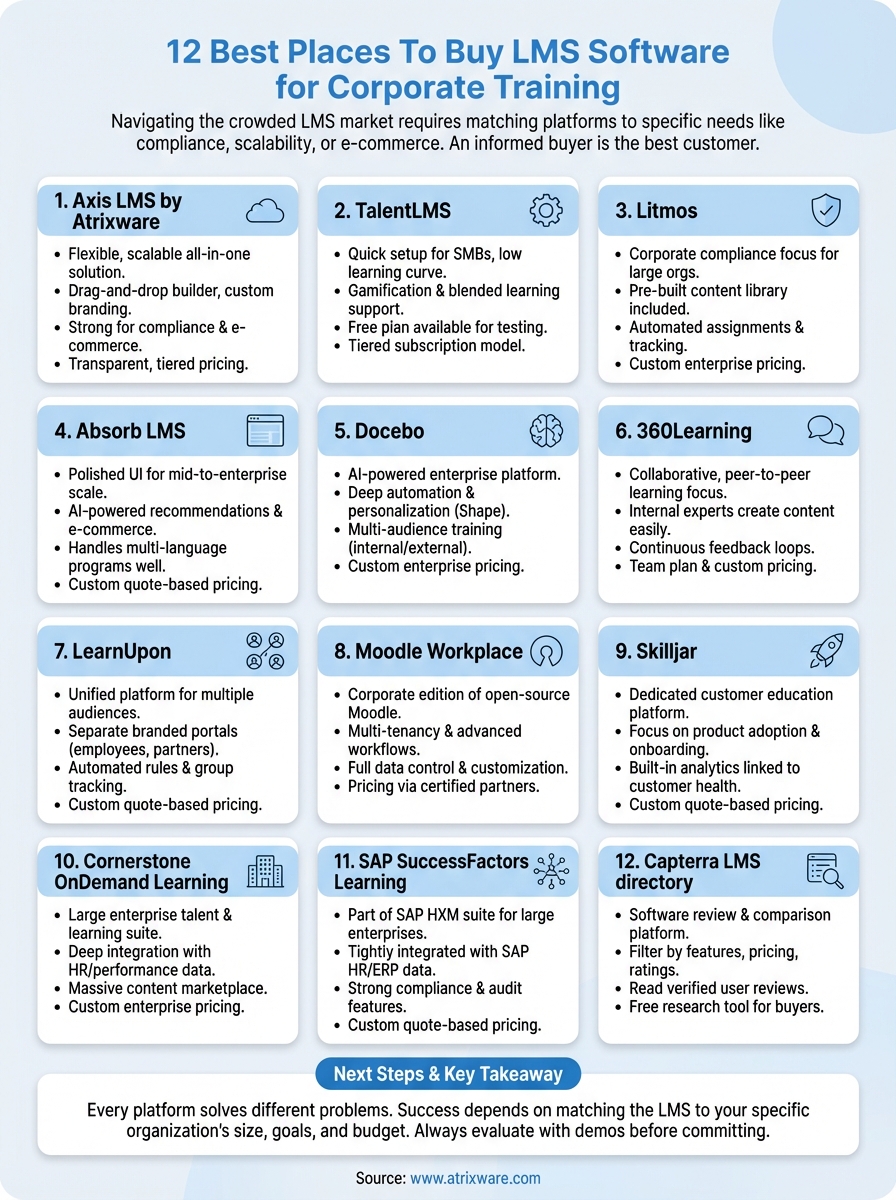
Every platform on this list solves a real problem, but the right pick depends entirely on your organization’s size, training goals, and budget. If you are managing compliance-heavy programs, selling training externally, or scaling across multiple audiences, the differences between these systems matter more than any feature checklist suggests.

Before you buy LMS software and commit to a contract, it helps to know exactly where you stand in the buying process. Some organizations are ready to start a demo tomorrow. Others still need to clarify requirements internally before talking to any vendor. Knowing your stage saves time on both sides.
Take the LMS readiness quiz to figure out where you are in the process before your next step. If Axis LMS looks like a strong fit based on what you read here, you can also sign up for a demo and see the platform running against your actual training use case.
