
Organizing multiple courses into a logical sequence can transform scattered training content into a structured learning experience that actually sticks. Thinkific learning paths give course creators the ability to bundle related courses together, guiding students through content in a specific order rather than leaving them to figure it out on their own.
Whether you’re onboarding new customers, building certification programs, or creating comprehensive skill-building tracks, learning paths help you design intentional journeys instead of random course catalogs. The challenge? Setting them up correctly requires understanding both the technical steps and the strategic thinking behind effective course sequencing.
At Atrixware, we build Axis LMS to help organizations deliver training that drives real results, so we know what separates a well-designed learning path from a confusing mess of content. This guide walks you through how Thinkific’s learning path feature works, from initial setup to design best practices. You’ll find step-by-step instructions for creating multi-course journeys, tips for structuring content logically, and practical examples you can adapt for your own training programs.
What Thinkific learning paths do
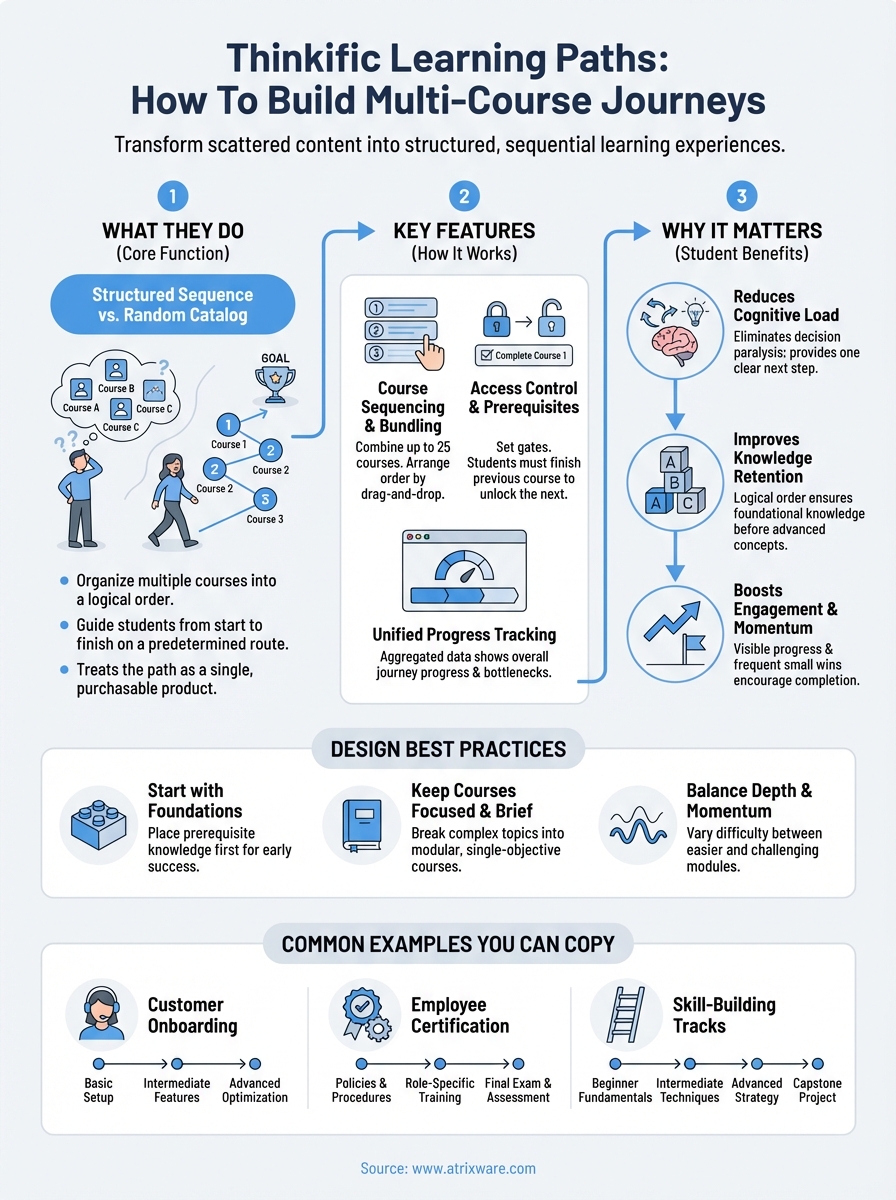
Learning paths function as container structures that group multiple courses into a single, ordered sequence. When you create a learning path in Thinkific, you’re building a predetermined route through your content that students follow from start to finish. Instead of showing learners a list of individual courses and hoping they pick the right order, you decide the exact progression and enforce it through the platform’s sequencing rules.
The core function centers on content organization and access control. You select which courses belong in the path, arrange them in the sequence you want, and set whether students must complete one before accessing the next. This sequential unlocking happens automatically based on completion status, so you don’t manually gate access for each student. Students who enroll in a learning path see their entire journey mapped out, but they can only access courses according to the rules you’ve established.
Course bundling and sequencing
Thinkific lets you combine up to 25 courses into a single learning path, giving you flexibility to create anything from short onboarding tracks to comprehensive certification programs. You arrange courses by dragging them into order within the path settings, and each course maintains its original structure with all chapters, lessons, and assessments intact. The platform treats the learning path as a separate product in your system, which means you can price it differently from individual course sales.
Students see a unified dashboard showing their progress across all courses in the path, making it easier to track completion and maintain momentum through longer training sequences.
Sequential access works through completion gates that you control for each course in the path. When you enable prerequisites, students cannot jump ahead to course three if they haven’t finished course two. Thinkific checks completion status automatically, unlocking the next course only after students meet your requirements. You decide what "completion" means for each course, whether that’s finishing all lessons, passing a final quiz, or both.
Progress tracking and enrollment management
The platform provides aggregated progress data for learning paths that goes beyond individual course metrics. You can see how many students have started the path, where they currently are in the sequence, and how many have completed the entire journey. This bird’s-eye view helps you identify dropout points and understand which courses within the path create bottlenecks for learners.
Enrollment happens at the path level rather than course level, which simplifies your administrative work considerably. When students purchase or get assigned to a learning path, they’re automatically enrolled in all included courses according to your sequencing rules. You don’t need to manually enroll them in each course separately or worry about students accidentally skipping required content. The system handles access permissions based on the path structure you’ve built.
Students receive automated notifications when new courses unlock within their learning path, keeping them engaged without requiring you to send manual reminders. These notifications trigger based on completion of prerequisite courses, helping maintain momentum through the full sequence. You can customize the notification content to match your brand voice and provide specific guidance for what students should do next in their learning journey.
Why learning paths matter for student progress
Random access to multiple courses creates decision paralysis that stalls learning before students even start. When you drop learners into a catalog of individual courses without clear direction, they waste time figuring out where to begin, what order makes sense, and whether they’ve missed prerequisites. Structured learning paths eliminate this friction by making the route obvious, which directly impacts both engagement and completion rates.

Reduced cognitive load and decision fatigue
Students facing a dozen standalone courses must constantly evaluate what to learn next, draining mental energy that should go toward actual learning. You remove this unnecessary cognitive burden when you organize content into thinkific learning paths that present one clear next step. Learners can focus on mastering the current course instead of questioning whether they should have taken something else first or worrying about what comes after.
Sequential structure transforms overwhelming course libraries into manageable learning journeys, reducing dropout rates by as much as 40% compared to self-directed course selection.
The psychological benefit of visible progress compounds as students move through your path. Each completed course becomes a milestone that reinforces their commitment to finishing the entire sequence. This momentum effect proves particularly valuable for longer training programs where students might otherwise lose interest halfway through disconnected individual courses.
Improved knowledge retention through logical sequencing
Building concepts in the correct order matters more than most course creators realize. When you control the sequence, you ensure students have foundational knowledge before encountering advanced material that depends on it. This scaffolded approach prevents the frustration and confusion that comes from jumping into complex topics without proper preparation, which often leads to students abandoning training entirely.
Strategic course ordering also allows you to reinforce key concepts across multiple courses within the same path. You can reference earlier material in later courses, creating connections that deepen understanding and improve long-term retention. Students who follow a well-designed learning path demonstrate measurably better performance on assessments compared to those who piece together courses randomly, because they’ve built knowledge systematically rather than in disconnected chunks.
How to build a learning path in Thinkific
Creating your first learning path requires navigating through Thinkific’s product settings rather than the course builder interface, which trips up many creators expecting to find it alongside their course management tools. The platform treats learning paths as standalone products that bundle existing courses together, so you’ll configure them in a different area of your admin panel than where you create or edit individual courses.
Accessing the learning path builder
You start by logging into your Thinkific admin dashboard and clicking "Products" in the left sidebar menu. From there, select "Learning Paths" and click the button to create a new path. The system prompts you to name your path and add a description that students will see when browsing your offerings. This initial setup screen also lets you set pricing, create a custom URL slug, and upload thumbnail images that represent the entire learning journey.
Adding and sequencing courses
The course selection interface shows all published courses in your Thinkific account as options you can add to your path. You click the courses you want to include, and they appear in a list where you can drag and drop them into the order students should follow. Each course retains its full structure with chapters, lessons, and assessments intact, so you’re organizing complete courses rather than individual lessons.

Your sequencing decisions here determine the exact route students take through your content. Thinkific displays the courses in this order on the student-facing learning path page, showing learners where they are in the overall journey. You can add up to 25 courses to a single path, though most effective paths contain between three and eight courses to maintain student engagement without overwhelming them.
The drag-and-drop interface updates instantly, letting you experiment with different course orders until you find the progression that builds knowledge most effectively.
Configuring completion requirements
After arranging your courses, you set prerequisite rules that control when students can access each course in the sequence. Toggle on the "Make previous course a prerequisite" option for any course that should remain locked until students finish what comes before it. This creates the gated progression that defines structured thinkific learning paths, preventing students from jumping ahead before they’re ready.
Completion triggers depend on your course-level settings rather than path-level configuration. You define what counts as "completing" each course within the individual course settings, whether that means finishing all lessons, passing a final assessment, or both. These completion criteria then determine when the next course in your path unlocks automatically for each student.
Design best practices for multi-course journeys
Your learning path design determines whether students complete the journey or abandon it halfway through, so you need to balance comprehensiveness with digestibility from the start. Building effective thinkific learning paths requires more than just stacking courses in order. You must consider how concepts build on each other, how long students stay engaged, and where you provide opportunities to practice what they’ve learned before moving forward.
Start with foundational concepts first
You set students up for success by placing prerequisite knowledge at the beginning of your path, even when that content seems basic or obvious to you. Students who lack foundational understanding will struggle with every subsequent course, creating frustration that leads to dropout. Your first course should establish core vocabulary, introduce key frameworks, and provide context for why the entire learning path matters to their goals.
Avoid the temptation to rush through fundamentals in favor of more advanced material. Students need time to absorb basic concepts before you layer complexity on top. If your advanced courses keep referencing principles students should already know, your path structure needs adjustment. Move that foundational content earlier in the sequence or create a dedicated introductory course that covers all prerequisites.
Keep individual courses focused and brief
Breaking complex topics into shorter, focused courses works better than creating marathon learning experiences that span dozens of lessons. Each course in your path should address one clear objective or skill set, allowing students to complete it in a single session or over a few days. This modular approach gives learners natural stopping points where they can pause, reflect, and apply what they’ve learned before continuing.
Students complete paths with five to seven focused courses at rates 35% higher than paths containing two to three lengthy comprehensive courses, even when total lesson count remains similar.
Your completion rates improve when students can achieve small wins frequently rather than working toward distant finish lines. Design each course to deliver standalone value while contributing to the larger learning journey. This structure also makes your paths easier to update later, since you can revise individual courses without rebuilding the entire sequence.
Balance depth with momentum
You maintain student engagement by varying course complexity throughout your path rather than front-loading all difficult material or saving it for the end. Place challenging courses between easier ones to prevent burnout and give students mental breaks where they consolidate learning. This rhythm keeps motivation high because learners experience both growth and accomplishment as they progress through your sequence.
Common setups and examples you can copy
You can adapt proven learning path structures instead of designing your sequences from scratch, saving time while benefiting from frameworks that already work for similar training scenarios. The most effective thinkific learning paths share common organizational patterns that address specific business outcomes, whether you need to onboard customers, certify employees, or build comprehensive skill tracks. Understanding these standard configurations helps you choose the right structure for your content and goals.
Customer onboarding and product training
Your customer education path should move users from initial setup through advanced features in a logical progression that matches their actual product adoption journey. Start with a basic orientation course covering account creation, interface navigation, and core functionality that every user needs immediately. Follow with intermediate courses focused on specific workflows or use cases that solve common customer problems, then conclude with advanced optimization techniques and integration options.
This structure works because it mirrors natural product adoption, where users need foundational knowledge before they can implement sophisticated strategies. You reduce support tickets and increase product engagement when customers progress through properly sequenced training that builds confidence at each stage.
Employee certification programs
Compliance and professional development paths require formal assessment checkpoints between courses to verify knowledge retention before advancing. Your path typically includes foundational policy or procedure courses first, followed by role-specific application courses, then concludes with comprehensive certification exams or practical assessments. Each course gates the next one through mandatory quiz completion, ensuring employees cannot skip required material.
Organizations using structured certification paths see 60% higher compliance rates compared to standalone course assignments, because the sequential format prevents partial completion and knowledge gaps.
Skill-building career tracks
Technical training paths work best when you organize content by competency levels rather than random topic groupings. Design your sequence with beginner fundamentals, intermediate technique courses, advanced strategy courses, and capstone projects that demonstrate mastery. Each level prepares students for increased complexity, allowing them to practice skills before adding new concepts. You maintain engagement by spacing difficult courses between practical application modules where learners implement what they’ve learned.
Next steps
You’ve learned how thinkific learning paths organize multiple courses into structured journeys that improve completion rates and student outcomes. The technical setup process takes minimal time once you understand the product interface, but your real work involves strategic content sequencing and thoughtful course design that builds knowledge systematically. Start by mapping your existing courses into logical progressions based on prerequisite knowledge requirements before you begin creating paths in the platform.
Before you invest significant time building out complex learning paths, evaluate whether your current platform truly supports your long-term training goals and organizational needs. Many course creators discover critical limitations in their LMS only after they’ve committed to a specific structure and enrolled hundreds of students. Take our LMS readiness quiz to determine whether you need advanced features like custom integrations, compliance tracking, or enterprise-level reporting that go beyond basic learning path functionality. Your training programs deserve infrastructure that scales with your ambitions.
