Training teams often face a tough choice: stick with traditional classroom sessions that offer hands-on interaction, or shift to online learning that scales easily and cuts costs. But what if you didn’t have to choose? With blended learning explained as a strategic approach, organizations combine the best of both worlds, merging face-to-face instruction with digital coursework to create flexible, effective training programs.
This hybrid model has gained serious traction across industries because it addresses real challenges. Employees learn differently, schedules vary, and training budgets aren’t unlimited. Blended learning lets you deliver personalized experiences while maintaining the human connection that drives engagement. Whether you’re onboarding new hires, running compliance certifications, or upskilling your sales team, this approach adapts to your needs rather than forcing you into a rigid format.
At Atrixware, we’ve built Axis LMS to support exactly this kind of training flexibility. Our platform helps organizations design, deliver, and track blended learning programs that combine online modules, virtual classrooms, and in-person sessions, all from a single system. The result? Training that actually sticks, with the data to prove it.
This article breaks down what blended learning really means, walks through the most common implementation models, highlights the benefits backed by real outcomes, and shares practical examples you can apply to your own programs. By the end, you’ll have a clear picture of how to structure blended learning for your organization.
What blended learning is and what it is not
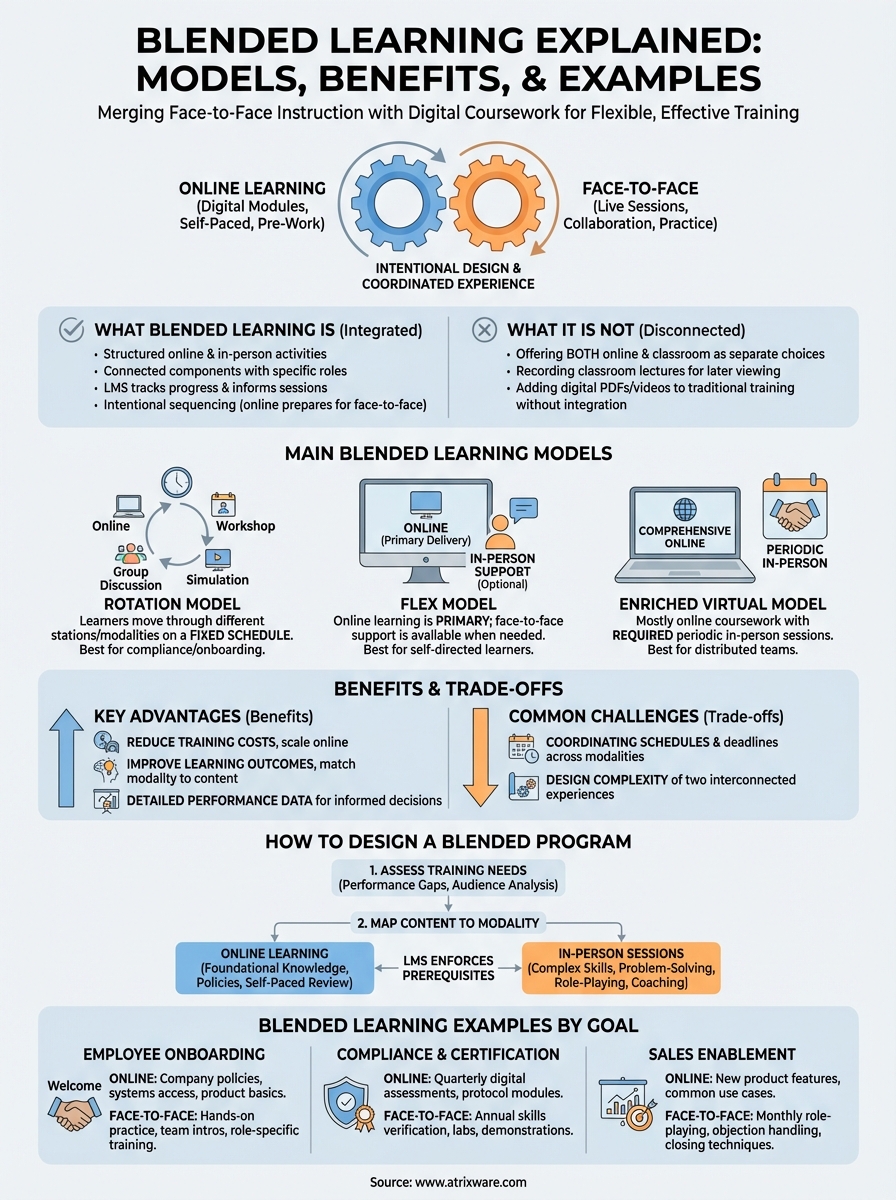
Blended learning combines structured online learning activities with face-to-face instruction in a coordinated program. You’re not simply adding digital resources to a classroom or recording a lecture for later viewing. Instead, you design an intentional learning journey where each component plays a specific role, and both parts work together to achieve your training goals.
What qualifies as blended learning
Your program counts as blended learning when you integrate online and in-person elements into a single coherent experience. The online portion typically covers foundational knowledge, self-paced modules, or pre-work that learners complete before attending live sessions. You might deliver video lessons, interactive simulations, or digital assessments that prepare employees for hands-on practice or discussion in the classroom.
The in-person component builds on what learners already absorbed online. You use this time for collaborative activities, skill demonstrations, problem-solving exercises, or complex discussions that benefit from direct interaction. A customer service training might include online modules about product features, followed by role-playing sessions where team members practice handling difficult conversations with a trainer present.
True blended learning requires intentional design where online and offline activities complement each other, not just coexist.
Coordination between components separates real blended learning from loosely connected training events. Your LMS should track online progress and inform what happens during face-to-face sessions. If someone struggles with a particular concept in their digital coursework, your instructor addresses it specifically during the live training. This connection creates a learning path rather than disconnected experiences.
What doesn’t count as blended learning
Simply offering both online courses and classroom training in your catalog doesn’t make your program blended. When employees choose between attending a workshop or taking an e-learning course on the same topic, they’re selecting separate delivery methods, not participating in an integrated program. Each stands alone as a complete training experience.
Recording your classroom sessions and posting them online also falls short of blended learning explained as a strategic approach. This practice provides flexibility for review or makeup work, but it doesn’t create the intentional integration that defines true blended learning. Learners still receive the same content through one primary channel.
Adding digital supplements like PDFs, reference documents, or optional videos to traditional training doesn’t qualify either. These resources support learning but don’t create the structured combination of modalities that blended learning requires. Your program needs deliberate sequencing where online activities directly prepare learners for face-to-face work, and vice versa, creating dependencies between both components.
The main blended learning models
Organizations structure blended learning programs using several proven models, each with distinct characteristics that serve different training needs. Your choice depends on factors like your workforce distribution, the complexity of skills you’re teaching, and how much control you want over the learning sequence. Understanding these frameworks helps you select the right approach for your specific situation rather than improvising a hybrid model that doesn’t deliver results.
Rotation model
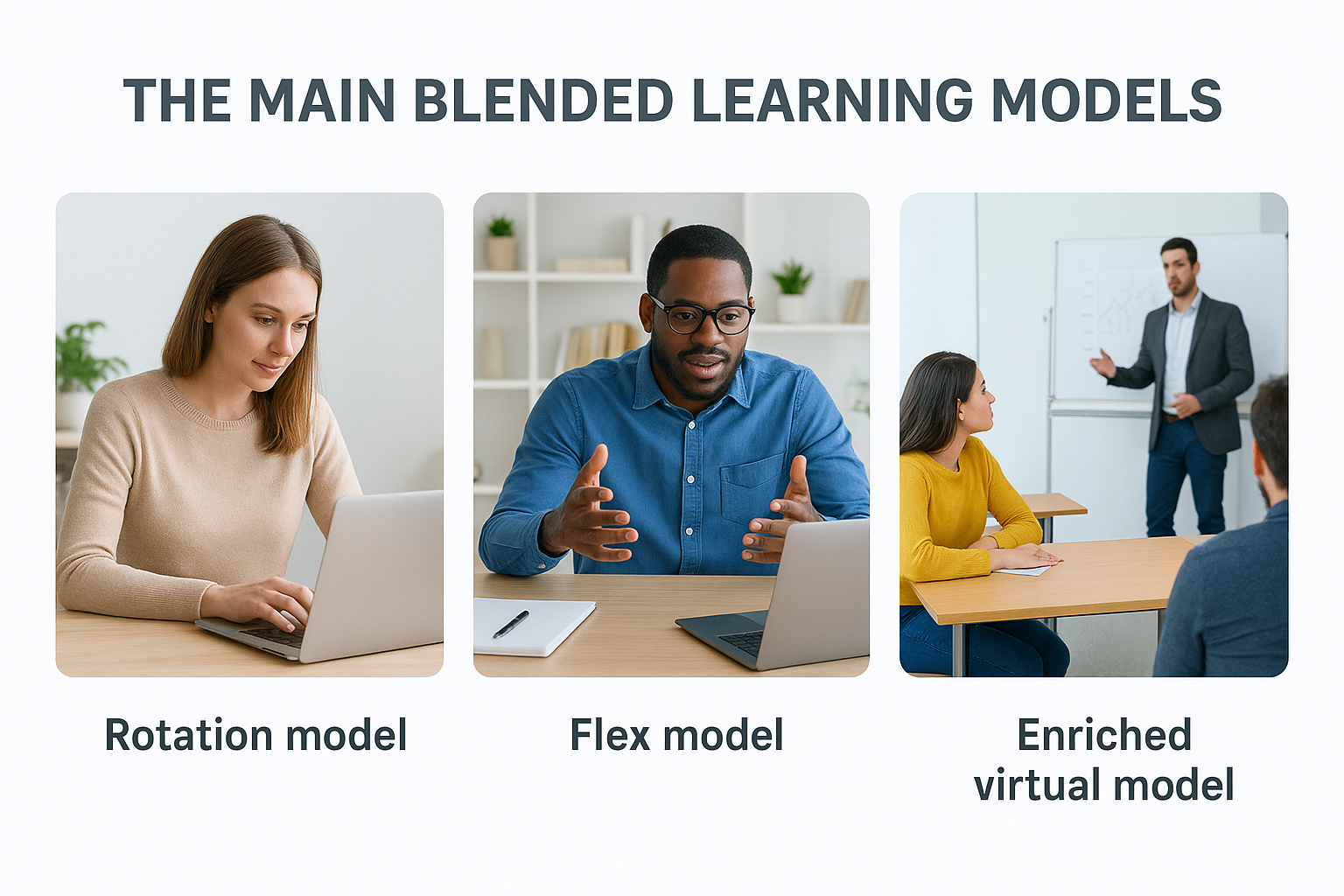
You design a rotation model by moving learners through different stations or modalities on a fixed schedule. Employees might spend Monday completing online modules at their desks, attend a workshop on Tuesday, practice with simulations on Wednesday, and participate in group discussions on Thursday. This structured approach works well for compliance training or onboarding programs where you need everyone to complete the same sequence of activities. Your team maintains control over pacing, ensuring learners don’t skip critical components or rush through foundational material before they’re ready for advanced concepts.
Flex model
The flex model places online learning as the primary delivery method, with face-to-face support available when learners need it. You provide digital courses as the backbone of your program, then schedule optional coaching sessions, office hours, or workshops where employees can get help with challenging topics. This approach serves experienced professionals who can direct their own learning but occasionally need expert guidance. Your training team spends less time delivering content and more time supporting individual learners where they struggle most.
Enriched virtual model
An enriched virtual model splits time between comprehensive online coursework and periodic in-person sessions. Learners complete most training digitally but attend required face-to-face meetings for hands-on practice, assessments, or team projects. You might structure this as monthly workshops combined with weekly online modules, or quarterly intensive sessions supported by continuous digital learning. This model fits distributed teams or situations where travel costs make frequent classroom training impractical.
The most effective model matches your organizational constraints while maintaining the intentional integration that defines blended learning explained as a strategic approach.
Benefits and trade-offs to expect
Blended learning delivers measurable improvements in training outcomes, but it also introduces complexity you need to prepare for. Your organization gains flexibility and cost savings while taking on coordination challenges that purely online or classroom training doesn’t face. Understanding both sides helps you set realistic expectations and build support for your program.
Key advantages for your organization
You reduce training costs significantly by cutting travel expenses, venue rentals, and instructor time while maintaining the effectiveness of face-to-face instruction. Online components scale across your entire workforce without requiring additional classroom space or repeated delivery sessions. A sales training program that previously needed five workshops in different cities now requires only one central session, with preparatory work completed digitally beforehand.
Learning outcomes improve when you match instruction methods to content types. Complex concepts that benefit from discussion happen in person, while foundational knowledge transfers efficiently through self-paced online modules. Learners absorb information at their own speed during digital portions, then apply it during live sessions where they receive immediate feedback.
Your training team gains detailed performance data that pure classroom instruction never provides. Axis LMS tracks exactly where learners struggle in online modules, how long they spend on each topic, and which assessments they fail. This visibility lets you adjust content before problems multiply across your workforce.
Blended learning explained as a data-driven approach gives you insights into learning patterns that inform both immediate interventions and long-term program improvements.
Common challenges to manage
Coordinating schedules across online deadlines and in-person sessions requires careful planning. You need systems that automatically notify learners about upcoming requirements, track completion rates, and flag people who fall behind before they miss critical face-to-face components.
Design complexity increases because you’re building two interconnected experiences instead of one standalone program. Your team must ensure online content genuinely prepares learners for classroom activities rather than just covering unrelated topics through different channels.
How to design a blended program at work
Designing an effective blended program requires strategic planning that goes beyond simply mixing online and classroom elements. You need a systematic approach that analyzes your training goals, evaluates your audience, and matches content types to the most effective delivery methods. The process starts with understanding what you’re trying to achieve and ends with a coordinated learning experience that leverages both modalities deliberately.
Assess your training needs first
You begin by identifying specific performance gaps your program should address. Document what employees need to know, what skills they must demonstrate, and what behaviors should change after training. A manufacturing safety program might require workers to memorize protocols, practice emergency procedures, and demonstrate proper equipment handling. Each outcome suggests different instructional approaches.
Analyze your learner population to understand their schedules, locations, technical capabilities, and learning preferences. Remote teams need different structures than co-located employees. Workers with irregular schedules benefit from flexible online components paired with scheduled live sessions they can plan around.
Map content to the right modality
You assign declarative knowledge like policies, procedures, and product specifications to online modules where learners can review and reference material at their own pace. This frees classroom time for activities that genuinely require face-to-face interaction.
Complex skills, problem-solving, and interpersonal training move to in-person sessions where learners practice with immediate feedback. Role-playing customer objections, troubleshooting equipment failures, or leading difficult conversations all benefit from live coaching that digital platforms can’t replicate effectively.
With blended learning explained as a deliberate design process, you create dependencies between components rather than treating them as interchangeable alternatives.
Your LMS should enforce prerequisite sequences, ensuring learners complete online preparation before attending workshops. Axis LMS automatically tracks progress and restricts access to live sessions until employees finish required digital coursework, maintaining the intentional structure your program needs.
Blended learning examples by training goal
Real-world applications show how different training objectives benefit from specific blended approaches. Your implementation strategy should align with what you’re trying to accomplish, whether that’s getting new hires productive quickly, maintaining certifications, or improving sales performance. These examples demonstrate how organizations structure programs to match their unique goals while maintaining the intentional integration that defines effective blended learning.
Employee onboarding
You accelerate new hire productivity by assigning online modules that cover company policies, systems access, and product basics before their first day. New employees complete these self-paced courses at home, then spend their first week in face-to-face sessions focused entirely on hands-on practice, team introductions, and role-specific training. A retail organization might have new store managers complete digital courses about inventory systems and scheduling software, then attend a three-day workshop where they practice coaching techniques and shadow experienced managers. This approach cuts onboarding time by 40% because you eliminate basic information delivery from classroom sessions.
Compliance and certification
Your compliance programs combine digital assessments that employees complete quarterly with annual in-person workshops for skills verification. Healthcare organizations use this model for infection control training, where nurses complete online modules about protocols and procedures, then demonstrate proper techniques during scheduled skills labs. Axis LMS automatically tracks completion rates, sends renewal reminders, and generates audit reports showing exactly who completed which requirements when.
Sales enablement
You structure product training with online courses that sales teams complete whenever new features launch, followed by monthly practice sessions where they role-play customer scenarios. Each digital module introduces product capabilities and common use cases, then sales managers lead workshops focused entirely on handling objections and closing techniques specific to those features.
With blended learning explained through practical applications, you see how matching your delivery model to specific training goals creates measurable improvements in both efficiency and effectiveness.
Next steps
You now understand how blended learning explained as a strategic approach combines online and face-to-face training to create flexible, effective programs that address real organizational challenges. The key is intentional design where each component serves a specific purpose rather than simply offering multiple delivery options to your workforce.
Start by evaluating one existing training program you can convert to a blended model. Identify which content works better online and which activities require live interaction. Map out dependencies between components so online work genuinely prepares learners for classroom sessions. Your LMS should support this coordination by tracking online progress, enforcing prerequisites, and providing the reporting you need to measure results.
Axis LMS handles the technical complexity of blended programs while giving you complete control over how learners experience your training. Our platform tracks both digital coursework and in-person attendance, automates notifications, and generates reports that show exactly where your program succeeds and where it needs adjustment. Take our LMS readiness quiz to see if your organization is ready to implement blended learning that delivers measurable results.
