A new hire’s first weeks shape everything that follows, their engagement, their performance, and whether they’ll still be around in six months. Yet many organizations rush through onboarding or treat it as a paperwork exercise. Following onboarding training best practices means building a structured experience that turns new employees into confident, productive team members faster.
The stakes are significant. Strong onboarding programs directly impact retention and productivity, but knowing onboarding matters and executing it well are two different challenges. A systematic approach supported by the right learning management system bridges that gap.
At Atrixware, we’ve helped organizations across industries build effective onboarding programs with Axis LMS. This guide shares six proven practices that work. Whether you’re building from scratch or refining an existing process, these strategies will help you create training experiences that set new hires up for long-term success.
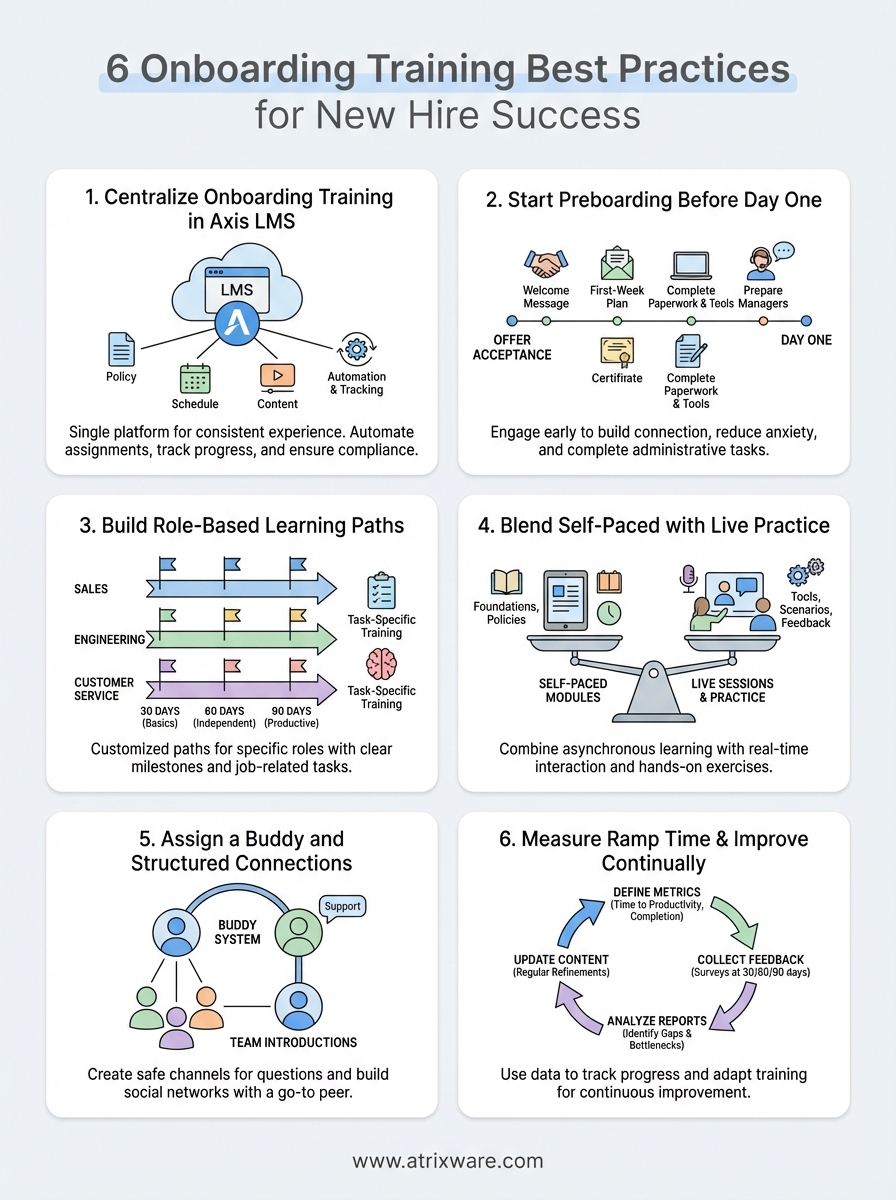
1. Centralize onboarding training in Axis LMS
Scattered training materials create confusion and inconsistent experiences. When onboarding content lives in email threads, shared drives, and different departments, you can’t control what new hires see or measure what they complete. Centralizing everything in Axis LMS gives you a single platform where every new employee gets the same high-quality experience regardless of their department or location.
Your LMS becomes the control center for onboarding. You can structure content, maintain version control, and ensure compliance documentation stays current. New hires know exactly where to go, and administrators can see the complete picture of who’s progressing and who needs help.
Centralization transforms onboarding from a scattered process into a repeatable system that scales with your organization.
Set up a single source of truth for onboarding
Building your onboarding library in Axis LMS means creating modules that cover company culture, policies, role-specific skills, and compliance requirements. You organize content into logical sequences that make sense for different roles and departments. The drag-and-drop course builder lets you assemble modules quickly without technical skills, and you can include videos, documents, quizzes, and interactive elements that keep new hires engaged.
Automate assignments, reminders, and deadlines
Manual tracking wastes time and creates gaps. Axis LMS lets you automatically assign the right training to new hires based on their role, department, or location the moment they’re added to the system. You set deadline rules that align with your onboarding timeline, and the system sends reminders to employees and their managers. This automation ensures nothing falls through the cracks and frees your team to focus on the human side of onboarding.
Track completion and compliance with reporting
You need real-time visibility into onboarding progress. Axis LMS provides dashboards and reports that show completion rates, quiz scores, and time spent on training. You can identify new hires who are falling behind and intervene before small issues become bigger problems. For compliance-critical training, the system maintains detailed records with timestamps and certificates that satisfy audit requirements.
Connect onboarding to HR and IT systems with integrations
Axis LMS integrates with your existing systems through pre-built connectors and a REST API. When HR adds a new employee to your HRIS, that data can flow directly into Axis LMS to trigger training assignments. You can also connect with SSO providers so new hires use their company credentials from day one. These integrations eliminate duplicate data entry and create a seamless experience across your technology stack.
2. Start preboarding before day one
The gap between offer acceptance and the first day creates risk. New hires spend weeks wondering if they made the right choice, and your competitors might still be calling. Preboarding fills this space with purposeful engagement that keeps excitement high and builds early connections. You reduce first-day anxiety, speed up time to productivity, and signal that your organization is professional and prepared.

Effective preboarding turns waiting time into learning time. You can complete administrative tasks, deliver essential information, and help new hires feel like part of the team before they step through the door.
Preboarding transforms the anxious waiting period into productive preparation that benefits both the organization and the new hire.
Keep momentum between offer acceptance and start date
Silence between acceptance and day one creates doubt. You need to maintain contact with regular touchpoints that reinforce their decision and build anticipation. Send a welcome message from their manager within 48 hours of acceptance, then follow up with materials that help them prepare. Share company news, introduce them to their team through brief videos or messages, and give them reading that provides context for their role.
Send a clear first-week plan and expectations
Uncertainty about the first week causes unnecessary stress. Provide new hires with a detailed schedule showing what happens each day, who they’ll meet, and what they’ll learn. Include start time, dress code, parking instructions, and where to report. This clarity helps them prepare mentally and logistically, which lets them focus on learning instead of logistics when they arrive.
Complete paperwork and tool access early
Administrative tasks consume valuable first-day time. Use your preboarding period to collect tax forms, direct deposit information, and benefit selections electronically. Coordinate with IT to create email accounts and provision access to core systems before day one. New hires can start engaging with work immediately instead of spending hours filling out forms.
Prepare managers and teams to welcome the new hire
Your existing team needs preparation too. Brief the hiring manager on their responsibilities during the first week and ensure they’ve blocked time for check-ins. Alert team members about the new hire’s start date and role so they can plan introductions and early collaborations. Set up their workspace with equipment, supplies, and a welcome note that shows you anticipated their arrival.
3. Build role-based learning paths with clear milestones
Generic onboarding programs waste time teaching irrelevant information. When you customize learning paths for specific roles, new hires focus on skills they’ll actually use. Role-based training maps directly to job responsibilities, which accelerates confidence and productivity. You create different tracks for sales, engineering, customer service, and other functions, then layer in shared modules for company-wide policies and culture.
Clear milestones transform onboarding from a vague period into a structured journey with visible progress. New hires understand what they need to achieve at specific intervals, and managers can measure development against consistent benchmarks.
Role-based paths with defined milestones give new hires a roadmap to success instead of leaving them to figure it out alone.
Define what success looks like at 30, 60, and 90 days
You need to establish specific outcomes for each milestone period. At 30 days, a new hire might complete all compliance training and shadow experienced team members. By 60 days, they should handle basic tasks independently and contribute to team projects. At 90 days, they’re performing their core responsibilities without supervision and meeting initial performance targets.
Map training to job tasks, not generic topics
Your training modules should teach actual workflows and scenarios new hires will encounter. Instead of generic customer service principles, show them how to use your specific ticketing system and handle real customer situations. Break down the most common tasks they’ll perform in their first month and create training that directly prepares them for those situations.
Use checklists to make progress visible
Checklists help new hires track what they’ve completed and what remains. You can create digital checklists in Axis LMS that include training modules, meetings with key stakeholders, and hands-on activities. Each checked item builds momentum and provides a tangible sense of progress that reduces anxiety about meeting expectations.
Validate learning with quick knowledge checks and practice
Testing understanding ensures new hires absorb critical information. Build short quizzes after each module that require application of concepts, not just memorization. Include scenario-based questions that simulate real decisions they’ll make. You can also assign practice tasks where they demonstrate skills in a safe environment before applying them with actual customers or projects.
4. Blend self-paced modules with live practice
Relying solely on one training format limits effectiveness. New hires learn different types of information through different methods, and combining self-paced modules with live practice creates stronger retention and faster application. This blended approach lets you scale foundational content while preserving valuable live time for the interactions that matter most. Following onboarding training best practices means matching each learning objective to the format that delivers results.
You need a deliberate strategy that determines what content works best asynchronously and what requires real-time interaction. This balance respects new hires’ time while ensuring they build practical skills through guided experience.
Blended learning combines the efficiency of self-paced content with the human connection and practice that live sessions provide.
Use self-paced training for foundations and policies
Deploy self-paced modules in Axis LMS for information new hires need to know but don’t require live instruction. Company history, policies, compliance requirements, and conceptual frameworks work well in this format. You allow learners to move at their own pace, reviewing complex sections multiple times if needed. This approach frees up live session time for higher-value activities while ensuring everyone receives consistent foundational knowledge.
Use live sessions for tools, scenarios, and Q and A
Reserve live training for content that benefits from demonstration, discussion, and immediate feedback. Show new hires how to navigate your CRM, handle challenging customer scenarios, or apply judgment to ambiguous situations. These sessions create space for questions, clarification, and learning from peers. You can address confusion in real time and adapt examples based on the group’s understanding.
Schedule hands-on practice with real work examples
Observing demonstrations isn’t enough. New hires need to practice skills with actual work materials under supervision. Give them sample customer inquiries to resolve, sales calls to conduct with feedback, or code to review and improve. This structured practice builds confidence before they handle real responsibilities and reveals gaps in understanding while support is readily available.
Reinforce learning with short refreshers in the flow of work
Learning fades without reinforcement. Send brief reminders about key processes when new hires are likely to use them. A quick video or checklist delivered just before they need to perform a task strengthens retention. You can also create job aids they access while working, turning your LMS into an ongoing performance support tool beyond initial onboarding.
5. Assign a buddy and create structured connections
Formal training can’t answer every question a new hire has. You need to build social infrastructure that gives them safe ways to learn the unwritten rules, ask basic questions, and feel connected to their team. A buddy system paired with structured introductions creates this network without overwhelming anyone. This approach reduces isolation, speeds cultural integration, and helps new hires navigate their first months with confidence instead of constant uncertainty.

The buddy relationship provides a go-to person outside the reporting chain who remembers what being new felt like. You combine this peer support with intentional team connections that build relationships across the organization.
Structured social connections turn isolated new hires into integrated team members who know where to turn for help.
Pick the right buddy and set expectations
Select buddies who represent your culture positively and have time to engage meaningfully. You want someone with at least six months of tenure who understands daily routines and communicates clearly. Give both the buddy and new hire a written outline of what the relationship includes, like weekly check-ins for the first month, answers to informal questions, and introductions to key people. Clear expectations prevent the buddy relationship from becoming vague or forgotten.
Build a meet-the-team schedule that scales
Create a standard schedule of introductions that happens for every new hire. You might include 15-minute coffee chats with five key collaborators in week one, a team lunch in week two, and meetings with cross-functional partners by day 30. This structure ensures no new hire gets overlooked while preventing calendar chaos for your existing team.
Create safe channels for questions and small wins
Set up dedicated spaces where new hires can ask questions without feeling judged. This might be a private Slack channel for your current onboarding cohort or regular office hours with learning specialists. Encourage them to share early wins in these spaces, which builds confidence and shows other new hires what success looks like.
Support remote and hybrid hires with intentional touchpoints
Remote employees need extra structure to build connections that happen naturally in offices. Schedule virtual coffee meetings, send welcome packages to their home, and include them in team video calls from day one. You create regular touchpoints with their manager and buddy through video, not just email, which builds relationships that pure remote work can diminish.
6. Measure ramp time and improve training continuously
Onboarding without measurement leaves you guessing about effectiveness. You need data-driven insights to understand what’s working and what slows new hires down. Measuring key metrics and acting on feedback transforms your program from static to adaptive. This continuous improvement approach helps you refine content, eliminate bottlenecks, and reduce time to productivity across all roles.
Strong onboarding training best practices include building feedback loops that inform regular updates. You collect quantitative data through your LMS and qualitative insights from new hires and managers, then use both to make targeted improvements.
Measurement turns onboarding from a one-time program into a system that gets better with every new hire.
Define onboarding metrics that matter
Track time to productivity as your primary metric, measuring how long new hires take to reach specific performance benchmarks. You also need completion rates for required training, quiz scores that show comprehension, and retention rates at 90 and 180 days. These numbers reveal whether your program prepares people for success and keeps them engaged.
Collect feedback at key points in the first 90 days
Survey new hires at 30, 60, and 90 days about training clarity, manager support, and confidence levels. Ask their managers to rate preparation and identify skill gaps. You capture insights while experiences are fresh, which gives you specific feedback you can act on immediately.
Use reports to spot bottlenecks and content gaps
Review your Axis LMS dashboards monthly to identify modules with low completion rates or poor quiz performance. These patterns reveal content that confuses learners or takes too long to complete. You can also spot timing issues where critical training happens too early or too late in the onboarding sequence.
Update content and processes on a regular cadence
Schedule quarterly reviews of your onboarding program using accumulated data and feedback. Update outdated information, replace ineffective modules, and adjust sequencing based on what you’ve learned. You keep your program current with business changes and continuously raise the quality bar for new hire experiences.
Quick recap
These six onboarding training best practices give you a proven framework for transforming new hire experiences from chaotic to structured. You centralize content in your LMS, start engagement before day one, build role-specific paths with clear milestones, blend learning formats strategically, create social connections through buddies and teams, and measure results to drive continuous improvement. Each practice addresses a specific challenge that undermines typical onboarding effectiveness.
Strong onboarding programs require the right technology foundation to execute consistently. Axis LMS provides the centralization, automation, and reporting capabilities that make these practices actionable at scale. You get tools built specifically for corporate training delivery, not generic platforms adapted for learning purposes. The difference shows in reduced administrative burden and faster time to productivity for your new hires.
Ready to see these capabilities in action? Start your free admin demo to explore how Axis LMS supports effective onboarding programs across organizations of all sizes.
