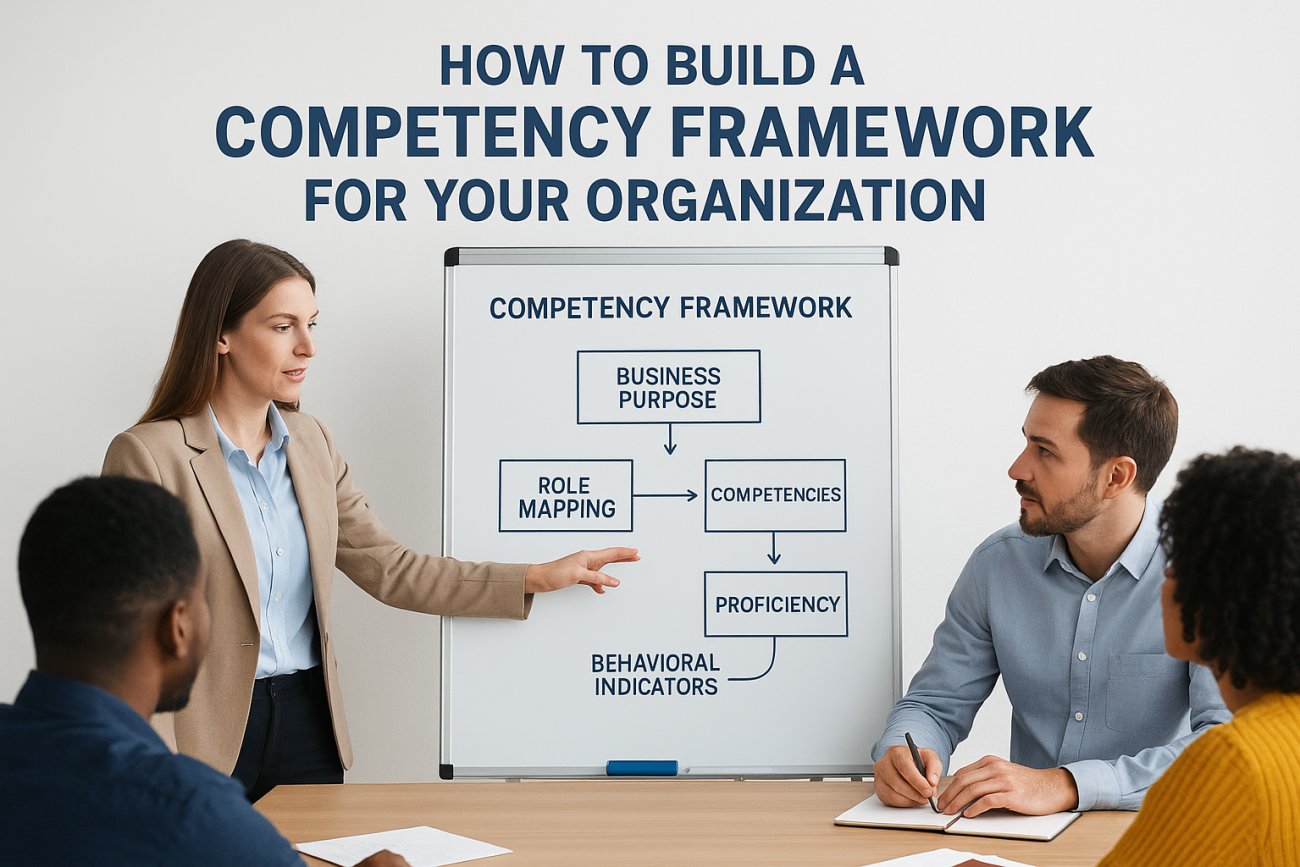
Organizations often invest heavily in training programs without a clear picture of what success looks like. They run workshops, deploy courses, and check compliance boxes, yet struggle to connect learning activities to actual job performance. The missing piece? A well-defined competency framework. Understanding how to build a competency framework gives your organization a blueprint that links specific skills and behaviors to role requirements, making training purposeful rather than arbitrary.
A competency framework does more than list desired skills. It creates alignment between individual development and business goals, ensuring that every training initiative moves employees closer to measurable outcomes. Without this foundation, learning programs become scattered efforts that may or may not address actual performance gaps. With it, you gain clarity on what "good" looks like for each role, and a roadmap to get there.
This guide walks you through the complete process of designing, developing, and implementing a competency framework that works. From defining core competencies to mapping them across roles, you’ll find practical steps and real examples to build a framework tailored to your organization. And once your framework is in place, a Learning Management System like Axis LMS becomes the vehicle for delivering targeted training, tracking competency development, and ensuring employees actually gain the skills your framework identifies as critical.
What a competency framework is and what it includes
A competency framework is a structured collection of knowledge, skills, and behaviors that define what effective performance looks like in specific roles within your organization. It serves as both a performance standard and a development roadmap, giving you concrete criteria for hiring, evaluating, and growing talent. When you understand how to build a competency framework, you create a shared language that connects job expectations with measurable outcomes.
The framework translates vague job requirements into observable, assessable competencies that you can track and develop. Instead of saying a manager needs "good leadership skills," your framework specifies competencies like "delegates tasks effectively" or "provides constructive feedback within 24 hours." This specificity makes performance expectations transparent for employees and gives leaders objective criteria for assessment.
"A competency framework transforms abstract job requirements into measurable skills and behaviors that drive real performance."
Core components of a competency framework
Your framework should include three essential elements that work together to define role requirements. First, you need competency statements that describe specific capabilities in clear, action-oriented language. These statements avoid ambiguity and focus on what people actually do in their roles, not just what they know.
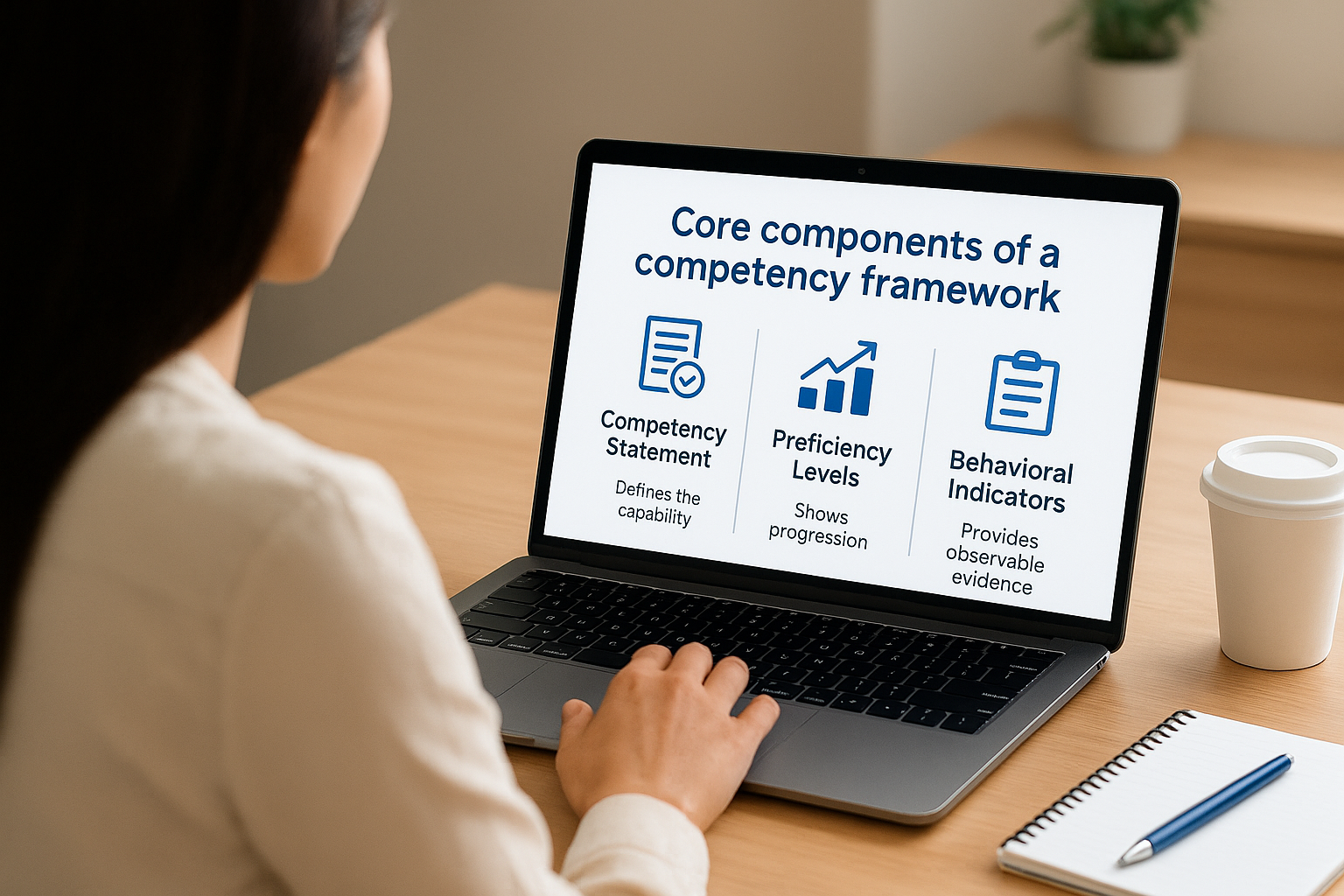
Second, your framework requires proficiency levels that show progression from beginner to expert. These levels create a development pathway and help you assess where someone currently stands versus where they need to be. Third, you include behavioral indicators that provide concrete examples of each competency in action.
| Component | Purpose | Example |
|---|---|---|
| Competency Statement | Defines the capability | "Analyzes customer data to identify trends" |
| Proficiency Levels | Shows progression | Basic → Intermediate → Advanced → Expert |
| Behavioral Indicators | Provides observable evidence | "Creates monthly reports highlighting key patterns" |
Types of competencies your framework should cover
You need to include core competencies that apply across your entire organization, regardless of role or department. These represent fundamental values and behaviors that every employee should demonstrate, such as communication, collaboration, or ethical decision-making. Core competencies reinforce your organizational culture and create consistency in how people work.
Role-specific competencies define the technical and functional skills unique to particular positions or job families. A software developer needs competencies in coding and debugging, while a sales representative requires negotiation and relationship-building skills. Leadership competencies form a third category, addressing capabilities needed at management and executive levels like strategic thinking, team development, and change management.
How competencies are structured in your framework
Each competency in your framework follows a consistent format that makes it easy to understand and assess. You start with a clear competency name, followed by a definition that explains what it means in your organizational context. The definition should be specific enough to guide behavior but flexible enough to apply across similar roles.
Below the definition, you add behavioral indicators organized by proficiency level. These indicators describe what you would observe someone doing at each stage of development:
Example: Data Analysis Competency
- Basic Level: Reviews provided reports and identifies obvious patterns
- Intermediate Level: Queries databases independently and creates standard visualizations
- Advanced Level: Designs custom analyses that answer complex business questions
- Expert Level: Builds predictive models and recommends strategic actions based on data insights
This structure gives you a practical tool for assessment and development planning, not just a document that sits unused. You can evaluate current skill levels, identify gaps, and create targeted learning paths that address specific deficiencies. The framework becomes your foundation for making training investments strategic rather than random.
Step 1. Define the purpose, scope, and success criteria
Before you start listing competencies or gathering data, you need clear answers to three fundamental questions: Why are you building this framework? What will it cover? How will you know if it works? These decisions shape every subsequent step and prevent your framework from becoming an unused document that gathers digital dust. Skipping this foundation leads to scope creep, misaligned stakeholders, and frameworks that try to solve everything but fix nothing.
Clarify why you’re building this framework
Your framework needs a specific business problem to solve, not just a vague goal of "improving performance." Write down the primary purpose in one sentence. Are you building this framework to standardize hiring criteria across departments? To identify training gaps systematically? To create clear promotion pathways? To support succession planning? Each purpose influences what competencies you include and how you structure them.
For example, if your purpose is "reduce new hire ramp-up time by 30%," your framework should emphasize competencies that drive early productivity rather than advanced leadership skills. If you’re addressing high turnover in specific roles, focus on competencies that predict success and satisfaction in those positions.
"A competency framework without a defined purpose becomes a documentation exercise instead of a performance tool."
Set boundaries and identify which roles to cover
You cannot build competencies for every role simultaneously. Start by defining which departments, job families, or levels your initial framework will address. Most organizations succeed by focusing on one critical area first, such as customer-facing roles, technical positions, or management levels. This focused approach lets you test your methodology and demonstrate value before expanding.
Document your scope boundaries explicitly. Will you include contractors and temporary workers? Are you covering only full-time employees? Which geographic locations does this framework serve? Clear boundaries prevent confusion and help you allocate resources appropriately when learning how to build a competency framework that actually gets implemented.
Establish measurable success criteria
Define concrete metrics that prove your framework works before you start building it. Success criteria might include reduced time-to-productivity for new hires, improved performance review scores, decreased turnover in key roles, or increased internal promotion rates. Choose three to five metrics that align with your stated purpose and can be measured both before and after implementation.
Example Success Criteria:
- Reduce average time-to-competency for sales roles from 6 months to 4 months
- Increase internal promotion rate by 25% within 18 months
- Achieve 90% manager adoption in performance reviews within 6 months
- Decrease skill-related performance issues by 40% in first year
These criteria give you accountability and direction, ensuring your framework delivers tangible results rather than theoretical improvements.
Step 2. Map roles and choose who to involve
You need a complete inventory of roles before you can define competencies for any of them. This step prevents duplication, identifies shared competencies across similar positions, and ensures you involve the right people in framework development. When you map roles systematically, you discover natural groupings and hierarchies that make your framework more efficient and easier to maintain.
Create your role inventory and groupings
Start by listing every role within your defined scope, using current job titles as your starting point. Group similar roles into job families based on shared responsibilities and skill requirements. For example, your sales roles might include Sales Representative, Account Manager, and Sales Director, while your technical roles could include Junior Developer, Senior Developer, and Engineering Manager. These groupings let you identify core competencies that apply across the family and specific competencies unique to each level.

Look for roles that have overlapping responsibilities or career progression paths. When you understand how to build a competency framework that reflects actual work relationships, you create natural development pathways. Your framework should show how competencies evolve as someone moves from entry-level to senior positions within the same job family.
| Job Family | Entry Level | Mid Level | Senior Level |
|---|---|---|---|
| Sales | Sales Rep | Account Manager | Sales Director |
| Engineering | Junior Developer | Senior Developer | Engineering Manager |
| Customer Support | Support Specialist | Support Lead | Support Manager |
"Role mapping reveals competency patterns that reduce redundancy and create clear development paths across your organization."
Assemble your stakeholder team strategically
You need input from people who actually do the work, not just those who manage it. For each role or job family, identify three types of stakeholders: subject matter experts who excel in the role, direct managers who evaluate performance, and senior leaders who understand strategic priorities. This combination ensures your framework captures both practical realities and organizational direction.
Avoid building your framework in isolation. Include 4-6 people per job family to gather diverse perspectives while keeping the group manageable. High performers provide insight into what excellence looks like, average performers help you define baseline competencies, and managers contribute assessment experience. Your stakeholder team should also include HR representatives who understand compliance requirements and organizational policies that affect competency definitions.
Schedule specific time commitments upfront. Tell stakeholders they will participate in interviews, review draft competencies, and validate final versions. Clear expectations prevent participation from dropping off halfway through your framework development process.
Step 3. Collect data on real work and expectations
You need real information about what people actually do, not assumptions about what their job descriptions say they should do. This step involves gathering both quantitative and qualitative data from multiple sources to understand the competencies that drive success in each role. When you collect data systematically, you avoid building a framework based on outdated job descriptions or manager opinions alone.
Conduct structured interviews with role experts
Schedule 60-90 minute interviews with your stakeholders to gather detailed information about role requirements. Focus on critical incidents, asking questions like "Tell me about a time when someone in this role performed exceptionally" or "What separates your top performers from average ones?" These behavioral questions reveal the actual competencies that matter rather than theoretical requirements.
Prepare a consistent interview guide that covers these areas:
- Key responsibilities and daily activities that consume most work time
- Critical tasks that have the biggest impact on business outcomes
- Skills and knowledge required to handle complex or challenging situations
- Behaviors that differentiate high performers from low performers
- Common mistakes or gaps you observe in new or struggling employees
- Future skills needed as the role evolves over the next 2-3 years
Document responses in detail, capturing specific examples and language that interviewees use. Their words often provide the best behavioral indicators for your competencies.
"Direct observation reveals competency gaps that interviews and surveys miss because people often don’t recognize their own expertise."
Observe work in action and review artifacts
Spend time shadowing high performers in each role to see competencies demonstrated in real work situations. Watch how they solve problems, interact with colleagues, use tools and systems, and make decisions under pressure. This observation uncovers tacit knowledge and unconscious competencies that people cannot articulate in interviews.
Review work products, performance data, and communication examples from both successful and struggling employees. Look at completed projects, customer interactions, reports, code samples, or sales presentations. These artifacts show tangible evidence of competency application and help you identify patterns that separate different performance levels.
Use surveys to validate patterns at scale
After initial interviews and observations, deploy targeted surveys to larger groups within each job family. Surveys let you validate whether the competencies you identified apply broadly or only to specific individuals. Keep surveys focused on critical tasks and required capabilities rather than general satisfaction questions.
Example Survey Questions:
- Rate the importance of [specific competency] to success in your role (1-5 scale)
- How frequently do you perform [specific task]? (Daily/Weekly/Monthly/Rarely)
- What skill gaps prevent you from being more effective?
- What new capabilities will this role need in the next two years?
Collect survey data within two weeks to maintain momentum in your framework development process. This timeline keeps stakeholders engaged and ensures you have fresh data when you move to defining competencies in the next step.
Step 4. Turn data into clear, observable competencies
Now you transform raw data into structured competency statements that people can understand and assess. This step requires sorting through interview notes, observation records, and survey results to identify patterns that reveal actual performance requirements. When you learn how to build a competency framework, this translation process separates useful frameworks from theoretical documents that nobody applies.
Extract competency themes from your data
Review all collected data and highlight recurring themes that appear across multiple sources. Look for skills, knowledge areas, and behaviors that your high performers consistently demonstrate and that managers repeatedly mention as critical. Create a spreadsheet with columns for competency theme, supporting evidence, and frequency of mention to organize patterns systematically.
Group related activities under broader competency headings. For example, if your data shows people "responding to emails within 2 hours," "updating customers proactively," and "following up on open issues," these activities fit under a competency like "Customer Communication." Your goal is to identify 15-25 distinct competencies per role that capture the full scope of requirements without creating overwhelming detail.
"Effective competencies describe observable actions, not personality traits or vague attributes that resist measurement."
Write competency statements that describe actions
Each competency needs a clear name and definition that focuses on what people do, not who they are. Avoid vague terms like "motivated" or "passionate" that describe attitudes rather than behaviors. Instead, use action verbs that specify observable activities: analyzes, creates, implements, facilitates, or evaluates.

Competency Statement Template:
[Competency Name]: [Action Verb] + [Object] + [Purpose/Context]

Example: "Data-Driven Decision Making: Analyzes quantitative
information to identify trends and recommend business actions that
improve operational efficiency."
Write definitions in 2-3 sentences maximum that explain what the competency means in your organization’s context. Include enough specificity to guide behavior but maintain flexibility to apply across similar roles.
Define behavioral indicators that show competency in action
Translate each competency into 3-5 concrete examples of what you would observe someone doing when they demonstrate that capability. These indicators should describe specific actions, not results or outcomes. Instead of "achieves sales targets," write "identifies customer pain points through discovery questions and proposes relevant solutions."
Test your indicators by asking "Would two different managers observe the same behavior and agree it happened?" If your indicator requires interpretation or judgment, make it more specific. Your behavioral indicators become the assessment criteria you use in performance reviews, training evaluations, and hiring decisions.
Step 5. Add proficiency levels and role requirements
Your competencies need measurable levels that show progression from beginner to expert. This step transforms your competencies from descriptive statements into practical tools for assessment and development planning. When you add proficiency levels, you create a clear roadmap that shows employees where they currently stand and what they need to demonstrate to advance. Without these levels, your framework becomes a checklist that cannot distinguish between someone who barely meets requirements and someone who excels.
Create your proficiency scale that shows progression
Define 4-5 proficiency levels that apply consistently across all competencies in your framework. Most organizations use scales like Basic, Intermediate, Advanced, and Expert, or numbered scales from 1-5. Each level should represent a meaningful difference in capability that you can observe and measure, not arbitrary divisions that blur together.
Write a clear definition for each level that describes what performance looks like at that stage. Your definitions should focus on autonomy, complexity, and impact as key differentiators:
| Level | Definition | Characteristics |
|---|---|---|
| Basic | Performs with guidance | Follows established procedures, requires supervision, handles routine situations |
| Intermediate | Performs independently | Completes tasks without oversight, solves common problems, adapts procedures to new situations |
| Advanced | Guides others | Handles complex scenarios, mentors team members, improves existing processes |
| Expert | Shapes the function | Creates new approaches, recognized authority, influences organizational standards |
"Proficiency levels transform competencies from binary checkboxes into development pathways that show clear progression and growth opportunities."
Map competencies to specific roles and levels
Assign required proficiency levels for each competency based on role requirements and seniority. An entry-level position might require Basic proficiency in most competencies, while senior roles demand Advanced or Expert levels. Understanding how to build a competency framework means recognizing that not every role needs expert-level competency in every area. Focus requirements on what actually drives performance.
Create a competency matrix that shows required versus desired levels for each role. Required levels represent the minimum standard for acceptable performance, while desired levels indicate what high performers typically demonstrate:
Example Competency Matrix:
Role: Senior Sales Manager
- Customer Relationship Management: Advanced (Required), Expert (Desired)
- Sales Forecasting: Advanced (Required), Advanced (Desired)
- Team Leadership: Advanced (Required), Expert (Desired)
- CRM Systems: Intermediate (Required), Advanced (Desired)

Role: Sales Representative
- Customer Relationship Management: Intermediate (Required), Advanced (Desired)
- Sales Forecasting: Basic (Required), Intermediate (Desired)
- Team Leadership: Not Required
- CRM Systems: Basic (Required), Intermediate (Desired)
This mapping gives you precise hiring criteria and development targets for every position within your scope, making your framework immediately actionable.
Step 6. Validate, revise, and get final sign-off
Your draft framework needs real-world testing before you roll it out organization-wide. This validation step catches ambiguities, unrealistic requirements, and gaps that only become visible when people actually try to use your competencies. Skipping validation leads to frameworks that look good on paper but fail in practice because they do not reflect how work actually happens. Treat this step as quality control that saves you from costly revisions after implementation.
Test your framework with a pilot group
Select 5-10 representatives from different roles within your scope and ask them to review your competency definitions, proficiency levels, and behavioral indicators. These pilot users should include managers who will conduct assessments, employees who will be evaluated against the framework, and HR staff who will administer it. Give them specific tasks to complete rather than asking for general feedback.
Ask pilot participants to rate themselves or others using your competencies and proficiency scales, then discuss where they struggled or found statements unclear. Request that they identify competencies that overlap, indicators that seem impossible to observe, or levels that do not show meaningful differences. This hands-on testing reveals problems that theoretical reviews miss.
"Validation with real users transforms your framework from a theoretical document into a practical tool that people can actually apply."
Collect feedback and iterate systematically
Create a structured feedback form that captures specific issues rather than vague opinions. Ask targeted questions about clarity, relevance, observability, and completeness for each competency. Document which statements caused confusion, which examples did not match real work situations, and which proficiency definitions needed better differentiation.
Validation Feedback Template:
For each competency, rate and comment on:
- Clarity: Is the definition clear and unambiguous? (1-5)
- Relevance: Does this competency matter for role success? (1-5)
- Observability: Can you see/measure these behaviors? (1-5)
- Completeness: Are any critical indicators missing?
- Suggested changes: [Specific revisions needed]
Revise your framework based on patterns in feedback, not individual preferences. When multiple people flag the same issue, prioritize those changes. Understanding how to build a competency framework includes recognizing that iteration improves quality, but endless revision creates delays.
Secure executive approval and organizational buy-in
Present your validated framework to senior leadership and key stakeholders for final approval. Prepare a brief document that explains your methodology, summarizes stakeholder input, shows pilot testing results, and connects competencies to business outcomes. Executives need to see how the framework supports strategic goals, not just HR processes.
Schedule individual meetings with department heads who will implement the framework. Address their concerns directly and secure explicit commitment to use competencies in their talent processes. Document all approvals and establish an official rollout date that gives you time to prepare supporting materials and training.
Step 7. Implement it in hiring, reviews, and training
Your framework becomes valuable only when people actually use it in daily talent decisions. This step transforms your competency definitions from reference documents into operational tools that shape hiring criteria, performance evaluations, and learning programs. When you integrate competencies throughout your talent lifecycle, you create consistency and accountability that was missing before. Implementation requires specific changes to existing processes, not just distributing the framework and hoping managers figure it out.
Build competency-based job descriptions and interview guides
Rewrite job postings to list required and desired proficiency levels for each relevant competency instead of vague skill requirements. Replace generic phrases like "strong communication skills" with specific competency requirements such as "Customer Communication at Intermediate level" with clear behavioral indicators. This precision helps candidates self-assess their fit and reduces applications from unqualified people.

Create structured interview guides that map questions directly to competencies you need to assess. Each competency should have 2-3 behavioral questions that probe for evidence of that capability at the required proficiency level. Include a scoring rubric that references your behavioral indicators so different interviewers evaluate candidates consistently.
Sample Interview Question Template:
Competency: Problem Solving (Required Level: Advanced)

Question: "Describe a situation where you had to solve a complex
problem with incomplete information. What was your approach?"

Scoring Guide:
- Basic: Describes waiting for more data or asking for help
- Intermediate: Explains structured approach with some assumptions
- Advanced: Details systematic analysis, tested hypotheses,
  implemented solution
- Expert: Shows how solution became repeatable process for team
"Competency-based interviews eliminate subjective gut feelings and replace them with evidence of actual capability at required proficiency levels."
Integrate competencies into performance reviews and development plans
Replace traditional performance review forms with competency assessment tools that rate employees on each relevant competency using your proficiency scale. Managers should provide specific behavioral evidence for each rating, referencing your framework’s indicators rather than personal opinions. This structure makes reviews more objective and actionable for development conversations.
Use competency gaps to drive individual development plans automatically. When someone scores Intermediate on a competency that requires Advanced proficiency, that gap becomes a development priority. Your framework already defines what Advanced looks like through behavioral indicators, giving both employee and manager a clear target for improvement over the next review period.
Connect training programs directly to competency development
Map every training course and learning resource in your system to specific competencies and proficiency levels it develops. This mapping lets you prescribe targeted learning based on assessment results rather than offering generic training catalogs. An employee who needs to move from Basic to Intermediate in "Data Analysis" gets recommendations for exactly the courses that build that competency to that level.
Track competency progression over time to measure training effectiveness beyond completion rates. If employees complete assigned courses but competency assessments show no improvement, your training content needs revision. Understanding how to build a competency framework includes recognizing that implementation connects assessment results directly to development actions through your Learning Management System.
Step 8. Maintain and update the framework over time
Your framework loses relevance the moment business needs change without corresponding updates to competency requirements. Roles evolve, new technologies emerge, organizational strategies shift, and yesterday’s critical competencies become less important while new ones gain priority. When you learn how to build a competency framework, you must also establish a maintenance system that keeps it current instead of letting it become an outdated artifact that people ignore.
Schedule regular review cycles
Establish annual reviews as your baseline maintenance schedule, with quarterly check-ins for roles in rapidly changing functions like technology or sales. During annual reviews, examine each competency for continued relevance, assess whether proficiency levels still match role requirements, and identify new capabilities that emerging business needs demand. Assign specific owners to each job family who conduct these reviews systematically rather than waiting for problems to surface.
Document your review process with a standard checklist that guides evaluators through key questions. Ask whether the competency still predicts success, whether behavioral indicators remain observable and relevant, whether proficiency definitions accurately reflect current performance standards, and whether new competencies should be added or outdated ones removed. This structured approach ensures consistent maintenance quality across all parts of your framework.
"Regular maintenance transforms your competency framework from a static document into a living tool that evolves with your business."
Monitor signals that indicate needed updates
Watch for specific triggers that demand immediate framework revisions outside your regular schedule. Major organizational changes like mergers, new product launches, technology platform changes, or strategic pivots require competency adjustments. Performance data also signals needed updates when you notice consistent gaps between framework requirements and actual success factors in specific roles.
Track these indicators monthly:
- New job postings that require skills not in your current framework
- Performance reviews where managers consistently add custom competencies
- Training requests that do not map to existing competencies
- Exit interviews citing skill gaps or unclear expectations
- Promotion decisions where framework criteria prove insufficient
Communicate changes and maintain version control
Create a version control system that tracks all framework changes with dates, rationale, and affected roles. This documentation lets you explain to employees why requirements changed and helps new stakeholders understand how the framework evolved. Number each version clearly and maintain an archive of previous versions for reference.
Notify affected employees at least 30 days before new competency requirements take effect. Explain what changed, why the update matters, and what support you provide for developing newly required capabilities. Your Learning Management System becomes essential here for delivering targeted training that helps people meet updated competency standards before you assess them on those new requirements.
Next steps
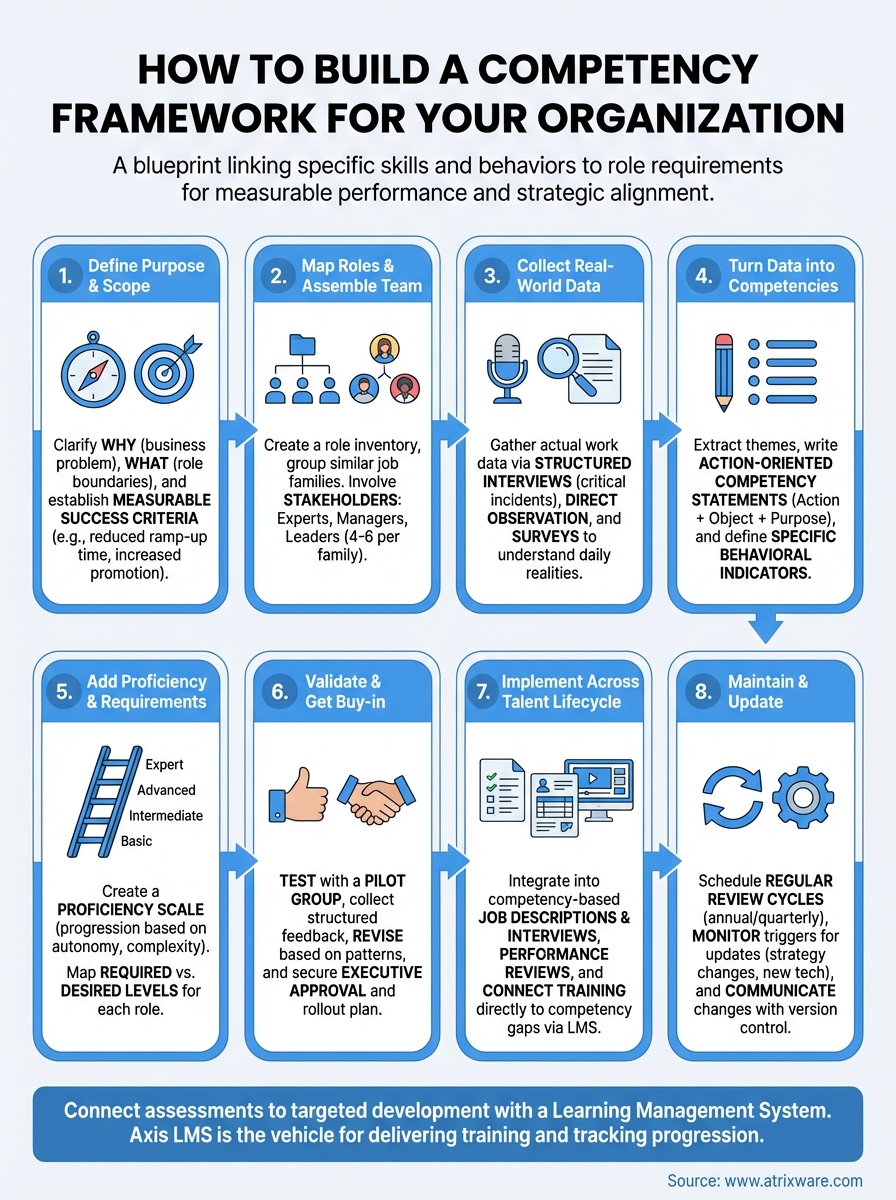
You now have a complete process for how to build a competency framework that drives real performance improvement in your organization. The eight steps take you from initial planning through ongoing maintenance, ensuring your framework stays relevant and useful. Your success depends on implementation discipline and consistent application across all talent processes.
Start by selecting one critical job family where competency gaps directly impact business results. Build your framework for this area first, validate it thoroughly, and demonstrate measurable improvements before expanding to other roles. This focused approach proves value quickly and builds organizational confidence in your methodology.
Your Learning Management System becomes the operational hub that connects competency assessments to targeted development. Axis LMS delivers training mapped directly to competency gaps, tracks progression over time, and provides the reporting you need to measure framework effectiveness. Explore how Axis LMS supports competency-based learning with a hands-on admin demo that shows you the complete system in action.
