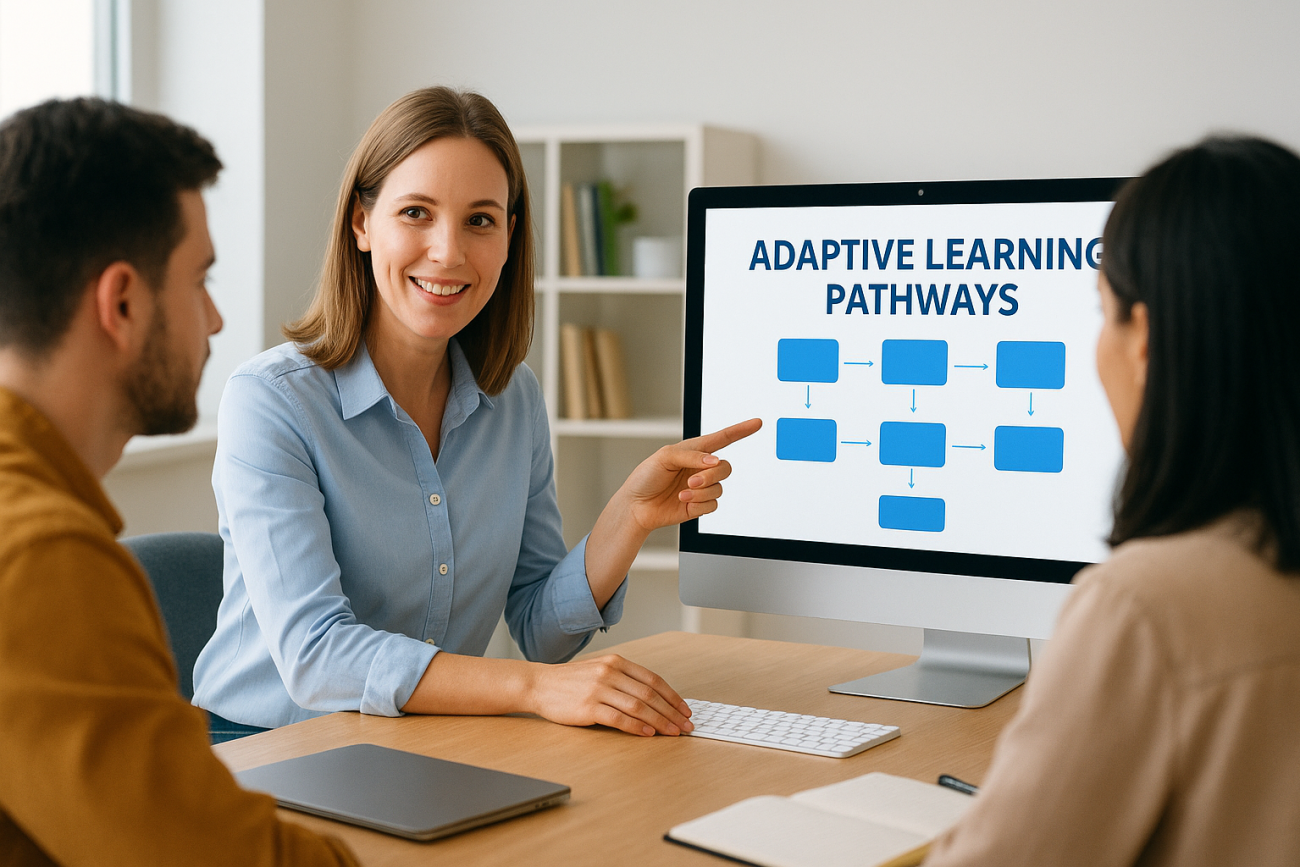
Training programs that treat every learner the same way rarely deliver the results organizations need. Some employees breeze through material they already know, while others struggle without enough support. Adaptive learning pathways solve this problem by automatically adjusting content, pace, and difficulty based on each learner’s performance and needs.
For HR managers, L&D specialists, and training professionals, implementing adaptive pathways means delivering more effective training in less time. At Atrixware, we built Axis LMS to help organizations create these personalized learning experiences, without requiring a technical background or a massive budget. The right approach can boost engagement, improve knowledge retention, and eliminate wasted effort across your employee, customer, and compliance training programs.
This article breaks down what adaptive learning pathways actually are, how they function behind the scenes, and practical steps you can take to build them within your organization. Whether you’re onboarding new hires or certifying channel partners, you’ll walk away with a clear framework for implementation that works.
Why adaptive learning pathways matter
Traditional training programs waste time and money. When you force every learner through identical content at the same pace, you end up with employees who zone out during material they already understand and others who fall behind when concepts move too quickly. This approach creates disengaged learners, poor knowledge retention, and frustrated managers who can’t understand why training investments fail to deliver results.
The cost of one-size-fits-all training
You’re paying for training that doesn’t stick. Studies show that employees forget 70% of training content within 24 hours when courses don’t match their skill level or learning style. Your organization loses money on repeated training sessions, extended onboarding timelines, and compliance gaps that create legal risk. Sales teams miss revenue targets because product training didn’t prepare them properly. Customer success teams struggle because their learning didn’t address actual job challenges.
Generic training programs fail because they ignore the fact that every learner enters with different knowledge, skills, and goals.
Time wasted on irrelevant content adds up quickly. When you calculate hours spent per employee multiplied across your entire workforce, the financial impact becomes clear. Engineers who already know your systems shouldn’t sit through beginner tutorials. New hires shouldn’t skip foundational concepts because advanced learners dominate the pace.
Business impact of personalized learning
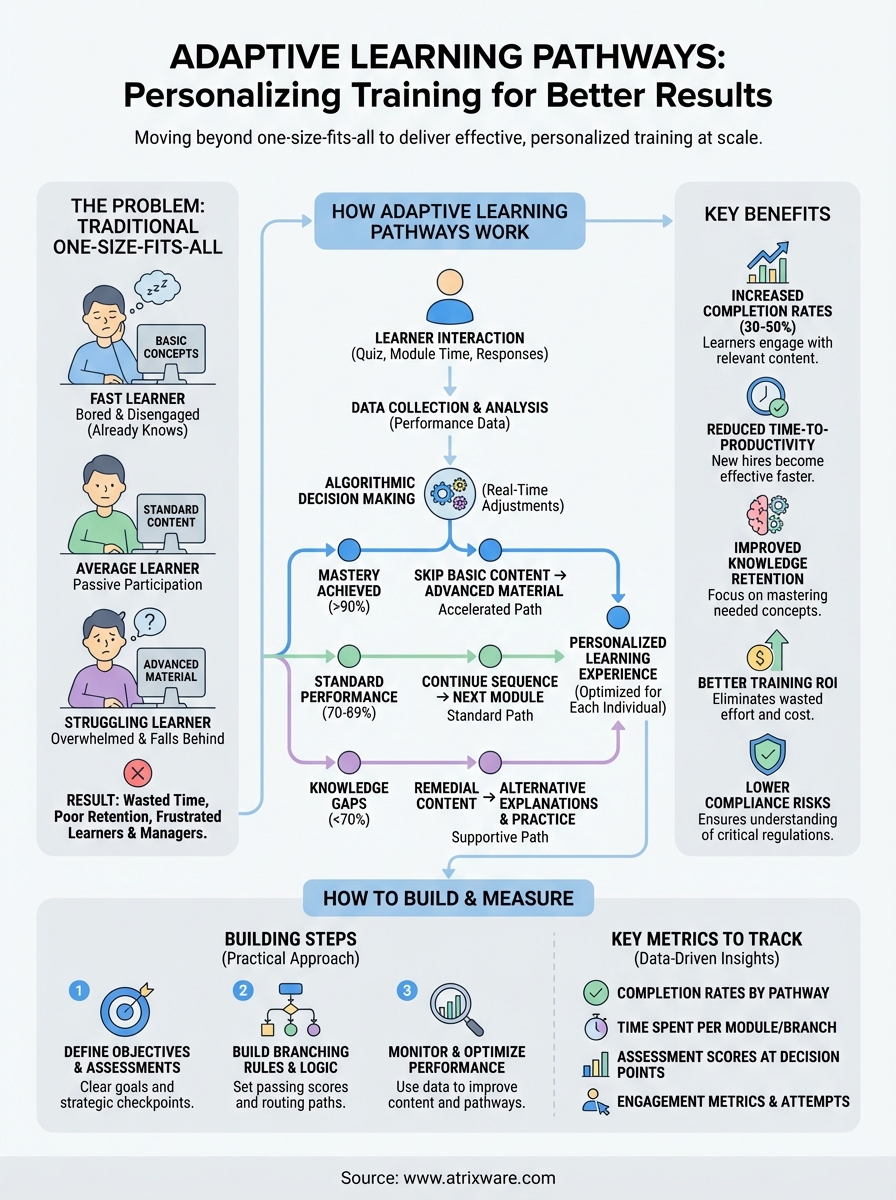
Adaptive learning pathways deliver measurable improvements across every training metric that matters to your organization. You’ll see completion rates increase by 30-50% because learners engage with content that matches their current skill level. Knowledge retention jumps when employees spend time on concepts they need to master rather than reviewing material they already know.
Your training ROI improves immediately. Organizations using adaptive approaches report reduced time-to-productivity for new hires, lower compliance violation rates, and higher customer satisfaction scores from better-trained support teams. You eliminate the need for remedial training sessions because the system identifies gaps and fills them automatically. Channel partners close deals faster because their product training adapts to their experience level and industry focus.
How adaptive learning pathways work
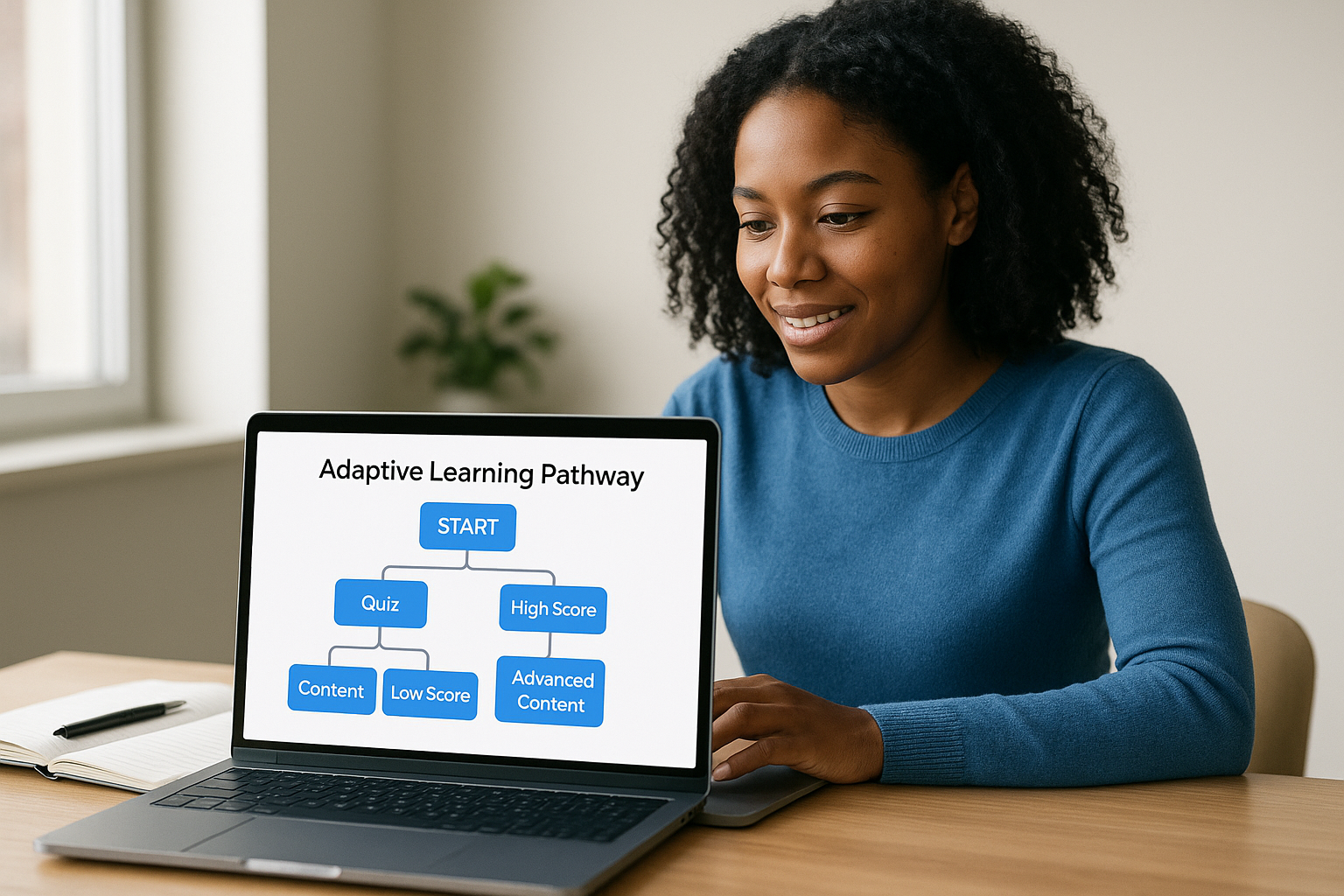
Adaptive learning pathways use data-driven algorithms to adjust training content based on each learner’s performance, preferences, and pace. The system tracks every interaction, from quiz responses to time spent on modules, then uses this information to determine what content the learner sees next. Instead of forcing everyone through the same sequence, the pathway branches automatically to deliver exactly what each person needs to master the material.
The core technology behind adaptation
Your LMS collects performance data at every touchpoint throughout the learning experience. When a learner answers questions correctly, the system recognizes mastery and moves them forward. When they struggle or fail assessments, it identifies knowledge gaps and routes them to remedial content or alternative explanations. This happens without manual intervention from trainers or administrators.
The system learns from each interaction to predict what content will be most effective for that specific learner.
Assessment results drive the branching logic. If someone scores 90% or higher on a skills check, they skip the basic modules and jump straight to advanced material. Another learner who scores below passing gets directed to foundational content they need before progressing. The pathway adapts continuously as performance changes throughout the training program.
Real-time decision making
Adaptive learning pathways make instant adjustments based on current learner behavior rather than relying on static course structures. Your system evaluates completion rates, assessment scores, and engagement metrics to optimize the learning experience in real time. This means learners never waste time on content they’ve already mastered or get pushed forward before they’re ready to succeed.
How to build an adaptive pathway step by step
Building adaptive learning pathways requires systematic planning and clear decision rules that your LMS can execute automatically. You don’t need to start from scratch or rebuild your entire training program. Start with one high-impact course where personalization will deliver measurable results, then expand your approach as you see what works. Your focus should be on creating branching logic that responds to learner performance rather than forcing everyone through identical content.
Define learning objectives and assessment points
Your pathway needs specific, measurable objectives for each concept or skill you’re teaching. Write these objectives as performance statements that describe what learners should be able to do, not just what they should know. Each objective requires an assessment that determines whether the learner has achieved mastery before moving forward.
Clear objectives and assessments create the foundation for every branching decision your adaptive pathway makes.
Place assessments strategically throughout your pathway rather than only at the end. Pre-assessments identify what learners already know so they can skip redundant content. Formative assessments after each major concept determine whether they need additional practice or can advance to more complex material. This approach creates natural decision points where your LMS routes learners based on their demonstrated performance.
Build branching rules and decision logic
Your LMS needs explicit rules that determine what happens after each assessment. Define passing scores that indicate mastery (typically 80-85% or higher) and route successful learners to the next level of difficulty. Create remedial pathways for learners who score below your threshold, directing them to alternative explanations, practice exercises, or prerequisite content they missed.
Adaptive pathway examples for corporate training
Real-world examples show how adaptive learning pathways transform specific training challenges into personalized experiences that deliver better results. These scenarios demonstrate the practical application of branching logic and performance-based routing across different corporate training needs. Understanding these examples helps you identify which areas of your training program will benefit most from an adaptive approach.
Sales onboarding for diverse experience levels
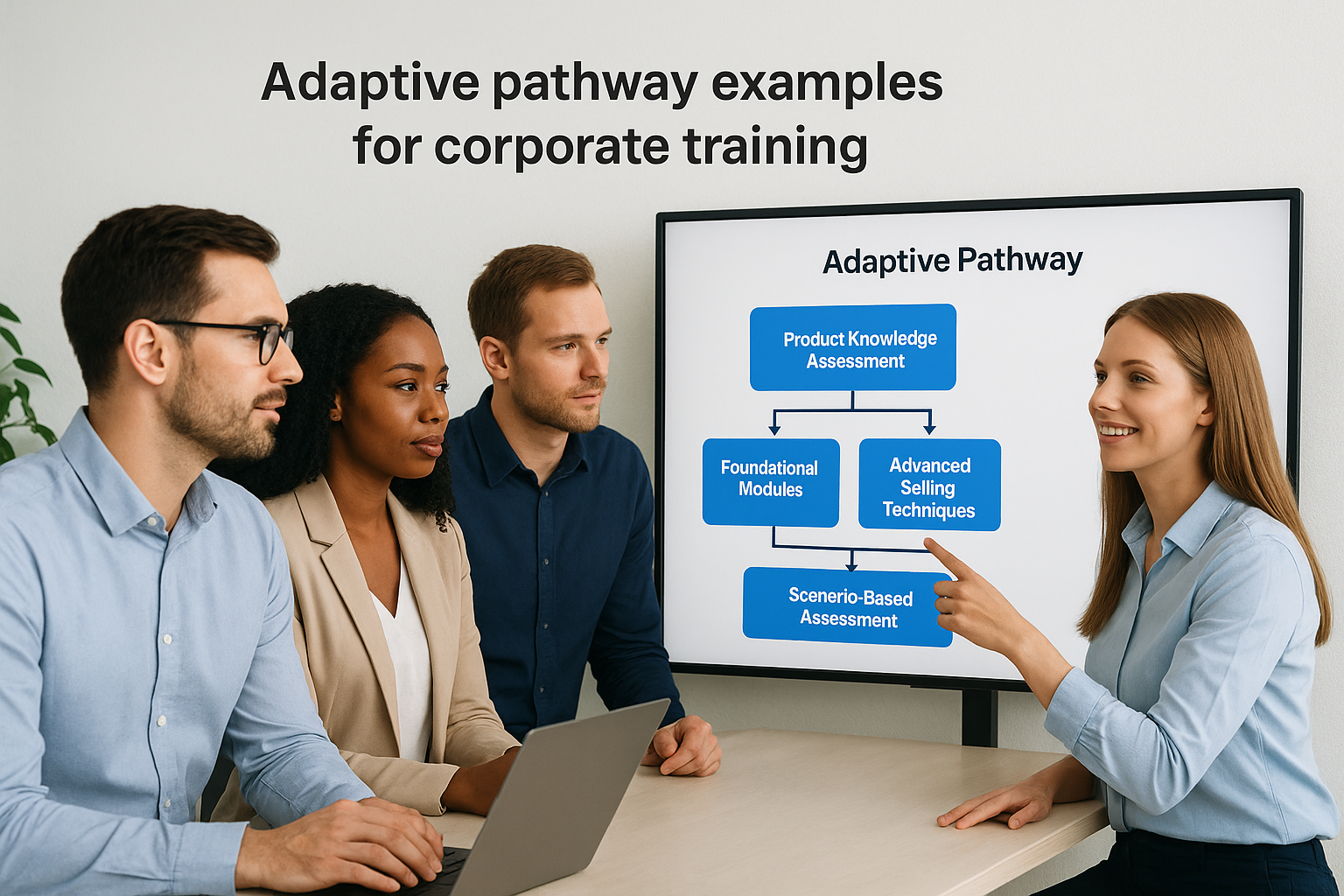
Your sales team includes brand-new reps alongside experienced sellers who transferred from competitors. An adaptive pathway starts with a product knowledge assessment that determines their baseline understanding. New reps who score below 60% receive foundational modules covering product features, pricing structures, and common objections. Experienced sellers who score above 80% skip basic content and jump directly to advanced selling techniques, competitive positioning, and negotiation tactics specific to your products.
Adaptive pathways eliminate the frustration of forcing experienced sales professionals through beginner content they already know.
After completing their personalized modules, all learners take a scenario-based assessment where they handle customer objections. Those who struggle receive additional practice with specific objection types they missed. Strong performers move immediately to territory planning and quota expectations, cutting their time-to-productivity by weeks.
Compliance training with role-specific requirements
Different departments face unique compliance obligations based on their job functions. Your adaptive pathway routes finance employees to SOX compliance modules while manufacturing staff learn OSHA requirements. Marketing teams focus on data privacy regulations like GDPR. The system identifies each learner’s department from your HR integration and automatically serves relevant compliance content without requiring manual course assignments or multiple training programs.
How to measure and improve pathway performance
Your adaptive learning pathways need continuous monitoring and data-driven optimization to deliver maximum value. Without tracking the right metrics, you won’t know whether your branching logic works correctly or which content needs improvement. Start measuring performance from day one so you can identify patterns, spot problems early, and make informed decisions about pathway adjustments that actually improve learning outcomes.
Key metrics to track
Focus on completion rates by pathway to identify where learners drop off or struggle. Compare completion times across different branches to ensure your adaptive logic isn’t creating unnecessarily long routes for struggling learners. Track assessment scores at each decision point to verify that your passing thresholds align with actual mastery levels. If learners consistently fail downstream assessments after passing earlier checkpoints, your branching logic needs adjustment.
Monitor engagement metrics like time spent per module and number of attempts on assessments. Low engagement often signals content that doesn’t match learner needs, while excessive attempts indicate concepts that require better explanations or additional practice opportunities.
Using data to optimize pathways
Your LMS analytics reveal which content variations produce better learning outcomes for different performance levels. Review pathway data quarterly to identify branches where learners succeed versus those where they struggle repeatedly. Replace or supplement weak content with alternative approaches that explain concepts differently.
Data-driven optimization transforms adaptive learning pathways from static structures into continuously improving systems that get better with each learner.
Test threshold adjustments by changing passing scores on key assessments and tracking downstream performance. If lowering a threshold from 85% to 80% doesn’t impact final outcomes, you’re moving learners forward faster without sacrificing quality.
Next steps
Your organization can start building adaptive learning pathways today, even if you’re working with existing training content. Begin with one high-impact course where personalization will deliver measurable improvements in completion rates or knowledge retention. Identify your assessment points, define your branching rules, and test the pathway with a small group before rolling it out organization-wide. This focused approach lets you prove value quickly without overwhelming your team.
The technology behind adaptive learning pathways works best when your LMS provides built-in branching logic and comprehensive analytics that track learner performance at every decision point. Axis LMS makes it easy to create these personalized experiences without custom development or technical expertise. You can build adaptive pathways using our drag-and-drop interface, set performance-based routing rules, and monitor results through detailed reporting dashboards.
Ready to see how adaptive pathways work in practice? Take our LMS readiness quiz to determine whether your organization is prepared to implement personalized learning experiences that drive better training outcomes.
